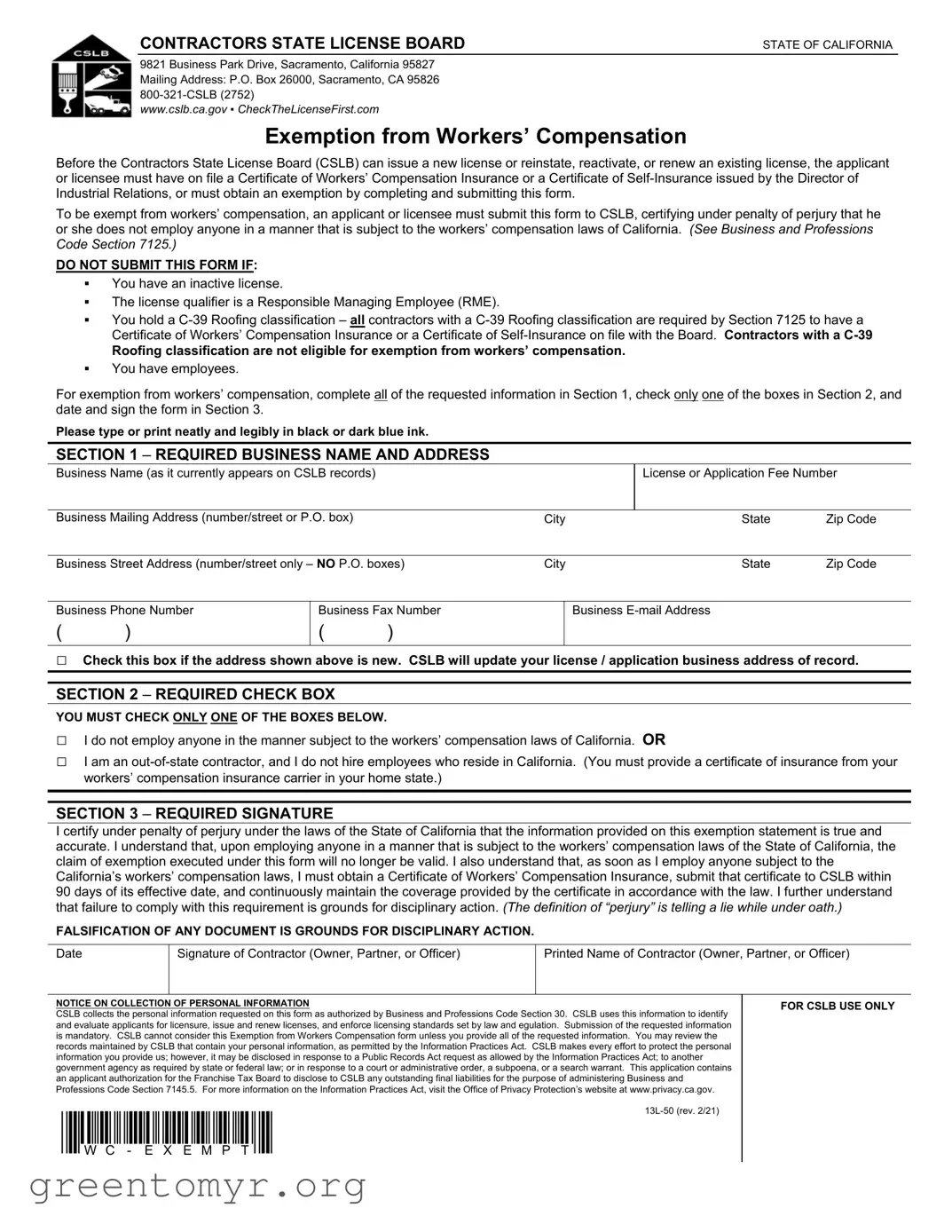
The 13L 50 form, utilized by the Contractors State License Board (CSLB) in California, serves as a crucial document for individuals seeking an exemption from workers' compensation requirements. This form is essential for applicants or licensees who do not employ anyone in a manner that falls under California's workers' compensation laws. To obtain an exemption, the individual must certify, under penalty of perjury, that they do not have any employees subject to these laws. The form includes several key sections, such as required business information, a checkbox to confirm eligibility for exemption, and a signature section for verification. It is important to note that certain contractors, particularly those holding a C-39 Roofing classification, are ineligible for this exemption and must maintain workers' compensation insurance. The form also outlines the consequences of providing false information and emphasizes the importance of compliance with the state’s regulations. Additionally, personal information collected on this form is subject to privacy regulations, ensuring that it is used appropriately for licensing and regulatory purposes.
CONTRACTORS STATE LICENSE BOARD |
STATE OF CALIFORNIA |
9821 Business Park Drive, Sacramento, California 95827 |
|
Mailing Address: P.O. Box 26000, Sacramento, CA 95826 |
|
|
|
www.cslb.ca.gov ▪ CheckTheLicenseFirst.com |
|
Exemption from Workers’ Compensation
Before the Contractors State License Board (CSLB) can issue a new license or reinstate, reactivate, or renew an existing license, the applicant or licensee must have on file a Certificate of Workers’ Compensation Insurance or a Certificate of
To be exempt from workers’ compensation, an applicant or licensee must submit this form to CSLB, certifying under penalty of perjury that he or she does not employ anyone in a manner that is subject to the workers’ compensation laws of California. (See Business and Professions Code Section 7125.)
DO NOT SUBMIT THIS FORM IF:
You have an inactive license.
The license qualifier is a Responsible Managing Employee (RME).
You hold a
Roofing classification are not eligible for exemption from workers’ compensation.
You have employees.
For exemption from workers’ compensation, complete all of the requested information in Section 1, check only one of the boxes in Section 2, and date and sign the form in Section 3.
Please type or print neatly and legibly in black or dark blue ink.
SECTION 1 – REQUIRED BUSINESS NAME AND ADDRESS
Business Name (as it currently appears on CSLB records) |
|
Business Mailing Address (number/street or P.O. box) |
City |
License or Application Fee Number
State |
Zip Code |
Business Street Address (number/street only – NO P.O. boxes) |
City |
State |
Zip Code |
||||
|
|
|
|
|
|
||
Business Phone Number |
Business Fax Number |
|
|
Business |
|
||
( |
) |
( |
) |
|
|
|
|
□Check this box if the address shown above is new. CSLB will update your license / application business address of record.
SECTION 2 – REQUIRED CHECK BOX
YOU MUST CHECK ONLY ONE OF THE BOXES BELOW.
□I do not employ anyone in the manner subject to the workers’ compensation laws of California. OR
□I am an
SECTION 3 – REQUIRED SIGNATURE
I certify under penalty of perjury under the laws of the State of California that the information provided on this exemption statement is true and accurate. I understand that, upon employing anyone in a manner that is subject to the workers’ compensation laws of the State of California, the claim of exemption executed under this form will no longer be valid. I also understand that, as soon as I employ anyone subject to the California’s workers’ compensation laws, I must obtain a Certificate of Workers’ Compensation Insurance, submit that certificate to CSLB within 90 days of its effective date, and continuously maintain the coverage provided by the certificate in accordance with the law. I further understand that failure to comply with this requirement is grounds for disciplinary action. (The definition of “perjury” is telling a lie while under oath.)
FALSIFICATION OF ANY DOCUMENT IS GROUNDS FOR DISCIPLINARY ACTION.
Date
Signature of Contractor (Owner, Partner, or Officer)
Printed Name of Contractor (Owner, Partner, or Officer)
NOTICE ON COLLECTION OF PERSONAL INFORMATION
CSLB collects the personal information requested on this form as authorized by Business and Professions Code Section 30. CSLB uses this information to identify and evaluate applicants for licensure, issue and renew licenses, and enforce licensing standards set by law and egulation. Submission of the requested information is mandatory. CSLB cannot consider this Exemption from Workers Compensation form unless you provide all of the requested information. You may review the records maintained by CSLB that contain your personal information, as permitted by the Information Practices Act. CSLB makes every effort to protect the personal information you provide us; however, it may be disclosed in response to a Public Records Act request as allowed by the Information Practices Act; to another government agency as required by state or federal law; or in response to a court or administrative order, a subpoena, or a search warrant. This application contains an applicant authorization for the Franchise Tax Board to disclose to CSLB any outstanding final liabilities for the purpose of administering Business and Professions Code Section 7145.5. For more information on the Information Practices Act, visit the Office of Privacy Protection’s website at www.privacy.ca.gov.
FOR CSLB USE ONLY
| Fact Name | Description |
|---|---|
| Purpose of Form | The 13L 50 form is used to request an exemption from workers' compensation requirements for contractors in California. |
| Eligibility Criteria | Applicants must certify that they do not employ anyone subject to California's workers' compensation laws or must be out-of-state contractors without California employees. |
| Important Sections | Sections include required business information, a check box for employment status, and a signature section to certify the information provided is accurate. |
| Governing Law | This form is governed by the Business and Professions Code Section 7125 of California law. |
| Consequences of Falsification | Providing false information on this form can lead to disciplinary action by the Contractors State License Board (CSLB). |
Once you have gathered all the necessary information, you are ready to fill out the 13L 50 form. This form is essential for certifying your exemption from workers' compensation in California. Be sure to complete each section carefully to avoid any delays in processing your application.
After completing the form, make sure to double-check all the information for accuracy. Once confirmed, submit the form to the Contractors State License Board (CSLB) for processing. Keep a copy for your records, as it may be needed in the future.
The 13L 50 form is used to apply for an exemption from workers’ compensation insurance requirements in California. It is required for contractors who do not employ anyone in a manner subject to California's workers’ compensation laws. This form must be submitted to the Contractors State License Board (CSLB) before a new license can be issued or an existing license can be reinstated or renewed.
Contractors who do not have any employees and want to be exempt from workers’ compensation insurance must fill out this form. Additionally, out-of-state contractors who do not hire employees residing in California can also use this form. However, if you have an inactive license or if you hold a C-39 Roofing classification, you cannot use this exemption form.
The form requires several pieces of information, including:
You can submit the form to the Contractors State License Board by mailing it to their office at 9821 Business Park Drive, Sacramento, California, 95827. Make sure to send it in a timely manner to avoid any delays in your licensing process.
If you begin to employ anyone in a manner subject to California’s workers’ compensation laws after submitting the 13L 50 form, your exemption will no longer be valid. You will need to obtain a Certificate of Workers’ Compensation Insurance and submit it to CSLB within 90 days of its effective date.
Providing false information on the 13L 50 form can lead to serious consequences. Falsification of any document may result in disciplinary action from the Contractors State License Board. This includes penalties for perjury, which is defined as lying under oath.
Yes, the Contractors State License Board takes measures to protect your personal information. However, be aware that it may be disclosed in certain situations, such as in response to a public records request or as required by law. You can review the records maintained by CSLB that contain your personal information, as permitted by the Information Practices Act.
Filling out the 13L 50 form can be a straightforward process, but several common mistakes can hinder the application. One frequent error is failing to provide all required information in Section 1. This section demands specific details about the business name, address, and contact information. Omitting any of these elements can lead to delays or rejection of the application. It is essential to ensure that all fields are completed accurately and legibly.
Another common mistake involves the selection of checkboxes in Section 2. Applicants must check only one box to indicate their employment status concerning California's workers' compensation laws. Selecting more than one box or failing to check any box can invalidate the form. This section is crucial for establishing eligibility for exemption, and attention to detail is necessary to avoid complications.
Many applicants overlook the importance of signing and dating the form in Section 3. This signature certifies that the information provided is true and accurate under penalty of perjury. Without a signature, the application cannot be processed. Additionally, applicants should ensure that they print their names clearly to avoid any confusion regarding the identity of the signatory.
Finally, a significant mistake occurs when applicants fail to read the instructions thoroughly. The form includes specific guidelines on who is eligible for exemption. For instance, individuals with an inactive license or those classified under C-39 Roofing must not submit this form. Ignoring these stipulations can lead to unnecessary complications and delays in obtaining or renewing a license. Careful review of the entire form and its requirements is advisable to ensure compliance.
The 13L 50 form serves as a critical document for contractors seeking an exemption from workers' compensation in California. However, it is often accompanied by several other forms and documents that play essential roles in the licensing process. Understanding these documents can help streamline the application and compliance process for contractors.
Each of these documents plays a vital role in ensuring that contractors meet the legal requirements to operate in California. By understanding and preparing these forms, contractors can navigate the licensing process more effectively and maintain compliance with state regulations.
The 13L 50 form serves a specific purpose related to workers' compensation exemption for contractors in California. However, it shares similarities with several other important documents in the realm of business and licensing. Below are six documents that are comparable to the 13L 50 form, along with an explanation of how they relate:
When filling out the 13L 50 form, follow these guidelines to ensure a smooth process. Here’s what you should and shouldn’t do:
By adhering to these guidelines, you can avoid common pitfalls and ensure your application is processed efficiently.
Understanding the 13L 50 form can be challenging, and several misconceptions often arise. Here are seven common misunderstandings about this form:
This form is not limited to new applicants. It can also be used for existing licensees seeking to reinstate or renew their licenses.
Only those who do not employ anyone in a manner subject to California's workers’ compensation laws can claim exemption using this form.
Filling out the form does not automatically grant an exemption. The Contractors State License Board (CSLB) must review and approve the application.
This is incorrect. If you have employees, you cannot submit the 13L 50 form for exemption.
A signature is essential. The form must be signed to certify the information provided is true and accurate.
Out-of-state contractors must provide a certificate of insurance from their home state if they do not hire California residents.
CSLB takes privacy seriously. While personal information is collected, it is protected and used in accordance with state laws.
Here are key takeaways regarding the 13L 50 form, which is essential for obtaining an exemption from workers’ compensation in California: