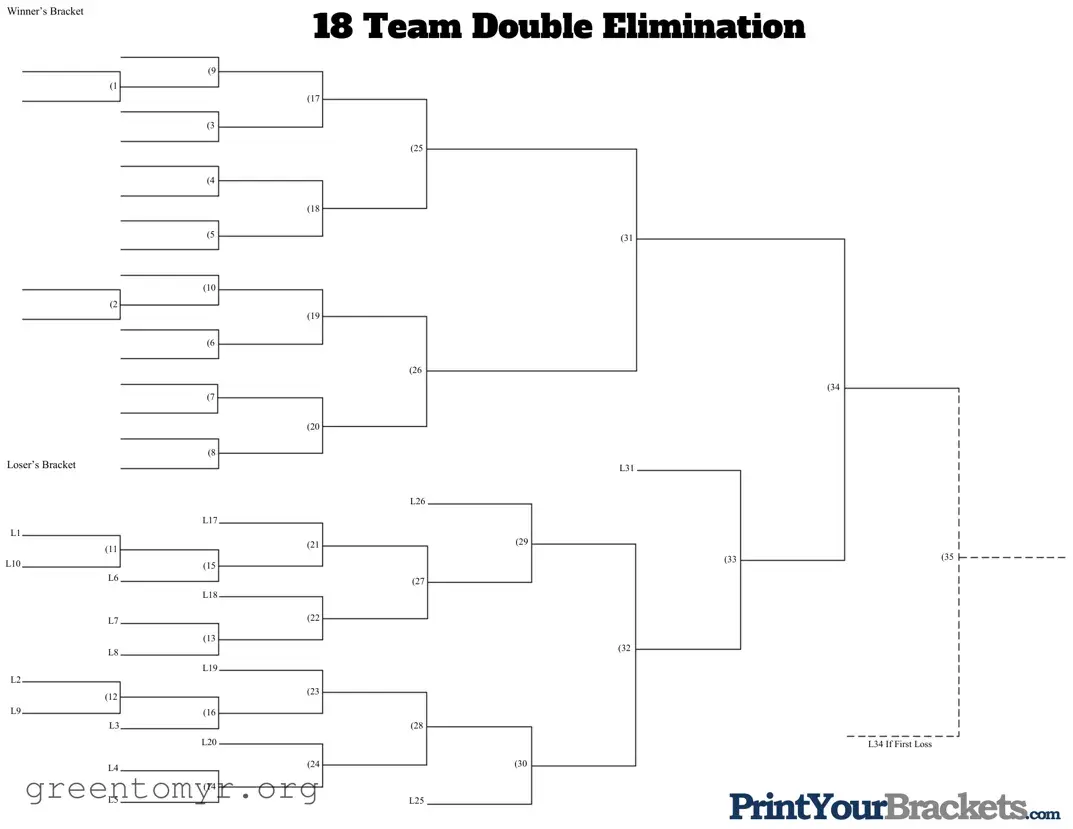
The 18 Double Elimination form is a popular structure used in competitive tournaments, allowing teams a chance to remain in contention even after a loss. This format is designed to provide a fair opportunity for all participants, ensuring that a single defeat does not eliminate a team from the competition. In the winner's bracket, teams compete in a series of matches, with the victors advancing while the losers drop into the loser's bracket. This secondary bracket gives teams a second chance to fight their way back into the tournament. The layout is intricate, with multiple matchups and pathways that can lead to an eventual champion, even after a team has experienced a loss. Each round of play is crucial, as teams navigate through the brackets, facing elimination with every defeat. The structure not only enhances the excitement of the competition but also tests the resilience and skill of the teams involved, making it a favored choice among organizers and participants alike.
Winner’s Bracket
(9
(1
(3
(4
(5
(10
(2
|
(6 |
|
(7 |
Loser’s Bracket |
(8 |
|
|
|
L17 |
L1 |
|
|
(11 |
L10 |
(15 |
|
L6 |
|
L18 |
L7
(13
L8
L19
L2
(12
L9 |
(16 |
L3
L20
L4
(14
L5
18 Team Double Elimination
(17
(25
(18
(31
(19
(26
(34
(20
L31
L26
(21 |
(29 |
(33 |
(35 |
(27
(22
(32
(23
(28
L34 If First Loss
(24 |
(30 |
L25PrintYourBrackets.com
| Fact Name | Description |
|---|---|
| Structure | The 18 Double Elimination format consists of a Winner's Bracket and a Loser's Bracket, allowing teams a second chance after their first loss. |
| Team Participation | This format accommodates 18 teams, ensuring a competitive environment where each team has the opportunity to advance through multiple rounds. |
| Governing Laws | In many states, the governing laws for tournament formats, including double elimination, can vary. Always check local regulations or state sports associations. |
| Match Progression | Teams progress through the brackets based on match outcomes, with teams in the Loser's Bracket facing elimination after their second loss. |
| Finals Structure | The finals may feature a unique structure where the team from the Winner's Bracket has to be beaten twice to lose the championship. |
Once you have the 18 Double Elimination form in front of you, it’s time to get started on filling it out. This form will help you organize the tournament structure effectively. Follow the steps below to ensure that all necessary information is accurately recorded.
An 18 Double Elimination tournament format allows teams to compete in a structured way, ensuring that each team has at least two chances to lose before being eliminated from the tournament. This format consists of a winner's bracket and a loser's bracket. Teams that lose in the winner's bracket drop down to the loser's bracket, where they have another opportunity to compete for the championship.
The bracket is divided into two main sections: the winner's bracket and the loser's bracket. Initially, all 18 teams start in the winner's bracket. As matches are played, teams that lose will move to the loser's bracket. The structure is designed so that teams must lose twice before being eliminated from the tournament. The winner of the loser's bracket will face the winner of the winner's bracket in the final match.
If a team loses in the winner's bracket, they are not immediately eliminated. Instead, they drop down to the loser's bracket. This gives them a second chance to continue competing. They must win all subsequent matches in the loser's bracket to remain in the tournament and have a shot at the championship.
Match pairings in the 18 Double Elimination format are typically determined through a seeding process. Teams may be seeded based on their performance in previous tournaments or through a random draw. The goal is to ensure a fair competition where stronger teams do not face each other in the early rounds. The specific pairing process can vary depending on the tournament organizer's rules.
Yes, a team can come back from the loser's bracket to win the tournament. If a team wins all their matches in the loser's bracket, they will face the winner of the winner's bracket in the final match. If the team from the loser's bracket wins that match, they may force a second match, as the winner's bracket team has not yet lost. This makes for an exciting conclusion to the tournament.
The double elimination format provides teams with a safety net, allowing them to recover from an early loss. This can reduce the pressure on teams, as they have the opportunity to regroup and strategize after a defeat. Additionally, it encourages competitive play, as every match remains significant until a team has lost twice. This format can enhance the overall experience for both players and spectators.
When filling out the 18 Double Elimination form, many individuals make common mistakes that can lead to confusion or errors in the tournament process. One frequent error is failing to clearly indicate the teams participating in the tournament. Without properly listing each team, it becomes difficult to track progress through the brackets. Ensure that all team names are entered correctly and legibly.
Another mistake often made involves overlooking the distinction between the winner’s bracket and the loser’s bracket. Participants sometimes mix up the two, placing teams in the wrong sections. This can disrupt the flow of the tournament and create unnecessary complications. It is essential to understand the structure of double elimination and to fill out each bracket accordingly.
In addition, individuals frequently forget to update the bracket after each match. Once a game concludes, the results should be recorded immediately. Delaying this process can lead to inaccuracies and may affect scheduling for subsequent matches. Keeping the brackets current is vital for maintaining the integrity of the tournament.
Some people also neglect to provide the correct match numbers. Each match should be clearly numbered to ensure that everyone knows which teams are playing against each other. Misnumbering matches can lead to confusion and miscommunication among participants.
Another common oversight is not checking for consistency in the format used throughout the form. For instance, if some teams are listed with their full names while others are abbreviated, it can create confusion. Consistency helps everyone understand the information presented without ambiguity.
Lastly, individuals sometimes fail to double-check their entries for accuracy before submitting the form. Simple typographical errors can have significant consequences in a tournament setting. Taking a moment to review the completed form can help catch mistakes that could otherwise lead to complications down the line.
When organizing a double elimination tournament, several forms and documents can facilitate the process and ensure smooth operation. Each of these documents plays a specific role in managing participants, scheduling matches, and maintaining records. Below is a list of commonly used forms that complement the 18 Double Elimination form.
Utilizing these forms and documents not only streamlines the tournament process but also enhances the overall experience for participants and spectators alike. By ensuring clear communication and organization, organizers can focus on what truly matters: the excitement of the competition.
The 18 Double Elimination form shares similarities with several other documents used in tournament organization and event planning. Below are seven documents that exhibit comparable structures or functions:
When filling out the 18 Double Elimination form, it's important to follow specific guidelines to ensure accuracy and clarity. Here are seven things you should and shouldn't do:
Misconceptions about the 18 Double Elimination format can lead to confusion among participants and organizers. Here are six common misunderstandings:
Filling out and using the 18 Double Elimination form requires careful attention to detail. Here are key takeaways to ensure proper usage: