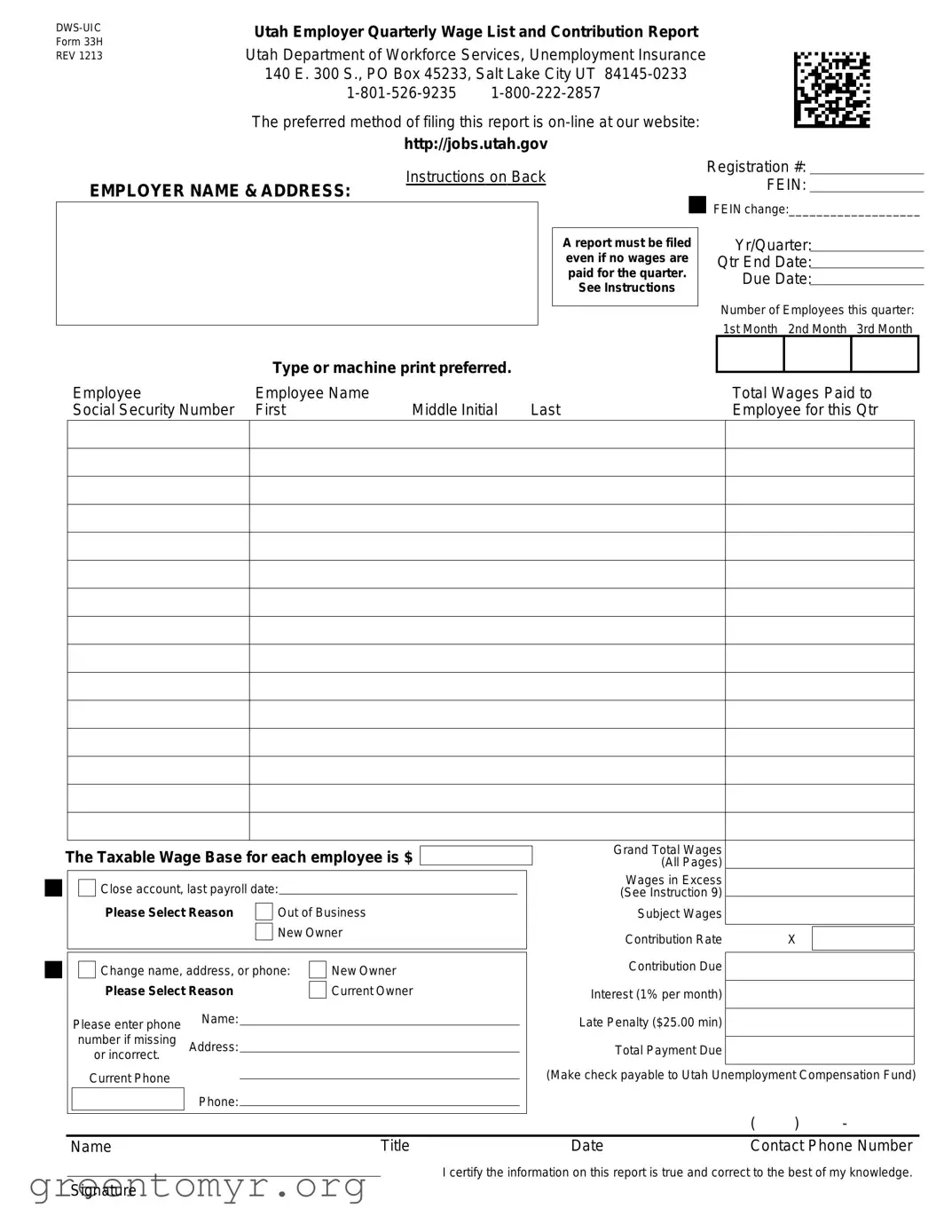
When it comes to managing your business in Utah, understanding the 33H form is essential for compliance with state regulations regarding unemployment insurance. This quarterly wage list and contribution report is not just a formality; it plays a crucial role in tracking the wages paid to your employees and ensuring that your business meets its obligations to the Utah Department of Workforce Services. Each quarter, employers must file this report, even if no wages were paid during that period. The form captures key information, including the employer's name and address, registration number, and the total wages paid to each employee. Additionally, it outlines the contribution rates and any penalties for late submissions, emphasizing the importance of timely and accurate reporting. Filing online is encouraged for convenience, but understanding the details of the form is vital for every employer. By grasping the purpose and requirements of the 33H form, you can ensure that your business remains compliant while supporting your employees and contributing to the state’s unemployment insurance program.
Utah Employer Quarterly Wage List and Contribution Report
Form 33H |
Utah Department of Workforce Services, Unemployment Insurance |
||||||
REV 1213 |
|||||||
|
140 E. 300 S., PO Box 45233, Salt Lake City UT |
||||||
|
|
|
|||||
|
The preferred method of filing this report is |
||||||
|
http://jobs.utah.gov |
||||||
|
Instructions on Back |
||||||
EMPLOYER NAME & ADDRESS: |
|
|
|
|
|
|
|
|
|
|
|
|
|
||
|
|
|
|
|
|
|
|
|
|
|
|
|
|
|
|
|
|
|
|
|
A report must be filed |
|
|
|
|
|
|
|
even if no wages are |
|
|
|
|
|
|
|
paid for the quarter. |
|
|
|
|
|
|
|
See Instructions |
|
|
|
|
|
|
|
|
|
|
|
|
|
|
|
|
|
|
Registration #:
FEIN:
FEIN change:___________________
Yr/Quarter:
Qtr End Date:
Due Date:
Number of Employees this quarter: 1st Month 2nd Month 3rd Month
Type or machine print preferred.
Employee |
Employee Name |
|
|
Total Wages Paid to |
Social Security Number |
First |
Middle Initial |
Last |
Employee for this Qtr |
|
|
|
|
|
|
|
|
|
|
The Taxable Wage Base for each employee is $
Close account, last payroll date:
|
|
Please Select Reason |
|
Out of Business |
||
|
|
|
|
New Owner |
||
|
|
|
|
|||
|
|
|
|
|
|
|
|
|
|
|
|
|
|
|
|
Change name, address, or phone: |
|
New Owner |
||
|
|
|
||||
|
|
Please Select Reason |
|
|
|
Current Owner |
|
|
|
|
|
||
Please enter phone |
Name: |
|
|
||
number if missing |
Address: |
|
or incorrect. |
||
|
||
Current Phone |
|
|
|
Phone: |
Grand Total Wages
(All Pages)
Wages in Excess
(See Instruction 9)
Subject Wages
Contribution RateX
Contribution Due
Interest (1% per month)
Late Penalty ($25.00 min)
Total Payment Due (Make check payable to Utah Unemployment Compensation Fund)
|
|
|
( |
) |
- |
Name |
Title |
Date |
Contact Phone Number |
||
I certify the information on this report is true and correct to the best of my knowledge.
Signature

Form 33HA
REV 0813
Utah Employer Quarterly Wage List Continuation Sheet
Utah Department of Workforce Services, Unemployment Insurance
140 E. 300 S., PO Box 45233, Salt Lake City UT
The preferred method of filing this report is
http://jobs.utah.gov
Registration #:
EMPLOYER NAME & ADDRESS:
Yr/Quarter:
Qtr End Date:
Due Date:
|
|
Type or machine print this report. |
|
|
Employee |
Employee Name |
|
Total Wages Paid to |
|
Social Security Number |
First |
Middle Initial |
Last |
Employee for this Qtr |
|
|
|
|
|
|
|
|
|
|
|
|
|
|
|
|
|
|
|
|
|
|
|
|
|
|
|
|
|
|
|
|
|
|
|
|
|
|
|
|
|
|
|
|
|
|
|
|
|
|
|
|
|
|
|
|
|
|
|
|
|
|
|
|
|
|
|
|
|
|
|
|
|
|
|
|
|
|
|
|
|
|
|
|
|
|
|
|
|
|
|
|
|
|
|
|
|
|
|
|
|
|
|
|
|
|
|
|
|
|
|
|
|
|
|
|
|
|
|
|
|
|
|
|
|
| Fact Name | Description |
|---|---|
| Form Purpose | The 33H form is used by employers in Utah to report quarterly wages paid to employees and to calculate contributions owed for unemployment insurance. |
| Filing Requirement | Employers must file the 33H form even if no wages were paid during the quarter, ensuring compliance with state regulations. |
| Preferred Filing Method | The Utah Department of Workforce Services encourages online filing through their website, which simplifies the submission process. |
| Governing Law | This form is governed by Utah state laws regarding unemployment insurance, specifically under Title 35A, Chapter 4 of the Utah Code. |
Completing the 33H form is essential for employers in Utah to report wages and contributions for unemployment insurance. Follow these steps to ensure accurate and timely submission.
The 33H form, officially known as the DWS-UIC Utah Employer Quarterly Wage List and Contribution Report, is a document that employers in Utah must file quarterly. This form provides essential information about wages paid to employees and the contributions owed to the state’s unemployment insurance fund. Filing this report is crucial as it helps ensure compliance with state laws regarding unemployment insurance, and it plays a vital role in maintaining the financial health of the unemployment system.
All employers in Utah are required to file the 33H form, regardless of whether they paid wages during the quarter. This includes businesses of all sizes and types. Even if no employees were paid, a report must still be submitted. By doing so, employers help the state keep accurate records and ensure that the unemployment insurance system functions effectively.
The preferred method for filing the 33H form is online through the Utah Department of Workforce Services website at http://jobs.utah.gov . This online submission is convenient and efficient. If online filing is not an option, employers can also complete a paper version of the form and mail it to the address provided on the form. Be sure to check the due date to avoid any late penalties.
Missing the filing deadline can lead to penalties. A late penalty of at least $25 may be assessed. Additionally, interest charges of 1% per month may apply to any unpaid contributions. To avoid these penalties, it is essential to submit the form on time, even if no wages were paid during the quarter.
To complete the 33H form, you will need the following information:
Make sure all information is accurate to avoid issues with compliance and reporting.
Filling out the Form 33H can be a straightforward process, but many individuals encounter common pitfalls that can lead to complications. One frequent mistake involves failing to provide the correct Employer Name and Address. This information is crucial, as it identifies the business and ensures that the report reaches the appropriate parties. An incorrect address can delay processing and lead to penalties.
Another common error occurs when individuals neglect to report wages for employees who may not have worked during the quarter. Even if no wages were paid, the form must still be submitted. This oversight can result in unnecessary fines and complications with unemployment insurance compliance.
Many filers also struggle with accurately entering the Federal Employer Identification Number (FEIN). This number is vital for tax purposes and must be entered correctly. A simple typographical error can create discrepancies that complicate matters for both the employer and the state.
Additionally, some individuals fail to complete the section regarding the Number of Employees for the quarter. This information is essential for calculating contributions and understanding the employer's obligations. Omitting this detail can lead to confusion and potential underpayment of taxes.
Another area of concern is the calculation of Total Wages Paid. Errors in summing these figures can result in incorrect tax assessments. It is advisable to double-check these calculations to ensure accuracy, as mistakes can lead to penalties or audits.
Some filers overlook the importance of providing a Contact Phone Number. This detail is crucial for the Department of Workforce Services to reach out for clarifications or additional information. Without it, communication can break down, leading to further complications.
When it comes to the Contribution Rate, inaccuracies can be detrimental. Employers must ensure that they are using the correct rate applicable for their business. An incorrect rate can lead to underpayment or overpayment, both of which can have financial implications.
It is also important to pay attention to the deadlines. Many individuals mistakenly submit their forms late, leading to penalties. Understanding the due dates and planning ahead can help avoid these unnecessary costs.
Lastly, failing to sign the form can render it invalid. The certification section is a crucial part of the process, as it affirms the truthfulness of the information provided. An unsigned form may be rejected, requiring resubmission and causing delays.
By being aware of these common mistakes, employers can streamline the process of completing Form 33H and ensure compliance with state regulations. Taking the time to review the form carefully can save both time and money in the long run.
The 33H form, known as the DWS-UIC Utah Employer Quarterly Wage List and Contribution Report, is essential for employers in Utah to report wages and contributions for unemployment insurance. Alongside this form, several other documents may be required to ensure compliance with state regulations. Below is a list of commonly used forms and documents that may accompany the 33H form.
Employers should ensure that they have all necessary forms completed and submitted in a timely manner to comply with state and federal regulations. Proper documentation helps facilitate accurate reporting and contributes to the smooth operation of payroll and unemployment insurance processes.
The 33H form, known as the DWS-UIC Utah Employer Quarterly Wage List and Contribution Report, serves a specific purpose in reporting employee wages and contributions for unemployment insurance. Several other documents share similar functions or requirements in the realm of employment and wage reporting. Below is a list of nine such documents, each with a brief explanation of how they relate to the 33H form.
Each of these documents plays a role in the broader context of wage reporting and compliance, ensuring that employers meet their legal obligations while providing transparency regarding employee earnings.
When filling out the 33H form for the Utah Employer Quarterly Wage List and Contribution Report, it is essential to approach the task with care. Here are some important dos and don'ts to keep in mind:
Misconceptions about the 33H form can lead to confusion for employers. Here are ten common misunderstandings, along with clarifications:
Understanding these points can help ensure compliance and avoid unnecessary penalties. Always refer to the instructions provided with the form for the most accurate guidance.
Filling out and using the 33H form is essential for employers in Utah. Here are key takeaways to ensure compliance and accuracy: