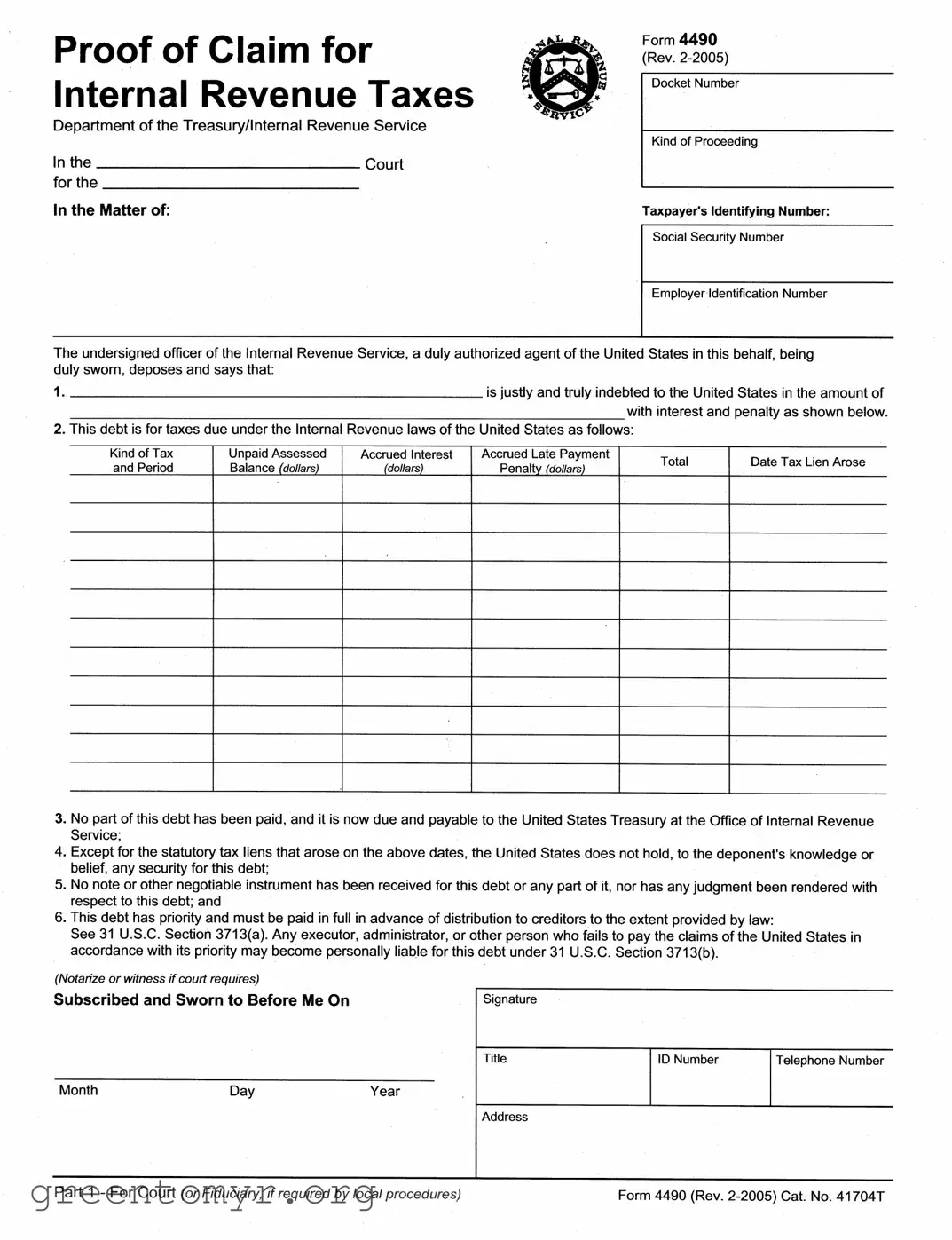
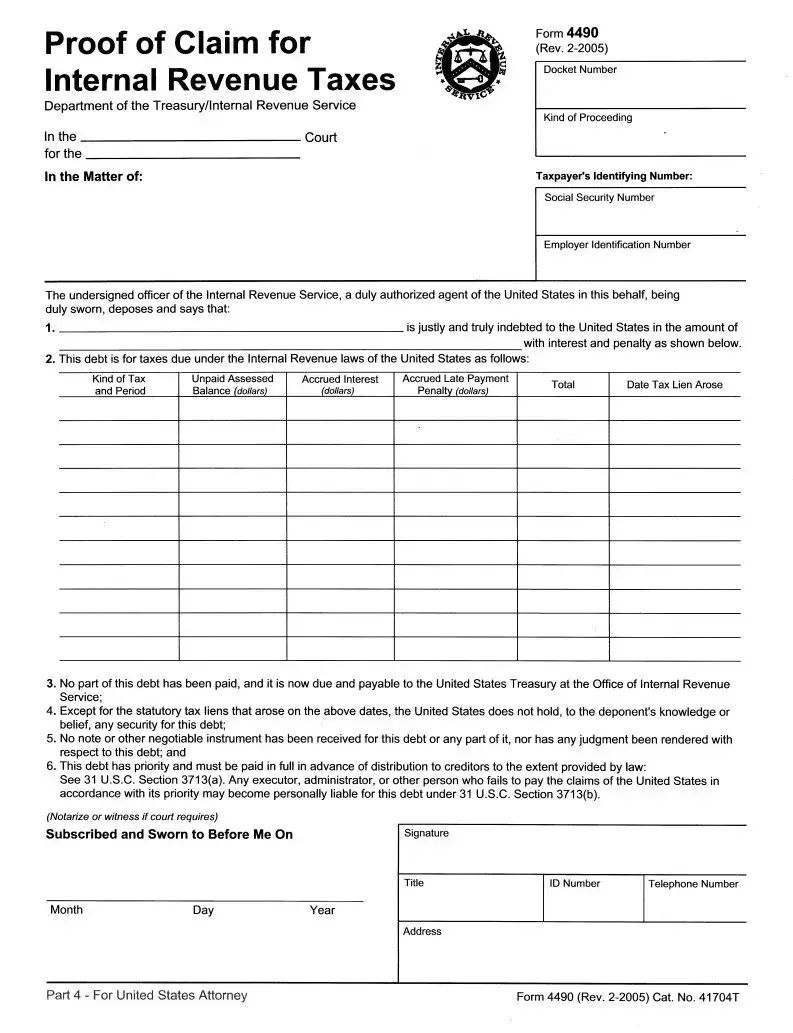
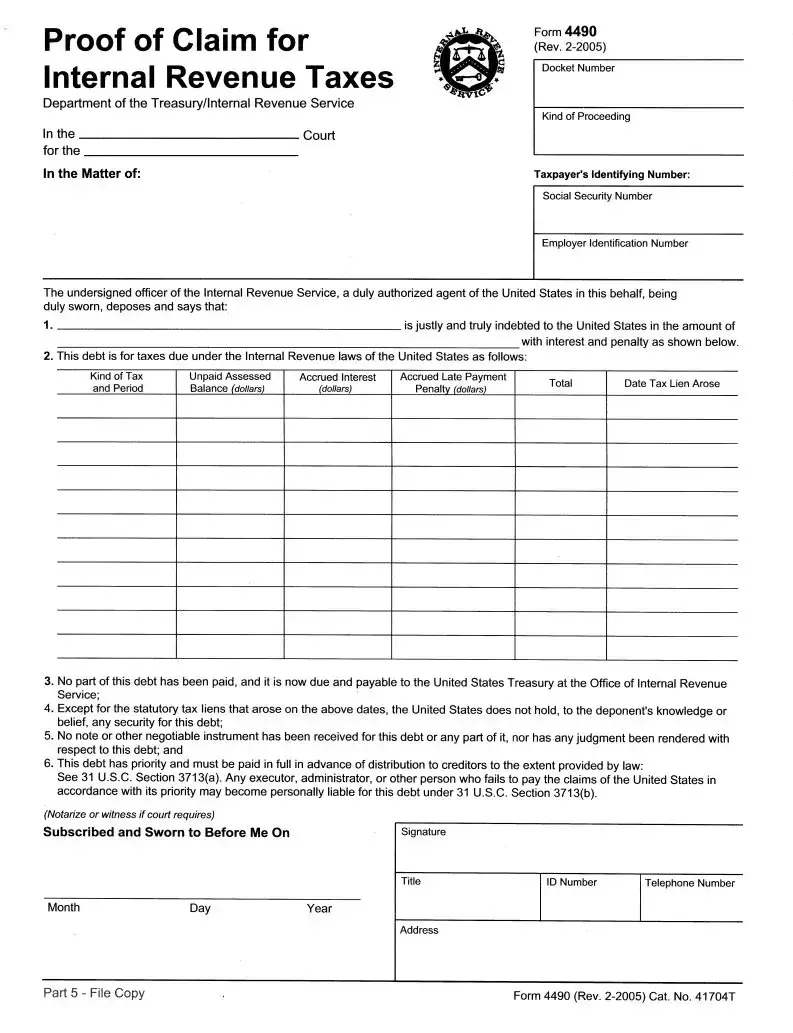
The 4490 form, officially known as the Proof of Claim for Internal Revenue Taxes, plays a crucial role in the legal process concerning tax debts owed to the United States. This form is utilized in court proceedings to assert claims related to unpaid federal taxes. It requires detailed information about the taxpayer, including their Social Security Number or Employer Identification Number, and outlines the specific tax liabilities, including any accrued interest and penalties. The form also emphasizes the priority of these tax debts, stating that they must be settled before any distributions to other creditors. It is essential for the undersigned officer of the Internal Revenue Service to provide a sworn statement confirming the amount owed, as well as the absence of any security or negotiable instruments related to the debt. Proper completion of the 4490 form ensures that the United States can enforce its claims effectively and protects the rights of the taxpayer involved in the proceedings.
| Fact Name | Description |
|---|---|
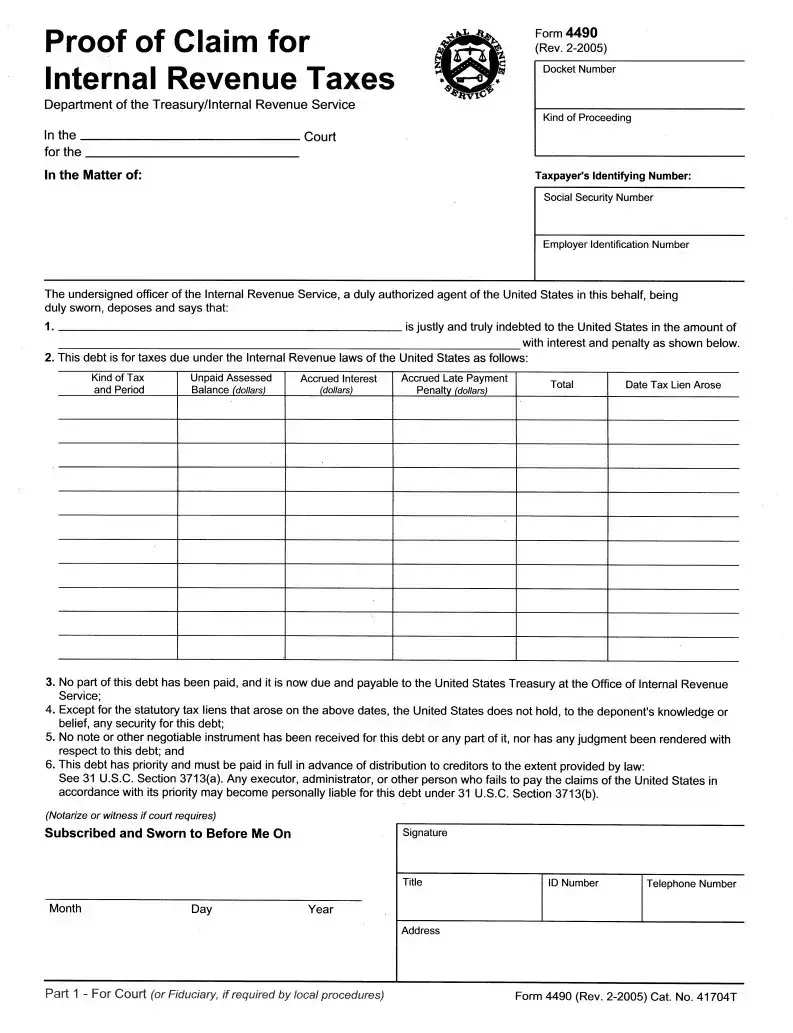
| Form Purpose | The 4490 form is used to submit a proof of claim for internal revenue taxes owed to the United States. |
| Governing Authority | This form is governed by the Internal Revenue laws of the United States. |
| Debt Declaration | The form requires the declaration of a taxpayer's indebtedness to the United States, including the amount owed, interest, and penalties. |
| Priority of Claims | Claims submitted using this form have priority and must be paid in full before any distributions to other creditors, as outlined in 31 U.S.C. Section 3713(a). |
| Signature Requirement | The form must be signed by an authorized officer of the Internal Revenue Service, affirming the accuracy of the information provided. |
| Notarization | Depending on local court procedures, the form may need to be notarized or witnessed. |
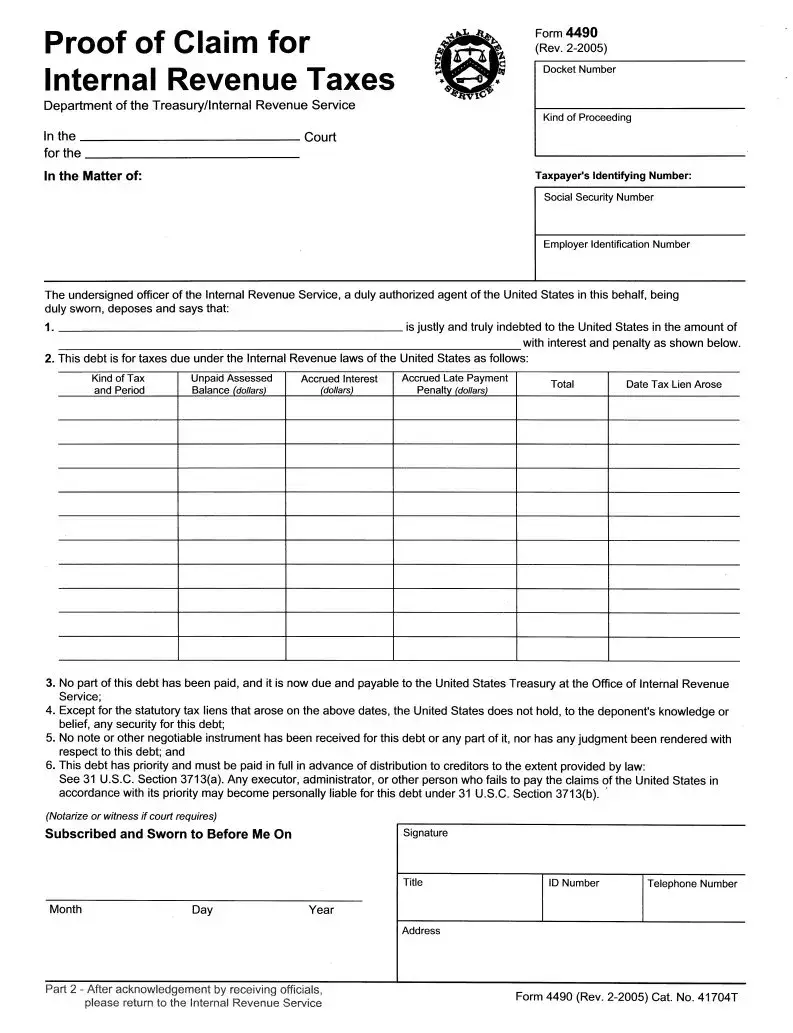
| Filing Instructions | After acknowledgment by receiving officials, the completed form should be returned to the Internal Revenue Service. |
Completing the 4490 form requires careful attention to detail. This form serves as a proof of claim for internal revenue taxes owed to the United States. To ensure accuracy and compliance, follow these steps closely.
Following these steps will help ensure that the 4490 form is filled out correctly and submitted in a timely manner. This process is crucial for maintaining compliance with tax obligations and legal requirements.
Form 4490 serves as a Proof of Claim for Internal Revenue Taxes. It is utilized to assert the United States' claim for unpaid taxes owed by a taxpayer. This form is particularly relevant in bankruptcy or insolvency proceedings, where the IRS seeks to recover tax debts that have not been settled.
The Internal Revenue Service (IRS) files Form 4490 when a taxpayer owes federal taxes that have not been paid. This form may be submitted in court during bankruptcy proceedings or other legal matters involving the taxpayer's financial obligations. Executors or administrators of estates may also need to file this form on behalf of deceased individuals.
Form 4490 requires several key pieces of information, including:
Accurate completion of these fields is essential for the form to be valid.
If the debt indicated on Form 4490 is not paid, the IRS has the authority to take legal action to recover the owed amount. This may include placing a lien on the taxpayer's property or garnishing wages. Additionally, failure to address this debt may result in personal liability for executors or administrators who do not prioritize the payment of federal tax claims.
Form 4490 establishes the IRS's claim as a priority debt. According to U.S. law, specifically 31 U.S.C. Section 3713, federal tax claims must be paid in full before other creditors can receive any distribution from the debtor's estate. This prioritization underscores the importance of addressing tax debts promptly.
Yes, Form 4490 must be notarized or witnessed, as required by local court procedures. This step is crucial to validate the authenticity of the claims made within the form and to ensure that the information provided is accurate and truthful.
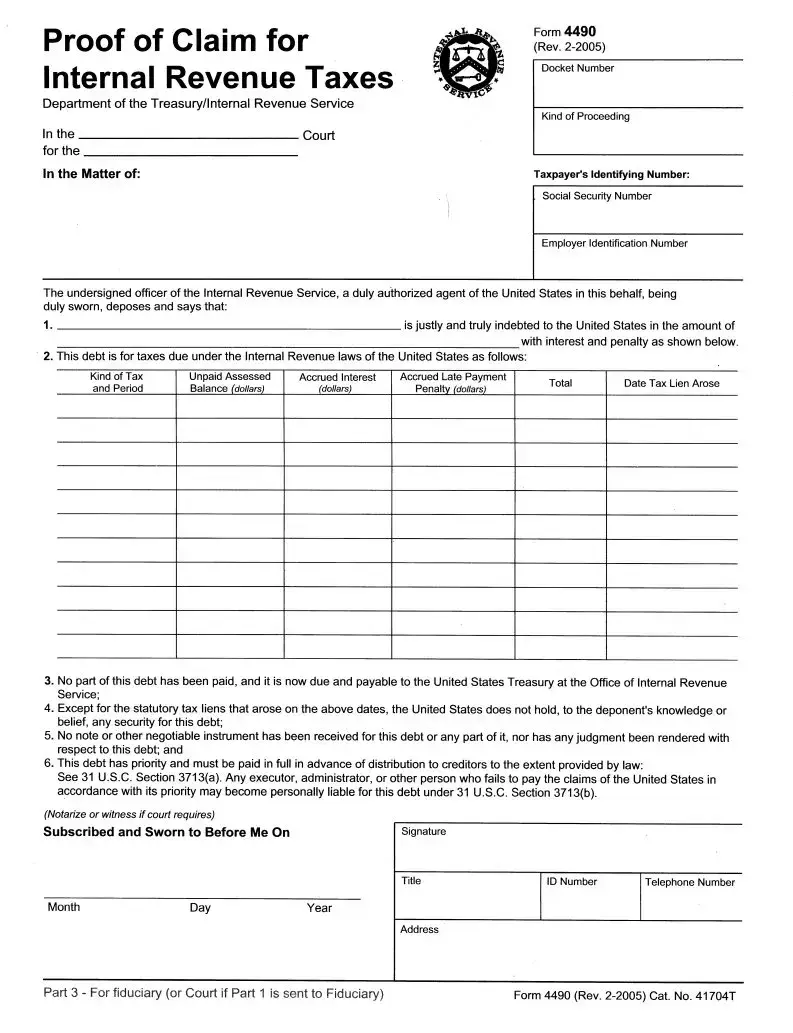
Form 4490 should be submitted to the appropriate court handling the bankruptcy or insolvency proceedings, or to the designated fiduciary if applicable. After acknowledgment by the receiving officials, a copy of the form must be returned to the IRS.
While Form 4490 asserts a claim for unpaid taxes, taxpayers have the right to contest the validity of the debt. This typically involves providing evidence or documentation to dispute the amounts claimed by the IRS. Legal counsel may be beneficial in navigating this process.
If you need help with Form 4490, consider reaching out to a tax professional or an attorney specializing in tax law. They can provide guidance on completing the form accurately and help you understand your rights and obligations regarding tax debts.
Filling out Form 4490, the Proof of Claim for Internal Revenue Taxes, can be a daunting task. Mistakes can lead to delays or complications in processing claims. Here are seven common errors people make when completing this form.
First, many individuals forget to include their Taxpayer Identifying Number. This number is crucial for the IRS to identify the taxpayer and process the claim accurately. Omitting it can lead to significant delays.
Second, failing to specify the correct kind of tax owed is another frequent mistake. The form requires clarity on the type of tax, whether it’s income tax, payroll tax, or another category. Without this information, the IRS may not understand the nature of the claim.
Third, some people do not provide the total amount owed accurately. This includes not only the unpaid tax but also any accrued interest and penalties. It is essential to ensure that these figures are correct to avoid disputes later.
Fourth, neglecting to sign and date the form is a critical oversight. A signature confirms the validity of the claim. Without it, the form may be considered incomplete and rejected.
Fifth, many fail to notarize or witness the document when required. If the court mandates this step, skipping it can result in the claim being dismissed. Always check the specific requirements for your jurisdiction.
Sixth, some individuals do not keep a copy of the submitted form. Retaining a copy is important for personal records and can assist in tracking the claim’s status. Without a copy, it may be challenging to reference details later.
Lastly, misunderstanding the priority of the claim can lead to errors. The form states that debts owed to the United States have priority over other claims. Failure to recognize this can result in improper handling of the claim during the distribution process.
By being aware of these common mistakes, individuals can improve their chances of a smooth filing process with Form 4490. Taking the time to double-check each section can save time and frustration in the long run.
The Form 4490 is a crucial document for filing a proof of claim for internal revenue taxes with the Internal Revenue Service (IRS). However, it is often accompanied by several other forms and documents that help to clarify and support the claim. Understanding these additional documents can streamline the process and ensure that all necessary information is provided.
By gathering these forms and documents, individuals can present a well-rounded proof of claim. This not only aids in clarity but also enhances the likelihood of a smooth review process by the IRS. Ensuring that all relevant information is available can make a significant difference in resolving tax matters efficiently.
The Form 4490 is a Proof of Claim for Internal Revenue Taxes, and it shares similarities with several other documents related to claims and debts. Below is a list of seven documents that are comparable to Form 4490, along with explanations of how they are similar.
When filling out the Form 4490, there are several important considerations to keep in mind. Below is a list of things you should and shouldn't do to ensure your submission is accurate and compliant.
By following these guidelines, you can help ensure that your Form 4490 is filled out correctly and submitted in a timely manner.
Understanding the Form 4490 can be challenging, especially with the various misconceptions surrounding it. Here are eight common misconceptions clarified:
Clearing up these misconceptions can help individuals and businesses navigate their tax obligations more effectively.
When filling out and using the 4490 form, it is essential to follow specific guidelines to ensure accuracy and compliance. Here are key takeaways to consider: