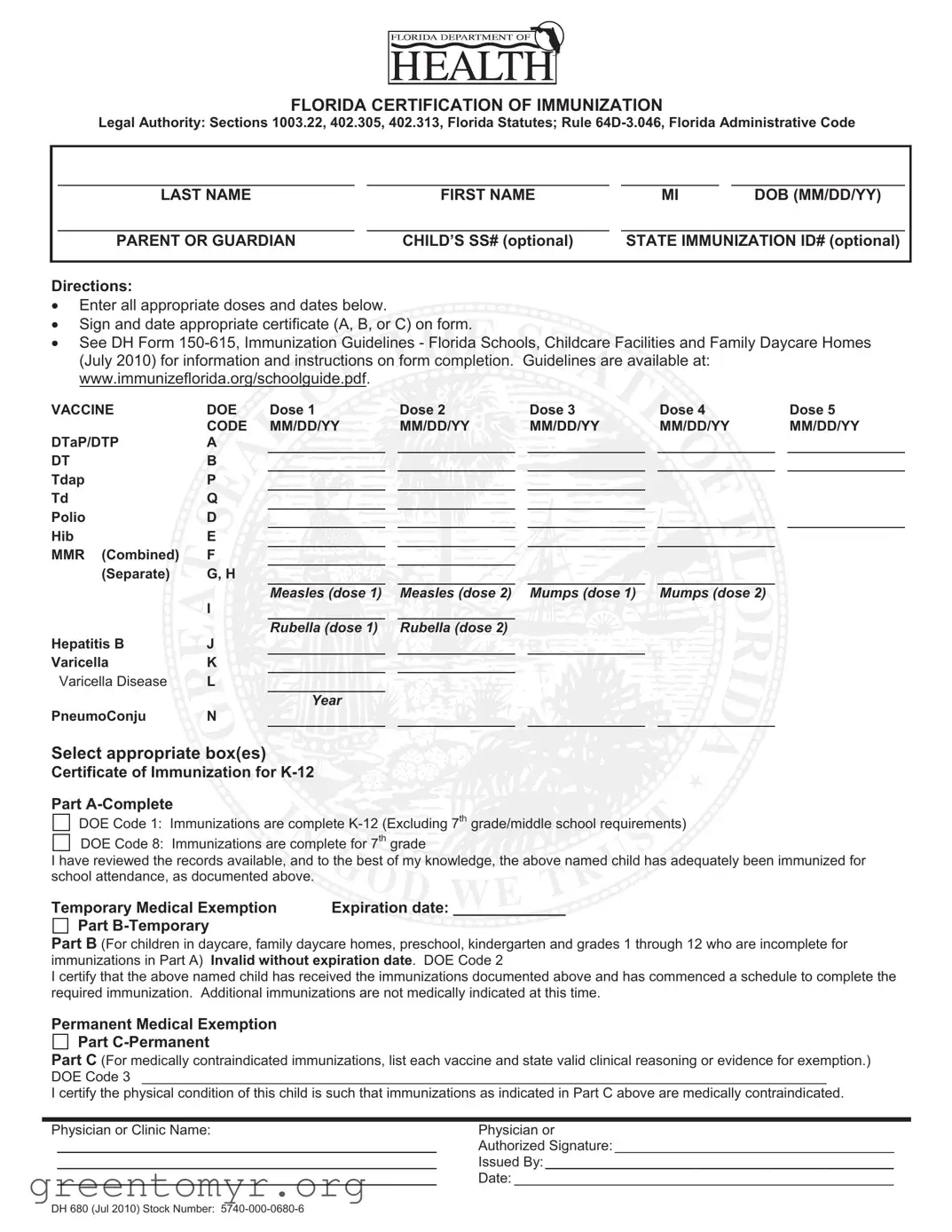
The Florida Certification of Immunization, commonly referred to as the 680 form, plays a vital role in ensuring that children meet the necessary immunization requirements for school attendance. This form is governed by various legal authorities, including specific sections of the Florida Statutes and the Florida Administrative Code. It captures essential information such as the child's name, date of birth, and immunization history, while also allowing for optional entries like the child's Social Security number and state immunization ID. The form is divided into several parts, each designed to accommodate different immunization statuses: complete immunizations for K-12, temporary exemptions for those still in the process of receiving their vaccinations, and permanent medical exemptions for children who cannot be vaccinated due to health reasons. Each section requires careful documentation of vaccine doses and dates, ensuring that parents or guardians provide accurate and complete information. Clear instructions guide users through the process, and resources are available for additional support. Completing the 680 form accurately is crucial, as it not only facilitates school enrollment but also contributes to public health efforts by promoting vaccination among children.

FLORIDA CERTIFICATION OF IMMUNIZATION
Legal Authority: Sections 1003.22, 402.305, 402.313, Florida Statutes; Rule
|
|
|
|
|
|
|
|
|
|
LAST NAME |
|
FIRST NAME |
|
MI |
|
DOB (MM/DD/YY) |
|
|
|
|
|
|
|
|
|
|
|
PARENT OR GUARDIAN |
|
CHILD’S SS# (optional) |
|
STATE IMMUNIZATION ID# (optional) |
|
||
|
|
|
|
|
|
|
|
|
Directions:
Enter all appropriate doses and dates below.
Sign and date appropriate certificate (A, B,or C) on form.
See DH Form
VACCINE |
DOE |
Dose 1 |
|
Dose 2 |
|
Dose 3 |
|
Dose 4 |
|
Dose 5 |
|
CODE |
MM/DD/YY |
|
MM/DD/YY |
|
MM/DD/YY |
|
MM/DD/YY |
|
MM/DD/YY |
DTaP/DTP |
A |
|
|
|
|
|
|
|
|
|
DT |
B |
|
|
|
|
|
|
|
|
|
|
|
|
|
|
|
|
|
|
||
Tdap |
P |
|
|
|
|
|
|
|
|
|
Td |
Q |
|
|
|
|
|
|
|
|
|
Polio |
D |
|
|
|
|
|
|
|
|
|
|
|
|
|
|
|
|
|
|
||
Hib |
E |
|
|
|
|
|
|
|
|
|
|
|
|
|
|
|
|
|
|
||
MMR (Combined) |
F |
|
|
|
|
|
|
|
|
|
|
|
|
|
|
|
|
|
|
||
(Separate) |
G, H |
|
|
|
|
|
|
|
|
|
|
|
|
|
|
|
|
|
|
||
|
|
|
|
|
|
|
|
|
|
|
|
|
Measles (dose 1) |
|
Measles (dose 2) |
|
Mumps (dose 1) |
|
Mumps (dose 2) |
|
|
|
I |
|
|
|
|
|
|
|
|
|
|
|
|
|
|
|
|
|
|
|
|
|
|
Rubella (dose 1) |
|
Rubella (dose 2) |
|
|
|
|
|
|
Hepatitis B |
J |
|
|
|
|
|
|
|
|
|
Varicella |
K |
|
|
|
|
|
|
|
|
|
|
|
|
|
|
|
|
|
|
||
Varicella Disease |
L |
|
|
|
|
|
|
|
|
|
|
|
|
|
|
|
|
|
|
Year
PneumoConju N
Select appropriatebox(es)
Certificate of Immunization
Part
DOE Code 1: Immunizations are complete
DOE Code 8: Immunizationsare complete for 7th grade
I have reviewed the records available,and to the best of my knowledge, the above named child has adequately been immunized for school attendance, as documented above.
Temporary Medical Exemption |
Expiration date: _____________ |
Part |
|
Part B (For children in daycare, family daycare homes, preschool, kindergarten and grades 1 through 12 who are incomplete for immunizations in Part A) Invalid without expiration date. DOE Code 2
I certify that the above named child has received the immunizations documented above and has commenced a schedule to complete the required immunization. Additional immunizations are not medically indicated at this time.
Permanent Medical Exemption
Part
Part C (For medically contraindicated immunizations, list each vaccine and state valid clinical reasoning or evidence for exemption.) DOE Code 3 ________________________________________________________________________________________
I certify the physical condition of this child is such that immunizations as indicated in Part C above are medically contraindicated.
Physician or Clinic Name: |
Physician or |
_________________________________________________ |
Authorized Signature: ____________________________________ |
_________________________________________________ |
Issued By:_____________________________________________ |
_________________________________________________ |
Date: _________________________________________________ |
DH 680 (Jul 2010) Stock Number:
| Fact Name | Details |
|---|---|
| Legal Authority | The form is governed by Sections 1003.22, 402.305, and 402.313 of the Florida Statutes, as well as Rule 64D-3.046 of the Florida Administrative Code. |
| Purpose | The form serves to certify that a child has received the necessary immunizations for school attendance in Florida. |
| Optional Information | Parents or guardians may provide the child's Social Security number and state immunization ID number, although these fields are optional. |
| Completion Instructions | Individuals must enter all appropriate vaccine doses and dates. It is essential to sign and date the appropriate certificate (A, B, or C) on the form. |
| Immunization Guidelines | For detailed information on completing the form, refer to DH Form 150-615, which outlines the Immunization Guidelines for Florida Schools and Childcare Facilities. |
| Temporary Medical Exemption | The form includes a section for a temporary medical exemption, which is valid only if an expiration date is provided. |
| Permanence of Exemptions | A permanent medical exemption can be documented in Part C, where the physician must provide valid clinical reasoning for the exemption. |
| Form Version | This version of the form is dated July 2010 and is identified by the stock number 5740-000-0680-6. |
Filling out the Florida Certification of Immunization (Form 680) is a straightforward process that requires accurate information about a child's immunization history. Once completed, this form will help ensure that your child meets the necessary vaccination requirements for school attendance. Below are the steps to guide you through filling out the form correctly.
After completing the form, review it for accuracy. Ensure all necessary signatures are obtained, and submit it to the appropriate school or childcare facility as required. Keeping a copy for your records is also a good practice!
The Florida 680 Form, also known as the Certification of Immunization, serves to document a child's immunization status for school attendance. It ensures that children meet the required vaccination guidelines set by the state of Florida.
This form is necessary for children entering K-12 schools, daycare facilities, and family daycare homes in Florida. It applies to all students, including those in preschool, kindergarten, and grades 1 through 12.
The form requires several key pieces of information, including:
Additionally, you must provide details about each vaccine received, including the type and dates of administration.
The 680 Form consists of three main parts:
You can verify your child's immunization status by reviewing their vaccination records. The 680 Form includes a section where you can list all the vaccines received, along with the corresponding dates. For specific guidance, consult the Immunization Guidelines available at www.immunizeflorida.org/schoolguide.pdf.
If your child has a medical condition that prevents them from receiving certain vaccines, you will need to complete Part C of the 680 Form. This section requires a physician's signature and a valid clinical reason for the exemption.
Yes, the 680 Form should be submitted prior to your child starting school or daycare. It is advisable to complete and submit the form as early as possible to avoid any delays in enrollment.
Failure to submit the 680 Form may result in your child being unable to attend school or daycare. Schools and childcare facilities require this documentation to ensure the health and safety of all children.
Yes, the Florida 680 Form can be downloaded from the Florida Department of Health's website. You can also request a copy from your child's healthcare provider or school.
For detailed information on immunization requirements and guidelines, visit the Florida Department of Health's website or the Immunization Guidelines available at www.immunizeflorida.org/schoolguide.pdf.
Filling out the Florida Certification of Immunization form, commonly known as the 680 form, can be a straightforward process. However, many individuals make mistakes that can lead to delays or complications. Here are ten common errors to avoid when completing this important document.
One frequent mistake is failing to provide accurate personal information. It is essential to ensure that the child’s last name, first name, middle initial, and date of birth are entered correctly. Any discrepancies can cause issues when verifying immunization records.
Another common error involves omitting the parent or guardian's details. The form requires the name of the individual completing it. Leaving this section blank can lead to confusion and may delay processing.
Many people also forget to include the child’s Social Security number and state immunization ID number, even though these fields are optional. While not mandatory, providing this information can help streamline the verification process.
Inaccurate vaccine dates are another common pitfall. Each dose must be recorded with the correct date in the specified format (MM/DD/YY). Double-checking these dates is crucial, as errors can lead to questions about the child's immunization status.
Some individuals neglect to sign and date the appropriate certificate section. This signature confirms that the information provided is accurate and complete. Without it, the form may be considered invalid.
Another mistake is not selecting the correct DOE code for the child's immunization status. Understanding the differences between Part A, Part B, and Part C is vital. Each part serves a different purpose, and selecting the wrong code can lead to complications.
People often overlook the expiration date for temporary medical exemptions. If this date is not included, the exemption will be considered invalid. This detail is essential for ensuring that the child can continue attending school or daycare.
Some may also forget to provide clinical reasoning or evidence for a permanent medical exemption. This information is necessary for the form to be accepted. Without it, the request for exemption may be denied.
Lastly, failing to review the completed form before submission is a common oversight. Taking a moment to check for accuracy can prevent many of the issues mentioned above. A thorough review ensures that all required information is present and correct.
By being aware of these common mistakes, individuals can help ensure that the 680 form is completed accurately and efficiently, facilitating a smoother process for immunization certification.
When completing the Florida Certification of Immunization (Form 680), there are several other forms and documents that may be required or beneficial for a comprehensive understanding of a child's immunization status. Each of these documents serves a specific purpose in supporting the immunization process and ensuring compliance with state regulations.
Having these documents ready can simplify the process of enrolling a child in school or daycare, ensuring that all immunization requirements are met. Being proactive about immunization records can help prevent delays and ensure a smooth transition into educational settings.
The Florida Certification of Immunization Form (DH 680) is an important document for tracking a child's immunization status. Several other forms serve similar purposes in different contexts. Here are nine documents that share similarities with the DH 680 form:
When filling out the Florida Certification of Immunization form (Form 680), there are several important dos and don'ts to keep in mind. Following these guidelines can help ensure the form is completed accurately and efficiently.
This form is actually required for all students entering K-12 schools in Florida, including those in daycare and family daycare homes.
In fact, the 680 form requires verification of immunizations, which must be documented by a healthcare provider.
The 680 form serves a specific purpose: it certifies that a child has received the necessary immunizations to attend school in Florida.
Florida law mandates a comprehensive list of vaccinations, and the 680 form must reflect all required doses.
A valid signature from a healthcare provider is essential to validate the immunization records on the form.
These exemptions have an expiration date and must be renewed or updated as necessary.
Even homeschooled children may need to provide proof of immunizations for certain activities or programs.
It is also applicable for children in daycare and preschool settings, emphasizing the importance of early immunization.
The form must include all required vaccinations as specified by Florida law; selective documentation is not permitted.
As a child's immunization status changes, the form should be updated to reflect any new vaccinations received.
Filling out the Florida Certification of Immunization, commonly known as the 680 form, is a crucial step for parents and guardians to ensure their children meet school immunization requirements. Here are key takeaways to consider:
Understanding these points will help streamline the process of completing the 680 form and ensure that children are adequately prepared for school attendance.