Content Navigation

The 9 Team Double Elimination Bracket form is an effective way to organize a tournament where teams can compete even after losing a match. This structure allows each team to have a second chance, which is a key feature of double elimination formats. The tournament begins with a winner’s bracket, where teams face off in a series of matches. As teams win, they advance through the bracket, while those who lose drop into the loser’s bracket. Here, teams have the opportunity to fight their way back into contention. The design of the bracket accommodates various matchups, ensuring that teams are matched fairly based on their performance. With a total of nine teams, the bracket intricately balances the flow of competition, providing an engaging experience for players and spectators alike. Understanding how to navigate this bracket is essential for both participants and organizers, as it determines the path to victory and the ultimate champion of the tournament.

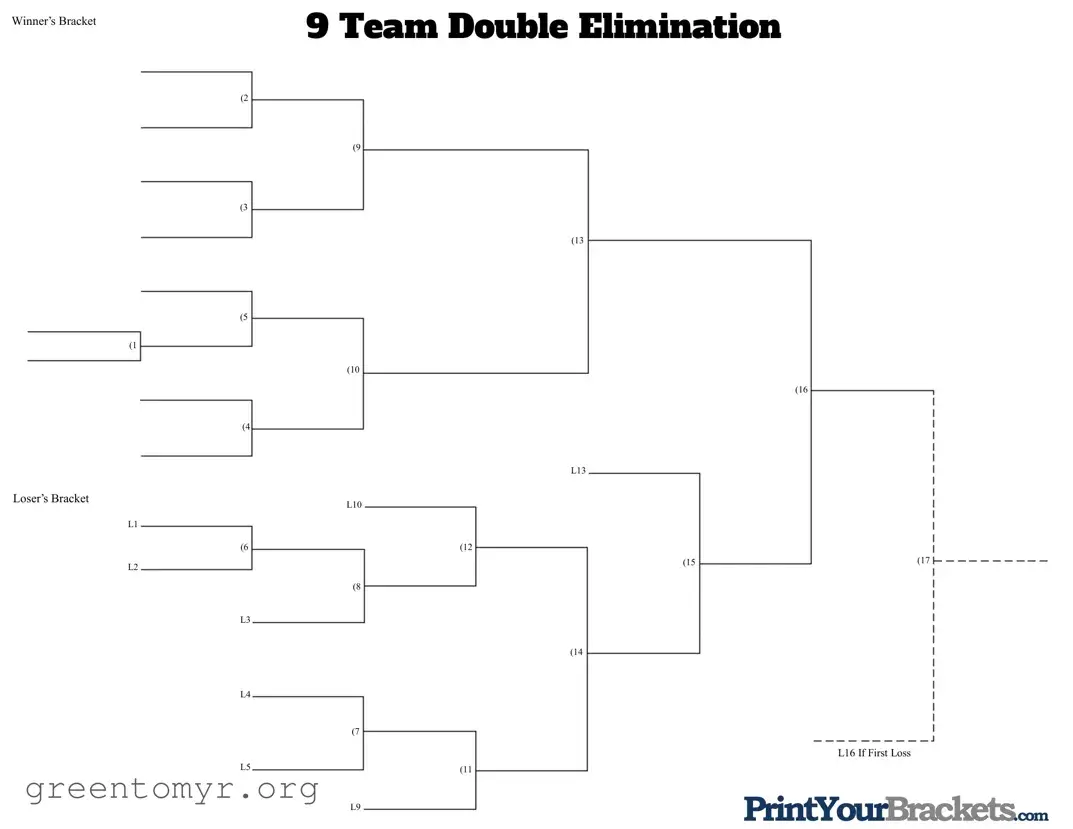
9 Team Double Elimination Bracket Example

Winner’s Bracket

(2

(3

(5

(1

(4

Loser’s Bracket

L1

(6

L2

L3

L4

L5

9 Team Double Elimination

(9

(13

(10

(16

L13

L10

(12

(15

(17

(8

(14

(7

L16 If First Loss

(11

L9PrintYourBrackets.com

File Breakdown

Fact Name Details
Structure A 9-team double elimination bracket consists of two main sections: the winner's bracket and the loser's bracket.
Initial Matchups The first round features four matches, with one team receiving a bye, allowing them to advance directly to the next round.
Elimination Rules Teams are eliminated from the tournament after losing two matches, which differentiates it from single elimination formats.
Winner's Bracket Progression Teams in the winner's bracket continue to play until they lose, while those in the loser's bracket must win every match to stay in the tournament.
Loser's Bracket Function The loser's bracket allows teams that lose in the winner's bracket a second chance to compete for the championship.
Finals Structure The final match typically involves the winner of the winner's bracket facing the winner of the loser's bracket, with the latter needing to win twice to claim the title.
Governing Laws State-specific regulations may apply to tournaments, such as those governed by local sports associations or amateur athletic regulations.

Guide to Using 9 Team Double Elimination Bracket

Filling out the 9 Team Double Elimination Bracket form is a straightforward process. This bracket allows teams to compete in a structured manner, ensuring that even if a team loses, they still have a chance to come back and win. Follow these steps to complete the form accurately.

  1. Start by identifying the teams participating in the tournament. Write down the names of all nine teams.
  2. Locate the section labeled WINNER’S BRACKET. This is where you will track the progress of teams that win their matches.
  3. In the first round of the Winner's Bracket, place Team 1 against Team 2, Team 3 against Team 4, and so on, until all teams are matched up.
  4. Record the winners of each match in the brackets provided. Use the format shown in the form to ensure clarity.
  5. After the first round, move to the next round in the Winner's Bracket. The winners from the first round will face each other. Write their names in the appropriate slots.
  6. Continue this process until you fill out the entire Winner’s Bracket, leading to the final match.
  7. Next, locate the LOSER’S BRACKET. This section tracks teams that have lost a match but still have a chance to compete.
  8. Record the first loss for teams in the Loser's Bracket. For example, if Team 1 loses, write it down as L1.
  9. As teams continue to lose, fill in the Loser's Bracket accordingly. Ensure that each loss is documented in the correct position.
  10. Continue updating both brackets until the tournament concludes, marking the final winner.

Get Answers on 9 Team Double Elimination Bracket

What is a Double Elimination Bracket?

A Double Elimination Bracket is a tournament format that allows teams to compete until they lose twice. In this setup, teams are divided into two brackets: the Winner's Bracket and the Loser's Bracket. If a team loses a match in the Winner's Bracket, they move to the Loser's Bracket, where they have another chance to compete. The tournament continues until one team remains without two losses, ultimately determining the champion.

How does the 9 Team Double Elimination Bracket work?

In a 9 Team Double Elimination Bracket, teams are paired for matches in a specific order. The first round typically involves some teams receiving byes, allowing them to advance without competing. The matches are organized as follows:

  1. Teams compete in the Winner's Bracket.
  2. Losers from the Winner's Bracket drop into the Loser's Bracket.
  3. Teams continue to compete until one team in the Winner's Bracket remains, and the final matches determine the overall champion.

This structure ensures that every team has a fair chance to continue competing, even after a loss.

What happens if a team loses in the Loser's Bracket?

If a team loses while competing in the Loser's Bracket, they are eliminated from the tournament. This is the final opportunity for teams to stay in the competition. Therefore, it is crucial for teams to perform well in both brackets to secure a spot in the final matches.

Can you explain the match pairings and byes in the bracket?

In the 9 Team Double Elimination Bracket, the match pairings are designed to ensure that every team has a chance to compete. Some teams may receive byes in the first round, meaning they automatically advance to the next round without playing. The pairing typically follows this structure:

  • Round 1: Some teams compete while others receive byes.
  • Subsequent rounds pair winners against each other, and losers drop into the Loser's Bracket.

This format helps maintain balance and fairness throughout the tournament, allowing for an exciting competition.

Common mistakes

Filling out a 9 Team Double Elimination Bracket form can be tricky. Many people overlook critical details, leading to confusion and errors. One common mistake is failing to correctly identify the teams participating. Each team must be clearly labeled, and any ambiguity can cause significant issues in tracking progress.

Another frequent error is misplacing the match results. When recording outcomes, ensure that each win and loss is accurately reflected in the appropriate brackets. A simple mix-up can alter the entire flow of the tournament.

Some individuals neglect to follow the bracket structure. The winner's bracket and loser's bracket must be filled out in accordance with the tournament rules. Ignoring the designated paths can lead to a disorganized bracket that is difficult to follow.

Many people also forget to update the bracket after each match. It’s essential to keep the bracket current to provide an accurate representation of the tournament's progress. Delays in updating can lead to confusion among participants.

Another mistake is not double-checking for typos or errors in team names. A misspelled name can create unnecessary complications, especially if teams are trying to verify their standings. Always ensure accuracy to maintain clarity.

Sometimes, individuals fail to account for the double elimination format. Understanding that a team must lose twice to be completely eliminated is crucial. Misunderstanding this can lead to incorrect assumptions about a team’s status in the tournament.

Some users overlook the importance of clearly marking which matches have been played. It’s vital to indicate completed matches to keep everyone informed. This oversight can create confusion about which teams are still in contention.

In addition, failing to communicate bracket updates to all participants can lead to frustration. Ensure that everyone involved is aware of the latest results and changes. Clear communication helps maintain engagement and excitement throughout the tournament.

Lastly, neglecting to review the rules of the tournament can result in misunderstandings. Each tournament may have specific guidelines that must be followed. Familiarity with these rules is essential for a smooth experience.

Documents used along the form

The 9 Team Double Elimination Bracket form is a crucial tool for organizing tournaments. However, several other documents often accompany this form to ensure smooth operations and clear communication. Below is a list of commonly used forms and documents that can enhance the tournament experience.

  • Team Registration Form: This document collects essential information about each team, including team name, player details, and contact information. It helps organizers keep track of all participating teams.
  • Match Schedule: This document outlines the dates, times, and locations of each match. It is vital for participants and spectators to know when and where to attend.
  • Score Sheet: A score sheet is used to record the outcomes of each match. It helps maintain accurate records of wins and losses, which are necessary for updating the bracket.
  • Rules and Regulations Document: This document provides a comprehensive overview of the tournament rules, including eligibility, conduct expectations, and game formats. It ensures all participants are aware of the guidelines.
  • Waiver and Release Form: Participants often sign this form to acknowledge the risks involved in the tournament. It protects organizers from liability in case of injuries or accidents.

Utilizing these documents alongside the 9 Team Double Elimination Bracket form can help create a well-structured and enjoyable tournament experience for everyone involved.

Similar forms

The 9 Team Double Elimination Bracket form is similar to several other documents used in tournament settings. Here are ten such documents:

  • Single Elimination Bracket: This document outlines a tournament format where teams are eliminated after one loss, similar to the winner's bracket in double elimination.
  • Round Robin Schedule: This format allows each team to play against every other team, providing a comprehensive overview of matchups, much like the multiple rounds in double elimination.
  • Pool Play Format: Teams are divided into groups, and each team plays all others in their group, similar to the initial rounds of a double elimination bracket.
  • Challenge Ladder: This document allows players to challenge each other for ranking, resembling the competitive nature of elimination rounds.
  • Swiss System Tournament: Each round pairs teams based on their performance, similar to how teams are matched in a double elimination setup.
  • League Standings Chart: This document tracks team performance over a season, akin to how teams advance or are eliminated in a bracket.
  • Playoff Bracket: This format is used in many sports to determine a champion, similar to the structure of the double elimination bracket.
  • Score Sheet: This document records the results of matches, which is essential in both single and double elimination formats.
  • Match Schedule: This outlines when and where each match will occur, similar to the organization found in a double elimination bracket.
  • Event Registration Form: This document collects information from participants, helping to set up brackets and schedules, just like in double elimination tournaments.

Dos and Don'ts

When filling out the 9 Team Double Elimination Bracket form, certain practices can help ensure accuracy and clarity. Below is a list of recommended actions and common mistakes to avoid.

  • Do: Clearly label each team in the appropriate section of the bracket.
  • Do: Double-check the matchups to ensure they follow the double elimination format.
  • Do: Use legible handwriting or type the information to prevent misinterpretation.
  • Do: Keep track of the winners and losers after each match to maintain an accurate progression.
  • Don't: Leave any sections of the bracket blank, as this can lead to confusion.
  • Don't: Forget to update the bracket after each match to reflect the current standings.
  • Don't: Use abbreviations or nicknames for teams that may not be universally recognized.
  • Don't: Overwrite or cross out information; instead, use a new form if errors occur.

Misconceptions

Understanding the 9 Team Double Elimination Bracket can be challenging. Here are ten common misconceptions that may lead to confusion:

  1. All teams must lose twice to be eliminated. In a double elimination format, a team is only eliminated after losing two matches. However, they can still compete in the loser’s bracket after their first loss.
  2. The winner's bracket is the only path to victory. While teams in the winner's bracket have a clear advantage, teams from the loser's bracket can still win the tournament by defeating the winner's bracket champion.
  3. Teams that lose in the winner's bracket are done. This is false. A team that loses in the winner's bracket moves to the loser's bracket and has another chance to compete.
  4. Seeding does not matter. Seeding is crucial in determining matchups. Higher-seeded teams typically face lower-seeded teams in the early rounds, which can affect their chances of advancing.
  5. All matches are played in a single day. Depending on the tournament's schedule, matches may be spread out over several days, allowing teams time to rest and prepare.
  6. The final match is always between the last two teams in the winner's bracket. The final match can involve a team from the loser's bracket if they defeat the winner's bracket champion, necessitating a second match if the winner's bracket team has only one loss.
  7. Teams can play in the loser’s bracket without any restrictions. Teams must wait for their turn in the loser's bracket, which is determined by the outcome of previous matches.
  8. There are no advantages to being in the winner's bracket. Teams in the winner's bracket enjoy a significant advantage by having to lose twice before elimination, while teams in the loser's bracket must win every match to stay in the tournament.
  9. All brackets are the same regardless of the number of teams. The structure and matchups can vary significantly based on the number of teams, affecting how the tournament is organized.
  10. Once a team loses, they cannot regain momentum. Teams in the loser's bracket can build momentum by winning consecutive matches, which can lead to an eventual championship victory.

Clarifying these misconceptions can help participants better understand the dynamics of the 9 Team Double Elimination Bracket.

Key takeaways

Filling out and using a 9 Team Double Elimination Bracket can be straightforward if you keep a few key points in mind. Here are some important takeaways:

  • Understand the Structure: The bracket consists of a winner's bracket and a loser's bracket. Teams must navigate both to determine the overall champion.
  • Initial Matchups: The first round typically involves four teams playing, while the remaining five teams receive a bye.
  • Tracking Wins and Losses: A team is eliminated after losing two matches. Keep track of each team's wins and losses throughout the tournament.
  • Advancing Teams: Winners from the winner's bracket continue to advance, while losers drop down to the loser's bracket for a second chance.
  • Finals Format: The final matchup may require a team from the loser's bracket to win twice to claim the championship, depending on the format.
  • Clear Labeling: Clearly label each match and team on the bracket to avoid confusion. Use team names or numbers consistently.
  • Updating the Bracket: After each match, promptly update the bracket to reflect the outcomes. This helps everyone stay informed.
  • Communication: Ensure all teams understand the rules and format before the tournament begins. Clear communication fosters a smoother experience.
  • Use of Technology: Consider using online tools or apps to manage the bracket, especially for larger tournaments. This can simplify tracking.
  • Enjoy the Process: Remember that the primary goal is to have fun and foster competition. Embrace the spirit of the tournament!