Content Navigation

The 90-Day Performance Review form is a crucial tool for assessing employee performance at Oklahoma Baptist University. This form not only serves as a structured evaluation but also fosters open communication between supervisors and employees. It encompasses key areas of job performance, including job knowledge, work quality, judgment, and initiative. Each of these areas is rated on a scale ranging from "Unsatisfactory" to "Superior," allowing for a comprehensive overview of an employee's strengths and areas needing improvement. Additionally, the form emphasizes the importance of communication and professional conduct, ensuring that employees understand how their behavior impacts the workplace. Supervisors are required to provide comments for all ratings except for "Satisfactory," which encourages thoughtful feedback and guidance. If an employee receives a rating of "Unsatisfactory" or "Needs Improvement" in any area, a follow-up meeting is mandated to discuss progress and potential action steps for improvement. This proactive approach not only supports employee development but also aligns individual performance with the university's goals.
90 Day Performance Example

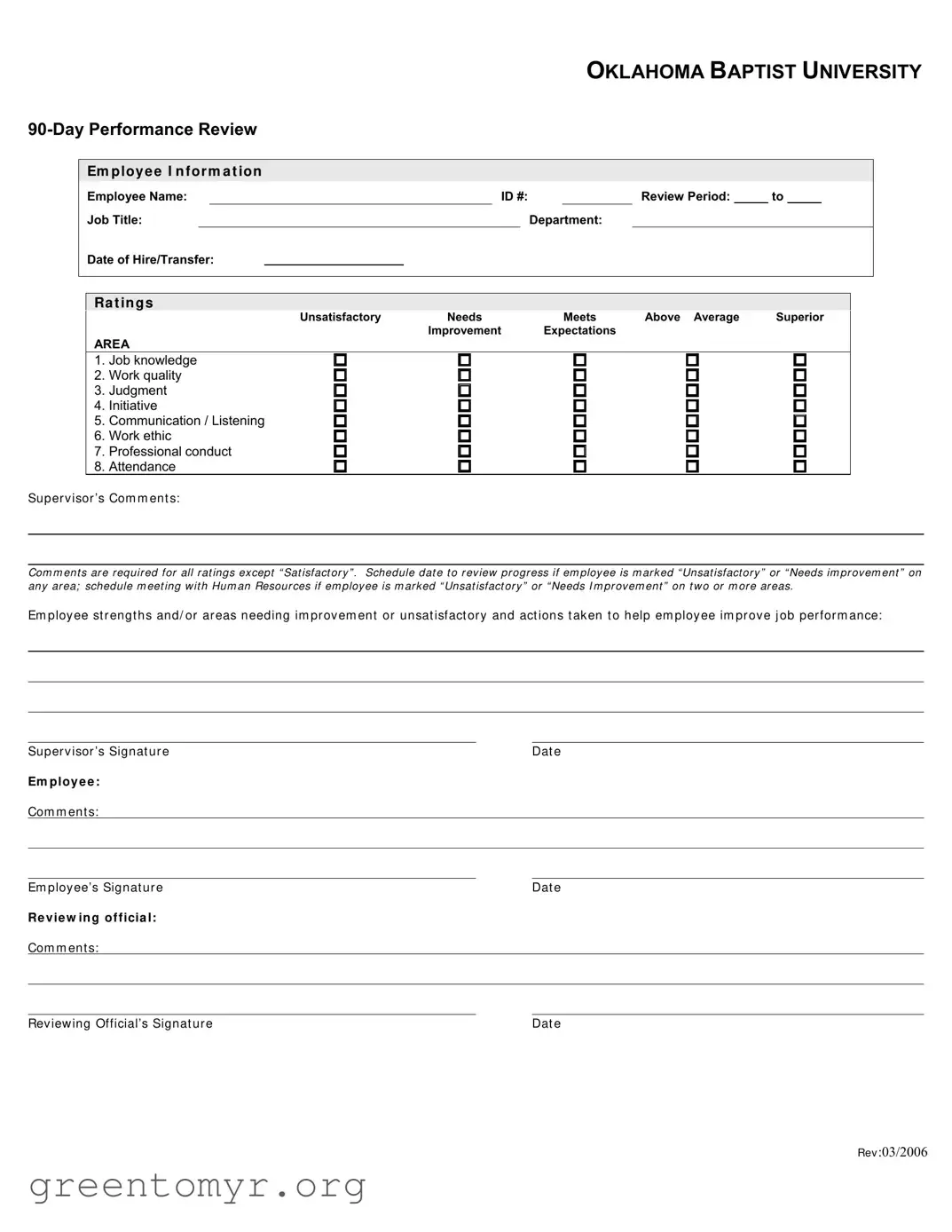
OKLAHOMA BAPTIST UNIVERSITY

90-Day Performance Review

Em p loy e e I n f o r m a t ion

Employee Name:


ID #:


Review Period:


to

Job Title:


Department:


Date of Hire/Transfer:

Ra t in g s


Unsatisfactory

Needs

Meets

Above Average

Superior


Improvement

Expectations


AREA


1.

Job knowledge


2.

Work quality


3.

Judgment


4.

Initiative


5.

Communication / Listening


6.

Work ethic


7.

Professional conduct


8.

Attendance


Super v isor ’s Com m ent s:

Com m ent s ar e r equir ed for all r at ings ex cept “ Sat isfact or y ” . Schedule dat e t o r ev iew pr ogr ess if em ploy ee is m ar k ed “ Unsat isfact or y ” or “ Needs im pr ov em ent ” on any ar ea; schedule m eet ing w it h Hum an Resour ces if em ploy ee is m ar ked “ Unsat isfact or y ” or “ Needs I m pr ov em ent ” on t w o or m or e ar eas.

Em ploy ee st r engt h s and/ or ar eas n eeding im pr ov em en t or unsat isfact or y and act ion s t ak en t o h elp em ploy ee im pr ov e j ob per for m ance:

Super v isor ’s Signat ur e


Dat e

Em p loy e e :


Com m en t s:


Em ploy ee’s Signat ur e


Dat e

Re v ie w in g of f icia l:


Com m en t s:


Rev iew ing Official’s Signat ur e


Dat e

Rev :03/2006

File Breakdown

Fact Name Description
Purpose of the Form The 90-Day Performance Review form is designed to evaluate an employee's performance during their initial 90 days of employment, providing a structured approach to assess job knowledge, work quality, and other critical areas.
Required Comments Comments are mandatory for all ratings except "Satisfactory." This requirement ensures that supervisors provide meaningful feedback, which can help employees understand their strengths and areas for improvement.
Follow-Up Actions If an employee receives an "Unsatisfactory" or "Needs Improvement" rating in any area, a follow-up meeting must be scheduled. This meeting should involve Human Resources if the employee is marked in two or more areas.
Governing Law In Oklahoma, the performance review process is governed by state employment laws, including regulations on employee rights and workplace standards. Employers should ensure compliance with the Oklahoma Employment Security Act and related statutes.

Guide to Using 90 Day Performance

Completing the 90 Day Performance Review form is an essential step in assessing employee performance and providing constructive feedback. This process not only helps in recognizing achievements but also identifies areas for improvement. Follow these steps to ensure the form is filled out accurately and effectively.

  1. Begin with Employee Information: Fill in the employee's name, ID number, job title, department, and the dates for the review period. Make sure all information is correct to avoid any confusion later.
  2. Rate Performance Areas: Assess the employee's performance in eight key areas: Job knowledge, Work quality, Judgment, Initiative, Communication / Listening, Work ethic, Professional conduct, and Attendance. Use the rating scale provided: Unsatisfactory, Needs Improvement, Meets Expectations, Above Average, and Superior.
  3. Provide Supervisor’s Comments: For each area rated, include comments explaining the reasoning behind the ratings, except for those rated as “Satisfactory.” This helps clarify your evaluations.
  4. Schedule Follow-Up Meetings: If any area is marked as “Unsatisfactory” or “Needs Improvement,” schedule a date to review progress. If two or more areas are rated as such, arrange a meeting with Human Resources.
  5. Detail Employee Strengths and Areas for Improvement: In this section, outline the employee's strengths as well as any areas needing improvement. Include specific actions taken to assist the employee in enhancing their job performance.
  6. Signatures: Ensure that the supervisor signs and dates the form. The employee should also sign and date it after reviewing the comments. Finally, the reviewing official must sign and date the form as well.

Once the form is filled out and signed by all parties, it will be submitted to the appropriate department for further processing. This step is crucial for maintaining accurate employee records and ensuring that performance evaluations are documented properly.

Get Answers on 90 Day Performance

What is the purpose of the 90-Day Performance form?

The 90-Day Performance form is designed to assess an employee's performance during their initial 90 days of employment. It helps supervisors evaluate key areas such as job knowledge, work quality, and communication skills. The feedback provided can guide both the employee and the supervisor in identifying strengths and areas for improvement.

What areas are evaluated on the form?

The form evaluates the following areas:

  1. Job knowledge
  2. Work quality
  3. Judgment
  4. Initiative
  5. Communication / Listening
  6. Work ethic
  7. Professional conduct
  8. Attendance

Each area is rated to provide a comprehensive overview of the employee's performance.

What do the ratings mean?

The ratings range from "Unsatisfactory" to "Superior." Each rating reflects the employee's performance level:

  • Unsatisfactory: Performance does not meet expectations.
  • Needs Improvement: Performance is below expectations.
  • Meets Expectations: Performance meets the basic requirements.
  • Above Average: Performance exceeds expectations.
  • Superior: Performance far exceeds expectations.

What happens if an employee receives an "Unsatisfactory" or "Needs Improvement" rating?

If an employee receives an "Unsatisfactory" or "Needs Improvement" rating in any area, the supervisor is required to schedule a date to review progress. If two or more areas are marked as such, a meeting with Human Resources should be arranged to discuss further steps.

How are comments used in the review process?

Comments are mandatory for all ratings except "Satisfactory." Supervisors must provide specific feedback to explain the ratings. This feedback is crucial for the employee's understanding of their performance and the steps needed for improvement.

What should an employee do if they disagree with their performance rating?

If an employee disagrees with their performance rating, they should first discuss their concerns with their supervisor. Open communication is encouraged. If the issue remains unresolved, the employee can seek further assistance from Human Resources.

What is the significance of the employee's comments section?

The employee's comments section allows the individual to share their perspective on their performance and any challenges they may have faced. This input is valuable for fostering a two-way dialogue between the employee and supervisor, promoting growth and understanding.

Common mistakes

Filling out the 90 Day Performance form can be a straightforward process, but several common mistakes can lead to inaccuracies and misunderstandings. One frequent error is failing to provide complete employee information. Omitting details such as the employee's name, ID number, or job title can create confusion and delay the review process.

Another mistake involves neglecting to include comments for all ratings except “Satisfactory.” Comments are essential for clarity and context. Without them, the ratings may seem arbitrary and could lead to misinterpretation of the employee’s performance.

Some individuals mistakenly rate an employee without sufficient evidence. It’s crucial to base ratings on specific examples and observations. Relying on assumptions or hearsay can result in unfair evaluations.

Inconsistent ratings across different areas are also common. For instance, if an employee is rated as “Unsatisfactory” in one area but “Superior” in another without clear justification, it may raise questions about the overall assessment. Each rating should reflect a balanced and fair evaluation.

Additionally, not scheduling a follow-up meeting when necessary is a significant oversight. If an employee receives an “Unsatisfactory” or “Needs Improvement” rating in any area, a progress review should be scheduled promptly to address concerns and set improvement goals.

Some supervisors fail to document employee strengths and areas needing improvement adequately. This section is vital for guiding future performance and development. Leaving it blank or vague can hinder the employee's growth.

Another mistake involves the supervisor’s signature. Failing to sign the form can render it incomplete and may lead to complications in the review process. It’s essential to ensure all necessary signatures are obtained.

Finally, neglecting to review the form for errors before submission can lead to misunderstandings. Typos or incorrect information can undermine the form’s effectiveness. A thorough review can prevent these issues and ensure a smooth performance evaluation process.

Documents used along the form

The 90-Day Performance Review is an essential tool for evaluating an employee's initial contributions and areas for growth within an organization. However, several other forms and documents often accompany this review to provide a comprehensive assessment and support the employee's development. Below is a list of these documents, each serving a unique purpose in the performance management process.

  • Employee Self-Assessment Form: This document allows employees to reflect on their own performance, achievements, and areas for improvement. It encourages self-awareness and can provide valuable insights during the review process.
  • Goal Setting Document: Used to outline specific objectives for the employee, this document sets clear expectations and benchmarks for performance. It helps in aligning the employee's goals with the organization's mission.
  • Feedback Form: Collected from peers, supervisors, or clients, this form gathers input on the employee’s performance. It provides a broader perspective and can highlight strengths and weaknesses that may not be apparent in a one-on-one review.
  • Development Plan: This plan outlines the steps and resources needed for the employee to improve their performance or skills. It can include training opportunities, mentorship, and timelines for achieving specific goals.
  • Attendance Record: This document tracks the employee's attendance and punctuality. It is essential for evaluating reliability and commitment, which are key components of overall job performance.
  • Performance Improvement Plan (PIP): If an employee is struggling, a PIP outlines specific areas needing improvement, along with measurable goals and a timeline for achieving them. It serves as a formal structure for addressing performance issues.
  • Job Description: This document details the responsibilities and expectations of the employee's role. It provides context for the performance review by clarifying what is required for success in the position.
  • Training Records: Keeping track of any training sessions or professional development courses the employee has completed is crucial. This record can demonstrate the employee's commitment to growth and help identify further training needs.
  • Exit Interview Form: If an employee leaves the organization, this form captures their feedback about their experience. While not directly related to the 90-day review, it can inform future performance assessments and organizational improvements.

By utilizing these forms and documents alongside the 90-Day Performance Review, organizations can create a more robust framework for employee evaluation and development. This comprehensive approach not only enhances individual performance but also contributes to the overall success of the organization.

Similar forms

  • Performance Improvement Plan (PIP): Like the 90-Day Performance form, a PIP outlines specific areas where an employee needs to improve. It sets measurable goals and timelines for improvement, ensuring that the employee understands expectations and has a clear path forward.
  • Annual Performance Review: This document assesses an employee’s performance over a longer period, typically a year. It includes evaluations of job knowledge, work quality, and other key performance indicators, similar to the 90-Day Performance form.
  • Employee Development Plan: This plan focuses on an employee's growth and development within the organization. It identifies skills and competencies to be developed, paralleling the areas of improvement found in the 90-Day Performance form.
  • Self-Assessment Form: Employees fill out this form to evaluate their own performance. It encourages reflection on strengths and weaknesses, much like the feedback section of the 90-Day Performance form.
  • Job Description: A job description outlines the responsibilities and expectations for a position. It serves as a baseline for evaluating performance, similar to the criteria listed in the 90-Day Performance form.
  • Feedback Form: This document collects input from peers or supervisors about an employee's performance. It can provide additional context and insights, aligning with the review process in the 90-Day Performance form.
  • Coaching Session Notes: These notes document discussions between a supervisor and employee about performance issues. They help track progress and set goals, similar to the action items noted in the 90-Day Performance form.
  • Exit Interview Form: While typically used when an employee leaves, this form gathers insights about performance and job satisfaction. It can highlight areas of improvement that relate back to the evaluations in the 90-Day Performance form.
  • Competency Assessment: This assessment evaluates specific skills and competencies required for a job. It provides a structured way to measure an employee's abilities, akin to the rating areas in the 90-Day Performance form.

Dos and Don'ts

Completing the 90-Day Performance form is an important task that can influence an employee's career trajectory. To ensure that the process is effective and constructive, here are five things you should and shouldn't do.

  • Do provide specific examples of the employee's performance in each area. This helps to clarify ratings and offers concrete feedback.
  • Do schedule follow-up meetings if an employee is marked as "Unsatisfactory" or "Needs Improvement." This shows a commitment to their development.
  • Do be honest in your assessments. Transparency fosters trust and can lead to better performance outcomes.
  • Do encourage employee input during the review process. Their perspective can provide valuable insights into their performance.
  • Do maintain a professional tone throughout the form. This ensures that feedback is constructive and respectful.
  • Don't use vague language when describing performance. General comments can be confusing and unhelpful.
  • Don't skip comments for ratings that are not "Satisfactory." Every rating deserves a rationale to guide future improvements.
  • Don't focus solely on weaknesses without acknowledging strengths. A balanced review is more motivating.
  • Don't rush through the form. Take the time necessary to reflect on the employee's performance comprehensively.
  • Don't forget to follow up on action items discussed during the review. This reinforces accountability and support.

Misconceptions

The 90 Day Performance form is a critical tool for evaluating employee performance, but several misconceptions can lead to misunderstandings. Here are four common misconceptions:

  • It is only a formality. Many believe the performance review is just a box to check. In reality, it plays a significant role in employee development and can influence promotions, raises, and training opportunities.
  • All ratings are the same. Some assume that all performance ratings hold equal weight. However, ratings such as "Unsatisfactory" or "Needs Improvement" require immediate attention and follow-up meetings, while "Satisfactory" ratings do not.
  • Feedback is optional. There is a misconception that comments from supervisors are not necessary. In fact, comments are required for all ratings except "Satisfactory," making constructive feedback essential for clarity and improvement.
  • It only concerns job performance. Many think the review solely focuses on work output. However, it encompasses various aspects, including communication, professional conduct, and attendance, all of which are vital for overall success in the workplace.

Understanding these misconceptions can help ensure that the performance review process is taken seriously and used effectively for employee growth and organizational success.

Key takeaways

The 90-Day Performance form is an essential tool for evaluating employee performance. Here are key takeaways for effectively filling out and utilizing this form:

  • Understand the Purpose: This form assesses an employee's performance over their first 90 days, helping identify strengths and areas for improvement.
  • Complete Employee Information: Fill in all relevant details, including the employee's name, ID number, job title, and department.
  • Use Clear Ratings: Ratings range from "Unsatisfactory" to "Superior." Choose the rating that best reflects the employee’s performance in each area.
  • Provide Comments: Comments are mandatory for all ratings except "Satisfactory." Use this space to elaborate on the reasons for your ratings.
  • Schedule Follow-Up: If an employee receives an "Unsatisfactory" or "Needs Improvement" rating in any area, schedule a meeting to discuss progress.
  • Human Resources Involvement: If an employee is rated "Unsatisfactory" or "Needs Improvement" in two or more areas, involve Human Resources for further guidance.
  • Focus on Strengths and Weaknesses: Clearly outline the employee's strengths and areas needing improvement. This helps in creating a development plan.
  • Signatures Matter: Ensure that both the supervisor and the employee sign the form, confirming that the review has been discussed.
  • Keep Records: Retain a copy of the completed form for future reference and to track the employee's progress over time.