Content Navigation

When it comes to managing personal finances, there may come a time when closing a bank account becomes necessary. The Account Closing form serves as a vital tool for individuals wishing to terminate their banking relationship with a financial institution. This form is straightforward, allowing account holders to specify which types of accounts—checking or savings—they wish to close. It requires essential information such as the name on the account and the corresponding account numbers. Additionally, the form provides a space for individuals to indicate where any remaining balances should be sent, ensuring that funds are directed to the correct address. Contact information is also requested in case the bank has any questions regarding the closure. This comprehensive yet simple form helps streamline the process, making it easier for individuals to manage their financial transitions effectively. Ultimately, understanding how to properly fill out and submit the Account Closing form can lead to a smoother experience when closing an account.

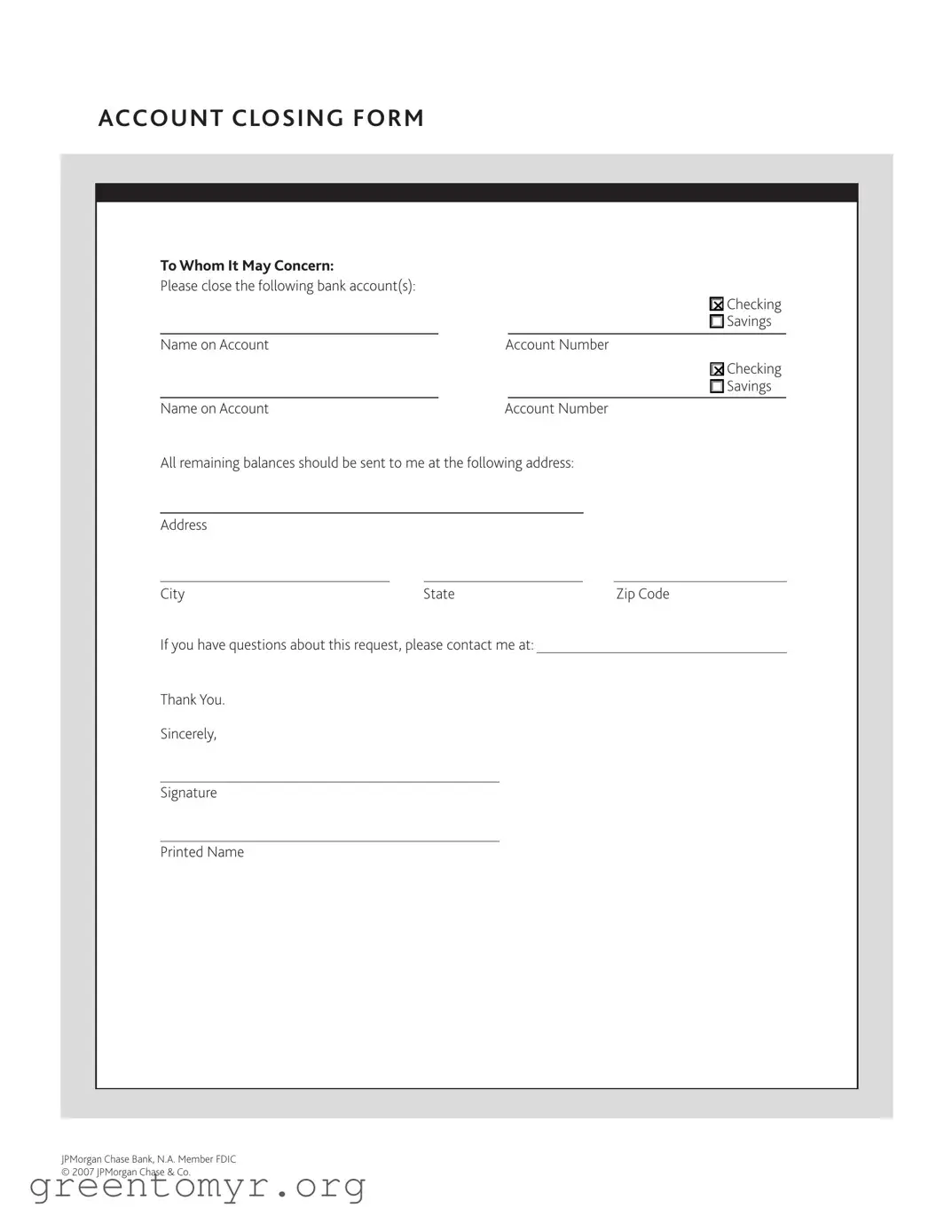
Account Closing Example

ACCOUNT CLOSING FORM

To Whom It May Concern:


Please close the following bank account(s):


o฀Checking


o฀Savings


Name on Account


Account Number


o฀Checking


o฀Savings


Name on Account


Account Number

All remaining balances should be sent to me at the following address:


Address


City

State


Zip Code

If you have questions about this request, please contact me at:

Thank You.

Sincerely,

Signature

Printed Name

JPMorgan Chase Bank, N.A. Member FDIC © 2007 JPMorgan Chase & Co.

File Breakdown

Fact Name Details
Form Purpose The Account Closing Form is used to formally request the closure of bank accounts, including checking and savings accounts.
Required Information Account holders must provide their name, account number, and a mailing address for any remaining balances.
Contact Information Individuals are encouraged to provide their contact information for any follow-up questions regarding the account closure.
Governing Laws The closure of bank accounts is governed by state banking regulations, which may vary by state.

Guide to Using Account Closing

After completing the Account Closing form, submit it to your bank. The bank will process your request and send any remaining balance to the address you provided. Ensure all details are accurate to avoid delays.

  1. Obtain the Account Closing form from your bank or download it from their website.
  2. Indicate the type of account you wish to close by checking the appropriate box for either Checking or Savings.
  3. Provide the Name on Account in the designated field.
  4. Enter the Account Number associated with the account you want to close.
  5. If you are closing multiple accounts, repeat steps 2 to 4 for each account.
  6. Fill in your Address, City, State, and Zip Code to ensure any remaining balance is sent to the correct location.
  7. Include your contact information in case the bank has questions regarding your request.
  8. Sign the form where indicated to authorize the account closure.
  9. Print your name below your signature.
  10. Submit the completed form to your bank, either in person or via mail, as instructed by your bank's policies.

Get Answers on Account Closing

What is the purpose of the Account Closing form?

The Account Closing form is a formal request to a bank to close one or more of your accounts. This document ensures that your request is recorded and processed efficiently. By completing this form, you provide the bank with the necessary information to identify your account(s) and facilitate the closure process.

What information do I need to provide on the form?

You will need to include the following details on the Account Closing form:

  • The type of account you wish to close (Checking or Savings).
  • Your name as it appears on the account.
  • Your account number(s).
  • Your current mailing address for any remaining balances to be sent.

Providing accurate information is crucial to ensure a smooth closure process.

How will I receive the remaining balance after closing my account?

After your account is closed, any remaining balance will be sent to the address you provided on the form. It is important to double-check your mailing address to avoid any delays in receiving your funds.

Can I close my account online or do I have to use the form?

While some banks offer online account closure options, using the Account Closing form is often recommended for clarity and record-keeping. If you prefer to close your account online, check with your bank to see if that option is available. If you choose to use the form, ensure it is submitted to the appropriate branch or department.

What should I do if I have questions about the form or the account closure process?

If you have questions or need assistance, you can contact the bank using the contact information provided on the form. It is advisable to reach out directly to customer service for specific inquiries regarding your account or the closing process.

Is there a fee associated with closing my account?

Some banks may charge a fee for closing an account, particularly if it is done within a certain timeframe after opening. It is best to review your bank's policies or contact customer service to understand any potential fees before submitting the Account Closing form.

Common mistakes

Filling out an Account Closing form can seem straightforward, but many people make common mistakes that can delay the process. One frequent error is failing to provide the correct account number. Each account has a unique identifier, and if this number is incorrect or missing, the bank may not be able to locate the account. Always double-check the number before submitting the form.

Another mistake is neglecting to specify all accounts that need to be closed. If you have multiple accounts, such as both checking and savings, it’s essential to indicate each one clearly. Leaving out an account can lead to confusion and may result in unwanted fees or complications down the line.

People often overlook the importance of providing a complete mailing address for the final balance transfer. The form requires an address, but if it is incomplete or incorrect, the remaining funds may not reach you. Make sure to include your full address, including city, state, and zip code, to ensure a smooth transaction.

Lastly, many forget to sign the form. A signature is a crucial part of the request. Without it, the bank cannot process the closure. Always remember to sign and print your name clearly at the end of the form. Taking these steps will help avoid unnecessary delays and ensure that your account is closed properly.

Documents used along the form

When closing a bank account, several forms and documents may be required to ensure a smooth process. Each of these documents serves a specific purpose and helps both the account holder and the bank manage the closure efficiently. Below is a list of common forms and documents that are often used alongside the Account Closing form.

  • Identification Document: A government-issued ID, such as a driver's license or passport, is often needed to verify the identity of the account holder during the account closure process.
  • Account Statement: A recent statement provides a summary of the account's activity and balance, helping to confirm any final transactions before closure.
  • Transfer Request Form: If there are remaining funds, this form allows the account holder to specify how they would like the balance transferred, whether to another account or via check.
  • Authorization Letter: In cases where a third party is closing the account on behalf of the account holder, an authorization letter is necessary to grant permission for the closure.
  • Tax Forms: Depending on the circumstances, tax-related forms may be required, especially if there are interest earnings that need to be reported to the IRS.
  • Final Payment Instructions: This document outlines how any final payments or outstanding fees should be handled, ensuring that there are no surprises at the end of the process.
  • Loan Closure Form: If the account is linked to any loans, this form may be necessary to officially close those loans and settle any remaining balances.
  • Joint Account Closure Agreement: For joint accounts, all account holders must agree to the closure, and this document serves as a mutual consent form.
  • Feedback Form: Some banks may request feedback on the account closure process, allowing customers to share their experiences and suggestions for improvement.

Understanding these documents can help streamline the account closing process. By preparing the necessary paperwork in advance, account holders can ensure that their requests are processed efficiently and without unnecessary delays.

Similar forms

The Account Closing form serves a specific purpose in the banking world, but it shares similarities with several other documents that facilitate the closure or management of accounts. Below are five documents that bear resemblance to the Account Closing form, each serving a unique yet comparable function.

  • Account Transfer Form: Like the Account Closing form, this document allows customers to request the transfer of funds from one account to another. Both forms require specific account details and personal information to ensure the transaction is processed accurately.
  • Change of Address Form: This document is used to update a bank's records with a new address. Similar to the Account Closing form, it requires personal identification and can affect the management of accounts, especially when closing or transferring accounts.
  • Account Reinstatement Request: When a customer wishes to reopen a previously closed account, they may need to fill out this form. It shares the same personal information requirements as the Account Closing form, ensuring that the bank can verify the identity of the account holder.
  • Authorization for Automatic Payments Cancellation: This document is used to cancel recurring payments linked to an account. Much like the Account Closing form, it requires the account holder’s details and is essential for managing financial obligations associated with the account.
  • Power of Attorney Form: This document allows an individual to designate another person to act on their behalf in financial matters. Similar to the Account Closing form, it necessitates clear identification of the parties involved and can influence how accounts are managed or closed.

Dos and Don'ts

When filling out the Account Closing form, it's important to ensure accuracy and completeness. Here are some dos and don'ts to keep in mind:

  • Do double-check your account number to avoid any errors.
  • Do provide a clear and complete address for the remaining balance to be sent.
  • Do sign the form to authorize the closure of your account.
  • Do keep a copy of the completed form for your records.
  • Don't leave any sections blank; fill out all required information.
  • Don't forget to specify which accounts you want to close.
  • Don't use a pen that could smudge; opt for a permanent ink pen instead.

Following these guidelines can help ensure a smooth account closure process.

Misconceptions

Misconceptions about the Account Closing form can lead to confusion and errors during the account closure process. Here are four common misconceptions:

  • All accounts must be closed at once. Many believe that submitting the Account Closing form requires closing all accounts linked to the individual. In reality, you can choose to close specific accounts while keeping others active.
  • Remaining balances are automatically transferred. Some assume that the bank will automatically transfer any remaining balance to their specified address. However, it is essential to explicitly state how you want the remaining balance handled to avoid delays.
  • Signature is optional. There is a misconception that a signature is not necessary for the Account Closing form. A signature is, in fact, required to validate the request and ensure that it is processed correctly.
  • The form can be submitted without personal contact information. Many think that providing an account number is sufficient for processing the closure. However, including personal contact information is crucial for the bank to reach you if there are any questions or issues with your request.

Key takeaways

When filling out the Account Closing form, keep these key points in mind:

  • Ensure you clearly indicate which type of account you wish to close, whether it’s a checking or savings account.
  • Provide the correct name on the account to avoid any processing delays.
  • Double-check the account number for accuracy; this is crucial for the bank to locate your account.
  • Specify where any remaining balance should be sent. Include a complete address, including city, state, and zip code.
  • If you have any questions or need assistance, include your contact information for the bank to reach you.
  • Don’t forget to sign the form. Your signature is necessary to authorize the closure.
  • Print your name clearly below your signature to ensure the bank knows who submitted the request.
  • Keep a copy of the completed form for your records before submitting it to the bank.

Following these steps will help ensure a smooth account closing process.