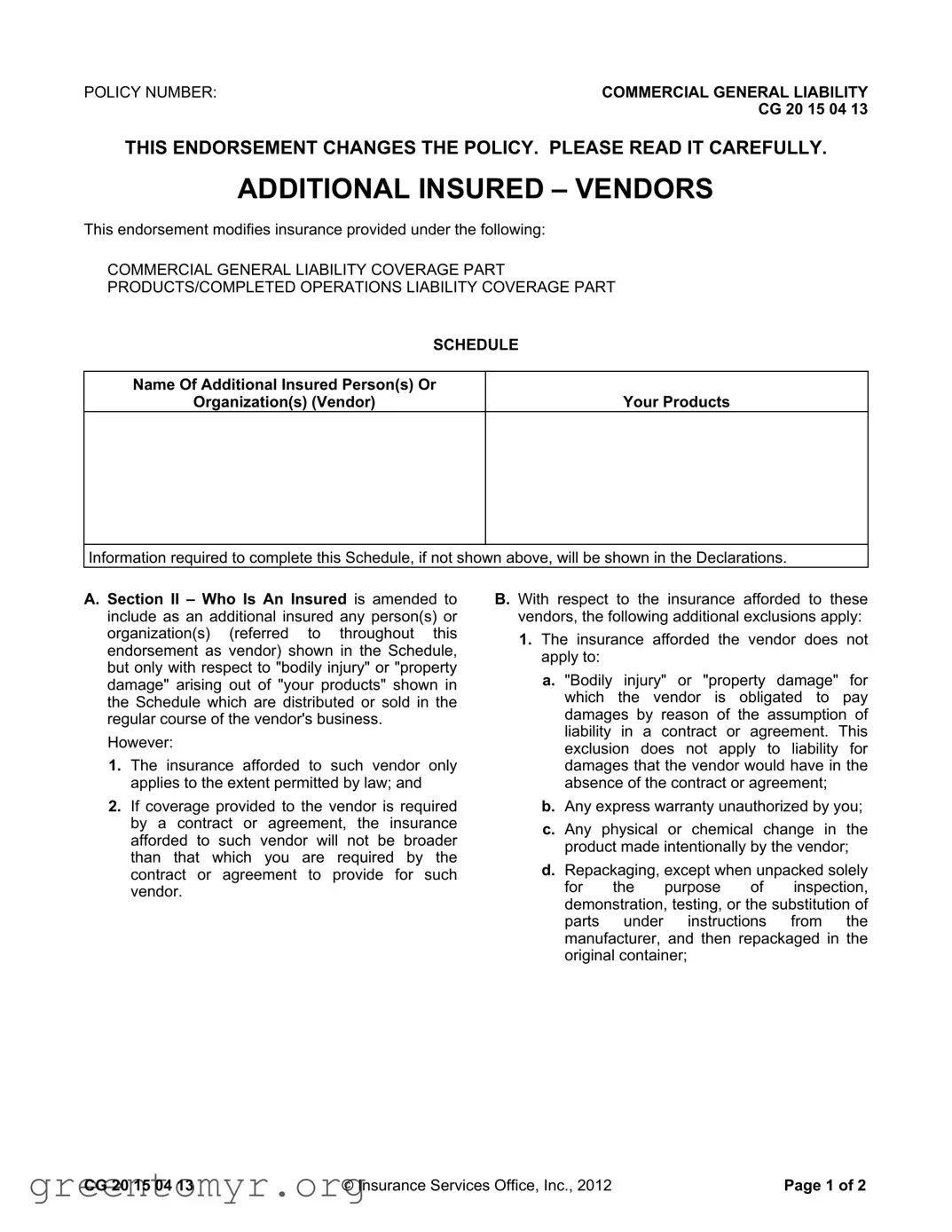
The Additional Insured Vendors form, identified as CG 20 15 04 13, plays a crucial role in the realm of commercial general liability insurance. This endorsement modifies the existing policy to extend coverage to specific vendors listed in the Schedule, ensuring they are protected against certain claims related to bodily injury or property damage arising from the insured's products. However, this coverage comes with essential limitations. It applies only to claims that occur in the regular course of the vendor's business and is contingent upon the terms outlined in any applicable contracts. The form also stipulates additional exclusions that can limit the vendor's coverage, such as liabilities arising from contractual obligations, unauthorized warranties, and specific actions taken by the vendor that alter the product. Furthermore, it clarifies that the insurance provided will not exceed the limits specified in the policy or those required by contract. Understanding these key elements is vital for both vendors and policyholders to navigate their insurance responsibilities effectively.
POLICY NUMBER: |
COMMERCIAL GENERAL LIABILITY |
|
CG 20 15 04 13 |
THIS ENDORSEMENT CHANGES THE POLICY. PLEASE READ IT CAREFULLY.
ADDITIONAL INSURED – VENDORS
This endorsement modifies insurance provided under the following:
COMMERCIAL GENERAL LIABILITY COVERAGE PART
PRODUCTS/COMPLETED OPERATIONS LIABILITY COVERAGE PART
SCHEDULE
Name Of Additional Insured Person(s) Or
Organization(s) (Vendor)
Your Products
Information required to complete this Schedule, if not shown above, will be shown in the Declarations.
A. Section II – Who Is An Insured is amended to include as an additional insured any person(s) or organization(s) (referred to throughout this endorsement as vendor) shown in the Schedule, but only with respect to "bodily injury" or "property damage" arising out of "your products" shown in the Schedule which are distributed or sold in the regular course of the vendor's business.
However:
1.The insurance afforded to such vendor only applies to the extent permitted by law; and
2.If coverage provided to the vendor is required by a contract or agreement, the insurance afforded to such vendor will not be broader than that which you are required by the contract or agreement to provide for such vendor.
B. With respect to the insurance afforded to these vendors, the following additional exclusions apply:
1.The insurance afforded the vendor does not apply to:
a."Bodily injury" or "property damage" for which the vendor is obligated to pay damages by reason of the assumption of liability in a contract or agreement. This exclusion does not apply to liability for damages that the vendor would have in the absence of the contract or agreement;
b.Any express warranty unauthorized by you;
c.Any physical or chemical change in the product made intentionally by the vendor;
d.Repackaging, except when unpacked solely for the purpose of inspection, demonstration, testing, or the substitution of parts under instructions from the manufacturer, and then repackaged in the original container;
CG 20 15 04 13 |
© Insurance Services Office, Inc., 2012 |
Page 1 of 2 |
e. Any failure to make such inspections, adjustments, tests or servicing as the vendor has agreed to make or normally undertakes to make in the usual course of business, in connection with the distribution or sale of the products;
f. Demonstration, installation, servicing or repair operations, except such operations performed at the vendor's premises in connection with the sale of the product;
g.Products which, after distribution or sale by you, have been labeled or relabeled or used as a container, part or ingredient of any other thing or substance by or for the vendor; or
h."Bodily injury" or "property damage" arising out of the sole negligence of the vendor for its own acts or omissions or those of its employees or anyone else acting on its behalf. However, this exclusion does not apply to:
(1)The exceptions contained in Sub- paragraphs d. or f.; or
(2)Such inspections, adjustments, tests or servicing as the vendor has agreed to make or normally undertakes to make in the usual course of business, in connection with the distribution or sale of the products.
2.This insurance does not apply to any insured person or organization, from whom you have acquired such products, or any ingredient, part or container, entering into, accompanying or containing such products.
C.With respect to the insurance afforded to these vendors, the following is added to Section III – Limits Of Insurance:
If coverage provided to the vendor is required by a contract or agreement, the most we will pay on behalf of the vendor is the amount of insurance:
1.Required by the contract or agreement; or
2.Available under the applicable Limits of Insurance shown in the Declarations;
whichever is less.
This endorsement shall not increase the applicable Limits of Insurance shown in the Declarations.
Page 2 of 2 |
© Insurance Services Office, Inc., 2012 |
CG 20 15 04 13 |
| Fact Name | Details |
|---|---|
| Policy Number | CG 20 15 04 13 |
| Endorsement Purpose | This endorsement adds additional insured status to vendors regarding specific liabilities. |
| Coverage Type | Applies to Commercial General Liability and Products/Completed Operations Liability. |
| Additional Insured Definition | Includes any person or organization listed in the Schedule as a vendor. |
| Scope of Coverage | Covers bodily injury or property damage arising from the insured's products sold by the vendor. |
| Legal Limitations | Coverage is limited to what is permitted by law and contract agreements. |
| Exclusions | Excludes certain liabilities, including those from contracts, unauthorized warranties, and vendor negligence. |
| Repackaging Clause | Insurance does not cover repackaging unless for inspection or under manufacturer instructions. |
| Limit of Insurance | The maximum payout is the lesser of contract requirements or available limits in the Declarations. |
| Governing Law | Varies by state; consult local regulations for specific laws applicable to additional insured endorsements. |
Filling out the Additional Insured Vendors form is an important step in ensuring that your vendors are covered under your general liability insurance policy. This form allows you to add specific vendors as additional insured parties, which can help protect both you and your vendors in the event of claims related to your products. Follow these steps carefully to complete the form accurately.
Once you have filled out the form, keep a copy for your records. You may need to submit the completed form to your insurance provider or retain it for future reference regarding your vendor's coverage. Ensure that all parties involved are informed about the added coverage to maintain transparency and compliance.
The Additional Insured Vendors form is an endorsement that modifies a Commercial General Liability insurance policy. It allows for certain vendors to be added as additional insured parties under the policy. This means that these vendors can receive coverage for specific liabilities related to the products they sell or distribute on behalf of the policyholder.
Any person or organization specified in the endorsement's schedule can qualify as an additional insured. This coverage applies only concerning bodily injury or property damage arising from the policyholder's products that the vendor sells or distributes in the regular course of their business.
The endorsement provides coverage for bodily injury and property damage claims related to the vendor's use of the policyholder's products. However, this coverage is subject to certain limitations and exclusions outlined in the endorsement.
Yes, there are several exclusions. For instance:
The endorsement specifies that if coverage is required by a contract, the maximum amount payable on behalf of the vendor will be the lesser of the amount specified in the contract or the limits of insurance stated in the policy. This means the endorsement does not increase the overall limits of insurance available under the policy.
To ensure compliance, the policyholder should:
No, the coverage provided to the vendor cannot be broader than what is stipulated in the contract or agreement. The endorsement is designed to align the coverage with the policyholder's contractual obligations.
Filling out the Additional Insured Vendors form can be straightforward, but many people make common mistakes that can lead to complications down the line. One frequent error is failing to accurately identify the additional insured parties. It is essential to list the correct names of the individuals or organizations that need coverage. Omitting a vendor or misspelling their name can result in a lack of coverage when it is most needed. Always double-check the spelling and details to ensure clarity.
Another common mistake involves misunderstanding the scope of coverage. The form specifies that the insurance only applies to "bodily injury" or "property damage" arising from the vendor's use of your products. Some individuals mistakenly assume that coverage extends to all activities of the vendor, which is not the case. It's important to read the terms carefully and understand that the insurance is limited to specific circumstances as outlined in the policy.
People also often overlook the exclusions listed in the form. There are various situations where coverage does not apply, such as when the vendor assumes liability through a contract or agreement. Ignoring these exclusions can lead to a false sense of security. It is crucial to review these points thoroughly to avoid any surprises if a claim arises.
Lastly, many individuals fail to consider the limits of insurance specified in the policy. The form states that if coverage is required by a contract, the maximum amount payable is either the amount stipulated in the contract or the limits shown in the declarations, whichever is lower. Not being aware of these limits can result in inadequate coverage. Always ensure that you understand how much coverage is being provided and how it aligns with any contractual obligations.
The Additional Insured Vendors form is an essential document in the realm of commercial general liability insurance. It provides clarity on coverage for vendors associated with your products. Alongside this form, several other documents are commonly utilized to ensure comprehensive insurance management. Below is a list of these documents, each accompanied by a brief description.
Understanding these documents and their purposes can significantly enhance your ability to navigate the complexities of insurance in business transactions. Each plays a vital role in protecting both parties and ensuring compliance with contractual obligations.
When filling out the Additional Insured Vendors form, it is essential to follow specific guidelines to ensure accuracy and compliance. Below is a list of actions to consider.
Understanding the Additional Insured Vendors form is essential for businesses. Unfortunately, several misconceptions can lead to confusion. Here are eight common misunderstandings:
Being aware of these misconceptions can help businesses make informed decisions and avoid potential pitfalls. It is always advisable to consult with an insurance professional for clarity and guidance.
Understanding the Additional Insured Vendors form is crucial for businesses that want to protect themselves and their vendors effectively. Here are some key takeaways to keep in mind:
By keeping these points in mind, businesses can navigate the complexities of the Additional Insured Vendors form more effectively and ensure better protection for themselves and their partners.