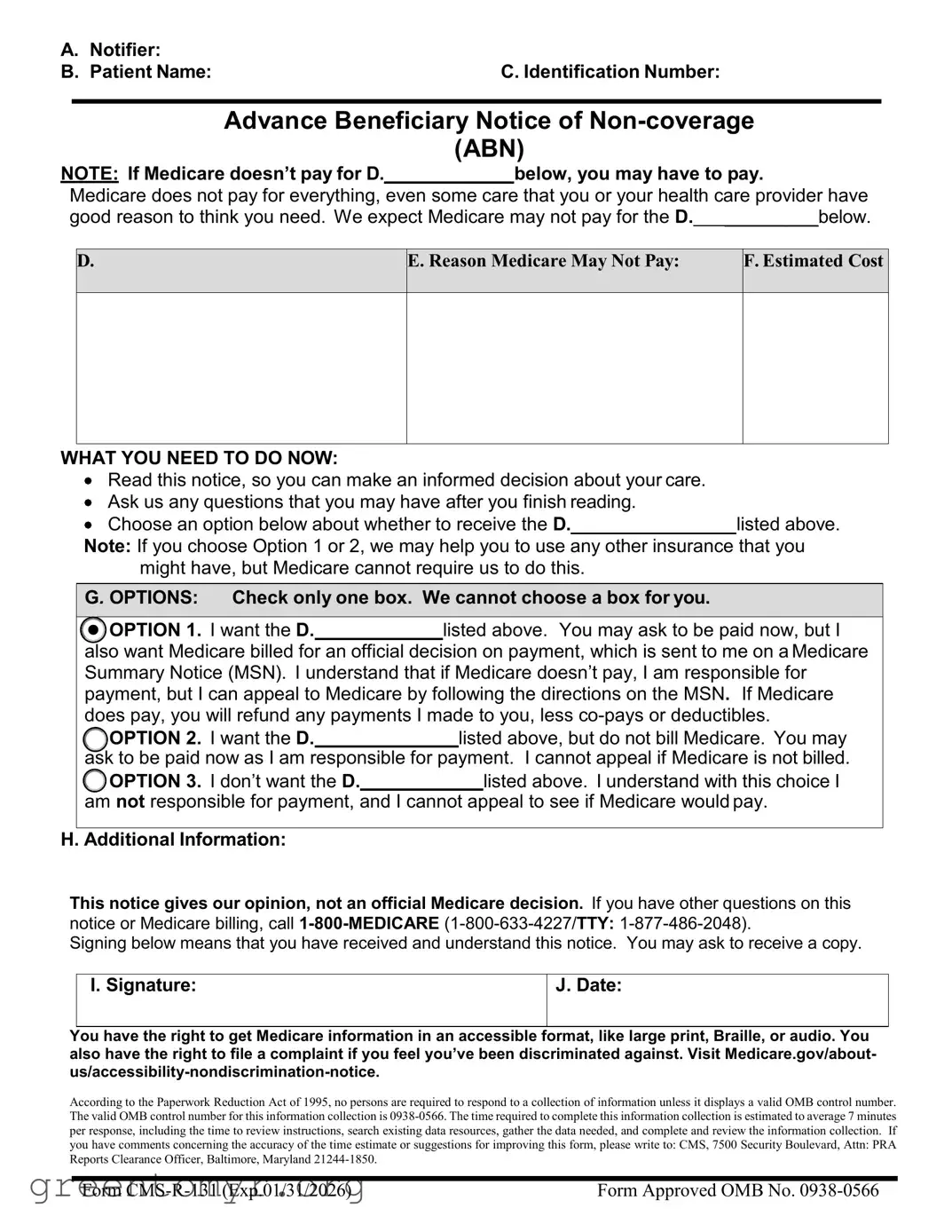
The Advance Beneficiary Notice of Non-coverage (ABN) form plays a crucial role in the healthcare landscape, particularly for Medicare beneficiaries. This important document informs patients when a healthcare provider believes that a service or item may not be covered by Medicare. By receiving an ABN, patients are empowered to make informed decisions about their care and potential out-of-pocket costs. The form outlines the specific service in question, explains the reason for the non-coverage, and provides options for the patient, including whether to proceed with the service despite the potential costs. Additionally, the ABN serves as a safeguard for providers, ensuring they communicate clearly with patients about their financial responsibilities. Understanding the nuances of this form can help beneficiaries navigate their healthcare choices more effectively, avoiding unexpected bills while ensuring they receive the care they need.
A. |
Notifier: |
|
B. |
Patient Name: |
C. Identification Number: |
Advance Beneficiary Notice of
(ABN)
NOTE: If Medicare doesn’t pay for D.____________ below, you may have to pay.
Medicare does not pay for everything, even some care that you or your health care provider have good reason to think you need. We expect Medicare may not pay for the D. _________below.
D.
E. Reason Medicare May Not Pay:
F. Estimated Cost
WHAT YOU NEED TO DO NOW:
•Read this notice, so you can make an informed decision about your care.
•Ask us any questions that you may have after you finish reading.
• Choose an option below about whether to receive the D.listed above. Note: If you choose Option 1 or 2, we may help you to use any other insurance that you
might have, but Medicare cannot require us to do this.
G. OPTIONS: |
Check only one box. We cannot choose a box for you. |
|
|
□OPTION 1. I want the D.listed above. You may ask to be paid now, but I also want Medicare billed for an official decision on payment, which is sent to me on a Medicare Summary Notice (MSN). I understand that if Medicare doesn’t pay, I am responsible for payment, but I can appeal to Medicare by following the directions on the MSN. If Medicare does pay, you will refund any payments I made to you, less
|
□ OPTION 2. |
I want the D. |
|
listed above, but do not bill Medicare. You may |
||
|
ask to be paid now as I am |
responsible for payment. I cannot appeal if Medicare is not billed. |
||||
|
□ OPTION 3. |
I don’t want the D. |
|
|
listed above. I understand with this choice I |
|
|
am not responsible for payment, |
and I cannot appeal to see if Medicare would pay. |
||||
H. |
|
|
|
|||
Additional Information: |
|
|
||||
This notice gives our opinion, not an official Medicare decision. If you have other questions on this notice or Medicare billing, call
Signing below means that you have received and understand this notice. You may ask to receive a copy.
I. Signature: |
J. Date: |
You have the right to get Medicare information in an accessible format, like large print, Braille, or audio. You also have the right to file a complaint if you feel you’ve been discriminated against. Visit Medicare.gov/about-
According to the Paperwork Reduction Act of 1995, no persons are required to respond to a collection of information unless it displays a valid OMB control number. The valid OMB control number for this information collection is
Form |
Form Approved OMB No. |
| Fact Name | Description |
|---|---|
| Purpose | The Advance Beneficiary Notice of Non-coverage (ABN) informs Medicare beneficiaries that a service or item may not be covered by Medicare. |
| When to Use | Providers must issue the ABN when they believe Medicare might deny payment for a service or item. |
| Beneficiary Rights | Beneficiaries have the right to refuse services after receiving the ABN, knowing they may be responsible for payment. |
| State-Specific Forms | Some states have specific ABN forms. Check local regulations for compliance. |
| Governing Laws | The ABN is governed by federal Medicare regulations, specifically 42 CFR § 411.20. |
| Validity Period | The ABN is valid for 12 months from the date it is issued, unless the circumstances change. |
After receiving the Advance Beneficiary Notice of Non-coverage (ABN), you will need to fill it out accurately to ensure that your Medicare benefits are properly addressed. This form is crucial for understanding your financial responsibilities regarding services that may not be covered by Medicare. Follow the steps below to complete the form correctly.
Once you have completed the form, keep a copy for your records. Submit the original to your healthcare provider. They will review it and inform you of any further actions needed regarding your Medicare coverage.
The Advance Beneficiary Notice of Non-coverage, commonly referred to as the ABN, is a form used by healthcare providers to inform Medicare beneficiaries that a service or item may not be covered by Medicare. This notice is crucial because it allows beneficiaries to understand potential out-of-pocket costs before receiving a service. The ABN must be provided in situations where the provider believes that Medicare will not pay for the service, giving beneficiaries the option to either accept or decline the service based on this information.
Healthcare providers are required to issue an ABN in specific circumstances. These include:
Issuing an ABN ensures that patients are informed about their financial responsibilities before receiving the service, allowing for informed decision-making.
If you receive an ABN, you should carefully read the form to understand which service is being discussed and the reason why it may not be covered. You have several options:
Make sure to communicate your decision to your healthcare provider, as this will affect how the service is billed.
Yes, you can appeal a Medicare decision even if you received an ABN. If Medicare denies coverage for a service and you believe it should be covered, you have the right to appeal. The ABN itself does not prevent you from seeking an appeal; it simply informs you of the potential for denial. To begin the appeal process, you will need to follow the steps outlined in the denial notice from Medicare. This often involves submitting a written request for reconsideration along with any supporting documentation.
When it comes to filling out the Advance Beneficiary Notice of Non-coverage (ABN) form, many individuals unknowingly make mistakes that can impact their healthcare coverage. Understanding these common pitfalls can help ensure that the process goes smoothly and that patients receive the benefits they are entitled to.
One significant mistake is failing to read the instructions carefully. The ABN form includes specific guidelines that must be followed. If individuals skip this step, they may miss critical information about their rights and responsibilities. Taking a few moments to thoroughly review the instructions can save a lot of time and confusion later on.
Another common error involves not providing complete information. The form requires detailed information about the services being denied. Omitting key details or being vague can lead to misunderstandings and potential denial of coverage. It is essential to be as clear and precise as possible when describing the services in question.
People also often overlook the importance of signing and dating the form. An unsigned or undated ABN can render the document invalid. This simple oversight can lead to complications in the claims process. Always double-check to ensure that the form is signed and dated before submission.
Additionally, some individuals make the mistake of not keeping a copy of the completed form. It’s crucial to retain a copy for personal records. This can serve as proof in case there are any disputes regarding coverage or if further clarification is needed down the line. Having a copy on hand can be invaluable.
Finally, many people fail to ask questions if they are unsure. The ABN process can be confusing, and it’s perfectly acceptable to seek clarification. Whether it’s asking a healthcare provider or a billing specialist, getting answers can prevent errors and ensure that individuals fully understand their options.
The Advance Beneficiary Notice of Non-coverage (ABN) form is an important document that informs patients about services that Medicare may not cover. However, it is often accompanied by several other forms and documents that play a crucial role in the healthcare process. Below is a list of these additional documents, each serving a unique purpose.
Understanding these forms can empower patients to navigate their healthcare journey more effectively. Each document plays a vital role in ensuring clarity and communication between patients, providers, and insurers.
The Advance Beneficiary Notice of Non-coverage (ABN) form serves a specific purpose in the healthcare system, primarily to inform Medicare beneficiaries about services that may not be covered. Several other documents share similar functions or characteristics. Below is a list of six documents that are comparable to the ABN form:
When filling out the Advance Beneficiary Notice of Non-coverage (ABN) form, it's important to follow certain guidelines to ensure accuracy and clarity. Here’s a list of things to do and avoid:
Following these guidelines will help ensure that your ABN form is processed smoothly and efficiently.
The Advance Beneficiary Notice of Non-coverage (ABN) form can often be misunderstood. Here are seven common misconceptions about this important document:
Some believe that healthcare providers can choose whether or not to issue an ABN. In reality, if a provider expects that Medicare may not cover a service, they are required to issue an ABN.
Many think that signing the ABN means Medicare will pay for the service. However, the ABN simply informs beneficiaries that coverage is uncertain; it does not guarantee payment.
This form is often mistakenly viewed as exclusive to Medicare. In fact, ABNs can be used in situations involving Medicare Advantage plans as well.
Some assume that ABNs are only necessary for high-cost procedures. However, they should be issued whenever there is doubt about coverage, regardless of the service's cost.
It’s a misconception that issuing an ABN indicates that a provider is not offering quality care. In reality, it reflects the provider's responsibility to inform patients about potential coverage issues.
Some believe that signing the ABN means they must pay upfront. In truth, payment is only required if Medicare denies the claim after the service is provided.
Lastly, there is a belief that ABNs apply solely to outpatient care. However, they can also be relevant in certain inpatient situations when coverage is uncertain.
Understanding these misconceptions can help beneficiaries make informed decisions about their healthcare and potential costs. Always consult with your healthcare provider if you have questions about the ABN process.
The Advance Beneficiary Notice of Non-coverage (ABN) is an important document for Medicare beneficiaries. Here are some key takeaways to help you understand how to fill it out and use it effectively:
Being informed about the ABN process can empower you to make better healthcare decisions. Always take the time to understand your rights and options when it comes to Medicare coverage.