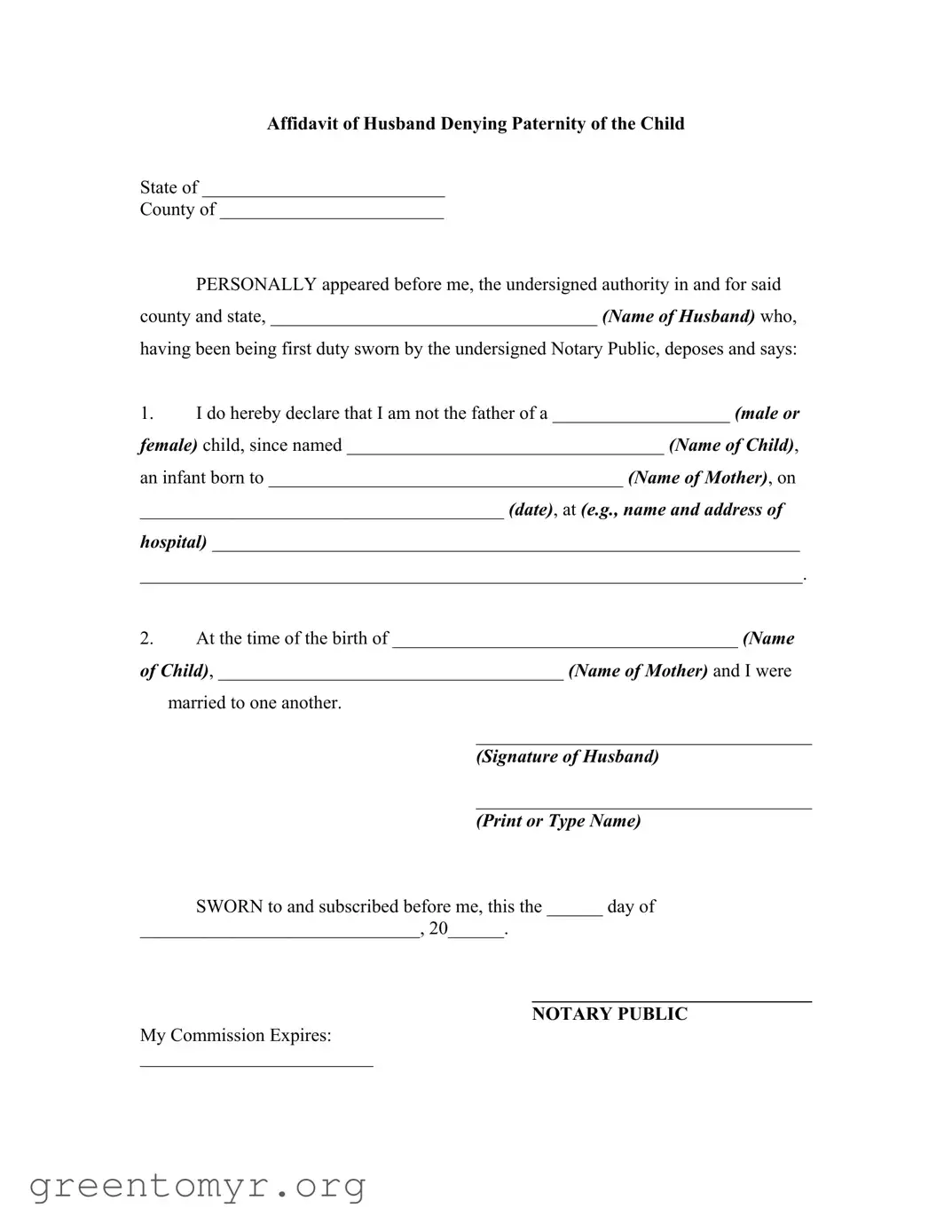
The Affidavit Denying Paternity form serves as an important legal document for individuals who wish to formally declare that they are not the biological father of a child. This form is typically utilized by husbands who, despite being married to the child's mother at the time of the child's birth, assert that they are not the child's father. The document requires specific details, including the names of the husband, mother, and child, as well as the date and place of the child's birth. It is essential for the husband to provide a sworn statement, affirming his denial of paternity, which must be notarized to ensure its validity. This process not only protects the rights of the husband but also clarifies the legal responsibilities regarding child support and custody. Understanding the implications of this affidavit is crucial, as it can significantly impact familial relationships and legal obligations. By navigating this form carefully, individuals can assert their position with clarity and confidence.
Affidavit of Husband Denying Paternity of the Child
State of __________________________
County of ________________________
PERSONALLY appeared before me, the undersigned authority in and for said county and state, ___________________________________ (Name of Husband) who,
having been being first duty sworn by the undersigned Notary Public, deposes and says:
1.I do hereby declare that I am not the father of a ___________________ (male or female) child, since named __________________________________ (Name of Child), an infant born to ______________________________________ (Name of Mother), on
_______________________________________ (date), at (e.g., name and address of hospital) _______________________________________________________________
_______________________________________________________________________.
2.At the time of the birth of _____________________________________ (Name of Child), _____________________________________ (Name of Mother) and I were
married to one another.
____________________________________
(Signature of Husband)
____________________________________
(Print or Type Name)
SWORN to and subscribed before me, this the ______ day of
______________________________, 20______.
______________________________
NOTARY PUBLIC
My Commission Expires:
_________________________
| Fact Name | Description |
|---|---|
| Purpose | The Affidavit Denying Paternity form is used by a husband to declare that he is not the biological father of a child born to his wife. |
| State-Specific Forms | Each state may have its own version of this form, tailored to local laws and regulations. |
| Governing Law | In many states, the governing law for paternity issues is found in family law statutes, such as the Uniform Parentage Act. |
| Signature Requirement | The form must be signed by the husband, affirming his statement under oath. |
| Notary Public | A Notary Public must witness the signing of the affidavit, ensuring its authenticity. |
| Child's Information | The affidavit requires the name and gender of the child, along with the mother's details and the birth date. |
| Marital Status | The form acknowledges that the husband and mother were married at the time of the child's birth. |
| Legal Implications | Filing this affidavit may have legal consequences regarding child support, custody, and inheritance rights. |
Completing the Affidavit Denying Paternity form is a straightforward process that requires accurate information. After filling out the form, it will need to be signed in the presence of a notary public to ensure its validity. Below are the steps to properly fill out the form.
Once the form is completed, it will need to be taken to a notary public for signing and notarization. This step is crucial to ensure the affidavit is legally recognized.
The Affidavit Denying Paternity form is a legal document used by a husband to formally declare that he is not the biological father of a child born to his wife. This form serves to clarify paternity issues, especially in situations where the husband believes he is not the father, and it may be necessary for legal, financial, or emotional reasons.
The form should be completed by the husband who wishes to deny paternity. It is important that he is aware of the implications of signing this affidavit, including potential legal ramifications regarding child support and custody. The wife, as the mother of the child, may also need to be involved in discussions surrounding the completion of this form.
The form requires specific details, including:
Accurate and complete information is essential to ensure the affidavit is valid and legally binding.
Once the affidavit is signed and notarized, it may need to be filed with the appropriate court or agency, depending on state laws. This filing can help establish a legal record that the husband is denying paternity. It is advisable to keep a copy of the signed affidavit for personal records.
Revoking or changing an affidavit is generally not straightforward. If circumstances change or new evidence arises, the husband may need to pursue legal action to contest paternity formally. It is recommended to consult with a legal professional to understand the options available and the necessary steps to take.
Filling out the Affidavit Denying Paternity form can be a straightforward process, but many individuals make mistakes that can complicate their situation. Awareness of these common pitfalls is crucial. Here are nine mistakes to avoid when completing this important document.
One frequent error is failing to provide accurate information about the child. It's essential to ensure that the child's name and birth details are correctly filled out. An incorrect name or date can lead to legal complications later on. Double-checking this information can save you from unnecessary stress.
Another mistake is neglecting to include the correct names of both parents. The form requires the name of the mother, and it must match the name on the child's birth certificate. If there are discrepancies, it can raise questions about the validity of the affidavit.
People often forget to sign the form in the designated area. A missing signature can render the document invalid. It’s vital to ensure that all required signatures are present before submitting the form.
In addition, some individuals fail to have the affidavit notarized. Notarization is a critical step that verifies the authenticity of the document. Without it, the affidavit may not be accepted by the court or other authorities.
Another common mistake is not including the date of the affidavit. This date is important for legal purposes, especially if there are future disputes regarding paternity. Always remember to fill in the date accurately.
Some people also overlook the requirement to provide the location of the child’s birth. This information is essential for establishing the context of the affidavit. Omitting it can lead to questions about the legitimacy of the claims being made.
Many individuals do not read the instructions carefully. Each state may have specific requirements for the affidavit. Ignoring these can lead to delays or rejections of the document. Take the time to understand what is needed.
Another mistake is assuming that the affidavit is a one-size-fits-all document. It is crucial to tailor your affidavit to your specific situation. Generic forms may not address unique circumstances that could impact the case.
Lastly, individuals sometimes fail to keep a copy of the completed affidavit for their records. Having a copy is important for future reference and can be helpful if any disputes arise later. Always retain a copy for your files.
By being mindful of these common mistakes, you can navigate the process of filling out the Affidavit Denying Paternity more effectively. Taking the time to ensure accuracy and completeness can help avoid complications down the road.
The Affidavit Denying Paternity form serves as a formal declaration by a husband asserting that he is not the biological father of a child. This document is often accompanied by several other forms and documents that can support the legal process surrounding paternity issues. Below is a list of some of the most common documents that may be used alongside the Affidavit Denying Paternity.
Understanding these documents can help individuals navigate the complexities of paternity issues more effectively. Each document plays a distinct role in establishing or denying paternity, and together they contribute to a clearer legal picture in family law matters.
The Affidavit Denying Paternity form shares similarities with several other legal documents that address parental rights, responsibilities, and acknowledgments. Below is a list of documents that are comparable to the Affidavit Denying Paternity, along with an explanation of how they are similar.
When filling out the Affidavit Denying Paternity form, certain practices can help ensure accuracy and compliance. Here are five things to consider:
By following these guidelines, individuals can navigate the process more effectively and avoid common pitfalls associated with this legal document.
Understanding the Affidavit Denying Paternity form is crucial for anyone involved in family law matters. However, several misconceptions often arise. Here are nine common misunderstandings:
Being informed about these misconceptions can help individuals make better decisions regarding paternity issues. Understanding the nuances of the Affidavit Denying Paternity form is essential for protecting one’s rights and responsibilities.
Filling out the Affidavit Denying Paternity form is a significant step for individuals who wish to formally declare that they are not the biological father of a child. Here are some key takeaways to consider: