When buying or selling a home, it’s easy to overlook the personal property that may not be included in the real estate purchase agreement. This is where the Agreement to Sell Personal Property comes into play. This form is essential for detailing the sale of personal items, such as appliances, furniture, or fixtures, that the buyer and seller agree upon outside the main real estate transaction. It establishes the terms of the sale, including the identities of the buyer and seller, the specific items being sold, and the agreed purchase price. The agreement ensures that both parties understand their responsibilities, particularly regarding the condition of the items being sold, which are typically purchased “as is.” Additionally, it emphasizes that the transaction is contingent upon the successful closing of the real estate deal, reinforcing the interconnected nature of these agreements. Notably, the seller must confirm that they own the items free from any liens or claims, providing peace of mind to the buyer. This form serves not only as a legal document but also as a clear communication tool, ensuring that both parties are on the same page and protecting their interests throughout the transaction.
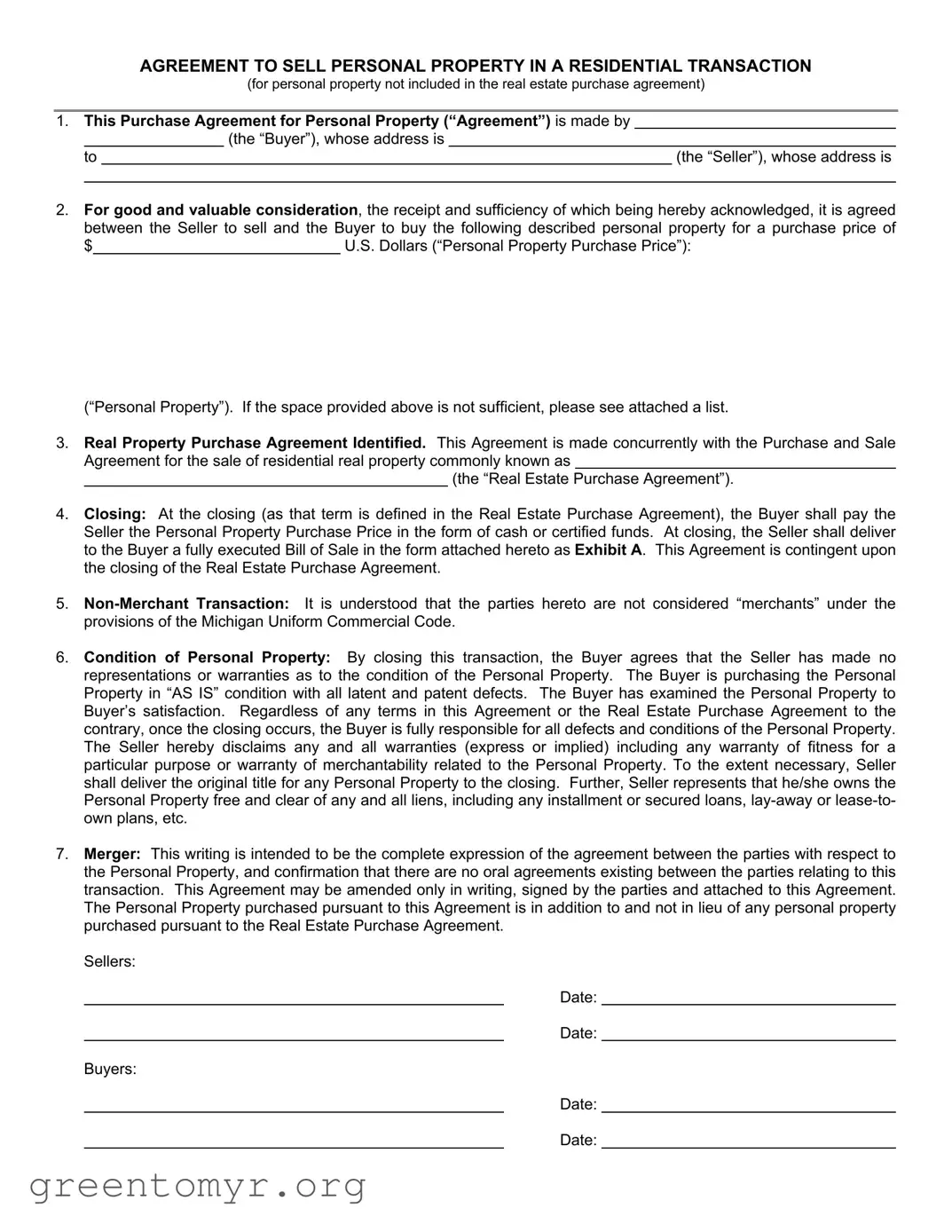
AGREEMENT TO SELL PERSONAL PROPERTY IN A RESIDENTIAL TRANSACTION
(for personal property not included in the real estate purchase agreement)
1.This Purchase Agreement for Personal Property (“Agreement”) is made by
|
(the “Buyer”), whose address is |
to |
(the “Seller”), whose address is |
2.For good and valuable consideration, the receipt and sufficiency of which being hereby acknowledged, it is agreed between the Seller to sell and the Buyer to buy the following described personal property for a purchase price of
$ |
|
U.S. Dollars (“Personal Property Purchase Price”): |
(“Personal Property”). If the space provided above is not sufficient, please see attached a list.
3. Real Property Purchase Agreement Identified. This Agreement is made concurrently with the Purchase and Sale Agreement for the sale of residential real property commonly known as
(the “Real Estate Purchase Agreement”).
4.Closing: At the closing (as that term is defined in the Real Estate Purchase Agreement), the Buyer shall pay the Seller the Personal Property Purchase Price in the form of cash or certified funds. At closing, the Seller shall deliver to the Buyer a fully executed Bill of Sale in the form attached hereto as Exhibit A. This Agreement is contingent upon the closing of the Real Estate Purchase Agreement.
5.
6.Condition of Personal Property: By closing this transaction, the Buyer agrees that the Seller has made no representations or warranties as to the condition of the Personal Property. The Buyer is purchasing the Personal Property in “AS IS” condition with all latent and patent defects. The Buyer has examined the Personal Property to Buyer’s satisfaction. Regardless of any terms in this Agreement or the Real Estate Purchase Agreement to the contrary, once the closing occurs, the Buyer is fully responsible for all defects and conditions of the Personal Property. The Seller hereby disclaims any and all warranties (express or implied) including any warranty of fitness for a particular purpose or warranty of merchantability related to the Personal Property. To the extent necessary, Seller shall deliver the original title for any Personal Property to the closing. Further, Seller represents that he/she owns the Personal Property free and clear of any and all liens, including any installment or secured loans,
7.Merger: This writing is intended to be the complete expression of the agreement between the parties with respect to the Personal Property, and confirmation that there are no oral agreements existing between the parties relating to this transaction. This Agreement may be amended only in writing, signed by the parties and attached to this Agreement. The Personal Property purchased pursuant to this Agreement is in addition to and not in lieu of any personal property purchased pursuant to the Real Estate Purchase Agreement.
Sellers:
Date:
Date:
Buyers:
Date:
Date:
| Fact Name | Details |
|---|---|
| Purpose of the Agreement | This Agreement is designed for the sale of personal property that is not included in a real estate purchase agreement. |
| Parties Involved | The agreement involves a Buyer and a Seller, each providing their respective addresses. |
| Purchase Price | The Buyer agrees to pay a specified purchase price for the personal property, which is stated in U.S. Dollars. |
| Closing Conditions | Closing occurs simultaneously with the real estate transaction, and payment is made in cash or certified funds. |
| Condition of Property | The Buyer accepts the personal property in "AS IS" condition, acknowledging no warranties from the Seller regarding its condition. |
| Governing Law | This agreement is governed by the Michigan Uniform Commercial Code, as the parties are not considered "merchants." |
After completing the Agreement Personal Property form, ensure all parties have signed and dated it. Keep a copy for your records and provide copies to both the buyer and seller. This form is essential for documenting the sale of personal property that is not included in the real estate purchase agreement.
The Agreement Personal Property form is designed to facilitate the sale of personal property that is not included in a real estate purchase agreement. This form outlines the terms under which the buyer agrees to purchase specific personal items from the seller, ensuring clarity and legal protection for both parties involved.
The agreement requires several key pieces of information, including:
If the space provided in the form is insufficient, an additional list can be attached to ensure all items are accounted for.
When the buyer agrees to purchase the personal property in "AS IS" condition, it means that they accept the property in its current state, without any guarantees from the seller regarding its condition. The seller disclaims any warranties, and the buyer assumes all responsibility for any defects or issues that may arise after the sale.
This Agreement Personal Property is intended to be executed alongside the Real Estate Purchase Agreement. It is contingent upon the closing of the real estate transaction, meaning that the sale of personal property will only occur if the real estate deal is finalized. This ensures that both transactions are linked and that the buyer is protected.
During the closing, the buyer is required to pay the agreed-upon purchase price for the personal property. In return, the seller must provide a fully executed Bill of Sale, which serves as proof of the transaction. Additionally, the seller must ensure that they deliver the original title for any applicable personal property, confirming that it is free of liens or other encumbrances.
Yes, the Agreement Personal Property can be amended. However, any changes must be made in writing and signed by both parties. This ensures that both the buyer and seller are in agreement about any modifications, maintaining the integrity of the original contract.
When completing the Agreement Personal Property form, individuals often make several common mistakes that can lead to complications in the transaction. One frequent error is failing to provide complete and accurate information about the Buyer and Seller. The form requires specific details, such as names and addresses. Incomplete or incorrect entries can result in confusion and may delay the closing process.
Another mistake is neglecting to specify the purchase price clearly. The form includes a designated space for the Personal Property Purchase Price, but some individuals leave this blank or enter an ambiguous amount. This oversight can create disputes over the agreed price and complicate the financial aspects of the transaction.
Many people also overlook the importance of the "Condition of Personal Property" clause. By signing the agreement, the Buyer acknowledges that the Seller has made no warranties regarding the property's condition. Failing to understand this can lead to dissatisfaction if the Buyer discovers defects after the sale. Buyers should ensure they thoroughly inspect the property before closing to avoid unexpected issues.
Lastly, individuals sometimes forget to attach a detailed list of the personal property being sold if the space provided on the form is insufficient. This can lead to misunderstandings about what is included in the sale. A clear and comprehensive list helps both parties understand the transaction and reduces the risk of disputes after closing.
The Agreement to Sell Personal Property is a crucial document in real estate transactions, particularly when personal property is involved. Several other forms and documents often accompany this agreement to ensure clarity and legal compliance. Below is a list of commonly used documents that may be relevant in conjunction with the Agreement to Sell Personal Property.
Each of these documents plays a significant role in the overall transaction, ensuring that both buyers and sellers are protected and informed throughout the process. Understanding these forms can facilitate smoother negotiations and help avoid potential disputes.
The Agreement to Sell Personal Property form is similar to several other documents used in real estate and personal property transactions. Here are ten such documents:
When filling out the Agreement Personal Property form, it’s essential to follow certain guidelines to ensure a smooth process. Here’s a list of things you should and shouldn’t do:
Misconceptions about the Agreement Personal Property form can lead to confusion and potential disputes in residential transactions. Below are seven common misconceptions and clarifications regarding this important document.
Understanding these misconceptions is crucial for both buyers and sellers to ensure a smooth transaction process. Clarity in agreements helps to protect all parties involved.
When filling out and using the Agreement Personal Property form, it’s essential to understand several key points. Here are ten important takeaways to keep in mind:
By keeping these takeaways in mind, you can navigate the Agreement Personal Property form with greater confidence and clarity.