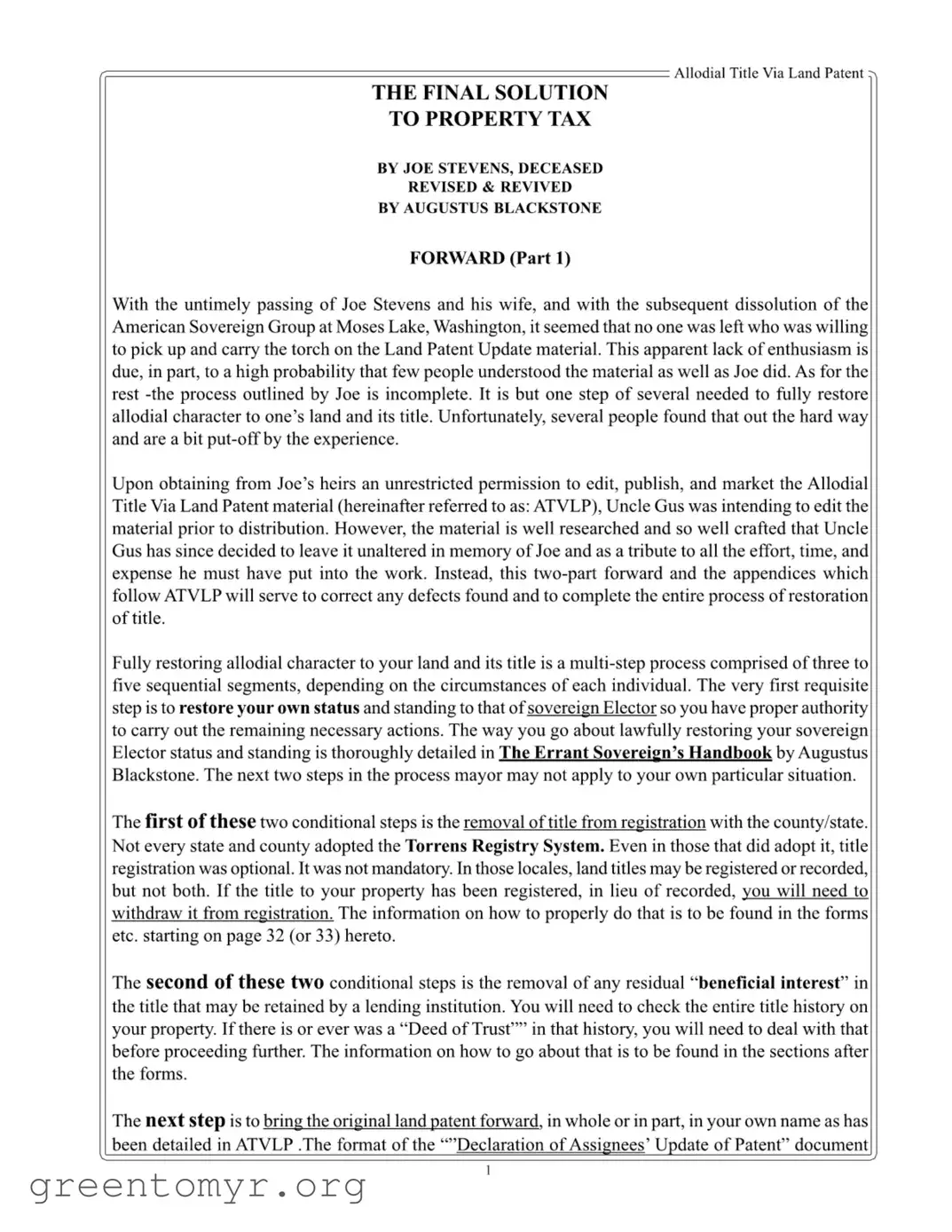
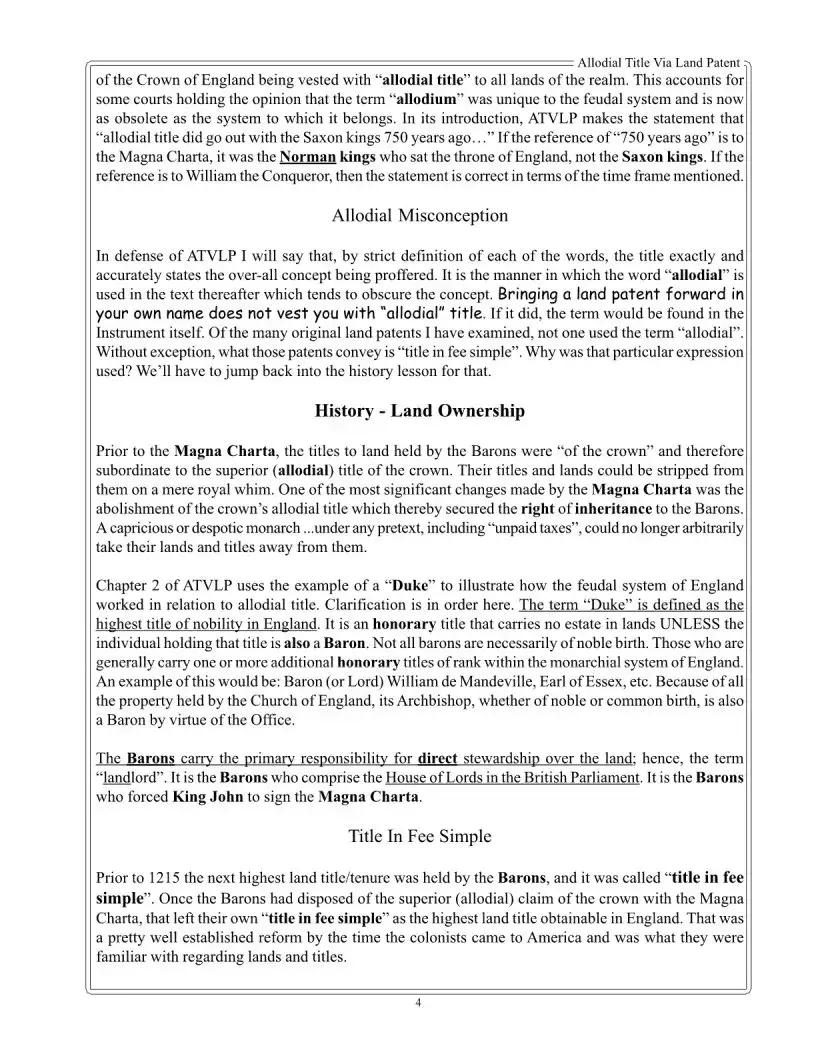
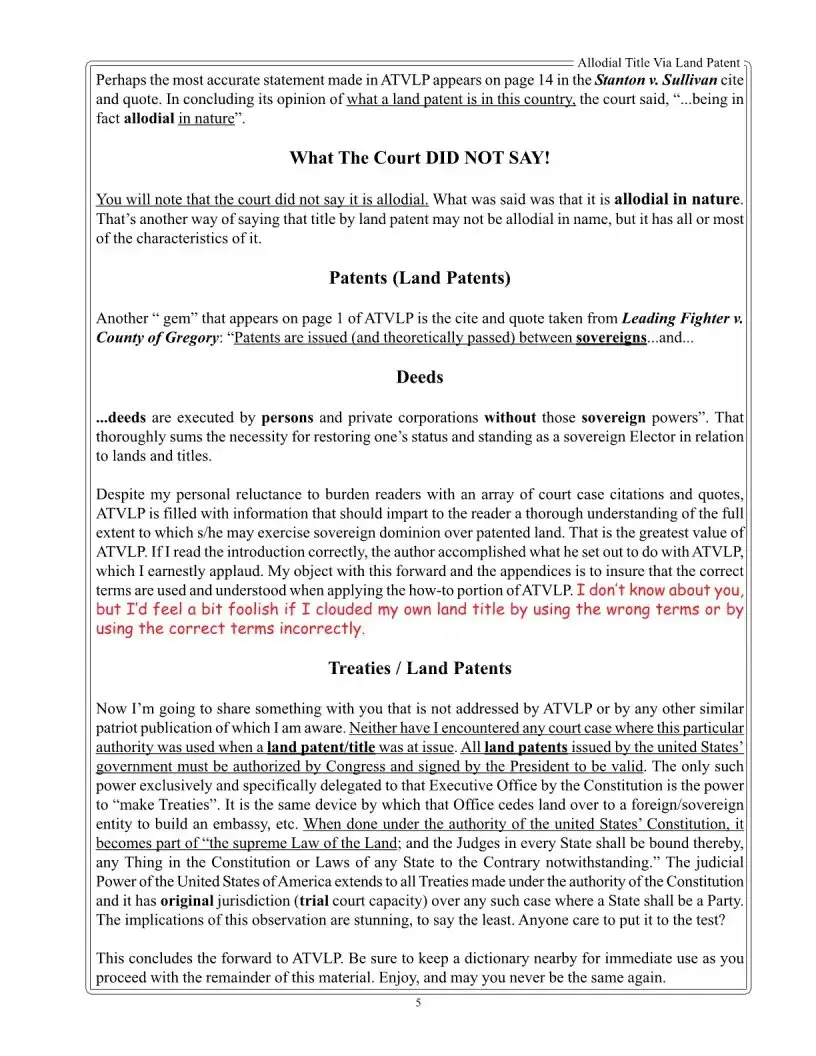
The Allodial Title form represents a significant concept in property ownership, aiming to provide individuals with a means to reclaim sovereignty over their land. This form is rooted in the idea that land ownership should be free from government interference, particularly in the form of property taxes. The process of obtaining an Allodial Title is not a straightforward task; it involves a series of steps that must be meticulously followed to ensure the restoration of allodial character to one’s title. The journey begins with the restoration of one's status as a sovereign Elector, which is essential for the legal authority to proceed with subsequent actions. Following this initial step, property owners may need to navigate the complexities of title registration and any existing obligations tied to lending institutions. The Allodial Title form outlines these steps, including the removal of titles from county or state registration and addressing any beneficial interests retained by lenders. The culmination of this process leads to the declaration of the original land patent in the individual's name, ultimately freeing the property from taxation. This article will explore the nuances of the Allodial Title form, the steps involved in the process, and the implications of achieving such a title, shedding light on an often misunderstood yet powerful aspect of land ownership.
| Fact Name | Description |
|---|---|
| Definition of Allodial Title | Allodial title refers to a system of land ownership that is free from any superior landlord, including the government. Owners have full control over their property without obligation to pay property taxes. |
| Process Overview | Restoring allodial character to land involves a multi-step process. This includes restoring one’s status as a sovereign Elector and removing title from registration with the county or state. |
| Conditional Steps | Two conditional steps may apply: withdrawing title from registration and addressing any beneficial interest held by lending institutions. Not all states require title registration. |
| Governing Laws | The laws governing allodial title vary by state. Washington State has specific processes outlined in the Allodial Title Via Land Patent material. |
| Historical Context | The concept of allodial title has roots in historical documents like the Magna Charta, which emphasized property rights and ownership free from feudal obligations. |
| Final Steps | The final steps involve bringing the original land patent forward in one’s name and extinguishing any remaining encumbrances, including tax obligations. |
Filling out the Allodial Title form is a crucial step in the process of restoring your land's title and sovereignty. By carefully completing this form, you take a significant step towards reclaiming your rights and responsibilities as a landowner. The following steps will guide you through the process of filling out the Allodial Title form correctly.
Once the form is submitted, the next steps will involve waiting for confirmation from the relevant authority regarding the status of your application. This process may take some time, so patience is essential. Keep a copy of your submission for your records, and be prepared to respond to any inquiries that may arise during the review process.
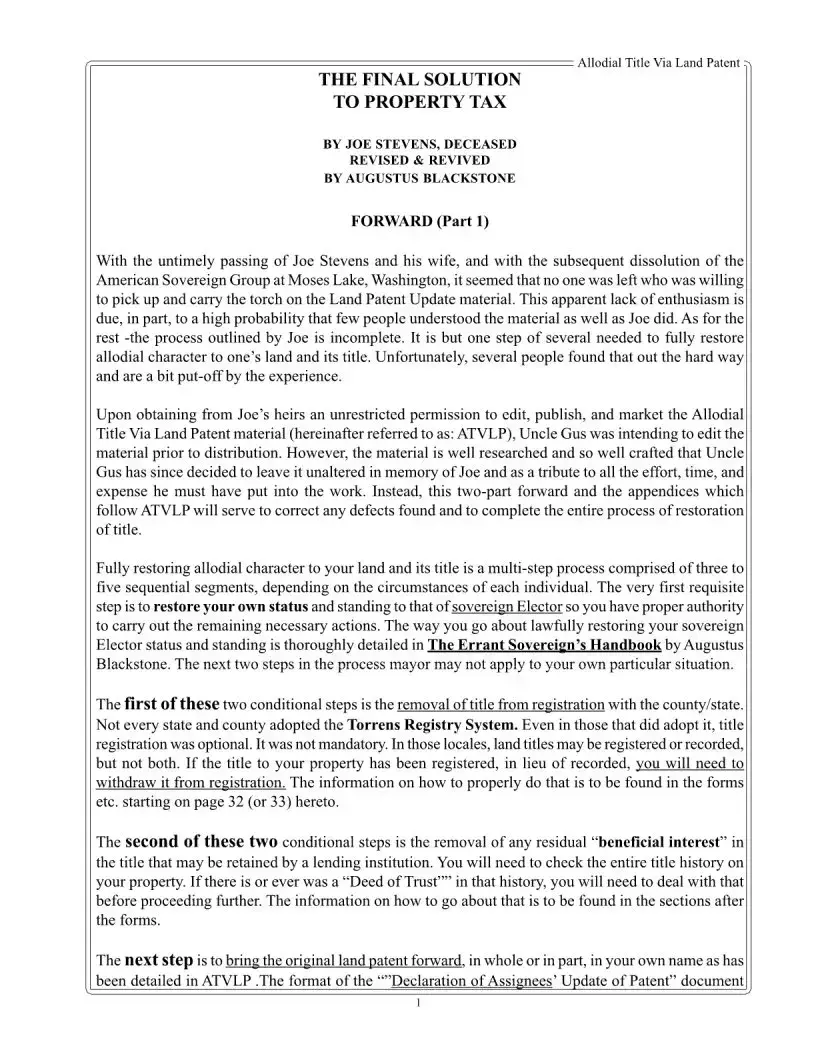
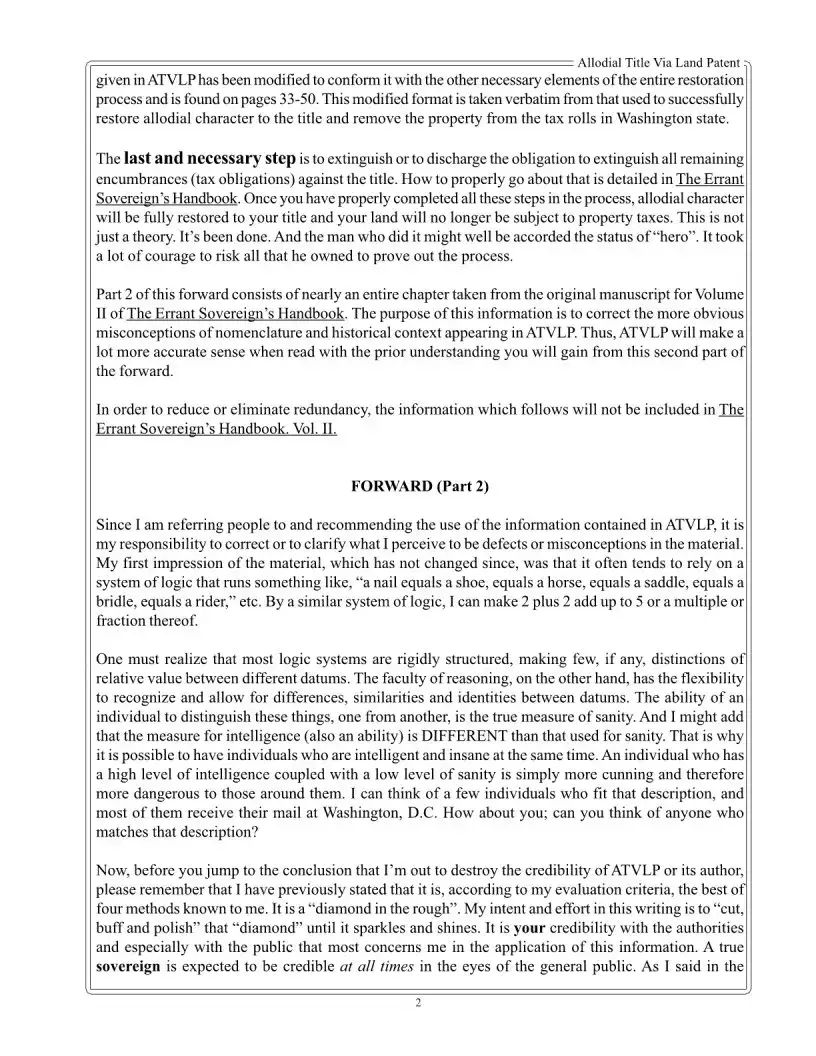
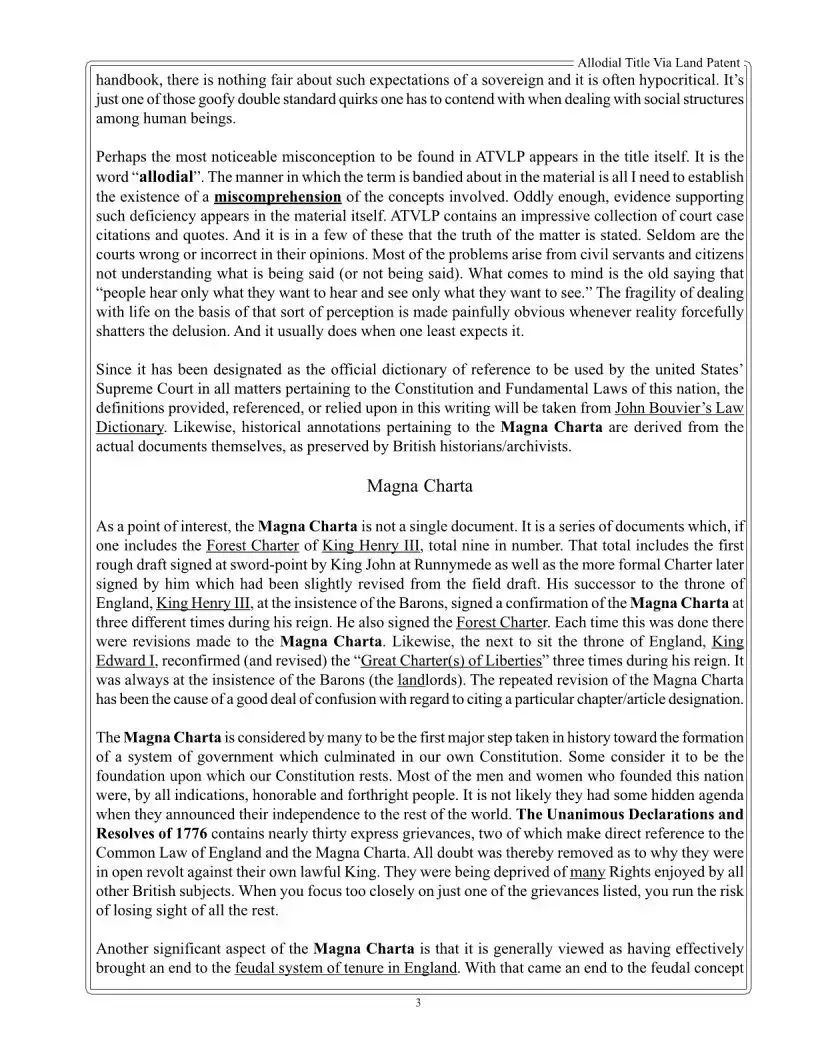
An allodial title refers to a type of land ownership that is free from any superior landlord or sovereign. This means that the owner has complete control over the property without the obligation to pay property taxes or any other encumbrances. The concept of allodial title has historical roots and is often associated with the idea of sovereignty over one’s land. It is important to note that achieving an allodial title typically requires a specific legal process, as outlined in the Allodial Title Via Land Patent material.
The first step in obtaining an allodial title is to restore your status as a sovereign Elector. This status grants you the authority needed to pursue the remaining actions required for allodial title restoration. Detailed instructions on how to restore your sovereign status can be found in The Errant Sovereign’s Handbook by Augustus Blackstone. Once you have established your sovereign status, you can proceed with the subsequent steps outlined in the Allodial Title Via Land Patent material.
Each of these steps is crucial to fully restore the allodial character of your land and title.
If your property title is registered, it is essential to withdraw it from that registration. Not every state has adopted the Torrens Registry System, and in places where it has, registration is often optional. If your title is registered, the process for withdrawing it is detailed in the Allodial Title Via Land Patent material. It is vital to follow these instructions carefully to ensure compliance with local regulations.
Removing beneficial interest refers to addressing any claims that a lending institution may have on your property. This often involves checking the title history for any “Deed of Trust” or similar documents that indicate a lender’s interest. If such a document exists, you will need to take steps to resolve this issue before proceeding with the allodial title process. Guidance on how to handle this situation can be found in the sections following the forms in the Allodial Title Via Land Patent material.
While the process outlined in the Allodial Title Via Land Patent material has been successful for some individuals, there is no absolute guarantee of success. Each case is unique, and various factors may influence the outcome. It is crucial to follow the steps carefully and ensure that all requirements are met. Additionally, understanding the legal landscape in your specific jurisdiction can play a significant role in the success of your efforts.
Once the allodial character of your title is fully restored, your land should no longer be subject to property taxes. This is one of the primary benefits of achieving an allodial title. However, it is important to ensure that all steps in the restoration process are completed correctly. Failure to do so may result in continued tax obligations or other encumbrances. Therefore, thorough attention to detail throughout the process is essential.
Filling out the Allodial Title form can be a straightforward process, but many people make common mistakes that can lead to complications. One significant error is failing to understand the prerequisites for restoring one’s status as a sovereign Elector. Before even beginning the form, it’s crucial to ensure that you have the proper authority to act. Without this foundational step, subsequent actions may be invalid or lead to unnecessary delays. Many individuals overlook this requirement, thinking they can simply fill out the form without addressing their status first.
Another frequent mistake is inaccurately completing the title registration section. Some individuals confuse the registration and recording of titles, which can lead to significant issues down the line. In certain states, title registration is optional, meaning that if your property is registered, you must withdraw it properly before proceeding. Failing to do so can result in legal complications, as the form may not be recognized without this step being completed correctly.
Additionally, many people neglect to check for any residual beneficial interests that may be tied to their property. If there’s a history of a Deed of Trust, it’s essential to address that before moving forward. Ignoring this step can create a situation where your title remains encumbered, which contradicts the goal of restoring allodial character to your land. Individuals often assume that their title is clear, only to discover later that there are lingering interests that need resolution.
Another common pitfall involves incomplete documentation. The Allodial Title process requires specific forms and declarations, and many people fail to provide all necessary documentation. This can lead to delays or even rejections of their application. It’s vital to carefully review the required documents and ensure that everything is included. Skipping this step can turn a seemingly simple process into a frustrating ordeal.
Finally, not following the instructions carefully can lead to significant errors. Each section of the Allodial Title form has specific guidelines, and overlooking even a minor detail can have major implications. Whether it’s the formatting of a declaration or the order of submission, attention to detail is crucial. Those who rush through the form often find themselves needing to redo their work, which can be both time-consuming and disheartening.
When pursuing an Allodial Title, several other forms and documents are often necessary to complete the process. Each of these documents serves a specific purpose in ensuring that the transition to an allodial title is smooth and legally sound. Below is a list of commonly used forms that may accompany the Allodial Title form.
Completing the allodial title process involves careful attention to each of these documents. Ensuring that they are properly filled out and submitted will help in securing your property rights and achieving the desired outcome. It is advisable to review each document thoroughly and seek guidance if needed to navigate this complex process successfully.
The Allodial Title form shares similarities with several other legal documents, each serving distinct purposes but often overlapping in their implications regarding property rights and ownership. Below is a list of six documents that are similar to the Allodial Title form, along with explanations of how they relate to it.
Each of these documents plays a role in the broader context of property ownership and rights. Understanding their similarities and differences can be crucial for anyone navigating the complexities of land ownership and title restoration.
When filling out the Allodial Title form, there are important guidelines to follow. Here is a list of things you should and shouldn’t do:
Misconceptions about Allodial Title can lead to confusion and misinterpretation of property rights. Here are eight common misconceptions:
This is not entirely accurate. While allodial title suggests a high degree of ownership, it does not eliminate all responsibilities, such as local laws and regulations.
Not all states in the U.S. recognize allodial title. Some states have adopted systems that may complicate the process of obtaining such title.
This is misleading. While the goal is to remove property from tax rolls, the process is complex and requires several steps to achieve.
Restoring allodial character to a title is a multi-step process that takes time and effort. It is not an overnight solution.
This is incorrect. Allodial title does not provide immunity from lawsuits or legal claims related to the property.
There are specific requirements and steps to follow before one can claim allodial title, including restoring one’s status as a sovereign Elector.
This misconception undermines the legitimacy of the process. It is about restoring rights rather than avoiding taxes illegally.
The concept varies significantly across jurisdictions. Understanding local laws is crucial to navigating the allodial title process.
Key Takeaways on Filling Out and Using the Allodial Title Form: