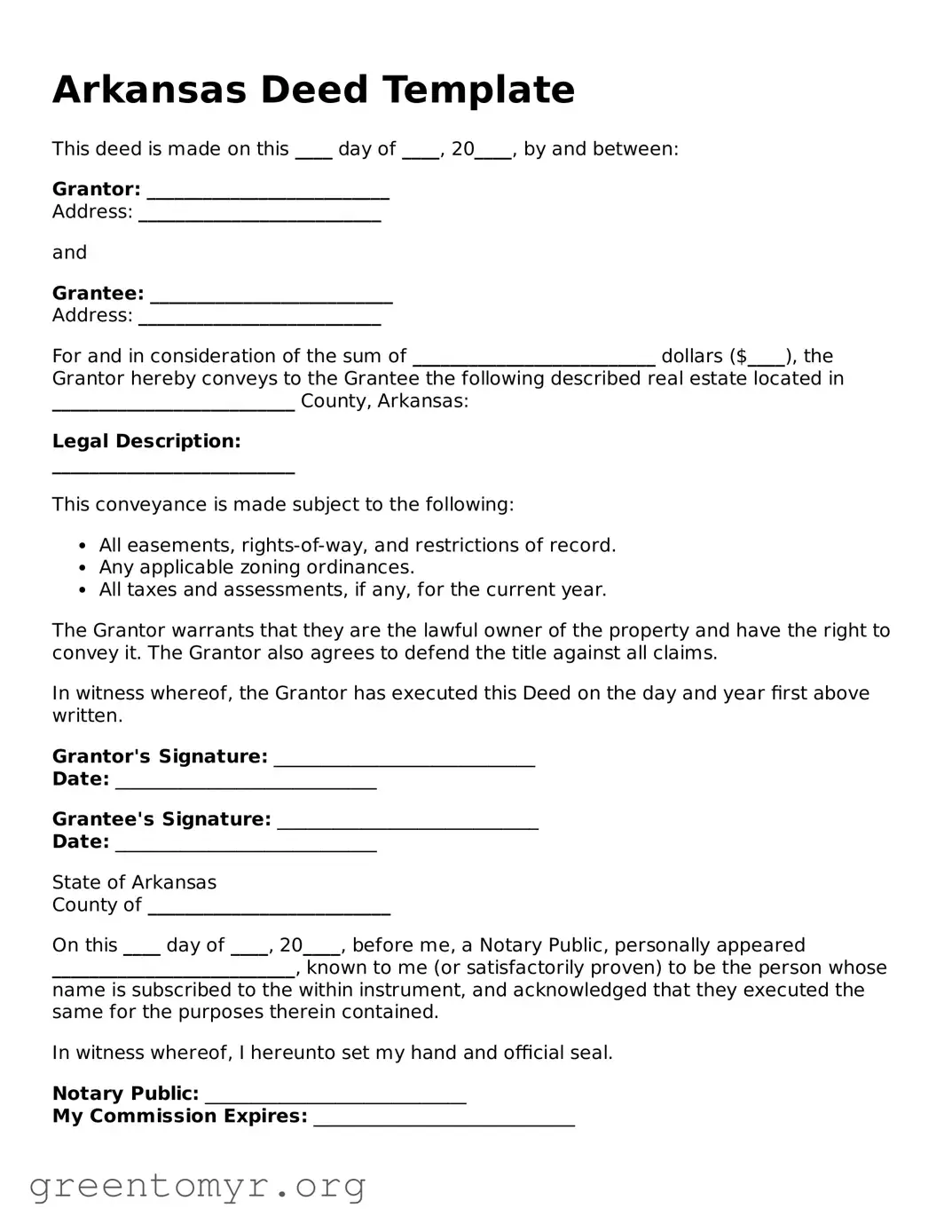
The Arkansas Deed form plays a crucial role in the transfer of property ownership within the state, serving as a legal document that outlines the specifics of the transaction. This form typically includes essential information such as the names of the parties involved, a detailed description of the property being conveyed, and the terms of the transfer. Additionally, it may specify any encumbrances or liens on the property, ensuring that both the buyer and seller are fully aware of any obligations tied to the real estate. Understanding the various types of deeds available in Arkansas, such as warranty deeds and quitclaim deeds, is vital for anyone looking to buy or sell property. Each type serves a different purpose and offers varying levels of protection to the parties involved. Furthermore, the Arkansas Deed form must be executed in accordance with state laws, which may include notarization and recording requirements to ensure the transfer is legally binding and recognized by the public. By familiarizing oneself with these aspects, individuals can navigate the property transfer process more effectively, minimizing potential disputes and ensuring a smooth transaction.
Arkansas Deed Template
This deed is made on this ____ day of ____, 20____, by and between:
Grantor: __________________________
Address: __________________________
and
Grantee: __________________________
Address: __________________________
For and in consideration of the sum of __________________________ dollars ($____), the Grantor hereby conveys to the Grantee the following described real estate located in __________________________ County, Arkansas:
Legal Description:
__________________________
This conveyance is made subject to the following:
The Grantor warrants that they are the lawful owner of the property and have the right to convey it. The Grantor also agrees to defend the title against all claims.
In witness whereof, the Grantor has executed this Deed on the day and year first above written.
Grantor's Signature: ____________________________
Date: ____________________________
Grantee's Signature: ____________________________
Date: ____________________________
State of Arkansas
County of __________________________
On this ____ day of ____, 20____, before me, a Notary Public, personally appeared __________________________, known to me (or satisfactorily proven) to be the person whose name is subscribed to the within instrument, and acknowledged that they executed the same for the purposes therein contained.
In witness whereof, I hereunto set my hand and official seal.
Notary Public: ____________________________
My Commission Expires: ____________________________
| Fact Name | Description |
|---|---|
| Governing Law | The Arkansas Deed form is governed by the laws of the State of Arkansas. |
| Types of Deeds | Common types of deeds in Arkansas include warranty deeds, quitclaim deeds, and special warranty deeds. |
| Signature Requirement | The deed must be signed by the grantor (the person transferring the property). |
| Notarization | A notary public must witness the signing of the deed for it to be valid. |
| Recording | To protect the interests of the grantee, the deed should be recorded with the county clerk's office. |
| Legal Description | A precise legal description of the property must be included in the deed. |
| Consideration | The deed should state the consideration (the amount paid for the property), although it can be nominal. |
| Tax Implications | Transfer taxes may apply when property is transferred, depending on the value of the transaction. |
Once you have the Arkansas Deed form in hand, you can begin the process of completing it. This form is essential for transferring property ownership and must be filled out accurately to ensure a smooth transaction. After filling out the form, it will need to be signed and possibly notarized before being submitted to the appropriate county office.
An Arkansas Deed form is a legal document used to transfer ownership of real property from one party to another within the state of Arkansas. This document outlines the details of the transaction, including the names of the parties involved, a description of the property, and the terms of the transfer. It serves as official proof of ownership once recorded with the appropriate county office.
There are several types of deeds commonly used in Arkansas, including:
Filling out an Arkansas Deed form requires careful attention to detail. Generally, you should include the following information:
Once completed, the deed must be signed by the grantor and may need to be notarized.
Yes, notarization is typically required for an Arkansas Deed. The grantor must sign the deed in the presence of a notary public, who will then affix their seal to the document. This step helps to verify the identities of the parties involved and ensures the authenticity of the signatures.
After completing and notarizing the deed, it must be filed with the county clerk’s office in the county where the property is located. This filing process officially records the change of ownership and makes the deed a matter of public record. It is advisable to keep a copy of the filed deed for your personal records.
Yes, there are usually fees associated with filing a deed in Arkansas. These fees can vary by county, so it’s important to check with the local county clerk’s office for the exact amount. Additionally, there may be costs related to notarization and any necessary title searches.
If you do not file the deed after a property transfer, the change in ownership may not be recognized legally. This can lead to complications, especially if disputes arise regarding property rights. Failing to file can also affect your ability to sell the property in the future or obtain financing.
Yes, you can use a standard form for an Arkansas Deed, which can often be found online or at legal supply stores. However, it is crucial to ensure that the form complies with Arkansas state laws and includes all necessary information. If you are unsure, consulting with a legal professional can provide clarity and help avoid potential issues.
If you have more questions about the Deed process in Arkansas, consider reaching out to a local attorney who specializes in real estate law. They can provide personalized guidance and ensure that you understand all aspects of the deed transfer process. Additionally, the county clerk’s office can be a valuable resource for specific filing requirements and procedures.
Filling out the Arkansas Deed form can seem straightforward, but many people make common mistakes that can lead to complications down the line. One frequent error is not including the full legal description of the property. Instead of a simple address, the deed requires a detailed description that identifies the property boundaries. Omitting this information can result in confusion or disputes over property lines.
Another mistake often made is failing to properly identify the grantor and grantee. The grantor is the person transferring the property, while the grantee is the person receiving it. If either party’s name is misspelled or incomplete, it could invalidate the deed. Always double-check names against official identification to ensure accuracy.
People also tend to overlook the importance of signatures. The deed must be signed by the grantor, and in some cases, it may require notarization. If the signature is missing or not properly notarized, the deed may not be legally binding. It’s crucial to follow the specific signing requirements to avoid future issues.
Lastly, many individuals forget to file the completed deed with the appropriate county office. After filling out the form, it’s essential to submit it for recording. This step makes the transfer of ownership official and protects the rights of the new owner. Without this filing, the deed may not hold up in legal situations, leaving the new owner vulnerable.
When completing a property transaction in Arkansas, several other forms and documents may be necessary alongside the Arkansas Deed form. Each document serves a specific purpose and helps ensure a smooth transfer of property ownership. Here are five commonly used forms:
Each of these documents plays a vital role in the property transfer process in Arkansas. Ensuring that you have the necessary forms can help prevent complications and facilitate a successful transaction.
The Deed form is similar to several other legal documents in terms of purpose and function. Here are ten documents that share similarities with the Deed form:
When filling out the Arkansas Deed form, there are specific actions to take and avoid to ensure accuracy and compliance. Below is a list of recommendations.
Things to Do:
Things Not to Do:
Understanding the Arkansas Deed form can be challenging due to various misconceptions that often arise. Here are nine common misunderstandings, along with clarifications to enhance comprehension.
All deeds are the same. Many people believe that all deed forms are identical. In reality, different types of deeds serve distinct purposes, such as warranty deeds, quitclaim deeds, and special warranty deeds. Each type has unique implications for the transfer of property rights.
A deed must be notarized to be valid. While notarization adds a layer of authenticity, it is not always required for a deed to be legally binding in Arkansas. However, having a deed notarized is highly recommended to prevent disputes.
Only lawyers can prepare a deed. Although legal professionals can assist in drafting deeds, individuals can also prepare them. It is crucial, however, to ensure that all necessary information is accurately included to avoid issues later.
Once a deed is recorded, it cannot be changed. Many people think that a recorded deed is permanent and unchangeable. In fact, deeds can be amended or corrected through a new deed or an affidavit, provided that the proper legal procedures are followed.
All property transfers require a deed. While most property transfers do necessitate a deed, there are exceptions. For instance, property transfers through inheritance or court orders may not always require a traditional deed.
The deed is the only document needed for a property transfer. This misconception overlooks the importance of other documents, such as title insurance and closing statements, which play vital roles in the property transfer process.
Deeds are only necessary for selling property. Many people associate deeds solely with sales. However, deeds are also essential for other transactions, such as gifting property or transferring ownership between family members.
All information on a deed is public. While it is true that recorded deeds are generally accessible to the public, certain personal details may be redacted for privacy reasons, depending on local laws.
Once signed, a deed is automatically effective. Signing a deed does not make it effective immediately. The deed must be delivered and accepted by the grantee to complete the transfer of ownership.
By addressing these misconceptions, individuals can better navigate the complexities of property transfers in Arkansas and ensure that their transactions proceed smoothly.
When filling out and using the Arkansas Deed form, there are several important points to keep in mind. Understanding these key takeaways can help ensure a smooth transaction and proper documentation.
By keeping these points in mind, individuals can navigate the process of filling out and using the Arkansas Deed form more effectively.