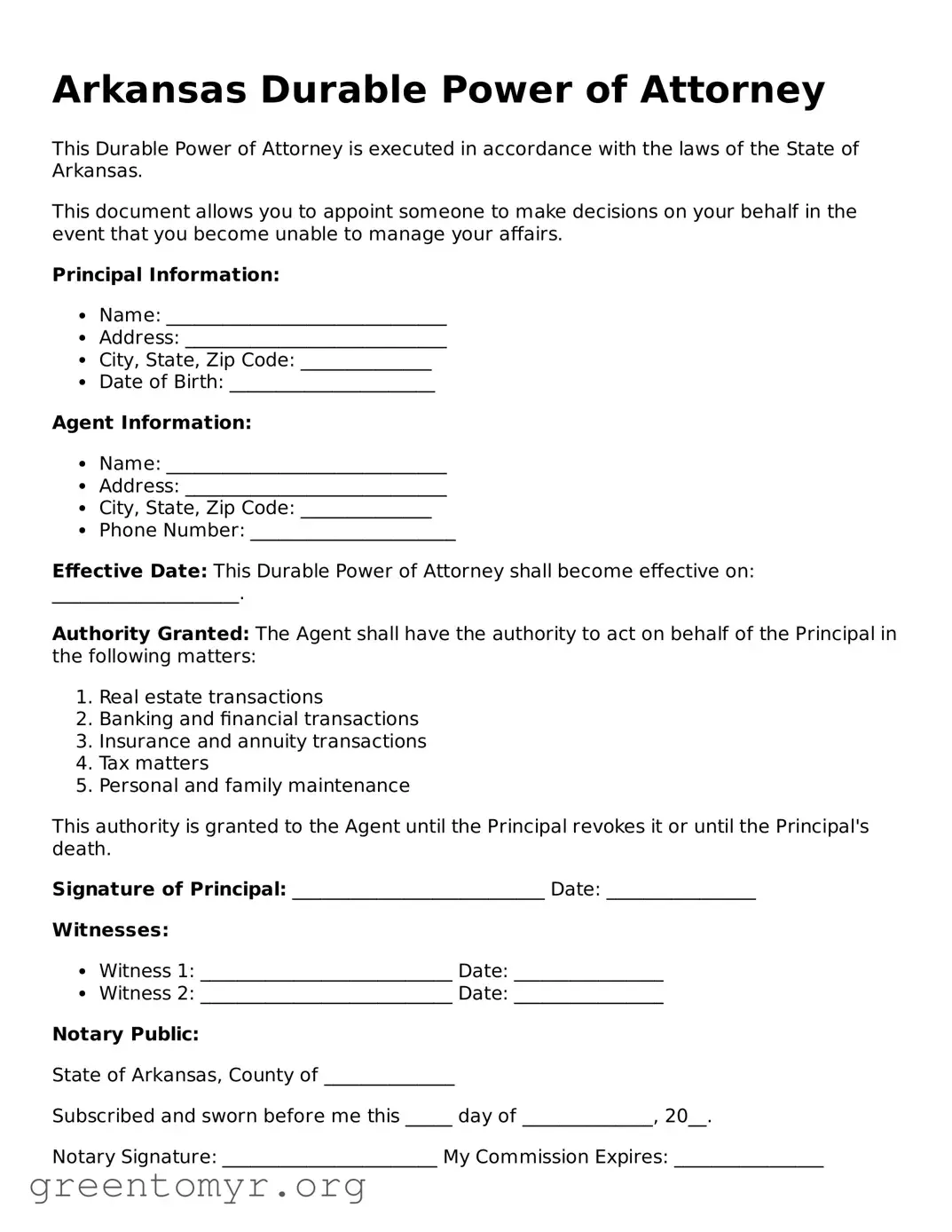
The Arkansas Durable Power of Attorney form serves as a crucial legal document that empowers individuals to designate a trusted person, known as an agent, to make decisions on their behalf in various situations, particularly when they become incapacitated. This form encompasses a wide range of powers, allowing the agent to manage financial matters, healthcare decisions, and other personal affairs, ensuring that the principal's wishes are respected even when they can no longer express them. Importantly, the document remains effective even if the principal loses the ability to make decisions, which distinguishes it from other types of power of attorney. In Arkansas, specific requirements must be met for the form to be valid, including the necessity for the principal to be of sound mind at the time of signing and the need for the document to be notarized or witnessed. Understanding the nuances of this form is essential, as it not only safeguards the principal's interests but also provides peace of mind for both the principal and their loved ones. By taking the time to carefully select an agent and outline the powers granted, individuals can ensure that their preferences are honored during critical moments in life.
Arkansas Durable Power of Attorney
This Durable Power of Attorney is executed in accordance with the laws of the State of Arkansas.
This document allows you to appoint someone to make decisions on your behalf in the event that you become unable to manage your affairs.
Principal Information:
Agent Information:
Effective Date: This Durable Power of Attorney shall become effective on: ____________________.
Authority Granted: The Agent shall have the authority to act on behalf of the Principal in the following matters:
This authority is granted to the Agent until the Principal revokes it or until the Principal's death.
Signature of Principal: ___________________________ Date: ________________
Witnesses:
Notary Public:
State of Arkansas, County of ______________
Subscribed and sworn before me this _____ day of ______________, 20__.
Notary Signature: _______________________ My Commission Expires: ________________
| Fact Name | Description |
|---|---|
| Definition | The Arkansas Durable Power of Attorney form allows an individual (the principal) to designate another person (the agent) to make financial decisions on their behalf. |
| Durability | This form remains effective even if the principal becomes incapacitated, ensuring continuous management of their affairs. |
| Governing Law | The form is governed by the Arkansas Code Annotated, specifically under Title 28, Chapter 68. |
| Agent Authority | The agent can manage a wide range of financial matters, including banking, real estate, and investments, depending on the powers granted in the form. |
| Revocation | The principal can revoke the Durable Power of Attorney at any time, as long as they are mentally competent. |
| Notarization | While notarization is not required, it is highly recommended to enhance the form's validity and acceptance by third parties. |
| Multiple Agents | The principal can appoint multiple agents, specifying whether they act jointly or independently in making decisions. |
| Legal Advice | Consulting with a legal professional is advisable to ensure that the form meets the principal's specific needs and complies with state laws. |
Filling out the Arkansas Durable Power of Attorney form is a straightforward process. After completing the form, it will need to be signed and witnessed to ensure its validity. The following steps will guide you through the process of filling out the form correctly.
A Durable Power of Attorney (DPOA) in Arkansas is a legal document that allows one person, known as the principal, to appoint another person, called the agent, to make decisions on their behalf. This authority remains effective even if the principal becomes incapacitated. The DPOA can cover a wide range of decisions, including financial matters, healthcare, and property management.
To create a Durable Power of Attorney in Arkansas, follow these steps:
Yes, you can revoke a Durable Power of Attorney in Arkansas at any time, as long as you are mentally competent. To revoke it, you should:
It’s advisable to keep a copy of the revocation for your records.
If you do not have a Durable Power of Attorney and become incapacitated, your loved ones may need to go through a court process to obtain guardianship or conservatorship. This process can be time-consuming and costly. Without a DPOA, the court will decide who manages your affairs, which may not align with your preferences. Thus, having a DPOA in place can provide peace of mind and ensure that your wishes are honored.
Filling out the Arkansas Durable Power of Attorney form is a crucial step in ensuring that your financial and medical decisions are managed according to your wishes. However, many individuals make mistakes during this process that can lead to significant complications. Understanding these common errors can help you avoid them.
One common mistake is failing to clearly identify the agent. The agent is the person you appoint to act on your behalf. It is essential to provide their full name and contact information. Omitting this information or using vague identifiers can lead to confusion and may render the document ineffective.
Another frequent error involves not specifying the powers granted to the agent. The form should detail the specific powers you wish to give. If the powers are too broad or too narrow, it may create challenges later on. Be explicit about what decisions your agent can make, whether they pertain to financial matters, healthcare, or other areas.
People often neglect to date the document. A date is crucial because it indicates when the authority begins. Without a date, there may be disputes about the validity of the document or when the powers were intended to take effect. Always ensure you date the form appropriately.
Additionally, failing to sign the document correctly is a common oversight. In Arkansas, the principal must sign the Durable Power of Attorney form in the presence of a notary public. Not having a notary present or not signing in front of them can invalidate the document. Ensure that all signatures are properly executed to avoid issues.
Some individuals also forget to inform their chosen agent about their appointment. It is not enough to complete the form; the agent must be aware of their responsibilities. Discussing your wishes with them ensures they are prepared to act on your behalf and understand your preferences.
Lastly, neglecting to review and update the document can lead to problems. Life circumstances change, and so do relationships. Regularly reviewing your Durable Power of Attorney is essential to ensure it reflects your current wishes. Failing to do so can result in outdated decisions being made on your behalf.
A Durable Power of Attorney (DPOA) is a crucial document that allows you to designate someone to make decisions on your behalf if you become unable to do so. In Arkansas, there are several other forms and documents that are often used alongside a DPOA to ensure that your wishes are clearly communicated and legally upheld. Here’s a brief overview of these important documents.
These documents work together to provide comprehensive planning for your health, finances, and estate. Having them in place can give you peace of mind, knowing that your preferences will be honored even if you cannot express them yourself.
The Durable Power of Attorney (DPOA) form is an important legal document, but it shares similarities with several other documents. Here’s a list of eight documents that are comparable to the DPOA, along with explanations of how they relate:
When filling out the Arkansas Durable Power of Attorney form, it's important to follow certain guidelines to ensure that the document is valid and meets your needs. Here are some things to keep in mind:
Understanding the Arkansas Durable Power of Attorney form is essential for effective estate planning. However, several misconceptions can lead to confusion. Below are nine common misconceptions explained.
This is not true. Anyone can establish a Durable Power of Attorney at any age. It is a proactive measure to ensure that financial and legal decisions can be made if an individual becomes incapacitated.
While both documents allow someone to act on your behalf, a Durable Power of Attorney remains effective even if you become incapacitated, whereas a regular Power of Attorney does not.
This is incorrect. You can revoke or modify a Durable Power of Attorney at any time, as long as you are mentally competent.
This is a misconception. Your agent can be anyone you trust, such as a family member or friend. They do not need to be a legal professional.
This is misleading. The powers granted can be specified in the document, allowing you to limit what your agent can and cannot do on your behalf.
In Arkansas, the Durable Power of Attorney must be signed in the presence of a notary public to be valid. Witnesses may also be required, depending on the situation.
This is false. While it often covers financial decisions, it can also include health care decisions if specified in the document.
This is not necessarily true. While many states recognize Durable Power of Attorney documents, specific requirements may vary. It is advisable to check local laws if you move or travel frequently.
Many resources are available to help you create this document. With the right guidance, the process can be straightforward and manageable.
Clarifying these misconceptions can help individuals make informed decisions regarding their Durable Power of Attorney in Arkansas.
Filling out and using the Arkansas Durable Power of Attorney form is an important step in planning for future decision-making. Here are key takeaways to consider: