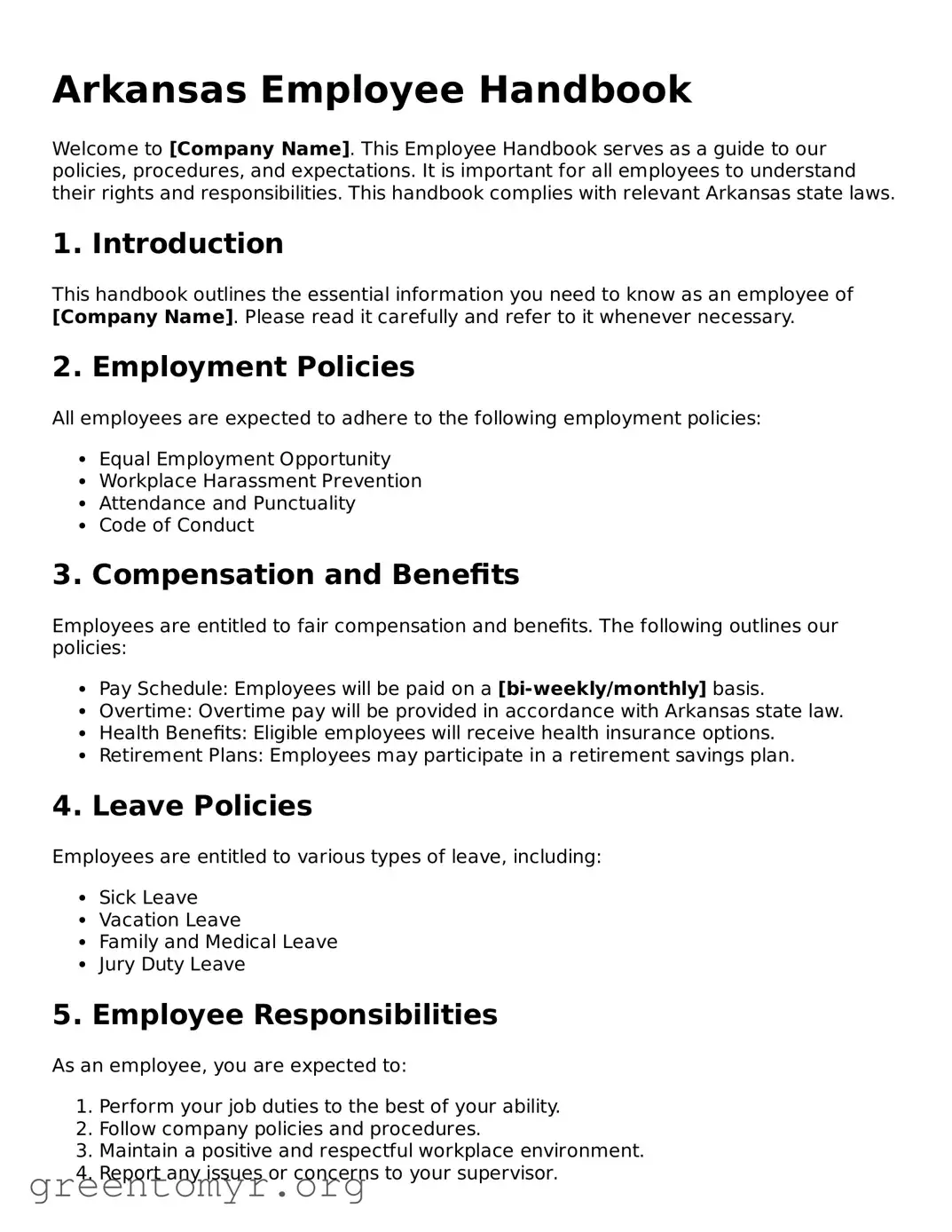
The Arkansas Employee Handbook form serves as a crucial resource for employers and employees alike, outlining essential workplace policies and expectations. This document typically includes sections on employee rights, workplace conduct, and company policies regarding attendance, dress code, and harassment. It also addresses benefits, including vacation time, sick leave, and health insurance options. By providing clear guidelines, the handbook helps foster a positive work environment and ensures compliance with state and federal laws. Additionally, it often contains information about the grievance process, giving employees a clear path for addressing concerns. Overall, the Arkansas Employee Handbook form is designed to protect both the employer's interests and the employees' rights, promoting transparency and accountability within the workplace.
Arkansas Employee Handbook
Welcome to [Company Name]. This Employee Handbook serves as a guide to our policies, procedures, and expectations. It is important for all employees to understand their rights and responsibilities. This handbook complies with relevant Arkansas state laws.
1. Introduction
This handbook outlines the essential information you need to know as an employee of [Company Name]. Please read it carefully and refer to it whenever necessary.
2. Employment Policies
All employees are expected to adhere to the following employment policies:
3. Compensation and Benefits
Employees are entitled to fair compensation and benefits. The following outlines our policies:
4. Leave Policies
Employees are entitled to various types of leave, including:
5. Employee Responsibilities
As an employee, you are expected to:
6. Disciplinary Procedures
In the event of a violation of company policies, disciplinary actions may be taken. These actions may include:
7. Acknowledgment of Receipt
By signing below, you acknowledge that you have received and read the [Company Name] Employee Handbook.
Employee Name: [Employee Name]
Employee Signature: [Employee Signature]
Date: [Date]
| Fact Name | Details |
|---|---|
| Purpose | The Arkansas Employee Handbook serves as a guide for employees regarding company policies and procedures. |
| State Requirement | While not legally required, having an employee handbook is highly recommended for Arkansas employers. |
| Governing Law | Arkansas Code Annotated § 11-2-101, which covers employment practices. |
| Content Areas | Common topics include workplace conduct, benefits, and disciplinary procedures. |
| At-Will Employment | Arkansas is an at-will employment state, meaning employees can be terminated for any reason, as long as it is not illegal. |
| Updates | Handbooks should be reviewed and updated regularly to reflect changes in laws and company policies. |
| Employee Acknowledgment | Employees should sign an acknowledgment form indicating they have received and understood the handbook. |
| Legal Protections | Handbooks can help protect employers from legal claims by clearly outlining policies and expectations. |
| Non-Discrimination Policies | Handbooks must include non-discrimination and harassment policies to comply with federal and state laws. |
Filling out the Arkansas Employee Handbook form is an essential step in ensuring that you understand your rights and responsibilities as an employee. Completing this form accurately will help you access important information about your workplace policies and procedures. Follow these steps carefully to ensure that you fill out the form correctly.
The Arkansas Employee Handbook form is a document that outlines the policies, procedures, and expectations of an employer. It serves as a guide for employees, helping them understand their rights and responsibilities within the workplace. This handbook can cover various topics, including workplace behavior, attendance, benefits, and safety protocols.
An Employee Handbook is essential for several reasons:
All employees should receive a copy of the Employee Handbook, whether they are full-time, part-time, or temporary workers. It is important for everyone to have access to the same information to ensure fairness and consistency in the workplace.
The Employee Handbook should be reviewed and updated regularly. Ideally, employers should revisit the handbook at least once a year or whenever there are significant changes in laws, company policies, or workplace practices. Keeping the handbook current ensures that employees have the most accurate information.
Yes, employees can provide valuable feedback on the Employee Handbook. Employers may choose to involve employees in the review process to gather insights and suggestions. This can help create a more inclusive work environment and ensure that the handbook reflects the needs of the workforce.
An effective Employee Handbook should include the following sections:
If employees have questions about the Employee Handbook, they should reach out to their supervisor or the Human Resources department. It’s important to clarify any uncertainties to ensure everyone is on the same page regarding company policies.
The Employee Handbook is generally not a legally binding contract. However, it can be used in legal situations to show that the employer has communicated certain policies. It’s important for employers to include a disclaimer stating that the handbook does not create a contract of employment and that policies may change at the employer's discretion.
Filling out the Arkansas Employee Handbook form can seem straightforward, but many people make common mistakes that can lead to confusion or complications later on. One frequent error is not reading the instructions carefully. Each section of the form has specific requirements. Skipping over these can result in incomplete or incorrect submissions.
Another mistake is failing to provide accurate personal information. It’s essential to double-check names, addresses, and contact details. Errors in this information can lead to communication issues or even payroll problems down the line.
Some individuals overlook the importance of signing and dating the form. A signature is often required to validate the document. Without it, the form may be considered invalid, which could affect your employment status.
Additionally, many people forget to ask questions if they are uncertain about any section. It’s perfectly acceptable to seek clarification. Ignoring uncertainties can lead to misunderstandings about company policies or employee rights.
Another common oversight is neglecting to update the form when personal circumstances change. Life events such as marriage, divorce, or a change of address should be reflected in the handbook. Keeping this information current ensures that the employer has the most accurate data.
Many also fail to review the entire handbook before signing. This document contains crucial information about workplace policies and procedures. Taking the time to read through it can prevent future issues and misunderstandings.
People sometimes rush through the form, leading to incomplete answers. Every question is there for a reason, and providing thorough responses is important. Missing details can create gaps in understanding and expectations.
Lastly, some individuals do not keep a copy of the completed form for their records. Having a personal copy is beneficial for reference and can help resolve any disputes that may arise later. It’s always a good idea to maintain documentation for your own protection.
When preparing an Arkansas Employee Handbook, several other documents may also be useful to ensure comprehensive employee management and compliance with state laws. Below is a list of forms and documents that are often used alongside the Employee Handbook.
Utilizing these documents alongside the Employee Handbook can help create a structured and supportive work environment. Each document plays a crucial role in ensuring clear communication and compliance within the workplace.
The Employee Handbook is a crucial document for any organization, outlining policies, procedures, and expectations for employees. It shares similarities with several other important documents. Here’s a breakdown of seven documents that are similar to the Employee Handbook:
Filling out the Arkansas Employee Handbook form can be straightforward if you keep a few key points in mind. Here’s a handy list of what to do and what to avoid:
Misconceptions about the Arkansas Employee Handbook form can lead to misunderstandings for both employers and employees. Here are nine common misconceptions, along with clarifications.
This is not true. While having an employee handbook is beneficial, it is not a legal requirement for all businesses in Arkansas.
Handbooks can be provided in digital formats. As long as employees have access to the information, the format is flexible.
Policies and regulations change over time. Regular reviews and updates are essential to ensure compliance and relevance.
Not every policy needs to be documented. Focus on key policies that govern workplace behavior and compliance.
While handbooks set expectations, they typically do not constitute a contract unless explicitly stated.
While obtaining a signature can be helpful, it is not legally required. Employers should document that employees received the handbook.
In addition to policies, handbooks can also include company culture, mission statements, and employee benefits.
Employers can provide access through electronic means. Ensure that all employees can access the handbook, regardless of the format.
Small businesses can also benefit from having an employee handbook. It helps establish clear expectations and fosters a positive work environment.
When filling out and using the Arkansas Employee Handbook form, it is essential to keep several key points in mind. These points will help ensure that the handbook serves its purpose effectively and complies with relevant regulations.
By following these key takeaways, organizations can create a comprehensive and effective employee handbook that supports a positive workplace environment.