The Arkansas General Power of Attorney form is a vital legal document that allows individuals to appoint someone they trust to make decisions on their behalf. This form empowers the designated agent to handle a wide range of financial and legal matters, from managing bank accounts to signing contracts. It is particularly useful in situations where the principal is unable to make decisions due to illness, travel, or other circumstances. The form must be completed with specific details, including the names of the principal and agent, the scope of authority granted, and any limitations on that authority. Furthermore, it requires the principal’s signature and, in some cases, notarization to ensure its validity. Understanding the nuances of this form is crucial, as it provides a framework for managing one’s affairs and protecting interests during challenging times.
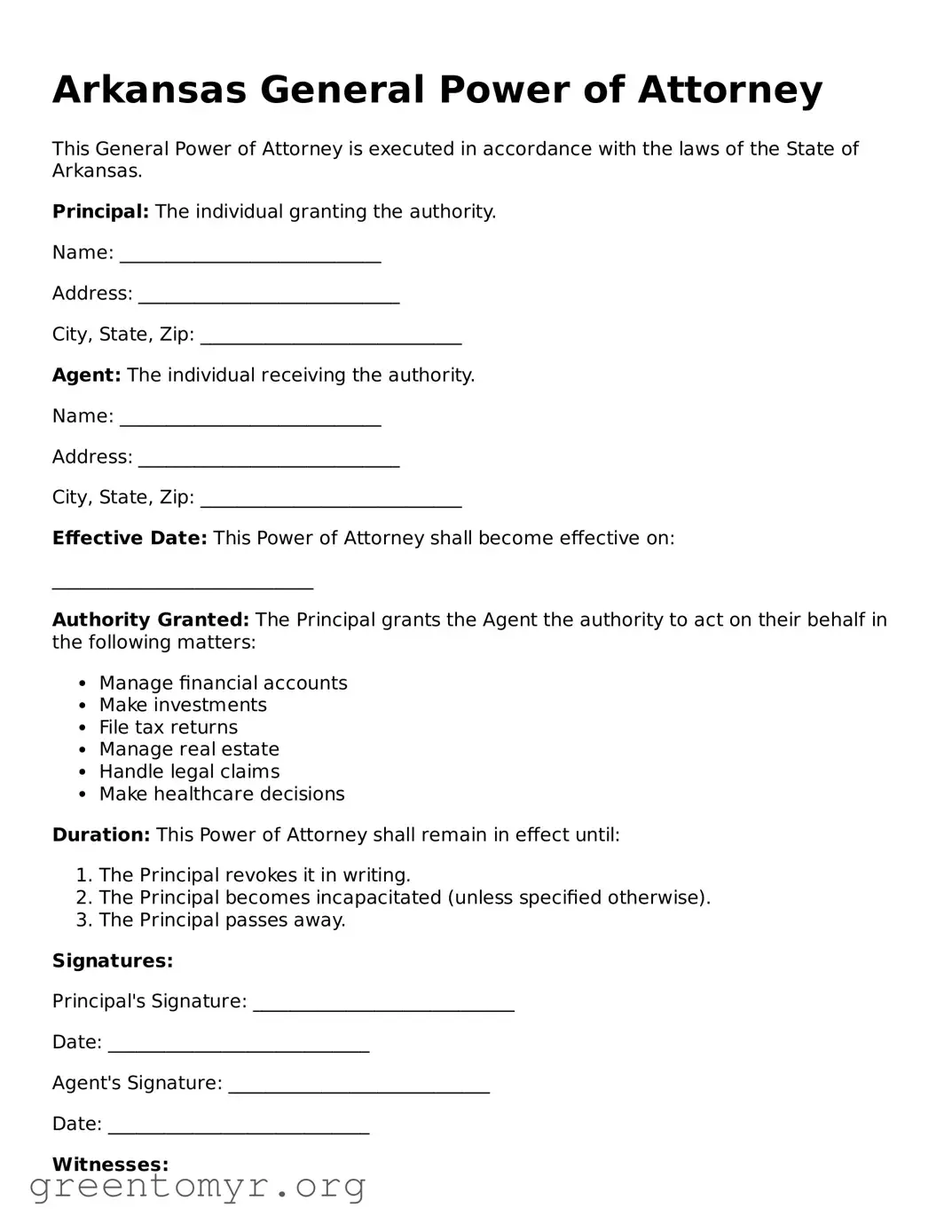
Arkansas General Power of Attorney
This General Power of Attorney is executed in accordance with the laws of the State of Arkansas.
Principal: The individual granting the authority.
Name: ____________________________
Address: ____________________________
City, State, Zip: ____________________________
Agent: The individual receiving the authority.
Name: ____________________________
Address: ____________________________
City, State, Zip: ____________________________
Effective Date: This Power of Attorney shall become effective on:
____________________________
Authority Granted: The Principal grants the Agent the authority to act on their behalf in the following matters:
Duration: This Power of Attorney shall remain in effect until:
Signatures:
Principal's Signature: ____________________________
Date: ____________________________
Agent's Signature: ____________________________
Date: ____________________________
Witnesses:
Witness 1: ____________________________
Witness 2: ____________________________
This document must be signed in the presence of a notary public.
| Fact Name | Details |
|---|---|
| Governing Law | Arkansas Code Annotated § 28-68-101 et seq. |
| Purpose | To grant authority to an agent to act on behalf of the principal in financial and legal matters. |
| Durability | The power of attorney can be durable, meaning it remains effective even if the principal becomes incapacitated. |
| Agent's Authority | The agent can perform various tasks, including managing bank accounts, selling property, and making healthcare decisions if specified. |
| Revocation | The principal can revoke the power of attorney at any time, provided they are competent to do so. |
| Execution Requirements | The form must be signed by the principal and acknowledged before a notary public or two witnesses. |
| Limitations | Some powers, such as those related to healthcare decisions, may require a separate document to be valid. |
Filling out the Arkansas General Power of Attorney form requires careful attention to detail. Once completed, the form allows you to designate someone to make decisions on your behalf. It is crucial to ensure that all information is accurate and clearly stated to avoid any potential issues in the future.
After completing the form, it is important to communicate with the person you have appointed to ensure they understand their responsibilities. Additionally, keep the original document in a safe place and provide copies to relevant parties as needed.
A General Power of Attorney is a legal document that allows one person, known as the principal, to appoint another person, called the agent or attorney-in-fact, to make decisions on their behalf. This authority can cover a wide range of matters, including financial transactions, property management, and personal affairs. In Arkansas, the form must be signed by the principal and may need to be notarized to be legally binding.
The powers granted can vary based on the principal's needs. Common powers include:
It is important for the principal to clearly outline the specific powers they wish to grant to the agent in the document.
Yes, a General Power of Attorney can be revoked at any time by the principal, as long as they are mentally competent. To revoke the document, the principal should provide written notice to the agent and any relevant third parties. It is advisable to create a formal revocation document and, if possible, notify any institutions or individuals that were relying on the original power of attorney.
If the principal becomes incapacitated, the General Power of Attorney typically remains in effect unless it specifically states otherwise. However, it is important to consider a Durable Power of Attorney if the intent is for the agent to continue acting on behalf of the principal during periods of incapacity. This type of document remains valid even if the principal is no longer able to make decisions.
Filling out a General Power of Attorney (POA) form in Arkansas can seem straightforward, but many people make common mistakes that can lead to complications down the road. One frequent error is not specifying the powers granted. The form allows for a range of powers, from managing finances to making healthcare decisions. If you leave this section vague or unchecked, the agent may not have the authority to act in your best interest when needed.
Another mistake is failing to date the document. A General Power of Attorney is only valid if it is dated properly. Without a date, there can be confusion about when the authority was granted, which can lead to disputes or challenges regarding the validity of the document. Always ensure that you include the date when you sign the form.
People often overlook the importance of having witnesses or a notary public. In Arkansas, the General Power of Attorney must be signed in front of a notary to be legally binding. Skipping this step can render the document invalid. Ensure that you have the necessary witnesses or notary present when signing to avoid this pitfall.
Another common error is not informing the agent about their responsibilities. Once you fill out the form, it's crucial to communicate with the person you designate as your agent. They should understand their role and the powers you are granting them. Without this conversation, your agent might not act as you intended, leading to decisions that do not align with your wishes.
Additionally, people sometimes forget to keep copies of the completed form. Once the General Power of Attorney is signed, it’s essential to distribute copies to your agent and any relevant institutions, such as banks or healthcare providers. If only one copy exists and it gets lost, it could create significant issues when the agent needs to act on your behalf.
Failing to update the document when circumstances change is another mistake. Life events, such as marriage, divorce, or the death of an agent, can affect your POA. If you do not revise the document to reflect these changes, you may inadvertently grant authority to someone who is no longer suitable for the role.
Lastly, many people do not review the document carefully before signing. Each section should be read thoroughly to ensure that all information is accurate and complete. Small errors can lead to big problems, so take the time to double-check everything before you finalize your General Power of Attorney.
When establishing a General Power of Attorney in Arkansas, it’s important to consider additional forms and documents that may complement your needs. These documents can help ensure that your wishes are clearly communicated and legally supported. Here’s a list of commonly used forms that work well alongside the General Power of Attorney.
Having these documents prepared can provide peace of mind and ensure that your personal and financial affairs are managed according to your wishes. It’s wise to consult with a professional to tailor these documents to your specific situation and needs.
When filling out the Arkansas General Power of Attorney form, there are several important considerations to keep in mind. Here’s a list of things you should and shouldn't do:
Many people have misunderstandings about the Arkansas General Power of Attorney (GPOA) form. Here are five common misconceptions:
While a General Power of Attorney often includes financial powers, it can also grant authority over health care decisions, property management, and other personal matters. The specific powers depend on how the document is drafted.
This is not true. A General Power of Attorney can be durable, meaning it remains effective even if you become incapacitated. You must specify this durability in the document.
While you can choose anyone as your agent, it’s essential to select someone you trust. The person you choose should be responsible and capable of handling your affairs.
A General Power of Attorney is not necessarily permanent. You can revoke it at any time, as long as you are mentally competent. This flexibility allows you to change your agent or the powers granted as needed.
Many people think that creating a GPOA requires extensive legal knowledge. In reality, it can be straightforward. With the right information and guidance, you can create a document that meets your needs without unnecessary complexity.
When considering the use of the Arkansas General Power of Attorney form, it is important to understand its implications and how to fill it out correctly. Here are some key takeaways to keep in mind: