Content Navigation

The Arkansas Hold Harmless Agreement is an important legal document that plays a crucial role in protecting individuals and organizations from liability. This form is commonly used in various situations, such as when one party agrees to assume the risks associated with an activity or event, thereby shielding the other party from potential legal claims. By signing this agreement, participants acknowledge that they understand the risks involved and agree not to hold the other party responsible for any injuries or damages that may occur. The agreement typically outlines the specific activities covered, the parties involved, and any conditions or limitations that apply. It is essential for those engaging in activities that could pose risks, such as recreational events, construction projects, or other ventures, to understand the implications of this document. Clarity and mutual understanding are key, as both parties must comprehend their rights and responsibilities under the agreement. This form not only fosters a sense of security but also promotes accountability among participants, making it a valuable tool in various contexts.

Arkansas Hold Harmless Agreement Example

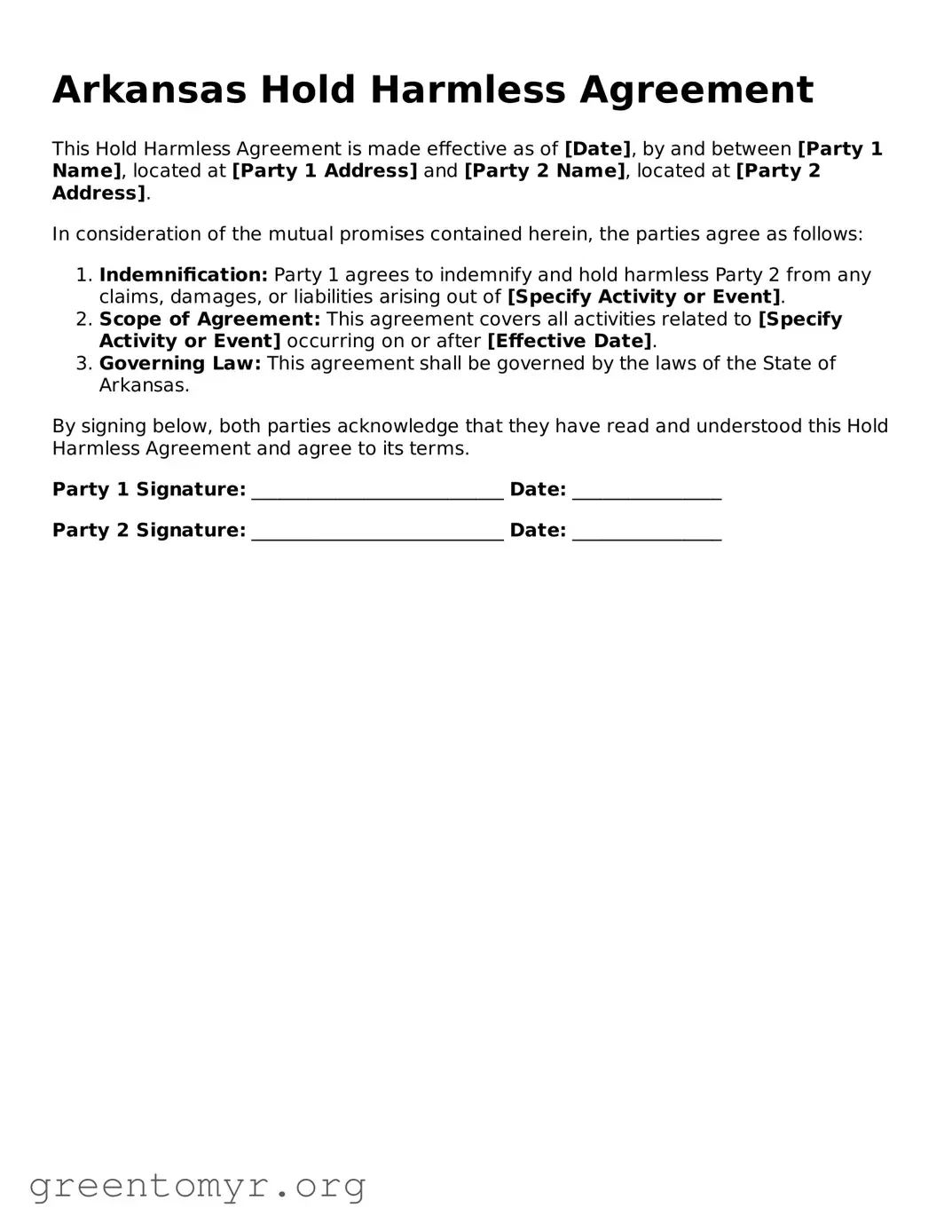
Arkansas Hold Harmless Agreement

This Hold Harmless Agreement is made effective as of [Date], by and between [Party 1 Name], located at [Party 1 Address] and [Party 2 Name], located at [Party 2 Address].

In consideration of the mutual promises contained herein, the parties agree as follows:

  1. Indemnification: Party 1 agrees to indemnify and hold harmless Party 2 from any claims, damages, or liabilities arising out of [Specify Activity or Event].
  2. Scope of Agreement: This agreement covers all activities related to [Specify Activity or Event] occurring on or after [Effective Date].
  3. Governing Law: This agreement shall be governed by the laws of the State of Arkansas.

By signing below, both parties acknowledge that they have read and understood this Hold Harmless Agreement and agree to its terms.

Party 1 Signature: ___________________________ Date: ________________

Party 2 Signature: ___________________________ Date: ________________

PDF Form Features

Fact Name Description
Purpose The Arkansas Hold Harmless Agreement form is designed to protect one party from liability for damages or injuries incurred by another party during a specific activity or event.
Governing Law This agreement is governed by the laws of the State of Arkansas, ensuring that all provisions comply with local regulations.
Key Components The form typically includes sections outlining the responsibilities of each party, the scope of the agreement, and the specific activities covered.
Enforceability For the agreement to be enforceable, it must be signed by all parties involved, demonstrating their consent to the terms outlined in the document.

Guide to Using Arkansas Hold Harmless Agreement

Filling out the Arkansas Hold Harmless Agreement form is a straightforward process. Once completed, you will be prepared to submit the document as required. Follow these steps to ensure accuracy and compliance.

  1. Begin by downloading the Hold Harmless Agreement form from the appropriate source.
  2. Read through the entire form to understand the information required.
  3. In the first section, enter your full name and contact information accurately.
  4. Provide the name and contact information of the other party involved in the agreement.
  5. Clearly describe the activity or event that the agreement pertains to.
  6. Include the date(s) of the activity or event.
  7. Review any specific terms or conditions outlined in the form and fill in the necessary details.
  8. Sign and date the form at the designated area.
  9. If required, have the other party sign the form as well.
  10. Make a copy of the completed form for your records before submitting it.

After completing the form, ensure that all parties involved have copies for their records. This will help maintain clarity and accountability moving forward.

Get Answers on Arkansas Hold Harmless Agreement

What is an Arkansas Hold Harmless Agreement?

An Arkansas Hold Harmless Agreement is a legal document designed to protect one party from liability for damages or injuries that may occur during a specific activity or event. This agreement typically involves two parties: one party agrees to assume responsibility for any risks associated with the activity, while the other party is released from any claims or legal actions that may arise. These agreements are commonly used in various contexts, including rental agreements, event planning, and construction projects.

Who should use a Hold Harmless Agreement in Arkansas?

Individuals and organizations engaging in activities that carry potential risks may consider using a Hold Harmless Agreement. Common users include:

  • Event organizers who want to protect themselves from liability during events.
  • Property owners renting out their space for activities or events.
  • Contractors and subcontractors involved in construction projects.
  • Nonprofit organizations hosting community events.

Each party should carefully evaluate their needs and the potential risks before entering into such an agreement.

What are the key components of a Hold Harmless Agreement?

A Hold Harmless Agreement typically includes several important components:

  1. Identification of Parties: Clearly state the names and roles of all parties involved.
  2. Description of Activity: Provide a detailed description of the activity or event for which the agreement applies.
  3. Assumption of Risk: Include a clause where one party acknowledges understanding and accepting the risks associated with the activity.
  4. Indemnification Clause: Specify that one party agrees to indemnify and hold the other party harmless from any claims or damages.
  5. Signature and Date: Ensure that all parties sign and date the agreement to make it legally binding.

Is a Hold Harmless Agreement enforceable in Arkansas?

In general, Hold Harmless Agreements are enforceable in Arkansas, provided they meet certain legal requirements. The agreement must be clear and unambiguous, and all parties must enter into it voluntarily. Courts may scrutinize the language used in the agreement, especially if it seeks to waive liability for gross negligence or willful misconduct. It is advisable for parties to consult with a legal professional to ensure that the agreement complies with Arkansas law and adequately protects their interests.

Common mistakes

Filling out the Arkansas Hold Harmless Agreement form can be straightforward, but mistakes are common. One frequent error is failing to provide complete information. Individuals often overlook essential details such as their full name, address, or the specific activity related to the agreement. Incomplete information can lead to misunderstandings or complications in the future.

Another mistake involves misunderstanding the scope of the agreement. People sometimes assume that the Hold Harmless Agreement covers all potential liabilities, but this is not always the case. It is crucial to clearly understand what risks are being assumed and whether the agreement protects against negligence or only specific incidents. Misinterpretation can lead to unexpected legal challenges.

Many individuals also neglect to read the entire document before signing. Skimming through the terms may seem harmless, but it can result in signing away important rights. It is essential to understand the implications of the agreement fully. Taking the time to read and comprehend each section can prevent future disputes and ensure that all parties are on the same page.

Finally, failing to seek legal advice is a common oversight. While the form may appear straightforward, legal language can be complex. Consulting with a legal expert can provide clarity and help individuals navigate any potential pitfalls. This step can be especially important for those unfamiliar with legal documents or the specific implications of the Hold Harmless Agreement.

Documents used along the form

The Arkansas Hold Harmless Agreement is an important legal document that outlines the responsibilities and liabilities of the parties involved in a specific activity or transaction. Alongside this agreement, several other forms and documents may be necessary to ensure comprehensive legal protection and clarity. Below is a list of these documents, each serving a distinct purpose.

  • Release of Liability Form: This document allows one party to waive their right to sue another party for any injuries or damages that may occur during an event or activity. It is often used in recreational settings.
  • Indemnity Agreement: Similar to the Hold Harmless Agreement, this document obligates one party to compensate another for any losses or damages that may arise from a specific action or event.
  • Insurance Certificate: This certificate provides proof of insurance coverage, ensuring that the parties involved have adequate protection against potential claims or liabilities.
  • Contract for Services: This document outlines the terms and conditions under which services will be provided, including payment terms, responsibilities, and timelines.
  • Waiver of Subrogation: This form prevents an insurance company from pursuing a claim against a third party after compensating the insured for a loss, thereby protecting the relationship between the parties involved.
  • Event Permit: Depending on the nature of the activity, an event permit may be required from local authorities, ensuring that the event complies with local laws and regulations.
  • Participant Agreement: This agreement is typically used in events involving multiple participants, outlining the rules and expectations for behavior, safety, and liability.
  • Confidentiality Agreement: Often used in business contexts, this document ensures that sensitive information shared between parties remains confidential and is not disclosed to unauthorized individuals.
  • Notice of Risk: This document informs participants about the inherent risks associated with an activity, ensuring they are aware of potential dangers before participating.

Understanding these additional documents can greatly enhance the effectiveness of the Arkansas Hold Harmless Agreement. Each serves a unique function that contributes to the overall safety and legal clarity of the involved parties. It is essential to consider these forms when entering into agreements to ensure comprehensive protection and understanding of obligations.

Similar forms

  • Indemnity Agreement: This document is similar in that it also seeks to protect one party from liability. It outlines the responsibilities of one party to cover losses or damages incurred by another.
  • Waiver of Liability: A waiver of liability releases a party from legal responsibility for injuries or damages. Like a Hold Harmless Agreement, it emphasizes the acceptance of risk by the other party.
  • Release Agreement: This document allows one party to relinquish their right to pursue legal action against another. It shares the same goal of limiting liability for the party being released.
  • Contractor Agreement: Often used in construction, this agreement can include clauses that hold harmless one party for damages caused during a project, similar to the Hold Harmless Agreement.
  • Insurance Policy: While not a legal agreement between two parties, insurance policies often contain hold harmless clauses that protect the insured from certain liabilities, mirroring the intent of a Hold Harmless Agreement.
  • Service Agreement: This document may include hold harmless provisions to protect service providers from claims arising from the use of their services, akin to the Hold Harmless Agreement.
  • Event Liability Waiver: Common in event planning, this waiver protects organizers from claims related to injuries or damages during the event, much like a Hold Harmless Agreement.
  • Partnership Agreement: In some cases, these agreements include hold harmless clauses to protect partners from liabilities incurred by the actions of other partners, paralleling the purpose of a Hold Harmless Agreement.
  • Lease Agreement: Many lease agreements contain hold harmless provisions to protect landlords from claims arising from tenant activities, similar to the protective nature of a Hold Harmless Agreement.

Dos and Don'ts

When filling out the Arkansas Hold Harmless Agreement form, it is important to be careful and thorough. Here are some guidelines to help you navigate the process.

  • Do read the entire agreement carefully before signing.
  • Do provide accurate and complete information.
  • Do consult with a legal professional if you have questions.
  • Don't rush through the form; take your time to understand each section.
  • Don't leave any blanks unless specifically instructed.
  • Don't sign the agreement without fully understanding your obligations.

By following these guidelines, you can ensure that you fill out the form correctly and protect your interests.

Misconceptions

The Arkansas Hold Harmless Agreement form is often misunderstood. Here are seven common misconceptions about this document:

  1. It eliminates all liability. Many believe that signing a Hold Harmless Agreement means they cannot be held responsible for any actions or damages. In reality, it typically only protects one party from claims arising from specific activities or situations.
  2. It is only for businesses. While businesses frequently use Hold Harmless Agreements, individuals can also utilize them. Anyone engaging in activities that may pose risks can benefit from this form.
  3. It is legally binding in all situations. The enforceability of a Hold Harmless Agreement can depend on various factors, including state laws and the specific circumstances surrounding its use. Not all agreements will hold up in court.
  4. It covers gross negligence. A common misconception is that these agreements protect against claims of gross negligence or willful misconduct. Most Hold Harmless Agreements do not provide this level of protection.
  5. It requires notarization. Some people think that a Hold Harmless Agreement must be notarized to be valid. However, notarization is not always necessary unless specified by state law or the terms of the agreement.
  6. It is a one-size-fits-all document. Each Hold Harmless Agreement should be tailored to fit the specific situation and parties involved. Generic forms may not adequately address the unique circumstances of a particular case.
  7. It absolves parties from all responsibilities. Signing the agreement does not mean that a party can act recklessly. Parties still have a duty to exercise reasonable care and follow safety protocols, regardless of the agreement.

Understanding these misconceptions can help individuals and businesses make informed decisions when using the Arkansas Hold Harmless Agreement form.

Key takeaways

When filling out and using the Arkansas Hold Harmless Agreement form, keep these key takeaways in mind:

  1. Ensure that all parties involved are clearly identified. This includes full names and addresses.
  2. Clearly state the purpose of the agreement. Specify the activities or events that are covered.
  3. Review the terms carefully. Understand what liabilities are being waived and under what conditions.
  4. Include a section for signatures. All parties must sign the agreement to make it legally binding.
  5. Consider having the agreement notarized. This adds an extra layer of authenticity and can be beneficial in disputes.
  6. Keep a copy of the signed agreement for your records. This is important for future reference.
  7. Be aware of state laws regarding hold harmless agreements. Different states may have varying enforceability rules.
  8. Consult with a legal professional if unsure about any terms. Clarity can prevent future complications.
  9. Use clear and straightforward language. Avoid complex terms that could lead to misunderstandings.

Following these guidelines will help ensure the Hold Harmless Agreement is effective and enforceable.