The Arkansas Homeschool Letter of Intent form serves as a crucial step for families wishing to educate their children at home. This document notifies the local school district of the parents' intention to homeschool, ensuring compliance with state regulations. It requires essential information, including the names and ages of the children being homeschooled, as well as the educational curriculum or approach that will be utilized. Timeliness is important, as the form must be submitted within a specific timeframe to avoid potential penalties. Additionally, while the form itself is straightforward, it represents a significant commitment to providing a tailored educational experience. Understanding the requirements and implications of this form is vital for any family considering homeschooling in Arkansas.
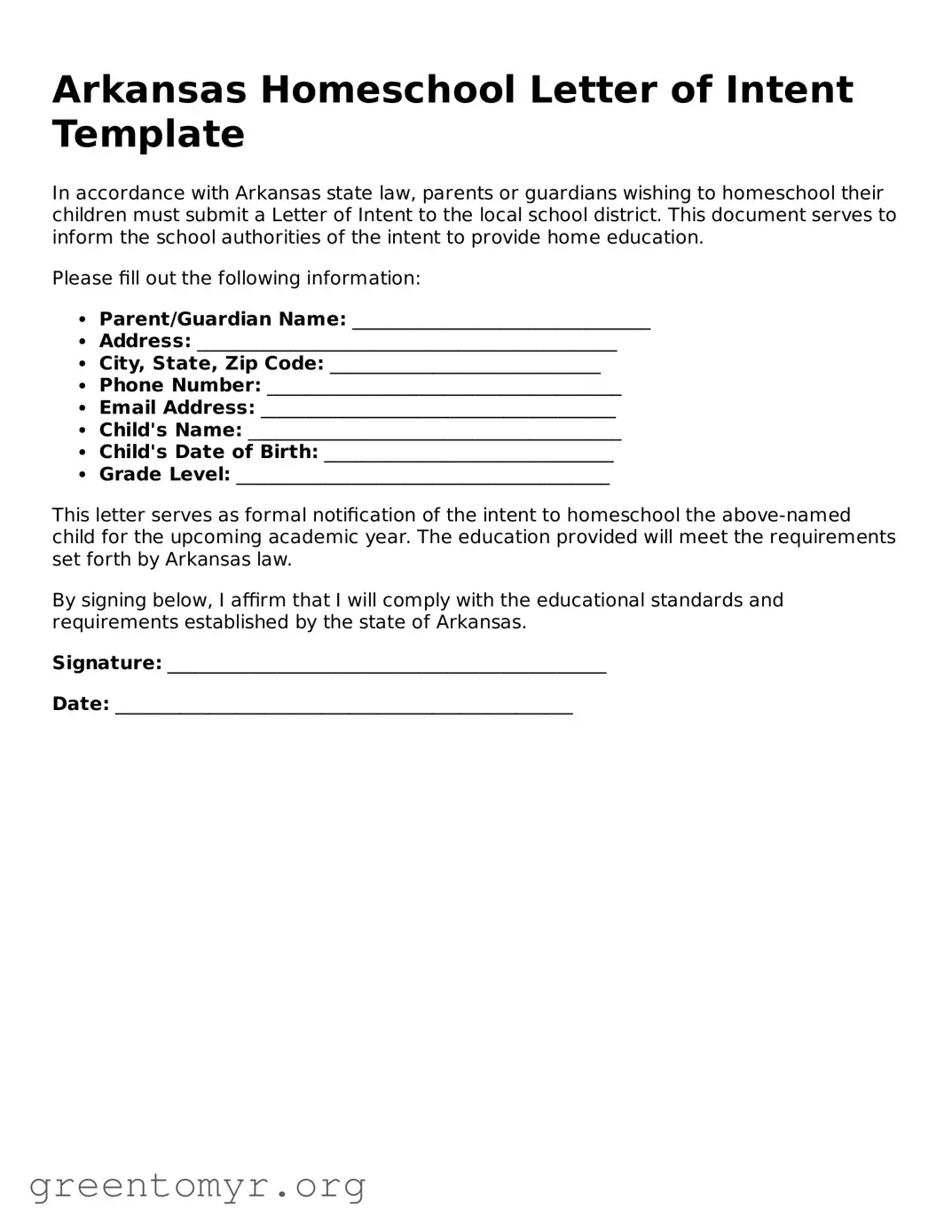
Arkansas Homeschool Letter of Intent Template
In accordance with Arkansas state law, parents or guardians wishing to homeschool their children must submit a Letter of Intent to the local school district. This document serves to inform the school authorities of the intent to provide home education.
Please fill out the following information:
This letter serves as formal notification of the intent to homeschool the above-named child for the upcoming academic year. The education provided will meet the requirements set forth by Arkansas law.
By signing below, I affirm that I will comply with the educational standards and requirements established by the state of Arkansas.
Signature: _______________________________________________
Date: _________________________________________________
| Fact Name | Description |
|---|---|
| Governing Law | The Arkansas Homeschool Letter of Intent form is governed by Arkansas Code Annotated § 6-15-503. |
| Submission Deadline | The form must be submitted to the local school district within 30 days of beginning homeschooling. |
| Required Information | The form requires the names and ages of the children being homeschooled. |
| Annual Updates | Parents must submit an updated Letter of Intent each year to continue homeschooling. |
Once you have decided to homeschool your child in Arkansas, the next step is to fill out the Homeschool Letter of Intent form. This form is essential for notifying the state of your decision and outlining your educational plans. Completing this form accurately will help ensure a smooth start to your homeschooling journey.
After submitting the form, you will await confirmation from your school district. They may reach out with additional information or requirements. Stay proactive and ensure you meet any further obligations to maintain compliance with Arkansas homeschooling laws.
The Arkansas Homeschool Letter of Intent form is a document that parents or guardians must submit to officially notify the state of their intention to homeschool their children. This form serves as a formal declaration that the family will be providing an education at home, rather than enrolling the child in a public or private school. By filing this letter, parents comply with Arkansas state laws regarding homeschooling.
Any parent or guardian who wishes to homeschool their child in Arkansas must file the Letter of Intent. This requirement applies to children of school age, typically between the ages of 5 and 17. If you are starting a homeschooling program or transitioning from a public or private school, you will need to submit this form to ensure you are following state regulations.
The Letter of Intent should be submitted at the beginning of the homeschooling year or as soon as you decide to homeschool your child. Arkansas law requires that the form be filed at least 30 days before you begin your homeschooling program. This timeline allows for proper documentation and ensures that you are in compliance with state requirements.
The Arkansas Homeschool Letter of Intent form typically requires several key pieces of information, including:
It’s essential to ensure that all information is accurate and complete to avoid any potential issues with compliance.
The Arkansas Homeschool Letter of Intent form can usually be found on the Arkansas Department of Education's website or through local homeschooling organizations. Many resources are available online, making it easy to access the necessary forms. Additionally, you can contact your local school district for guidance on obtaining the form and any other relevant information related to homeschooling in your area.
Filling out the Arkansas Homeschool Letter of Intent form can be a straightforward process, but many individuals make common mistakes that can lead to complications. Understanding these pitfalls can help ensure that your application is complete and accepted without issues.
One frequent mistake is failing to include all required information. The form asks for specific details about the child, such as their name, age, and address. Omitting any of this information can result in delays or rejection of the application. Always double-check to ensure that every section is filled out completely.
Another common error is not signing the form. A signature is essential to validate your intent to homeschool. Some people forget to sign or mistakenly think that submitting the form electronically negates the need for a signature. Ensure that your signature is present before submission.
Many applicants also neglect to submit the form within the required timeframe. Arkansas law mandates that the Letter of Intent must be submitted at least 30 days before the start of the homeschool year. Missing this deadline can lead to complications, so it is wise to plan ahead and submit the form early.
Some individuals make the mistake of not keeping a copy of the submitted form. It is crucial to retain a copy for your records. This can be helpful in case of any questions or issues that may arise later. Always make a photocopy or save a digital version for your files.
Another issue arises when parents do not provide accurate contact information. If the school district needs to reach you for any reason, incorrect or outdated contact details can create confusion. Ensure that your phone number and email address are current and correct.
In addition, misunderstanding the requirements for educational plans can lead to mistakes. While the Letter of Intent does not require a detailed curriculum, some parents mistakenly believe they need to provide a comprehensive educational plan at this stage. It is important to know what is required and what is not.
Some applicants fail to review the form for typographical errors. Simple mistakes, such as misspellings or incorrect dates, can undermine the professionalism of your application. Take the time to proofread your form before submitting it.
Another common error is not checking for updates in the law. Regulations can change, and it is important to stay informed about any new requirements for homeschooling in Arkansas. Regularly reviewing the state’s education website can help you remain compliant.
Lastly, some individuals forget to consider the implications of homeschooling. It is vital to understand the responsibilities that come with this choice. Researching the laws and requirements can help you avoid pitfalls and ensure that you are prepared for the journey ahead.
When families decide to homeschool in Arkansas, they often need to prepare several important documents in addition to the Homeschool Letter of Intent. Each of these forms plays a crucial role in ensuring compliance with state regulations and facilitating a smooth homeschooling experience. Below is a list of commonly used documents that accompany the Letter of Intent.
In summary, these documents are essential for families embarking on the homeschooling journey in Arkansas. Each one serves a unique purpose, ensuring that educational standards are met while providing a comprehensive view of the child's learning experience. By preparing these forms, families can navigate the homeschooling process with confidence and clarity.
When filling out the Arkansas Homeschool Letter of Intent form, it is important to adhere to certain guidelines to ensure a smooth process. Below is a list of actions to take and avoid.
By following these guidelines, individuals can facilitate the homeschooling process in Arkansas effectively.
There are several misconceptions surrounding the Arkansas Homeschool Letter of Intent form. Understanding these misconceptions can help parents navigate the homeschooling process more effectively. Below are six common misunderstandings:
By clarifying these misconceptions, parents can make informed decisions about their homeschooling journey in Arkansas.
Filling out the Arkansas Homeschool Letter of Intent form is an important step for families choosing to homeschool their children. Here are some key takeaways to consider: