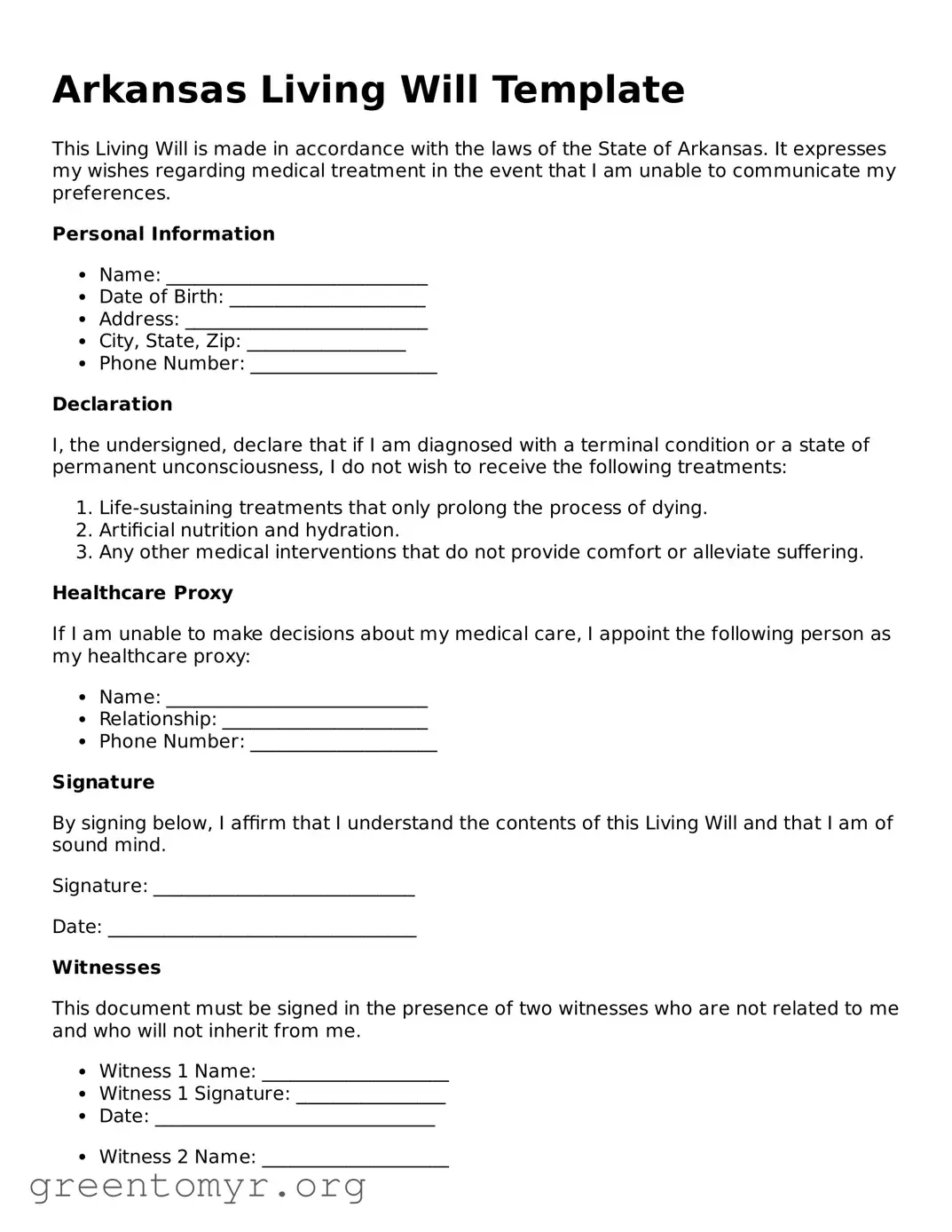
When it comes to planning for the future, many people overlook the importance of a Living Will, especially in Arkansas. This crucial document allows individuals to express their wishes regarding medical treatment in the event they become unable to communicate those preferences themselves. In Arkansas, the Living Will form outlines specific medical interventions a person may or may not want, such as resuscitation efforts, life support, and other life-sustaining treatments. It’s designed to ensure that your healthcare providers and loved ones understand your desires during difficult times. Additionally, the form must be signed in the presence of witnesses to be legally valid, emphasizing the need for proper execution. By taking the time to complete this form, you can provide clarity and peace of mind for yourself and your family, making sure that your values and choices are honored even when you can’t voice them yourself.
Arkansas Living Will Template
This Living Will is made in accordance with the laws of the State of Arkansas. It expresses my wishes regarding medical treatment in the event that I am unable to communicate my preferences.
Personal Information
Declaration
I, the undersigned, declare that if I am diagnosed with a terminal condition or a state of permanent unconsciousness, I do not wish to receive the following treatments:
Healthcare Proxy
If I am unable to make decisions about my medical care, I appoint the following person as my healthcare proxy:
Signature
By signing below, I affirm that I understand the contents of this Living Will and that I am of sound mind.
Signature: ____________________________
Date: _________________________________
Witnesses
This document must be signed in the presence of two witnesses who are not related to me and who will not inherit from me.
| Fact Name | Details |
|---|---|
| Definition | A Living Will in Arkansas is a legal document that outlines a person's wishes regarding medical treatment in the event they become incapacitated. |
| Governing Law | The Arkansas Living Will is governed by the Arkansas Code Annotated, Title 20, Chapter 17. |
| Requirements | The form must be signed by the individual and witnessed by two adults who are not related to the individual or entitled to any portion of the individual's estate. |
| Revocation | A Living Will can be revoked at any time by the individual, either verbally or in writing. |
| Effectiveness | The document becomes effective when the individual is unable to communicate their wishes regarding medical treatment. |
Filling out the Arkansas Living Will form is an important step in making your healthcare wishes known. This document allows you to express your preferences regarding medical treatment in case you become unable to communicate them yourself. Once you have completed the form, it is advisable to share it with your healthcare provider and loved ones to ensure that your wishes are respected.
A Living Will is a legal document that allows you to outline your preferences for medical treatment in case you become unable to communicate your wishes. It specifically addresses end-of-life care, detailing the types of medical interventions you do or do not want.
Anyone over the age of 18 should consider having a Living Will. It is especially important for individuals with chronic illnesses, those facing major surgeries, or anyone who wants to ensure their healthcare preferences are known and respected.
To create a Living Will, you need to:
Yes, Arkansas law requires that your Living Will be signed in front of two witnesses or a notary public. Witnesses must be at least 18 years old and cannot be related to you or have any financial interest in your estate.
Yes, you can change or revoke your Living Will at any time, as long as you are mentally competent. To do so, you should destroy the original document and create a new one, or provide written notice to your healthcare provider.
If you do not have a Living Will, medical decisions may be made by your family members or healthcare providers based on what they believe you would want. This can lead to confusion or disagreements among loved ones during a difficult time.
No, a Living Will and a Power of Attorney are different documents. A Living Will focuses on your medical treatment preferences, while a Power of Attorney allows someone to make healthcare decisions on your behalf if you are unable to do so.
Yes, you can specify which medical treatments you want or do not want. This may include interventions like resuscitation, mechanical ventilation, or tube feeding. Be as clear as possible to avoid ambiguity.
Keep your Living Will in a safe but accessible place. Inform your family members and healthcare providers about its location. It’s also a good idea to carry a copy with you, especially when visiting healthcare facilities.
A Living Will from another state may be honored in Arkansas, but it’s best to check with a legal professional to ensure it meets Arkansas requirements. Creating a new Living Will that complies with Arkansas laws is often the safest option.
Filling out the Arkansas Living Will form is an important step in ensuring that your healthcare wishes are respected. However, many individuals make mistakes that can lead to confusion or even disputes among family members. Understanding these common errors can help you avoid them and ensure that your intentions are clearly communicated.
One common mistake is failing to date the document. A Living Will must be dated to be considered valid. Without a date, it can be challenging to determine if the document is current or if previous versions exist. This can lead to unnecessary complications when the time comes to implement your wishes.
Another frequent error is not being specific about medical treatments. While it’s important to express your general wishes regarding end-of-life care, failing to specify which treatments you do or do not want can leave room for interpretation. This ambiguity can create stress for your loved ones during an already difficult time.
Many people also overlook the importance of having witnesses sign the document. In Arkansas, two witnesses must sign the Living Will for it to be valid. If this step is skipped, the document may not be honored by healthcare providers, leaving your wishes unfulfilled.
Additionally, some individuals make the mistake of not discussing their wishes with family members. It’s crucial to have open conversations with your loved ones about your preferences. This not only prepares them for your decisions but also helps prevent misunderstandings or disagreements when the time comes.
Another pitfall is using outdated forms. Laws and regulations can change, and using an old version of the Living Will form may not comply with current requirements. Always ensure that you are using the most up-to-date form to avoid any legal complications.
People sometimes forget to review and update their Living Will regularly. Life circumstances change, and so do personal preferences. Regularly revisiting your Living Will ensures that it reflects your current wishes, particularly after major life events such as marriage, divorce, or the birth of a child.
Moreover, some individuals neglect to designate a healthcare proxy. While a Living Will outlines your preferences, appointing someone to make decisions on your behalf can provide additional clarity. This person can advocate for your wishes if you are unable to communicate them yourself.
Lastly, not seeking legal advice can lead to mistakes. While the form may seem straightforward, consulting with a professional can help clarify any uncertainties and ensure that your document is legally sound. This step can provide peace of mind, knowing that your wishes are properly documented.
By being aware of these common mistakes, individuals can take proactive steps to ensure that their Living Will accurately reflects their healthcare preferences. Taking the time to carefully fill out this important document can provide comfort and clarity for both you and your loved ones.
A Living Will is an important document that outlines your wishes regarding medical treatment in case you become unable to communicate. However, there are several other forms and documents that are often used alongside a Living Will to ensure your healthcare preferences are respected. Here’s a brief overview of these related documents.
Having these documents in place can provide peace of mind for you and your loved ones. They ensure that your healthcare preferences are clearly communicated and respected, even in difficult situations. Taking the time to prepare these forms is a meaningful step towards making your wishes known.
A Living Will is an important legal document that outlines your preferences for medical treatment in the event you are unable to communicate your wishes. There are several other documents that serve similar purposes, providing guidance on healthcare decisions and end-of-life care. Below is a list of nine documents that share similarities with a Living Will:
Each of these documents plays a vital role in ensuring that your healthcare preferences are respected, especially when you cannot communicate them yourself. Understanding their similarities can help you make informed decisions about your medical care and end-of-life wishes.
When filling out the Arkansas Living Will form, it's important to follow certain guidelines. Here are six things to keep in mind:
Understanding the Arkansas Living Will form can be challenging, and many misconceptions surround it. Here are ten common myths that need clarification:
This is a misconception. Anyone, regardless of age, can benefit from having a Living Will. It allows individuals to express their healthcare preferences in case they become unable to communicate them.
While both documents address end-of-life care, they serve different purposes. A Living Will outlines your wishes regarding medical treatment, while a DNR specifically instructs healthcare providers not to perform CPR.
This is false. You can modify or revoke your Living Will at any time, as long as you are mentally competent to do so.
In reality, a Living Will can guide healthcare decisions in various settings, including nursing homes and at home, as long as it is recognized by the healthcare providers involved.
While it's not legally required to have a lawyer, consulting one can provide valuable guidance to ensure that your document accurately reflects your wishes and complies with state laws.
This is not true. Each state has its own laws regarding Living Wills. It’s essential to ensure that your Living Will meets Arkansas's specific legal requirements.
This misconception can be alarming. A Living Will does not prevent all medical treatment; it simply allows you to refuse specific types of treatment under certain conditions.
In most cases, family members cannot override your Living Will if it is valid and properly executed. Healthcare providers are obligated to follow your documented wishes.
Living Wills can address various scenarios, including irreversible conditions or situations where you cannot make decisions for yourself, not just terminal illnesses.
This is a misconception. You can review and update your Living Will as your health situation or personal preferences change.
By dispelling these myths, individuals can better understand the importance of Living Wills and make informed decisions about their healthcare preferences.
When filling out and using the Arkansas Living Will form, it is essential to understand its purpose and requirements. Here are some key takeaways: