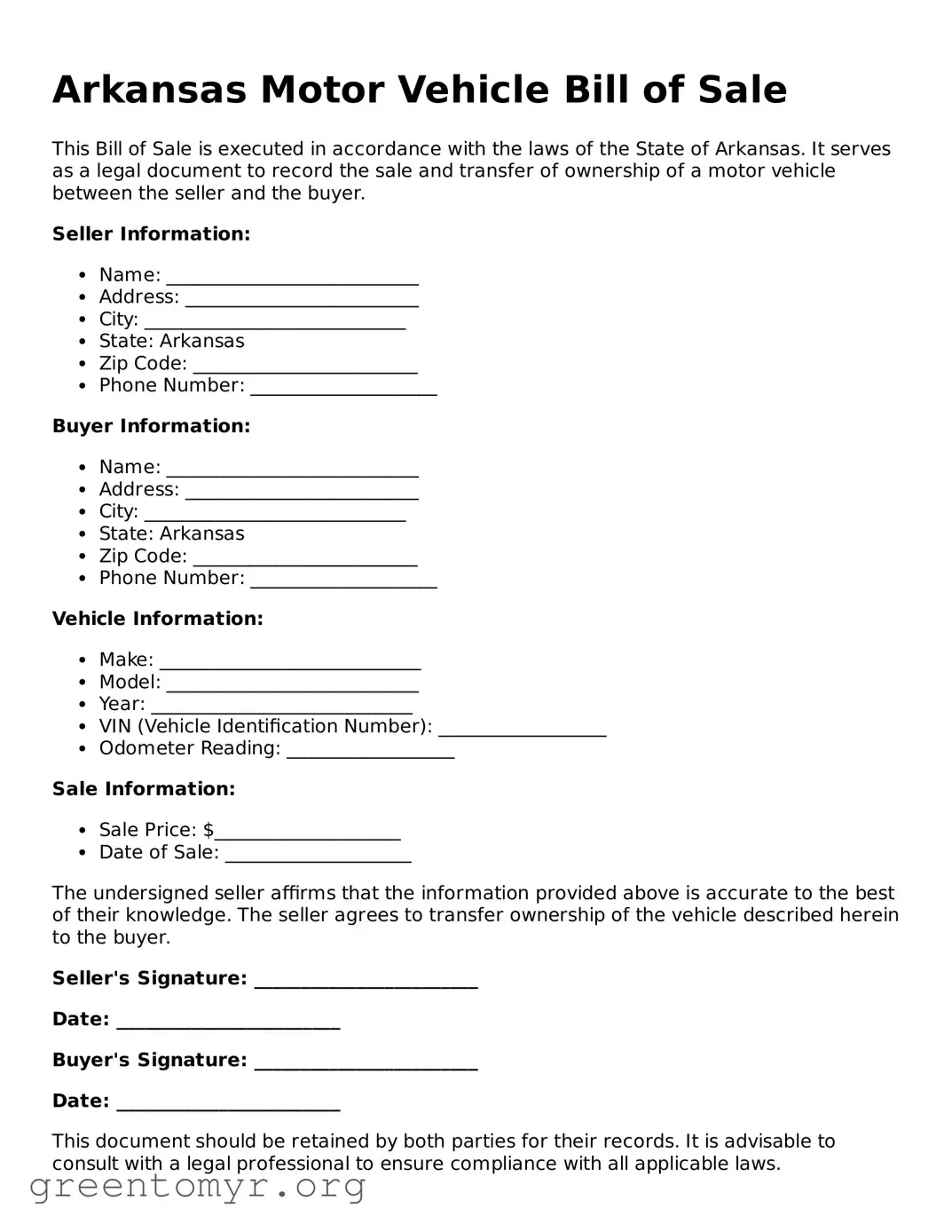
When it comes to buying or selling a vehicle in Arkansas, having the right documentation is crucial. One essential document that facilitates this process is the Arkansas Motor Vehicle Bill of Sale form. This form serves as a legal record of the transaction between the buyer and seller, capturing important details such as the vehicle's make, model, year, and identification number. It also includes the sale price and the date of the transaction, ensuring that both parties are clear about the terms of the sale. Additionally, the form typically requires the signatures of both the buyer and the seller, which solidifies the agreement and protects both parties in case of any disputes in the future. Whether you're a first-time buyer or an experienced seller, understanding how to properly fill out and utilize this form is vital for a smooth and legally sound vehicle transfer.
Arkansas Motor Vehicle Bill of Sale
This Bill of Sale is executed in accordance with the laws of the State of Arkansas. It serves as a legal document to record the sale and transfer of ownership of a motor vehicle between the seller and the buyer.
Seller Information:
Buyer Information:
Vehicle Information:
Sale Information:
The undersigned seller affirms that the information provided above is accurate to the best of their knowledge. The seller agrees to transfer ownership of the vehicle described herein to the buyer.
Seller's Signature: ________________________
Date: ________________________
Buyer's Signature: ________________________
Date: ________________________
This document should be retained by both parties for their records. It is advisable to consult with a legal professional to ensure compliance with all applicable laws.
| Fact Name | Description |
|---|---|
| Purpose | The Arkansas Motor Vehicle Bill of Sale form serves as a legal document that records the transfer of ownership of a motor vehicle from one party to another. |
| Governing Laws | This form is governed by the Arkansas Code Annotated, specifically under Title 27, Chapter 14, which outlines vehicle registration and titling laws. |
| Required Information | Essential details must be included, such as the vehicle identification number (VIN), make, model, year, and the names and addresses of both the seller and buyer. |
| Signatures | Both the seller and the buyer are required to sign the form to validate the transaction, ensuring that both parties acknowledge the sale. |
| Notarization | While notarization is not mandatory, it is recommended to add an extra layer of authenticity and protection for both parties involved in the sale. |
| Record Keeping | After the sale, it is advisable for both parties to keep a copy of the Bill of Sale for their records, as it may be needed for future reference or legal purposes. |
Once you have the Arkansas Motor Vehicle Bill of Sale form in hand, it's important to ensure that all necessary information is accurately filled out. This document serves as a record of the sale, providing essential details about the transaction between the buyer and the seller. Follow these steps to complete the form correctly.
A Motor Vehicle Bill of Sale is a legal document that records the sale of a vehicle between a buyer and a seller. In Arkansas, this form serves as proof of the transaction and includes essential details such as the vehicle's make, model, year, Vehicle Identification Number (VIN), and the sale price. It protects both parties by providing a written record of the agreement and can be useful for title transfer and registration purposes.
While a Bill of Sale is not strictly required for every vehicle sale in Arkansas, it is highly recommended. Having this document helps clarify the terms of the sale and can prevent disputes in the future. If the vehicle is being sold to a dealer or if it is a more complex transaction, a Bill of Sale becomes even more important. Additionally, it is often needed when the buyer registers the vehicle in their name.
When completing a Motor Vehicle Bill of Sale in Arkansas, ensure the following information is included:
Including accurate and complete information helps facilitate a smooth transaction and can be crucial for future reference.
Completing the Bill of Sale form is straightforward. Begin by gathering all necessary information about the vehicle and both parties involved. Next, fill out the form clearly, ensuring that all fields are completed accurately. Both the buyer and seller should sign the document to validate the transaction. It's advisable to keep a copy for your records, as it may be needed for future reference or legal purposes.
You can find a Motor Vehicle Bill of Sale form through several sources:
Regardless of where you obtain the form, ensure it meets the requirements set by Arkansas law.
Completing the Arkansas Motor Vehicle Bill of Sale form can be straightforward, but many people make common mistakes that can lead to complications down the line. Awareness of these pitfalls can help ensure a smooth transaction.
One frequent error is omitting essential information. Buyers and sellers must provide complete details, including the vehicle's make, model, year, and Vehicle Identification Number (VIN). Missing any of this information can create confusion or legal issues later.
Another common mistake is failing to sign the document. Both the buyer and seller must sign the Bill of Sale for it to be valid. A lack of signatures can render the document ineffective, leaving both parties vulnerable to disputes.
Many individuals also neglect to date the form. Including the date is crucial, as it establishes when the transaction took place. Without this, it can be challenging to prove ownership transfer or resolve any potential disputes regarding the sale.
Inaccurate information can be problematic as well. For instance, listing the wrong VIN or vehicle details can lead to serious issues with registration or insurance. Always double-check the information before submitting the form.
Another mistake involves not providing a purchase price. The Bill of Sale should clearly state the amount paid for the vehicle. This is important for tax purposes and can also help in case of future disputes regarding the value of the vehicle.
Some individuals forget to include any conditions of the sale. If the vehicle is sold "as-is," this should be explicitly stated. This protects the seller from future claims regarding the vehicle's condition and informs the buyer of what to expect.
Another oversight is not keeping a copy of the Bill of Sale. After the transaction, both parties should retain a copy for their records. This can be invaluable for future reference, especially if any issues arise regarding ownership or condition.
Lastly, not checking state-specific requirements can lead to complications. Each state may have unique regulations regarding vehicle sales. Familiarizing yourself with Arkansas laws can help avoid unnecessary delays or issues with the transaction.
By being aware of these common mistakes, individuals can navigate the process of completing the Arkansas Motor Vehicle Bill of Sale form more effectively. Attention to detail will help ensure a successful vehicle transaction.
When buying or selling a vehicle in Arkansas, the Motor Vehicle Bill of Sale is an essential document. However, several other forms and documents are often needed to ensure a smooth transaction. Below is a list of these important documents, each serving a specific purpose in the vehicle transfer process.
Having these documents ready can simplify the buying or selling process and help avoid potential legal issues. Always ensure that all forms are filled out accurately and kept in a safe place for future reference.
When filling out the Arkansas Motor Vehicle Bill of Sale form, it is essential to follow certain guidelines to ensure the document is accurate and legally binding. Here are nine important do's and don'ts to consider:
By adhering to these guidelines, you can facilitate a smooth transaction when buying or selling a vehicle in Arkansas.
Understanding the Arkansas Motor Vehicle Bill of Sale form is essential for both buyers and sellers. However, several misconceptions can lead to confusion. Here are six common misunderstandings:
While notarization can add an extra layer of security, it is not a requirement for a Bill of Sale in Arkansas. A simple signature from both parties is sufficient.
A Bill of Sale serves as a receipt for the transaction but does not transfer ownership. To officially transfer the vehicle's title, additional paperwork must be completed with the Arkansas Department of Finance and Administration.
Many people believe that the Bill of Sale must be completed face-to-face. In reality, it can be filled out remotely, as long as both parties agree to the terms.
Private individuals can also create a Bill of Sale for their vehicle transactions. It is not exclusive to licensed dealerships.
While it is important to include certain key details, such as the vehicle's identification number and purchase price, there is no mandated format for the Bill of Sale in Arkansas.
Regardless of the vehicle's value, having a Bill of Sale is recommended. It provides proof of the transaction and can protect both parties in case of disputes.
Addressing these misconceptions can help ensure a smoother transaction process for everyone involved.
When completing and utilizing the Arkansas Motor Vehicle Bill of Sale form, there are several important points to keep in mind: