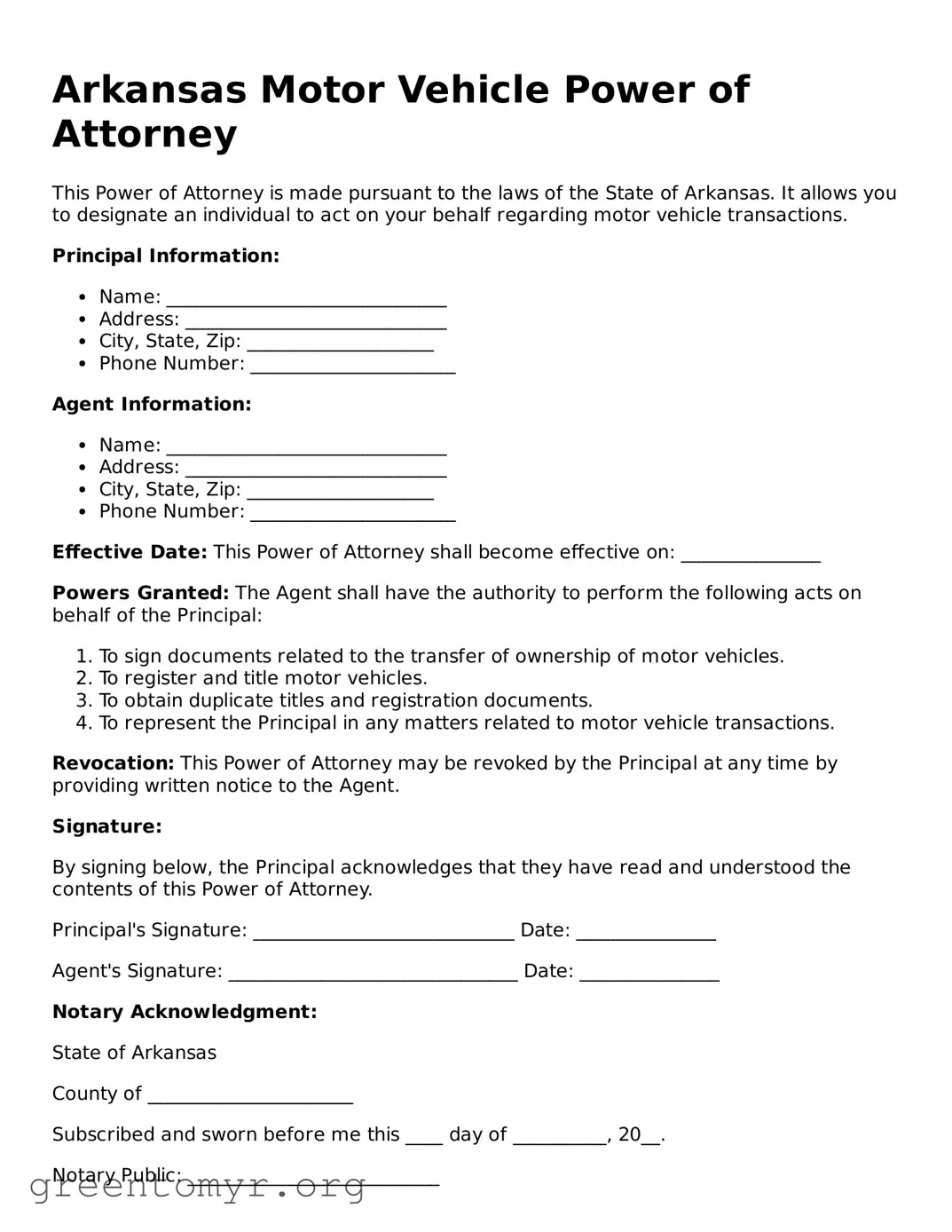
The Arkansas Motor Vehicle Power of Attorney form serves as a vital legal document that empowers an individual to act on behalf of another in matters related to motor vehicle transactions. This form is particularly useful when the vehicle owner cannot be present to complete necessary paperwork, such as transferring ownership, registering a vehicle, or obtaining a title. By designating an agent, the vehicle owner ensures that their interests are represented, whether due to time constraints, health issues, or geographical distance. The form requires specific information, including the names and addresses of both the principal and the agent, as well as details about the vehicle in question. Additionally, it must be signed and dated to be valid, often necessitating notarization to enhance its legal standing. Understanding the nuances of this document can streamline vehicle transactions and provide peace of mind for both parties involved.
Arkansas Motor Vehicle Power of Attorney
This Power of Attorney is made pursuant to the laws of the State of Arkansas. It allows you to designate an individual to act on your behalf regarding motor vehicle transactions.
Principal Information:
Agent Information:
Effective Date: This Power of Attorney shall become effective on: _______________
Powers Granted: The Agent shall have the authority to perform the following acts on behalf of the Principal:
Revocation: This Power of Attorney may be revoked by the Principal at any time by providing written notice to the Agent.
Signature:
By signing below, the Principal acknowledges that they have read and understood the contents of this Power of Attorney.
Principal's Signature: ____________________________ Date: _______________
Agent's Signature: _______________________________ Date: _______________
Notary Acknowledgment:
State of Arkansas
County of ______________________
Subscribed and sworn before me this ____ day of __________, 20__.
Notary Public: ___________________________
My Commission Expires: ________________
| Fact Name | Description |
|---|---|
| Purpose | The Arkansas Motor Vehicle Power of Attorney form allows an individual to designate another person to act on their behalf regarding motor vehicle transactions. |
| Governing Law | This form is governed by the Arkansas Code Annotated § 27-14-101 et seq., which covers motor vehicle registration and titling. |
| Signatories | The form must be signed by the principal (the person granting authority) and may require a witness or notarization for validity. |
| Duration | The authority granted remains effective until the principal revokes it or until the specified transaction is completed. |
| Transactions Covered | This form can be used for various motor vehicle transactions, including title transfers, registrations, and applying for permits. |
| Revocation | The principal can revoke the power of attorney at any time by providing written notice to the agent and any relevant parties. |
| Agent Responsibilities | The agent must act in the best interest of the principal and can only perform actions explicitly authorized in the form. |
| Eligibility | Any adult can serve as an agent, but they must be trustworthy and capable of handling the responsibilities assigned to them. |
| Filing Requirements | While the form itself does not need to be filed with the state, it should be kept in a safe place and presented when required for transactions. |
| Limitations | This power of attorney is specific to motor vehicle matters and does not grant authority over other legal or financial matters. |
Filling out the Arkansas Motor Vehicle Power of Attorney form is a straightforward process. Once completed, this form allows someone you trust to act on your behalf regarding your vehicle. Follow the steps below to ensure you fill out the form correctly.
A Motor Vehicle Power of Attorney is a legal document that allows an individual (the principal) to designate another person (the agent) to act on their behalf regarding specific matters related to motor vehicles. This can include tasks like transferring ownership, registering a vehicle, or obtaining a duplicate title.
You may need this document if you are unable to handle vehicle-related transactions due to various reasons, such as being out of state, having health issues, or simply needing someone to assist you. It ensures that someone you trust can manage these responsibilities without delay.
To complete the form, you will need to provide the following information:
Ensure that the form is filled out clearly and accurately to avoid any issues later on.
While notarization is not always required for a Motor Vehicle Power of Attorney in Arkansas, it is highly recommended. Having the document notarized adds an extra layer of authenticity and can help prevent disputes regarding its validity.
Yes, you can revoke a Motor Vehicle Power of Attorney at any time, as long as you are mentally competent. To do this, you should provide a written notice of revocation to the agent and any relevant parties, such as the Department of Motor Vehicles (DMV).
While there is no state-mandated form, using a standardized Motor Vehicle Power of Attorney form is advisable. This ensures that all necessary information is included and helps streamline the process at the DMV.
The powers granted to the agent can be limited to specific actions related to motor vehicles. For example, you can specify that the agent is only authorized to sell a particular vehicle or to handle registration renewals. It is essential to clearly outline these limitations in the document.
The validity of a Motor Vehicle Power of Attorney generally lasts until it is revoked by the principal or until the principal passes away. If you anticipate needing the document for a limited time, you can specify an expiration date in the form.
If you believe that your agent is not acting in your best interest, you have the right to revoke the Power of Attorney immediately. It is crucial to communicate your concerns and take appropriate action to protect your interests.
You can find a Motor Vehicle Power of Attorney form at local legal stationery stores, online legal resources, or by contacting the Arkansas DMV. Ensure that the form you select is appropriate for your specific needs and complies with Arkansas laws.
When filling out the Arkansas Motor Vehicle Power of Attorney form, many individuals make common mistakes that can lead to delays or complications in processing. Understanding these pitfalls can help ensure that the form is completed correctly and efficiently.
One frequent mistake is not providing complete information about the vehicle. The form requires specific details such as the Vehicle Identification Number (VIN), make, model, and year. Omitting any of this information can render the form invalid. It's essential to double-check that all vehicle details are accurate and fully filled out.
Another common error involves the designation of the attorney-in-fact. Some people fail to clearly identify who they are granting power to. This section must include the full name and address of the person designated to act on their behalf. Incomplete or unclear information can lead to confusion and potential disputes.
Many individuals also overlook the importance of signatures. The form requires signatures from both the principal (the person granting power) and the attorney-in-fact. If either signature is missing, the form will not be accepted. Always ensure that both parties have signed and dated the document.
In addition, individuals sometimes neglect to have the form notarized. In Arkansas, notarization is often required for the Power of Attorney to be valid. Failing to have the document notarized can result in rejection by the Department of Motor Vehicles (DMV).
Another mistake is using outdated versions of the form. Laws and regulations can change, so it is crucial to use the most current version of the Power of Attorney form. Always check for updates on official state websites to avoid using obsolete documents.
People may also make the error of not reading the instructions carefully. Each section of the form has specific requirements, and misunderstanding these can lead to incomplete submissions. Taking the time to read through the instructions thoroughly can prevent many common mistakes.
Additionally, some individuals fail to keep copies of the completed form. It is important to retain a copy for personal records. This can be useful for future reference or in case any issues arise regarding the power granted.
Lastly, individuals sometimes rush through the process. Filling out the form hastily can lead to careless mistakes. Taking the time to review each section and ensure accuracy can save time and frustration down the line.
When dealing with motor vehicle transactions in Arkansas, several forms and documents may accompany the Motor Vehicle Power of Attorney form. These documents help ensure that all legal requirements are met and that the process runs smoothly. Below is a list of commonly used forms.
These documents play a crucial role in ensuring that vehicle transactions are legally sound and transparent. Having them prepared and ready can save time and reduce complications during the process.
The Motor Vehicle Power of Attorney form allows a person to authorize another individual to act on their behalf regarding vehicle-related matters. Here are eight documents that share similarities with this form:
When filling out the Arkansas Motor Vehicle Power of Attorney form, it's important to ensure accuracy and clarity. Here are some key do's and don'ts to keep in mind:
Understanding the Arkansas Motor Vehicle Power of Attorney form is essential for anyone looking to delegate authority regarding their vehicle. However, several misconceptions often arise. Below is a list of common misunderstandings along with clarifications to help you navigate this important document.
This form can be used for various purposes, including registering a vehicle, obtaining a title, or handling other motor vehicle-related tasks, not just ownership transfer.
While you can choose anyone to be your agent, it is wise to select someone you trust, as they will have significant authority over your vehicle matters.
Notarization is not always required for the form to be effective. However, having it notarized can add an extra layer of authenticity and may be necessary for certain transactions.
You have the right to revoke the Power of Attorney at any time, as long as you follow the proper procedures to do so.
The Power of Attorney is generally effective until you revoke it or until a specified event occurs, such as the completion of a particular transaction.
While legal professionals can assist, you are allowed to fill out the form yourself, provided you understand the requirements and implications.
This form is primarily designed for use within Arkansas, but it may be recognized in other states, depending on their laws regarding Powers of Attorney.
The authority granted can be limited to specific tasks. You can define what actions your agent can and cannot take on your behalf.
A will governs the distribution of assets after death, whereas a Power of Attorney is effective during your lifetime for managing vehicle-related matters.
The Motor Vehicle Power of Attorney is specific to vehicle-related issues, while a general Power of Attorney covers a broader range of financial and legal matters.
By dispelling these misconceptions, individuals can make informed decisions about using the Arkansas Motor Vehicle Power of Attorney form. It is always advisable to seek guidance if you have specific questions or concerns.
When dealing with the Arkansas Motor Vehicle Power of Attorney form, several important considerations come into play. Understanding these aspects can ensure that the process is smooth and legally sound.