In the competitive landscape of today's job market, protecting business interests while fostering employee growth is a delicate balance. The Arkansas Non-compete Agreement form serves as a vital tool for employers aiming to safeguard their trade secrets and customer relationships. By outlining the specific terms under which an employee agrees not to engage in similar work for a competing business after leaving, this agreement can help prevent the erosion of a company’s competitive edge. Key aspects of the form include the duration of the non-compete period, the geographical scope of the restriction, and the type of work that is prohibited. It’s essential for both employers and employees to understand these elements, as they can significantly impact career mobility and business operations. When crafted thoughtfully, a non-compete agreement can provide clarity and protection for all parties involved, ensuring that the interests of the business are upheld while allowing employees to navigate their professional paths responsibly.
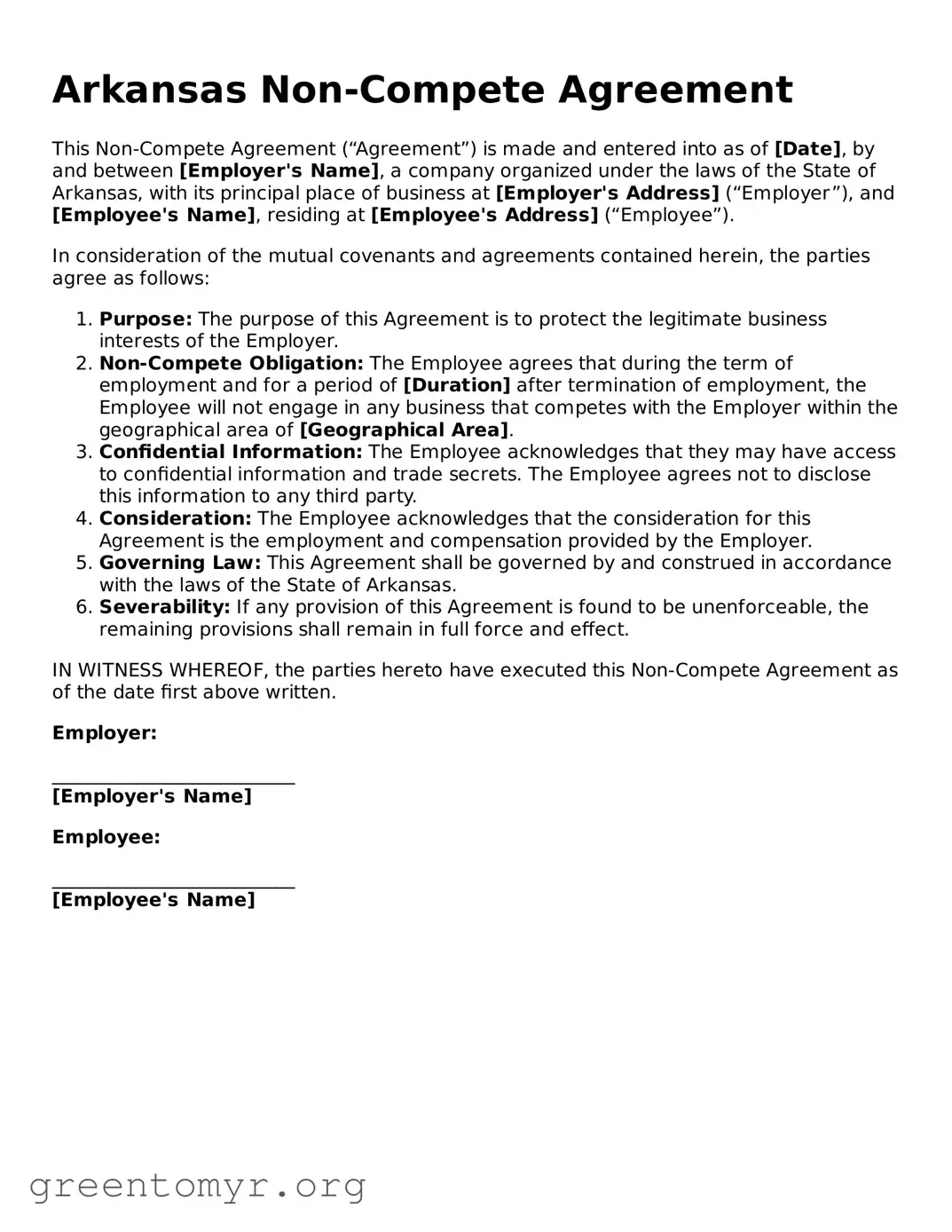
Arkansas Non-Compete Agreement
This Non-Compete Agreement (“Agreement”) is made and entered into as of [Date], by and between [Employer's Name], a company organized under the laws of the State of Arkansas, with its principal place of business at [Employer's Address] (“Employer”), and [Employee's Name], residing at [Employee's Address] (“Employee”).
In consideration of the mutual covenants and agreements contained herein, the parties agree as follows:
IN WITNESS WHEREOF, the parties hereto have executed this Non-Compete Agreement as of the date first above written.
Employer:
__________________________
[Employer's Name]
Employee:
__________________________
[Employee's Name]
| Fact Name | Description |
|---|---|
| Governing Law | The Arkansas Non-compete Agreement is governed by Arkansas Code Annotated § 4-75-101. |
| Enforceability | Non-compete agreements in Arkansas are enforceable only if they are reasonable in time, geographic area, and scope of activity. |
| Time Limit | Typically, a non-compete agreement in Arkansas should not exceed three years in duration. |
| Consideration | For a non-compete agreement to be valid, there must be adequate consideration, such as employment or specialized training. |
| Restrictions on Employment | The agreement should not unreasonably restrict an individual's right to work in their chosen profession. |
Completing the Arkansas Non-compete Agreement form is a straightforward process. It is important to ensure that all sections are filled out accurately to avoid any potential issues in the future. Follow the steps outlined below to successfully complete the form.
A Non-compete Agreement is a legal document that restricts an employee from working for competitors or starting a competing business for a specified period after leaving a job. This agreement aims to protect a company's proprietary information, trade secrets, and overall business interests. In Arkansas, these agreements must be reasonable in scope and duration to be enforceable.
Yes, Non-compete Agreements can be enforceable in Arkansas, but they must meet certain criteria. The agreement should be reasonable in terms of duration, geographic area, and the type of work restricted. Arkansas courts typically look for a balance between protecting the employer's interests and not unduly restricting the employee's ability to earn a living.
Several factors can influence whether a Non-compete Agreement is considered reasonable:
If an employee violates a Non-compete Agreement, the employer may seek legal remedies. This could include:
It's important for both parties to understand their rights and obligations under the agreement.
Yes, Non-compete Agreements can be modified or terminated, but this typically requires mutual consent from both the employer and the employee. Any changes should be documented in writing to ensure clarity and enforceability. It's advisable to consult with a legal professional when making modifications to ensure compliance with state laws.
Yes, it is highly recommended to consult a lawyer before signing a Non-compete Agreement. A legal professional can help clarify the terms of the agreement and assess its fairness and enforceability. This step can provide peace of mind and ensure that you fully understand your rights and obligations.
Filling out the Arkansas Non-compete Agreement form can be a straightforward process, but many people make common mistakes that can lead to complications down the line. One frequent error is failing to clearly define the scope of the non-compete clause. This includes not specifying the geographic area in which the restrictions apply. Without a clear definition, the agreement may be deemed unenforceable.
Another mistake is neglecting to include a reasonable duration for the non-compete period. If the time frame is too long, it may be seen as overly restrictive, making it difficult to enforce. A well-defined duration helps to ensure that the agreement is fair and legally sound.
Many individuals also overlook the importance of mutual consideration. A non-compete agreement should provide something of value to both parties. Failing to outline what each party gains from the agreement can render it invalid. This could be a job offer, a promotion, or access to sensitive information.
Inadequate details about the specific activities that are restricted is another common pitfall. Simply stating that an employee cannot work for competitors is often too vague. Clear descriptions of what constitutes competition can help avoid confusion and potential legal disputes.
People sometimes forget to date the agreement. A missing date can create ambiguity regarding when the terms take effect. This can lead to misunderstandings about the enforceability of the agreement and the obligations of the parties involved.
Additionally, individuals may fail to have the agreement reviewed by a legal professional. This oversight can lead to errors that could have been easily avoided. Consulting with a lawyer ensures that the agreement complies with Arkansas law and meets the specific needs of both parties.
Another mistake is not considering the possibility of changes in employment circumstances. If the agreement does not account for potential changes, such as job title or responsibilities, it may become irrelevant. It’s important to draft the agreement with flexibility in mind.
Finally, some people neglect to keep a copy of the signed agreement. Without a copy, it can be challenging to enforce the terms later. Both parties should retain copies to ensure clarity and accountability moving forward.
When drafting or reviewing an Arkansas Non-compete Agreement, several other forms and documents may also be relevant. These documents can help clarify the terms of employment, protect business interests, and ensure compliance with state laws. Below is a list of commonly used forms that may accompany a Non-compete Agreement.
Each of these documents plays a significant role in establishing clear expectations and protecting the interests of both employers and employees. It is essential to consider how they interact with the Non-compete Agreement to ensure comprehensive legal protection.
When filling out the Arkansas Non-compete Agreement form, it is essential to approach the task with care and attention to detail. Here are some key points to consider:
Non-compete agreements can often be misunderstood, leading to confusion among employees and employers alike. Here are six common misconceptions about the Arkansas Non-compete Agreement form:
Many people believe that once a non-compete agreement is signed, it is automatically enforceable. However, in Arkansas, these agreements must meet specific criteria to be valid, including being reasonable in scope and duration.
It is a common misconception that non-compete agreements follow a one-size-fits-all model. In reality, each agreement can vary significantly based on the nature of the business, the role of the employee, and the specific terms negotiated.
Some believe that non-compete agreements are only necessary for executives or high-ranking employees. In fact, any employee who has access to sensitive information or trade secrets may be required to sign such an agreement.
This misconception suggests that a non-compete agreement completely restricts an individual from working in their industry. However, these agreements typically limit competition in specific ways, allowing for potential employment in other capacities or locations.
Some individuals think that only companies utilize non-compete agreements. Conversely, employees may also seek to include such clauses in their contracts to protect their own interests when transitioning to new opportunities.
Many believe that once a non-compete agreement is presented, it is set in stone. In truth, these agreements can often be negotiated to better fit the needs of both the employer and the employee.
Understanding these misconceptions can help individuals navigate the complexities of non-compete agreements more effectively, ensuring that both parties are aware of their rights and obligations.
When considering the Arkansas Non-compete Agreement form, there are several important points to keep in mind. Understanding these can help both employers and employees navigate the legal landscape more effectively.
By keeping these key takeaways in mind, both employers and employees can better understand their rights and obligations under the Arkansas Non-compete Agreement form.