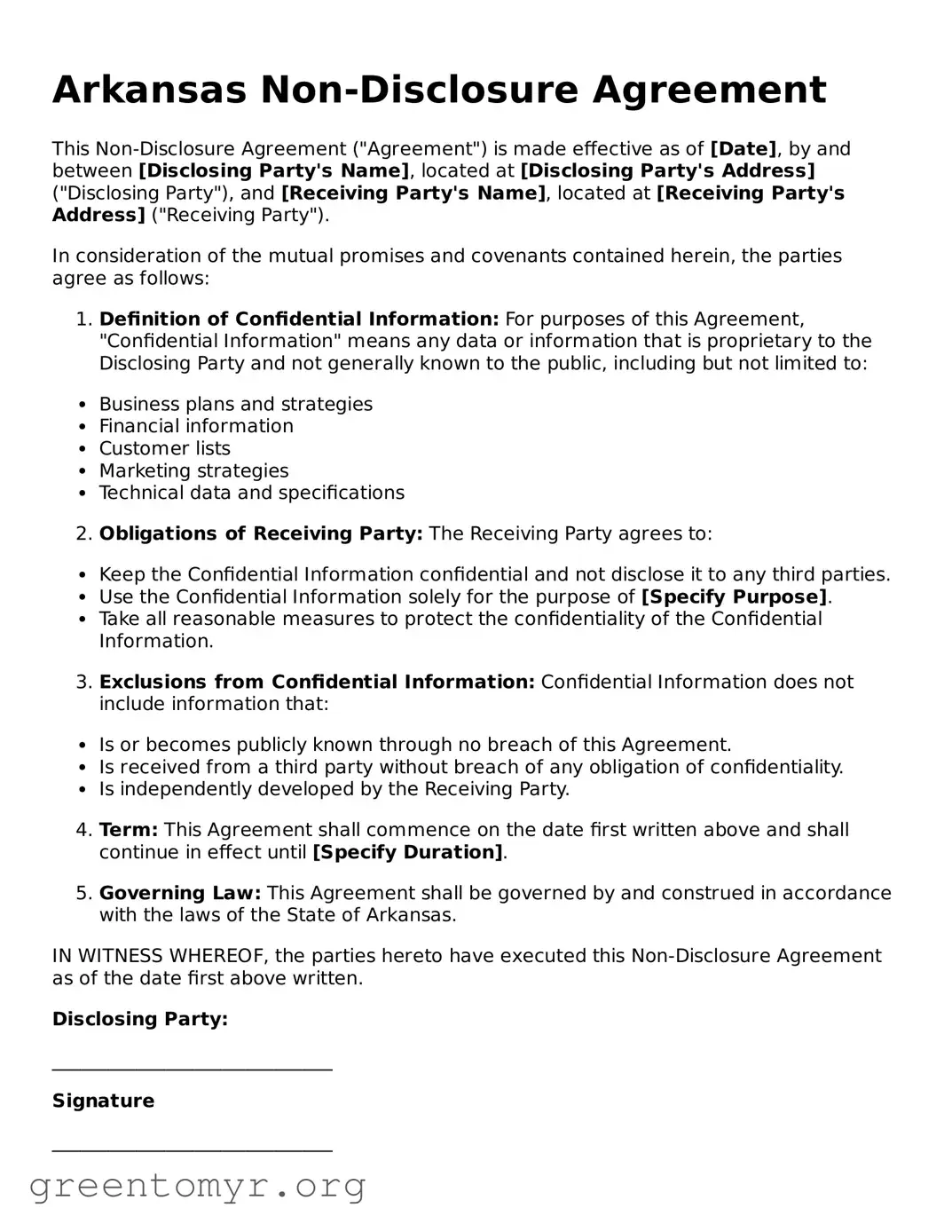
In the realm of business and personal transactions, confidentiality plays a pivotal role in protecting sensitive information. The Arkansas Non-disclosure Agreement (NDA) form serves as a crucial tool for individuals and entities seeking to safeguard proprietary data from unauthorized disclosure. This legally binding document outlines the specific terms under which confidential information can be shared, ensuring that both parties understand their obligations. Key elements of the form include a clear definition of what constitutes confidential information, the duration of the confidentiality obligation, and the consequences of breach. Additionally, the agreement may specify the permitted uses of the disclosed information and any exceptions that apply. By utilizing the Arkansas NDA, parties can foster trust and encourage open communication while minimizing the risk of information leaks that could jeopardize their competitive edge or personal privacy.
Arkansas Non-Disclosure Agreement
This Non-Disclosure Agreement ("Agreement") is made effective as of [Date], by and between [Disclosing Party's Name], located at [Disclosing Party's Address] ("Disclosing Party"), and [Receiving Party's Name], located at [Receiving Party's Address] ("Receiving Party").
In consideration of the mutual promises and covenants contained herein, the parties agree as follows:
IN WITNESS WHEREOF, the parties hereto have executed this Non-Disclosure Agreement as of the date first above written.
Disclosing Party:
______________________________
Signature
______________________________
Name
______________________________
Title
Receiving Party:
______________________________
Signature
______________________________
Name
______________________________
Title
| Fact Name | Description |
|---|---|
| Purpose | The Arkansas Non-disclosure Agreement (NDA) is used to protect confidential information shared between parties. |
| Governing Law | This agreement is governed by the laws of the State of Arkansas. |
| Parties Involved | The NDA typically involves a disclosing party and a receiving party. |
| Duration | The duration of confidentiality is usually specified within the agreement, often lasting several years. |
| Permitted Disclosures | The NDA outlines circumstances under which confidential information may be disclosed, such as legal obligations. |
| Consequences of Breach | Violating the NDA can lead to legal action and potential damages for the disclosing party. |
Filling out the Arkansas Non-disclosure Agreement form is a straightforward process. Once you have completed the form, you will have a legally binding document that helps protect sensitive information. Follow the steps below to ensure you fill out the form correctly.
Once you have completed these steps, review the form to ensure all information is accurate and complete. After that, both parties should retain a copy for their records.
An Arkansas Non-disclosure Agreement is a legal contract designed to protect confidential information shared between parties. This agreement ensures that sensitive information, such as trade secrets or proprietary data, remains confidential and is not disclosed to unauthorized individuals or entities. It is commonly used in business relationships, employment situations, and partnerships.
You should consider using an NDA in various situations, including:
In any scenario where confidential information is exchanged, an NDA can help protect your interests.
An effective NDA typically includes the following key elements:
The duration of an NDA can vary based on the agreement between the parties involved. Generally, NDAs specify a time frame during which the information must remain confidential. This period can range from a few years to an indefinite duration, depending on the nature of the information and the agreement terms.
Yes, NDAs are enforceable in Arkansas as long as they meet the legal requirements. The agreement must be clear, reasonable in scope, and not overly restrictive. Courts will typically uphold NDAs that protect legitimate business interests without imposing undue hardship on the parties involved.
If a party breaches the NDA, the injured party may seek legal remedies. This can include:
It is crucial to document any breach and consult with legal counsel to determine the best course of action.
While it is possible to draft an NDA without legal assistance, consulting a lawyer is advisable. A legal professional can ensure that the agreement meets all necessary legal standards and adequately protects your interests. They can also help tailor the NDA to your specific needs and circumstances.
Filling out the Arkansas Non-disclosure Agreement form can be straightforward, but several common mistakes can lead to complications. One frequent error is failing to provide complete information. This includes not filling in all required fields, which may result in the form being rejected or deemed invalid.
Another mistake is neglecting to specify the duration of the confidentiality obligations. Without a clear timeline, the agreement may lack enforceability. Parties involved may have differing interpretations of how long the non-disclosure terms should last, leading to potential disputes.
People often overlook the importance of defining what constitutes "confidential information." If this section is vague or unclear, it can create confusion about what information is protected under the agreement. Clear definitions help ensure that all parties understand their responsibilities.
Additionally, many individuals forget to include the date of the agreement. This detail is crucial for establishing when the obligations begin. Without a date, it can be difficult to determine the timeline for confidentiality.
Some individuals may not consider the need for signatures from all parties involved. An unsigned agreement is not legally binding. Each party should review and sign the document to confirm their understanding and acceptance of the terms.
Another common oversight is not providing a clear explanation of the consequences for breach of the agreement. This section should outline the potential repercussions if the confidentiality terms are violated, ensuring that all parties are aware of the seriousness of the agreement.
People sometimes fail to consult legal advice before finalizing the agreement. While not mandatory, seeking guidance can help clarify any uncertainties and ensure that the document meets all legal requirements.
In some cases, individuals use outdated versions of the form. Laws and regulations can change, and using an old version may lead to compliance issues. Always ensure that the most current form is being utilized.
Lastly, individuals may not keep a copy of the signed agreement. Retaining a copy is essential for reference in case of disputes. Both parties should maintain their own copies to ensure they have access to the terms agreed upon.
When entering into a Non-disclosure Agreement (NDA) in Arkansas, several other forms and documents may be relevant to ensure a comprehensive understanding and protection of confidential information. Below is a list of commonly used documents that often accompany an NDA.
These documents serve various purposes and can enhance the protection of confidential information in business relationships. It is essential to consider each one carefully to ensure that all parties understand their rights and obligations.
When filling out the Arkansas Non-disclosure Agreement form, it's important to pay attention to detail. Here are five things you should and shouldn't do:
Understanding the Arkansas Non-disclosure Agreement (NDA) is essential for protecting sensitive information. However, several misconceptions can lead to confusion. Here are five common misconceptions:
Many believe that all NDAs are interchangeable. In reality, each NDA can be tailored to specific situations and needs. The terms can vary significantly based on the parties involved and the information being protected.
While businesses frequently use NDAs, individuals can also benefit from them. Anyone sharing sensitive personal information, such as during a job interview or partnership discussions, may find an NDA useful.
This is a common misunderstanding. NDAs typically specify what information is confidential. You can still discuss non-confidential matters freely.
Not all NDAs are enforceable. Courts may not uphold NDAs that are overly broad or that restrict a person’s ability to work or share information that is public knowledge.
Many assume that NDAs are indefinite. However, most NDAs have a specified duration, after which the obligations to keep information confidential may expire.
Clarifying these misconceptions can help individuals and businesses better protect their sensitive information while understanding their rights and obligations under an NDA.
When filling out and using the Arkansas Non-disclosure Agreement form, consider the following key points: