Content Navigation

The Arkansas Notary Acknowledgment form serves a crucial role in the notarization process, ensuring that documents are properly authenticated and recognized as valid. This form is typically utilized when individuals need to verify their identities and confirm their willingness to sign a document. It includes essential elements such as the name of the signer, the date of the acknowledgment, and the notary's official seal. Additionally, it often contains a statement affirming that the signer appeared before the notary and acknowledged their signature. The form is designed to protect both the signer and the notary, providing a clear record of the transaction. Understanding the components and requirements of this form is vital for anyone involved in legal, financial, or real estate transactions in Arkansas, as it helps to ensure that all parties are adequately informed and protected throughout the process.

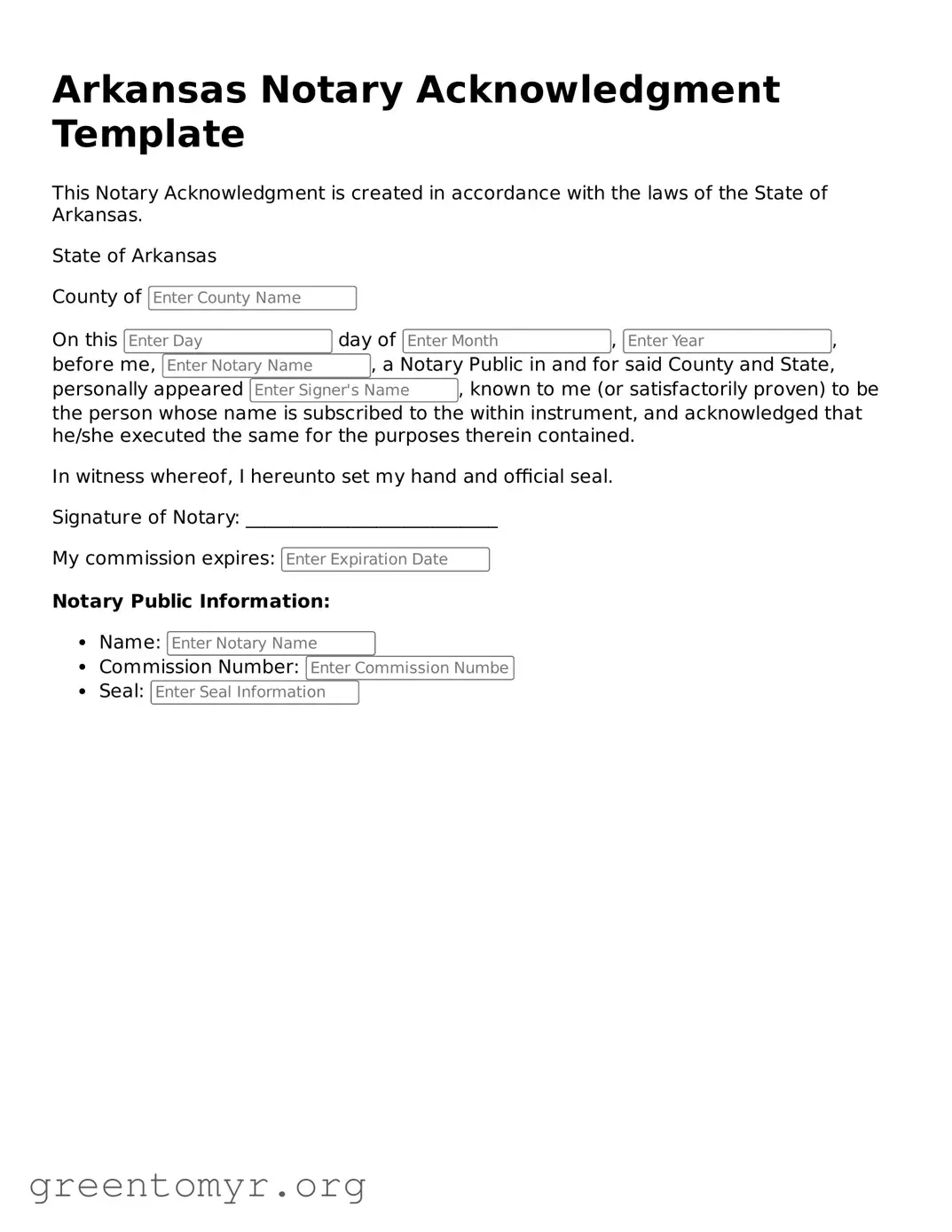
Arkansas Notary Acknowledgement Example

Arkansas Notary Acknowledgment Template

This Notary Acknowledgment is created in accordance with the laws of the State of Arkansas.

State of Arkansas

County of

On this day of , , before me, , a Notary Public in and for said County and State, personally appeared , known to me (or satisfactorily proven) to be the person whose name is subscribed to the within instrument, and acknowledged that he/she executed the same for the purposes therein contained.

In witness whereof, I hereunto set my hand and official seal.

Signature of Notary: ___________________________

My commission expires:

Notary Public Information:

  • Name:
  • Commission Number:
  • Seal:

PDF Form Features

Fact Name Description
Purpose The Arkansas Notary Acknowledgment form is used to verify the identity of the signer and confirm that they signed the document willingly.
Governing Law The form is governed by Arkansas Code Annotated, Title 21, Chapter 14, which outlines the powers and duties of notaries public.
Signer's Identity The notary must ensure that the signer presents valid identification to confirm their identity.
Signature Requirement The signer must sign the document in the presence of the notary public for the acknowledgment to be valid.
Notary's Role The notary public acts as an impartial witness to the signing of the document, ensuring that all parties understand the contents.
Record Keeping Notaries are required to keep a record of all acknowledgments performed, including details of the signer and the document.
Expiration Notary acknowledgments do not expire; however, the underlying document may have its own validity period.
Fees Notaries in Arkansas may charge a fee for their services, which is typically capped by state law.
Common Uses This form is commonly used for real estate transactions, legal documents, and other official paperwork requiring notarization.

Guide to Using Arkansas Notary Acknowledgement

Once you have your Arkansas Notary Acknowledgement form in hand, it’s time to fill it out correctly to ensure that your document is valid. Following these steps will help you complete the form efficiently.

  1. Identify the Document: At the top of the form, write the title of the document you are acknowledging. This could be a contract, deed, or any other legal instrument.
  2. Notary Public Information: Fill in your name as the notary public. Include your full name, followed by your title.
  3. State and County: Indicate the state (Arkansas) and the county where the acknowledgment is being made.
  4. Date: Write the date when the acknowledgment is being completed. Use the format MM/DD/YYYY for clarity.
  5. Signer's Information: Enter the name of the individual whose signature you are notarizing. Ensure the name is spelled correctly.
  6. Signature of the Signer: Leave space for the signer to provide their signature. This is crucial for the acknowledgment.
  7. Notary Seal: Affix your official notary seal in the designated area. This seal validates your acknowledgment.
  8. Complete the Certificate: Fill out the certificate section at the bottom of the form, ensuring all required information is included.

After completing the form, ensure that all entries are accurate. Once filled out, the form is ready for use, providing the necessary acknowledgment for the document in question.

Get Answers on Arkansas Notary Acknowledgement

What is an Arkansas Notary Acknowledgement form?

The Arkansas Notary Acknowledgement form is a document used to confirm that a person has willingly signed a document in front of a notary public. This form serves as a legal record that the signer was identified and that they understood the contents of the document they were signing.

Why do I need a Notary Acknowledgement?

A Notary Acknowledgement is important for several reasons:

  • It helps prevent fraud by verifying the identity of the signer.
  • It ensures that the signer is acting voluntarily and understands what they are signing.
  • Many legal documents require notarization to be considered valid, such as deeds, contracts, and powers of attorney.

How do I complete the Notary Acknowledgement form?

Completing the form is straightforward. Follow these steps:

  1. Fill in the name of the signer and the type of document being acknowledged.
  2. The signer must appear in person before the notary.
  3. The notary will verify the signer's identity, typically by checking a government-issued ID.
  4. After confirming the identity, the notary will complete the form, including their signature and seal.

Where can I obtain an Arkansas Notary Acknowledgement form?

You can find the Arkansas Notary Acknowledgement form in various places:

  • Online legal document services that provide templates.
  • Local government offices, such as the county clerk's office.
  • Law libraries or public libraries that offer legal resources.

Is there a fee for notarization in Arkansas?

Yes, notaries in Arkansas can charge a fee for their services. The maximum fee allowed is set by state law. Typically, it ranges from $5 to $10 per signature. It's a good idea to ask the notary about their fees before the appointment.

What if I cannot find a notary public?

If you are having trouble locating a notary public, consider these options:

  • Check with local banks, as many offer notary services to customers.
  • Look for mobile notary services that can come to your location.
  • Search online for notary directories that list notaries in your area.

Common mistakes

Filling out the Arkansas Notary Acknowledgement form can seem straightforward, but several common mistakes can lead to issues. One significant error is failing to include the correct date. The date should reflect when the acknowledgment is made, not when the document was signed. If the date is incorrect or missing, it can raise questions about the validity of the notarization.

Another frequent mistake involves not providing complete information about the signer. The form requires the full name of the individual whose signature is being acknowledged. Omitting middle names or initials can create confusion and may invalidate the notarization. It’s essential to ensure that the name matches the identification presented to the notary.

Additionally, people often overlook the requirement for the notary's signature and seal. The notary must sign and affix their official seal in the designated area. If either is missing, the acknowledgment may not be accepted. Always double-check that both the signature and seal are present before submitting the document.

Lastly, some individuals forget to include a statement of capacity. This section indicates the capacity in which the signer is acting, such as whether they are signing on their own behalf or as a representative of a company. Failing to clarify this can lead to misunderstandings about the authority of the signer, potentially complicating matters down the line.

Documents used along the form

In Arkansas, various forms and documents are often used in conjunction with the Notary Acknowledgment form. These documents serve different purposes, often related to legal and official transactions. Below is a list of commonly used forms.

  • This document allows one person to grant another the authority to act on their behalf in legal or financial matters.
  • A declaration that outlines the terms of a trust, including the roles of the trustee and beneficiaries.
  • This document specifies an individual's wishes regarding medical treatment in situations where they are unable to communicate their preferences.
  • A legal contract between a borrower and a lender, detailing the terms of a loan secured by real property.
  • A contract that outlines the terms and conditions under which one party agrees to sell property to another.
  • A legal document that expresses a person's wishes regarding the distribution of their assets after death.
  • A written statement confirmed by oath or affirmation, used as evidence in court or other legal proceedings.
  • A document that releases one party from liability for certain actions or events, often used in waivers and contracts.

These documents are essential in various legal processes and transactions. Understanding their purpose can help ensure that individuals complete their legal requirements accurately.

Similar forms

The Notary Acknowledgment form is an important document in the realm of legal transactions. It serves to verify the identity of the signer and confirm that they willingly signed the document. Several other documents share similar functions or purposes. Here’s a list of seven documents that are comparable to the Notary Acknowledgment form:

  • Affidavit: An affidavit is a written statement confirmed by oath or affirmation. Like a Notary Acknowledgment, it requires the signer to declare the truthfulness of the content before a notary public.
  • Power of Attorney: This document allows one person to act on behalf of another. It typically requires notarization to ensure that the principal's identity is verified and that they are granting authority willingly.
  • Certificate of Acknowledgment: Similar to the Notary Acknowledgment, this certificate confirms that the signer appeared before a notary and acknowledged their signature on a document.
  • Deed: A deed transfers ownership of property. Notarization is often required to validate the transaction and confirm that the parties involved are who they claim to be.
  • Will: While not always required, notarizing a will can help ensure its authenticity. A notary can confirm the identity of the testator and witness their signature.
  • Loan Documents: Many loan agreements require notarization. This process helps verify the identity of the borrower and ensures that they understand the terms of the loan.
  • Real Estate Closing Documents: These documents finalize the sale of property. Notarization is crucial in this process to confirm the identities of all parties and validate their signatures.

Each of these documents plays a vital role in legal proceedings and transactions, much like the Notary Acknowledgment form.

Dos and Don'ts

When filling out the Arkansas Notary Acknowledgement form, attention to detail is crucial. Here are ten guidelines to follow:

  • Do ensure that all required fields are completed.
  • Do use clear and legible handwriting or type the information.
  • Do verify the identity of the signer before notarizing.
  • Do include the date of the notarization.
  • Do sign and stamp the form in the appropriate sections.
  • Don't leave any sections blank unless specified.
  • Don't use white-out or erasers on the form.
  • Don't notarize a document if the signer is not present.
  • Don't alter the form after it has been signed.
  • Don't forget to keep a record of the notarization in your journal.

Misconceptions

Understanding the Arkansas Notary Acknowledgement form is crucial for anyone looking to navigate legal documents effectively. However, several misconceptions can lead to confusion. Here are eight common misunderstandings:

  1. Notaries can create legal documents. Many believe that notaries have the authority to draft legal documents. In reality, notaries serve to witness signatures and verify identities, not to provide legal advice or create documents.
  2. All notaries are lawyers. A common assumption is that all notaries are licensed attorneys. This is incorrect; notaries can come from various professional backgrounds and do not need to be lawyers.
  3. Notary Acknowledgements are the same as notarizations. While both involve a notary, a notary acknowledgment specifically confirms that a signer has willingly signed a document, whereas notarization may include other acts like administering oaths.
  4. Any document can be acknowledged. Some people think that any type of document can be acknowledged by a notary. However, only certain documents, such as deeds and contracts, typically require a notary acknowledgment.
  5. Notaries can refuse to acknowledge a signature. It is a misconception that notaries must acknowledge every signature presented. If a signer cannot provide proper identification or if the document appears fraudulent, a notary can refuse to proceed.
  6. A notary's seal is optional. Many believe that a notary's seal is not necessary for a valid acknowledgment. In Arkansas, however, the seal is essential for the acknowledgment to be considered valid.
  7. Notaries can charge any fee they want. Some assume that notaries can set their own fees without regulation. In Arkansas, notary fees are capped by law, ensuring consistency and fairness.
  8. Once notarized, a document is permanent. It is a common belief that notarization guarantees a document's permanence. Notarization does not prevent a document from being contested or invalidated in the future.

By dispelling these misconceptions, individuals can better understand the role of notaries and the importance of the Arkansas Notary Acknowledgement form in legal transactions.

Key takeaways

When filling out and using the Arkansas Notary Acknowledgement form, keep these key takeaways in mind:

  1. Ensure Proper Identification: The signer must provide valid identification to confirm their identity before notarization.
  2. Complete All Required Fields: Fill out all sections of the form accurately, including the date, name of the signer, and the type of document being acknowledged.
  3. Notary's Signature and Seal: The notary must sign the form and apply their official seal for the acknowledgment to be valid.
  4. Use Clear Language: Avoid legal jargon. The language in the acknowledgment should be straightforward and easy to understand.
  5. Record Keeping: Maintain a record of the notarized documents for your files, as this may be required for future reference.
  6. State-Specific Requirements: Be aware of any additional requirements specific to Arkansas, as these can vary from other states.