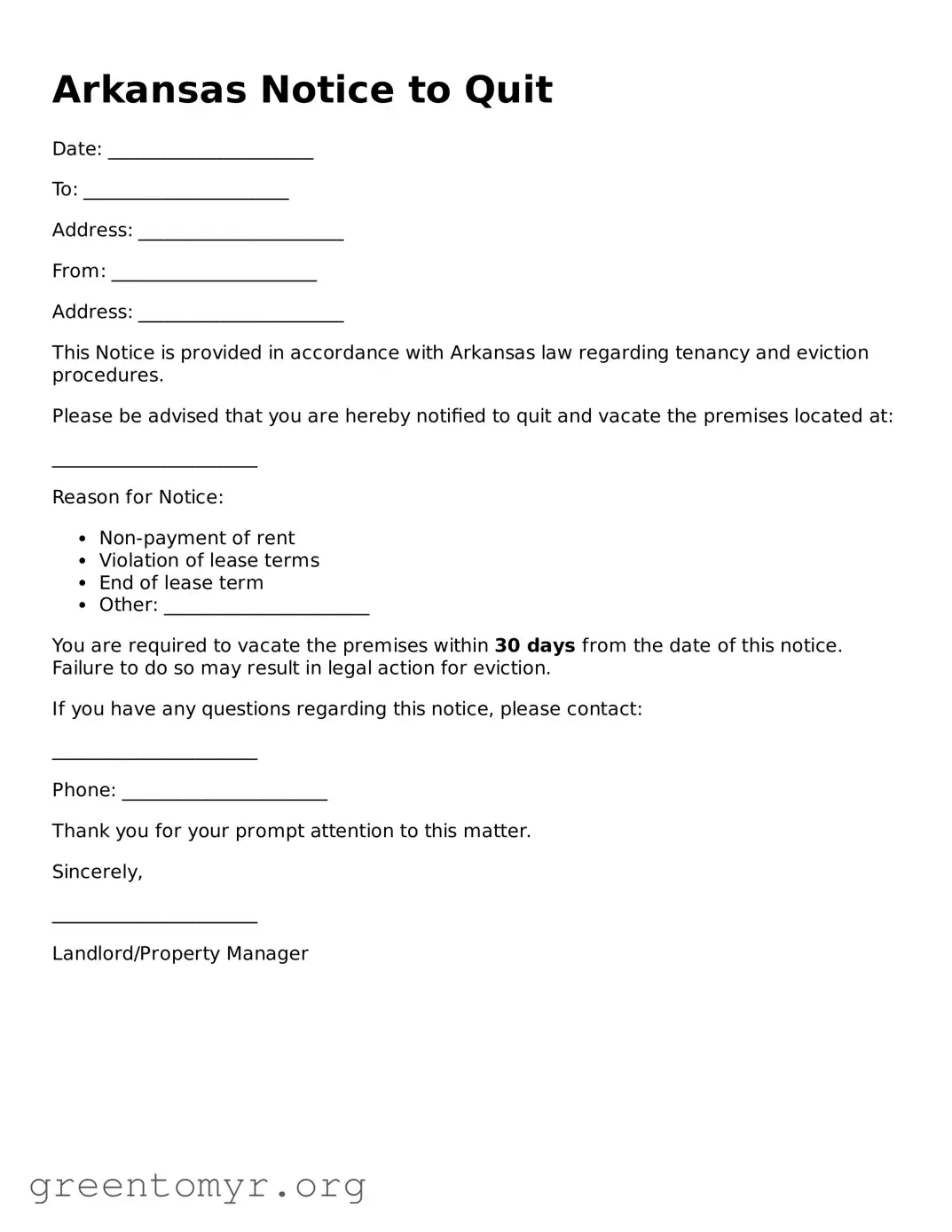
The Arkansas Notice to Quit form serves as a crucial document in landlord-tenant relationships, particularly when a landlord seeks to terminate a lease agreement. This form outlines the necessary steps a landlord must take to inform a tenant of their intent to end the tenancy, typically due to non-payment of rent or lease violations. It specifies the timeframe within which the tenant must vacate the premises, often giving them a set number of days to respond or remedy the situation. The form must be delivered in a manner that complies with state law, ensuring that the tenant receives proper notice. Additionally, it may include details about the reasons for eviction, reinforcing the landlord's position. Understanding the nuances of this form is essential for both landlords and tenants, as it plays a pivotal role in the eviction process and helps to establish a clear line of communication regarding tenancy issues.
Arkansas Notice to Quit
Date: ______________________
To: ______________________
Address: ______________________
From: ______________________
Address: ______________________
This Notice is provided in accordance with Arkansas law regarding tenancy and eviction procedures.
Please be advised that you are hereby notified to quit and vacate the premises located at:
______________________
Reason for Notice:
You are required to vacate the premises within 30 days from the date of this notice. Failure to do so may result in legal action for eviction.
If you have any questions regarding this notice, please contact:
______________________
Phone: ______________________
Thank you for your prompt attention to this matter.
Sincerely,
______________________
Landlord/Property Manager
| Fact Name | Details |
|---|---|
| Purpose | The Arkansas Notice to Quit form is used by landlords to inform tenants of the need to vacate the rental property. |
| Governing Law | The form is governed by Arkansas Code Annotated § 18-17-701 et seq. |
| Notice Period | Typically, landlords must provide a 30-day notice to tenants before initiating eviction proceedings. |
| Delivery Methods | The notice can be delivered in person, by mail, or posted on the property. |
| Contents Required | The notice must include the date, the tenant's name, the address of the rental property, and the reason for termination. |
| Tenant's Rights | Tenants have the right to contest the eviction in court if they believe the notice is unjust. |
| Form Availability | The form is available online or through local legal aid organizations. |
| Signature Requirement | The landlord must sign the notice to validate it. |
| Legal Consequences | Failure to properly serve a Notice to Quit may delay the eviction process. |
| Additional Considerations | Landlords should keep a copy of the notice for their records and document the delivery method. |
After completing the Arkansas Notice to Quit form, the next step is to deliver it to the tenant. This notice serves as a formal request for the tenant to vacate the premises. Proper delivery is crucial to ensure that the notice is legally effective. Follow these steps to accurately fill out the form.
The Arkansas Notice to Quit form is a legal document that a landlord uses to formally notify a tenant that they must vacate the rental property. This notice is typically issued when a tenant has violated the terms of the lease agreement, such as failing to pay rent or causing damage to the property. It serves as a preliminary step before the landlord can initiate eviction proceedings.
A landlord should issue a Notice to Quit when there is a clear violation of the lease agreement. Common reasons include:
It is crucial for landlords to follow the appropriate legal process, as failing to do so may result in delays or complications in eviction proceedings.
The amount of notice required can vary based on the reason for the eviction. Generally, a 14-day notice is required for non-payment of rent, while a 30-day notice may be needed for other lease violations. It is essential for landlords to specify the reason for the notice and ensure that the tenant receives it in a timely manner.
If the tenant does not comply with the Notice to Quit by vacating the property within the specified time frame, the landlord may proceed with filing an eviction lawsuit in court. This process can be lengthy and may require legal representation. It is advisable for landlords to document all communications and attempts to resolve the issue amicably before taking legal action.
Filling out the Arkansas Notice to Quit form can be a straightforward process, but mistakes are common. One frequent error is failing to provide the correct address of the rental property. The address is crucial for identifying the location in question. Without it, the notice may be deemed invalid, which can complicate the eviction process.
Another mistake often made is not including the tenant's full name. Using only a first name or a nickname can lead to confusion. It is important to ensure that the name matches the lease agreement. This helps avoid any potential disputes about who the notice is intended for.
Many individuals also overlook the importance of specifying the reason for the notice. Whether it’s for non-payment of rent or lease violations, clearly stating the reason is essential. A vague explanation can weaken the notice and may not meet legal requirements.
Timing is another critical aspect that can be mismanaged. Some people fill out the form without considering the notice period required by Arkansas law. Each situation may have different timeframes, so it’s important to check the specific requirements. Failing to provide adequate notice can lead to delays in the eviction process.
Inaccurate dates can also pose a problem. When filling out the form, it's vital to include the correct date of the notice. If the date is wrong, it could affect the timeline for the tenant's response. This may ultimately hinder the eviction process.
Lastly, many individuals forget to sign the Notice to Quit. A signature is necessary to validate the document. Without it, the notice may not be considered official, leaving the landlord without the proper legal standing to proceed with eviction.
The Arkansas Notice to Quit form is an important document in the eviction process. However, several other forms and documents may accompany it to ensure a thorough legal approach. Below is a list of these forms, each serving a specific purpose in the rental and eviction process.
Understanding these documents is crucial for both landlords and tenants navigating the eviction process in Arkansas. Each form plays a significant role in ensuring that the rights of both parties are respected and that the process follows legal guidelines.
When filling out the Arkansas Notice to Quit form, it's important to follow specific guidelines to ensure accuracy and compliance. Here’s a list of things to do and avoid:
Misconception 1: The Notice to Quit is the same as an eviction notice.
Many people believe that a Notice to Quit and an eviction notice are interchangeable. However, the Notice to Quit is a preliminary step that informs a tenant of the landlord's intent to terminate the lease. An eviction notice follows if the tenant does not vacate the premises after receiving the Notice to Quit.
Misconception 2: A landlord can issue a Notice to Quit for any reason.
Some assume that landlords can issue a Notice to Quit at will. In reality, landlords must have a valid reason, such as non-payment of rent or violation of lease terms, to issue this notice. Arbitrary reasons are not legally acceptable.
Misconception 3: Tenants have no rights after receiving a Notice to Quit.
Receiving a Notice to Quit does not strip tenants of their rights. Tenants have the opportunity to respond, negotiate, or contest the notice in court. Understanding these rights is crucial for tenants facing potential eviction.
Misconception 4: The Notice to Quit must be delivered in person.
Some believe that personal delivery is the only valid method for serving a Notice to Quit. In Arkansas, landlords can also deliver the notice via certified mail or post it on the property if the tenant is not present.
Misconception 5: A Notice to Quit guarantees immediate eviction.
Many think that once a Notice to Quit is issued, eviction is immediate. This is not the case. The process involves legal proceedings, and tenants often have a set period to vacate before a court can enforce an eviction.
When dealing with the Arkansas Notice to Quit form, it’s important to understand its purpose and how to use it effectively. Here are some key takeaways:
Using the Notice to Quit form correctly can help streamline the eviction process and protect your rights as a landlord.