In the realm of business formation, particularly for limited liability companies (LLCs), the Arkansas Operating Agreement form plays a crucial role in defining the internal operations and management structure of the entity. This document serves as a foundational blueprint, outlining the rights and responsibilities of the members, which can include everything from how profits and losses are allocated to the procedures for admitting new members or handling disputes. By establishing clear guidelines, the Operating Agreement helps prevent misunderstandings and provides a framework for decision-making. Additionally, it addresses important aspects such as the duration of the LLC, the management style—whether member-managed or manager-managed—and the process for amending the agreement itself. While Arkansas law does not mandate the creation of an Operating Agreement, having one is highly advisable as it enhances the credibility of the LLC and protects the limited liability status of its members. Thus, understanding and properly completing the Arkansas Operating Agreement form is essential for anyone looking to ensure a smooth operation of their business venture in the state.
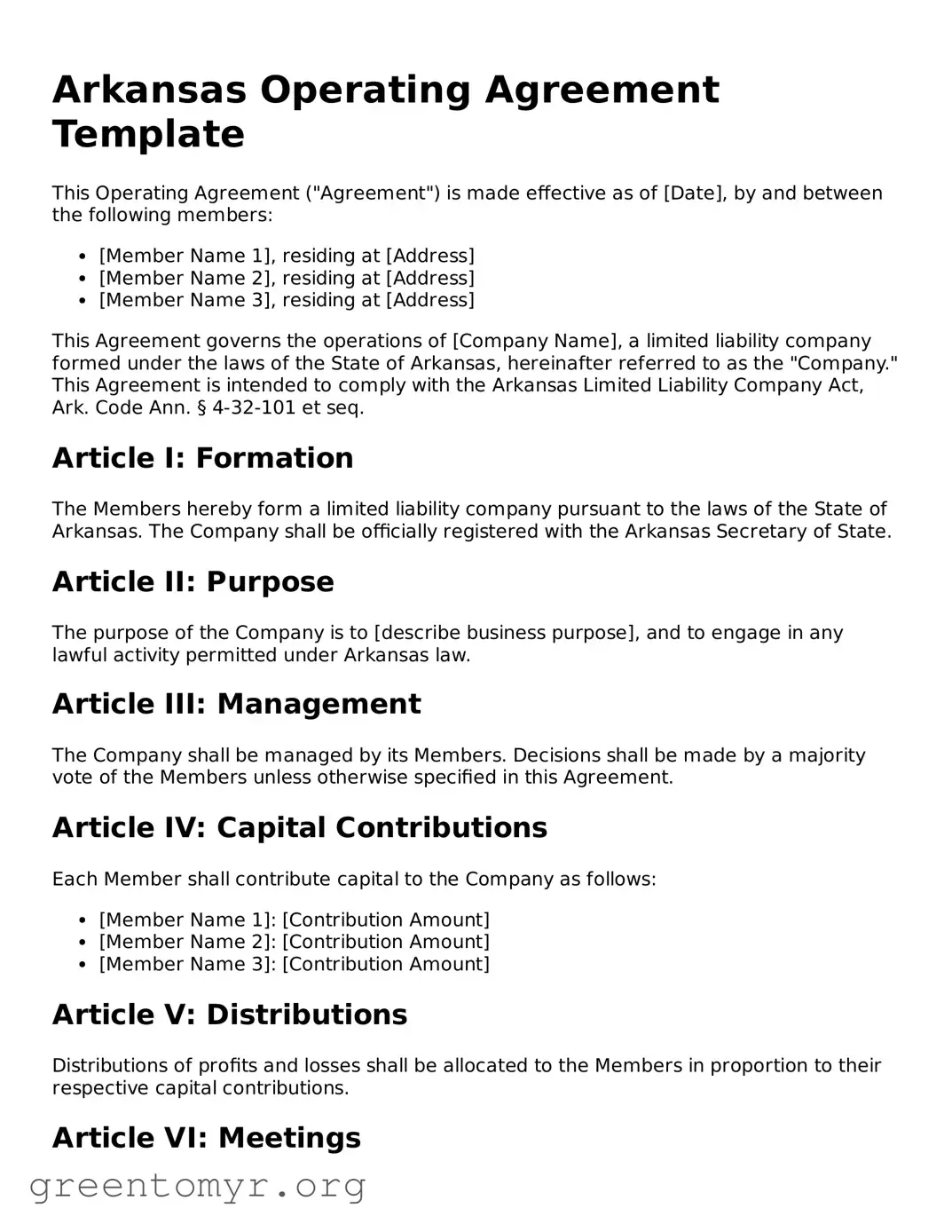
Arkansas Operating Agreement Template
This Operating Agreement ("Agreement") is made effective as of [Date], by and between the following members:
This Agreement governs the operations of [Company Name], a limited liability company formed under the laws of the State of Arkansas, hereinafter referred to as the "Company." This Agreement is intended to comply with the Arkansas Limited Liability Company Act, Ark. Code Ann. § 4-32-101 et seq.
Article I: Formation
The Members hereby form a limited liability company pursuant to the laws of the State of Arkansas. The Company shall be officially registered with the Arkansas Secretary of State.
Article II: Purpose
The purpose of the Company is to [describe business purpose], and to engage in any lawful activity permitted under Arkansas law.
Article III: Management
The Company shall be managed by its Members. Decisions shall be made by a majority vote of the Members unless otherwise specified in this Agreement.
Article IV: Capital Contributions
Each Member shall contribute capital to the Company as follows:
Article V: Distributions
Distributions of profits and losses shall be allocated to the Members in proportion to their respective capital contributions.
Article VI: Meetings
Meetings of the Members shall be held at least annually. Special meetings may be called by any Member upon [number] days' notice to the other Members.
Article VII: Amendments
This Agreement may be amended only by a written agreement signed by all Members.
Article VIII: Miscellaneous
This Agreement shall be governed by and construed in accordance with the laws of the State of Arkansas. If any provision of this Agreement is found to be invalid or unenforceable, the remaining provisions shall continue in full force and effect.
IN WITNESS WHEREOF, the undersigned Members have executed this Operating Agreement as of the date first above written.
______________________________
[Member Name 1]
______________________________
[Member Name 2]
______________________________
[Member Name 3]
| Fact Name | Description |
|---|---|
| Purpose | The Arkansas Operating Agreement outlines the management structure and operating procedures of a limited liability company (LLC). |
| Governing Law | This agreement is governed by the Arkansas Limited Liability Company Act, specifically Title 4, Chapter 32 of the Arkansas Code. |
| Required Signatures | All members of the LLC must sign the Operating Agreement to ensure that everyone agrees to the terms outlined. |
| Flexibility | The Operating Agreement can be customized to fit the specific needs and preferences of the LLC members. |
| Not Mandatory | While not required by state law, having an Operating Agreement is highly recommended for clarity and legal protection. |
| Dispute Resolution | The agreement can include provisions for how disputes among members will be resolved, which can help avoid costly litigation. |
Filling out the Arkansas Operating Agreement form is a straightforward process that requires careful attention to detail. Once completed, this form will help establish the internal rules and structure of your business. Follow the steps below to ensure accurate completion.
An Arkansas Operating Agreement is a crucial document for Limited Liability Companies (LLCs) in the state of Arkansas. This agreement outlines the management structure, responsibilities of members, and operational procedures of the LLC. While it is not a legal requirement to have one, having an Operating Agreement can help prevent misunderstandings among members and protect the company's limited liability status.
All LLC members should consider creating an Operating Agreement, regardless of the size of the company or the number of members involved. This document is especially important for multi-member LLCs, as it clarifies each member's role and responsibilities. Even single-member LLCs can benefit from having an Operating Agreement, as it provides a clear framework for operations and can be useful for legal and tax purposes.
An effective Operating Agreement should cover several key areas, including:
No, the Operating Agreement is not filed with the state of Arkansas. Instead, it is kept internally by the LLC. Members should ensure that all members have a copy and that it is easily accessible. While it does not need to be filed, having a well-documented Operating Agreement can be beneficial if legal disputes arise or if the company is audited.
Yes, the Operating Agreement can be amended. In fact, it is a living document that should evolve as the business grows and changes. To make amendments, the process outlined in the agreement itself should be followed. Typically, this involves obtaining a majority vote from the members. It’s important to document any changes and keep a record of the most current version to avoid confusion in the future.
Filling out the Arkansas Operating Agreement form can be a straightforward process, but many individuals make common mistakes that can lead to complications down the line. One prevalent error is failing to include all members' names and addresses. Each member's information is crucial for establishing clear ownership and responsibilities within the business. Omitting even one member can create confusion and potential disputes.
Another mistake often made is not specifying the management structure of the company. Whether the business is member-managed or manager-managed should be clearly outlined. This distinction affects how decisions are made and who has the authority to act on behalf of the company. Without this clarity, misunderstandings can arise among members.
Many people also overlook the importance of detailing the capital contributions of each member. This section should specify what each member is contributing to the business, whether it be cash, property, or services. Failing to document these contributions can lead to disagreements about ownership stakes and profit distribution.
Additionally, individuals sometimes neglect to include a process for resolving disputes. An Operating Agreement should outline how conflicts will be handled, whether through mediation, arbitration, or another method. Without this provision, members may find themselves in prolonged disagreements without a clear path to resolution.
Another common error is not addressing how profits and losses will be allocated among members. This section is essential for financial transparency and fairness. If the Operating Agreement does not specify how these distributions will occur, members may have different expectations, leading to conflicts.
Some individuals fail to update the Operating Agreement as changes occur. Life is dynamic, and so are businesses. If a member leaves, new members join, or roles change, the Operating Agreement should reflect these updates. Neglecting to do so can create legal challenges and misunderstandings.
Moreover, people often forget to include a clause about the amendment process. An Operating Agreement should have a clear procedure for making changes in the future. This ensures that all members understand how adjustments can be made and who must agree to them.
Another mistake is not considering the state laws that may impact the Operating Agreement. While Arkansas provides a framework, it’s essential to understand how state regulations might affect the terms of the agreement. Ignoring local laws can lead to non-compliance and potential legal issues.
Lastly, individuals sometimes rush through the signing process. All members must review the agreement thoroughly and sign it in the presence of a witness or notary if required. Skipping this step can result in an unenforceable agreement, leaving members vulnerable to disputes.
By avoiding these common pitfalls, individuals can create a comprehensive and effective Operating Agreement that serves the best interests of their business and its members.
An Operating Agreement is an essential document for any limited liability company (LLC) in Arkansas. It outlines the management structure, responsibilities, and operational guidelines for the business. Alongside this agreement, there are several other important forms and documents that are often utilized to ensure compliance and proper functioning of the LLC. Below are some of these documents, each serving a unique purpose.
Each of these documents plays a crucial role in the formation and operation of an LLC in Arkansas. Having them in place not only ensures compliance with state laws but also provides clarity and structure to the business. It is important to consider these forms as integral components of your LLC's foundation.
Bylaws: Much like an Operating Agreement, bylaws outline the internal rules and procedures for a corporation. They govern the management structure, including the roles of officers and directors, and detail how meetings should be conducted. While bylaws are specific to corporations, both documents serve to establish clear governance frameworks.
Partnership Agreement: This document is similar to an Operating Agreement in that it defines the relationships and responsibilities among partners in a business. It includes provisions for profit sharing, decision-making processes, and dispute resolution, ensuring that all partners understand their rights and obligations.
Shareholder Agreement: A shareholder agreement is akin to an Operating Agreement for corporations. It outlines the rights and responsibilities of shareholders, including how shares can be bought or sold and how decisions are made at the shareholder level. Both agreements aim to protect the interests of their respective stakeholders.
Joint Venture Agreement: This type of agreement is similar in that it governs the relationship between two or more parties working together on a specific project. It details the contributions of each party, how profits and losses will be shared, and the management structure for the joint venture, similar to how an Operating Agreement does for an LLC.
Employment Agreement: While primarily focused on the employer-employee relationship, an employment agreement shares similarities with an Operating Agreement in that it defines roles, responsibilities, and expectations. Both documents serve to clarify the terms of engagement and help prevent misunderstandings.
When filling out the Arkansas Operating Agreement form, it is essential to follow certain guidelines. Here is a list of things you should and shouldn't do:
Following these guidelines can help ensure that your Operating Agreement is completed correctly and effectively. Take the time to do it right, and it will benefit your business in the long run.
Understanding the Arkansas Operating Agreement form is crucial for anyone forming a limited liability company (LLC) in the state. However, several misconceptions can lead to confusion. Here are nine common misconceptions about this important document:
Being aware of these misconceptions can help ensure that LLC members in Arkansas create a comprehensive operating agreement that serves their needs effectively.
When it comes to filling out and using the Arkansas Operating Agreement form, there are several important points to keep in mind. This document serves as a foundational blueprint for how your business will operate. Here are some key takeaways:
By keeping these points in mind, you can create a solid Operating Agreement that not only meets legal requirements but also serves as a valuable tool for managing your business effectively.