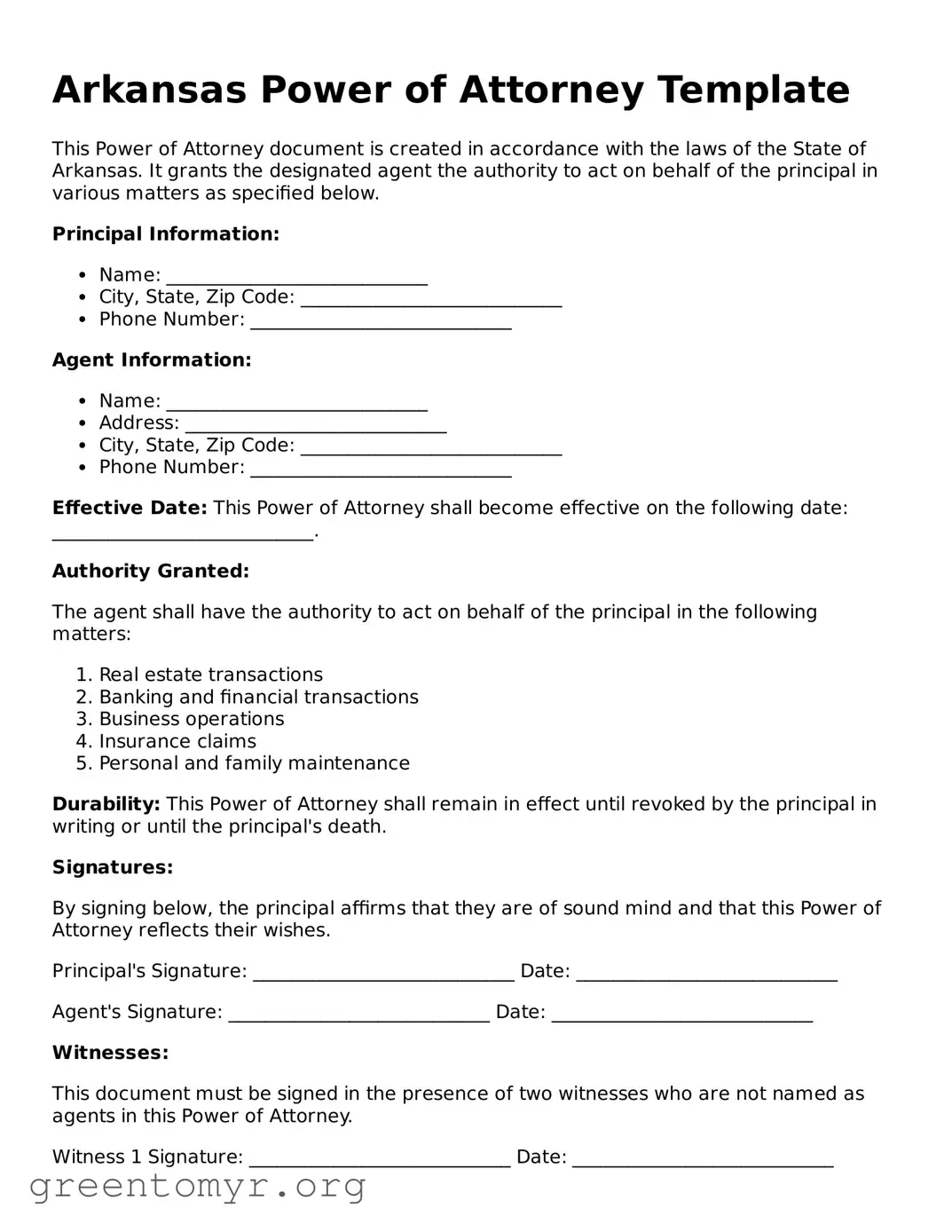
The Arkansas Power of Attorney form is a crucial legal document that allows individuals to designate someone they trust to make decisions on their behalf. This form is particularly important for managing financial matters, healthcare decisions, and other personal affairs when the individual is unable to do so themselves. It provides flexibility, enabling the appointed agent to act in various capacities, whether for a limited time or on an ongoing basis. The document can be tailored to meet specific needs, allowing for general powers or more restricted authority, depending on the situation. Additionally, it is essential to ensure that the form is properly executed, adhering to state requirements, to guarantee its validity. Understanding the nuances of this form can empower individuals to make informed decisions about their future and the management of their affairs.
Arkansas Power of Attorney Template
This Power of Attorney document is created in accordance with the laws of the State of Arkansas. It grants the designated agent the authority to act on behalf of the principal in various matters as specified below.
Principal Information:
Agent Information:
Effective Date: This Power of Attorney shall become effective on the following date: ____________________________.
Authority Granted:
The agent shall have the authority to act on behalf of the principal in the following matters:
Durability: This Power of Attorney shall remain in effect until revoked by the principal in writing or until the principal's death.
Signatures:
By signing below, the principal affirms that they are of sound mind and that this Power of Attorney reflects their wishes.
Principal's Signature: ____________________________ Date: ____________________________
Agent's Signature: ____________________________ Date: ____________________________
Witnesses:
This document must be signed in the presence of two witnesses who are not named as agents in this Power of Attorney.
Witness 1 Signature: ____________________________ Date: ____________________________
Witness 2 Signature: ____________________________ Date: ____________________________
Notarization:
State of Arkansas, County of ____________________________
Subscribed and sworn before me on this ______ day of ____________, 20__.
Notary Public Signature: ____________________________
My Commission Expires: ____________________________
| Fact Name | Description |
|---|---|
| Definition | A Power of Attorney (POA) in Arkansas is a legal document that allows one person to act on behalf of another in legal or financial matters. |
| Governing Law | The Arkansas Power of Attorney is governed by the Arkansas Code Annotated, Title 28, Chapter 68. |
| Types | There are several types of POA in Arkansas, including General, Limited, and Durable Power of Attorney. |
| Durability | A Durable Power of Attorney remains effective even if the principal becomes incapacitated. |
| Agent Authority | The agent can be granted broad or limited authority, depending on the principal's wishes outlined in the document. |
| Signing Requirements | The POA must be signed by the principal and acknowledged by a notary public to be valid. |
| Revocation | The principal can revoke the Power of Attorney at any time, as long as they are competent to do so. |
Filling out the Arkansas Power of Attorney form is a crucial step in designating someone to act on your behalf in financial or legal matters. After completing the form, you will need to ensure that it is signed, witnessed, and notarized, as required by Arkansas law. This process helps ensure that your chosen representative can effectively manage your affairs when necessary.
A Power of Attorney (POA) in Arkansas is a legal document that allows one person (the principal) to authorize another person (the agent or attorney-in-fact) to act on their behalf. This can include managing finances, making healthcare decisions, or handling legal matters. The principal must be of sound mind and capable of understanding the implications of the document when signing it.
In Arkansas, there are several types of Power of Attorney:
To create a Power of Attorney in Arkansas, follow these steps:
Yes, in Arkansas, a Power of Attorney must be signed in front of a notary public to be valid. This step ensures that the document is legally recognized and that the principal's signature is authentic. It is also advisable to have witnesses, although not required, to further validate the document.
Yes, you can revoke a Power of Attorney at any time, as long as you are mentally competent. To revoke it, you should create a written revocation document, sign it, and notify your agent and any institutions or individuals that were relying on the original POA. It is also wise to destroy any copies of the original document to avoid confusion.
If you become incapacitated without a designated Power of Attorney, the court may appoint a guardian or conservator to manage your affairs. This process can be lengthy and costly, and the person chosen may not be someone you would have selected. Therefore, it is advisable to establish a POA while you are still able to make your own decisions.
Filling out a Power of Attorney form in Arkansas can be a straightforward process, but many individuals make common mistakes that can lead to complications down the line. One frequent error is failing to specify the powers granted to the agent. The form allows for broad or limited authority, and without clear instructions, the agent may not have the necessary powers to act on behalf of the principal. This can create confusion and hinder important decisions when they need to be made.
Another mistake often seen is neglecting to date the document. A Power of Attorney is only valid if it is dated, as this establishes when the authority begins. If the form is not dated, it may be questioned in the future, leading to potential disputes about its validity. It is crucial to include the date clearly to avoid any ambiguity regarding the timing of the agent's powers.
Additionally, many people forget to sign the form in the presence of a notary public. In Arkansas, notarization is required for the Power of Attorney to be legally binding. Without a notary's signature, the document may be deemed invalid, rendering the agent unable to act on behalf of the principal. Ensuring that the form is properly notarized is essential for its acceptance in legal and financial matters.
Some individuals also overlook the importance of choosing a reliable and trustworthy agent. The agent will have significant authority over the principal's affairs, and selecting someone who may not act in the principal's best interest can lead to serious issues. It is vital to choose an agent who is responsible, ethical, and capable of handling the responsibilities that come with this role.
Another common error is failing to provide copies of the Power of Attorney to relevant parties. Once the form is completed and notarized, it is important to distribute copies to banks, healthcare providers, and any other institutions that may need to recognize the agent's authority. Without these copies, the agent may face challenges when attempting to act on behalf of the principal.
Finally, people sometimes neglect to review and update the Power of Attorney as circumstances change. Life events such as marriage, divorce, or the death of an agent can impact the effectiveness of the document. Regularly reviewing the Power of Attorney ensures that it reflects the principal's current wishes and circumstances, helping to avoid potential conflicts or confusion in the future.
When creating a Power of Attorney in Arkansas, there are several other forms and documents that may be relevant. These documents help clarify roles, responsibilities, and intentions. Below are five commonly used forms that often accompany a Power of Attorney.
Understanding these documents can provide clarity and security in managing personal and financial affairs. It is essential to consider how each document interacts with the Power of Attorney to ensure all legal and personal wishes are respected.
A Power of Attorney (POA) form is a vital legal document that allows one person to act on behalf of another in various matters. While it serves a unique purpose, several other documents share similarities with the POA. Here are four such documents:
When filling out the Arkansas Power of Attorney form, it's important to approach the task with care and attention. Here’s a helpful list of things you should and shouldn't do to ensure the document serves its intended purpose effectively.
By following these guidelines, you can help ensure that your Power of Attorney form is filled out correctly and meets your needs. Proper preparation can save you time and potential complications down the road.
When it comes to the Arkansas Power of Attorney form, several misconceptions can lead to confusion. Understanding these myths can help ensure that you make informed decisions regarding your legal affairs. Here are four common misconceptions:
Many people believe that a Power of Attorney can only be used for financial decisions. In reality, this document can grant authority over a wide range of matters, including healthcare decisions, real estate transactions, and personal affairs. Depending on how it is drafted, a Power of Attorney can cover various aspects of a person's life.
Another common myth is that once a Power of Attorney is established, it cannot be changed or revoked. This is not true. You can revoke a Power of Attorney at any time as long as you are mentally competent. It's important to formally notify the agent and any institutions that may have relied on the original document.
While many people choose family members or friends to serve as their agents, it is not a requirement. You can appoint anyone you trust, including professionals like attorneys or financial advisors. The key is to select someone who understands your wishes and will act in your best interests.
Some individuals think that a Power of Attorney automatically takes effect as soon as it is signed and remains valid forever. In Arkansas, you can create a Power of Attorney that is either immediate or springing. A springing Power of Attorney only takes effect under specific conditions, such as when you become incapacitated. Additionally, it can be set to expire after a certain period or event.
When filling out and using the Arkansas Power of Attorney form, keep these key takeaways in mind: