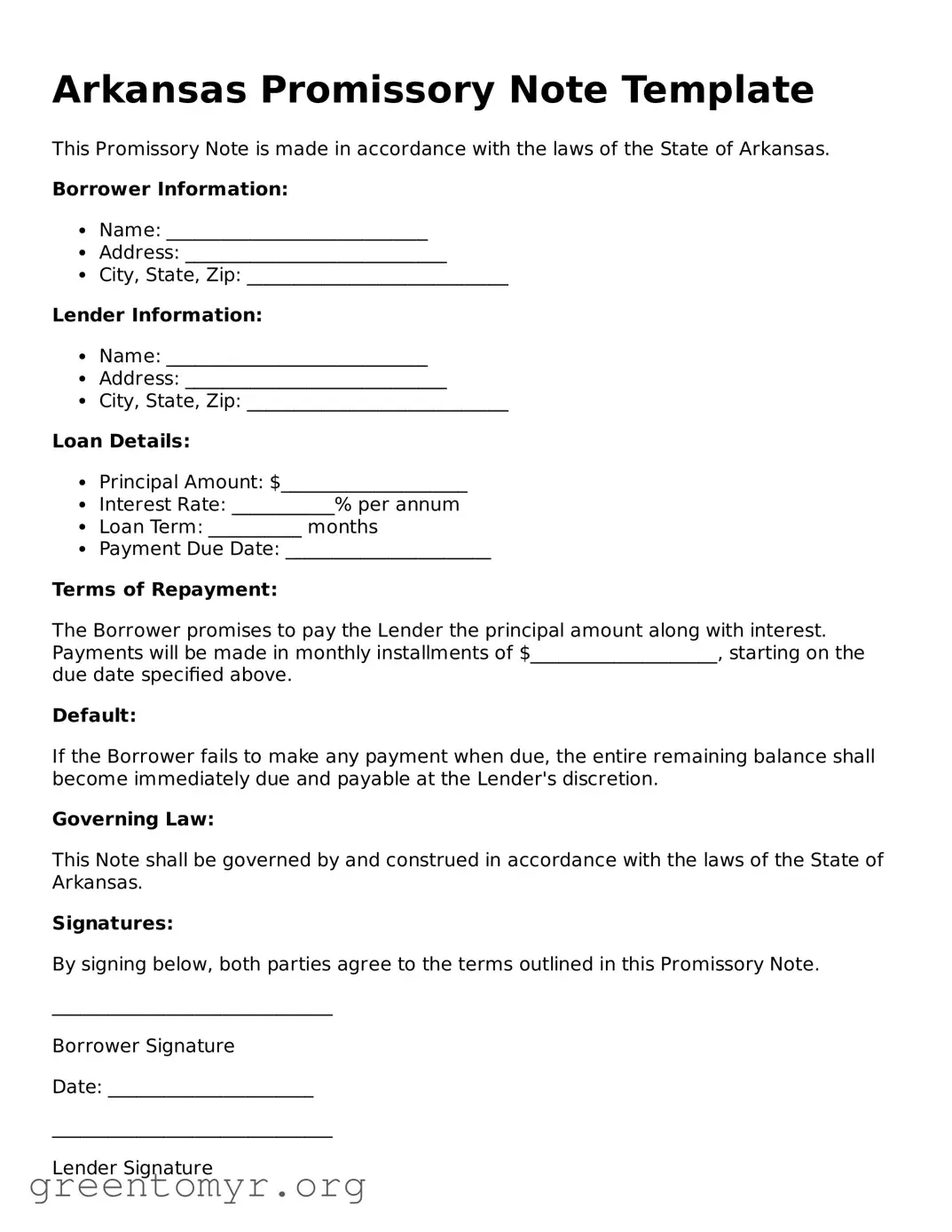
In Arkansas, a Promissory Note serves as a vital financial document that outlines the terms of a loan agreement between a borrower and a lender. This form details essential aspects such as the amount borrowed, the interest rate, and the repayment schedule, ensuring that both parties have a clear understanding of their obligations. It also specifies the consequences of default, protecting the lender's interests while providing the borrower with necessary terms. Notably, the Promissory Note can be tailored to meet specific needs, allowing for flexibility in repayment terms and conditions. By using this form, individuals and businesses can formalize their financial arrangements, fostering trust and accountability in their transactions. Understanding the components of the Promissory Note is crucial for anyone entering into a loan agreement in Arkansas, as it serves not only as a record of the debt but also as a legal tool that can be enforced if necessary.
Arkansas Promissory Note Template
This Promissory Note is made in accordance with the laws of the State of Arkansas.
Borrower Information:
Lender Information:
Loan Details:
Terms of Repayment:
The Borrower promises to pay the Lender the principal amount along with interest. Payments will be made in monthly installments of $____________________, starting on the due date specified above.
Default:
If the Borrower fails to make any payment when due, the entire remaining balance shall become immediately due and payable at the Lender's discretion.
Governing Law:
This Note shall be governed by and construed in accordance with the laws of the State of Arkansas.
Signatures:
By signing below, both parties agree to the terms outlined in this Promissory Note.
______________________________
Borrower Signature
Date: ______________________
______________________________
Lender Signature
Date: ______________________
| Fact Name | Description |
|---|---|
| Definition | A promissory note is a written promise to pay a specified amount of money to a designated person or entity at a specified time. |
| Governing Law | The Arkansas Uniform Commercial Code governs promissory notes in the state of Arkansas. |
| Essential Elements | For a promissory note to be valid, it must include the principal amount, interest rate, payment schedule, and signatures of the parties involved. |
| Enforceability | A properly executed promissory note can be enforced in court, allowing the lender to seek repayment if the borrower defaults. |
| Transferability | Promissory notes in Arkansas can be transferred to third parties, making them negotiable instruments under the law. |
After obtaining the Arkansas Promissory Note form, you will need to complete it accurately to ensure its validity. Follow these steps to fill out the form correctly.
An Arkansas Promissory Note is a legal document that outlines a borrower's promise to repay a specified amount of money to a lender. This note includes essential details such as the loan amount, interest rate, repayment schedule, and any penalties for late payments. It serves as a formal agreement that protects both parties involved in the transaction.
Promissory Notes are commonly used by individuals, businesses, and financial institutions. They can be beneficial in various situations, including:
In any case, having a written agreement helps clarify expectations and reduce misunderstandings.
To ensure the note is comprehensive and enforceable, it should contain the following information:
Including these details helps to create a clear understanding between both parties.
Yes, a Promissory Note is legally binding in Arkansas as long as it meets certain criteria. For the note to be enforceable, it must be signed by both parties and include all essential terms. While it’s not required to be notarized, having a notary can provide additional verification of the signatures, which may help in case of disputes.
Yes, a Promissory Note can be modified, but both parties must agree to the changes. It’s important to document any modifications in writing and have both parties sign the amended agreement. This helps maintain clarity and ensures that everyone is on the same page regarding the new terms.
When filling out the Arkansas Promissory Note form, individuals often overlook critical details, leading to potential issues down the line. One common mistake is failing to include the correct names of the borrower and lender. Accurate identification is essential, as any discrepancies can create confusion or legal complications.
Another frequent error is neglecting to specify the loan amount clearly. It is vital to write the amount both in numerals and in words to avoid any misinterpretation. For example, if the amount is $5,000, it should be written as "Five Thousand Dollars" in addition to the numerical representation.
People sometimes forget to include the interest rate or specify whether the loan is interest-free. This omission can lead to misunderstandings about repayment expectations. Clearly stating the interest rate ensures both parties are on the same page regarding the financial terms of the loan.
Additionally, the repayment schedule is often inadequately detailed. It is important to outline when payments are due and the total duration of the loan. Without this information, borrowers may miss payments, leading to penalties or default.
Some individuals mistakenly leave out the consequences of late payments. Clearly defining these consequences, such as late fees or increased interest rates, can help prevent misunderstandings and encourage timely payments.
Another mistake involves not signing the document. A signature is a legal acknowledgment of the terms agreed upon. Without it, the note may not hold up in court if disputes arise.
People may also fail to date the form correctly. Including the date is crucial, as it marks the start of the loan agreement and can impact the calculation of payment timelines and interest accrual.
In some cases, individuals neglect to include witnesses or notary signatures when required. Depending on the amount and nature of the loan, having a witness or notary can add an extra layer of validation to the agreement.
Lastly, failing to keep copies of the signed Promissory Note can lead to complications. Both parties should retain a copy for their records to reference the terms of the agreement in the future.
By being aware of these common mistakes, individuals can ensure that their Arkansas Promissory Note is filled out correctly, reducing the risk of disputes and ensuring a smoother lending experience.
A promissory note is a critical document in financial transactions, particularly when one party borrows money from another. In Arkansas, several other forms and documents are commonly used alongside a promissory note to ensure clarity and legal protection for both parties involved. Here is a list of five such documents:
These documents work together to create a clear understanding of the loan agreement. Ensuring all necessary forms are completed and understood can help prevent disputes and protect the interests of both parties.
A Promissory Note is a financial document that outlines a promise to pay a specific amount of money to a designated person or entity under agreed-upon terms. Several other documents share similarities with a Promissory Note. Here are ten such documents:
When filling out the Arkansas Promissory Note form, it's essential to be careful and thorough. Here’s a helpful list of things to do and avoid:
By following these guidelines, you can create a clear and enforceable Promissory Note that protects everyone involved.
Understanding the Arkansas Promissory Note form can be challenging, especially with the many misconceptions that exist. Here are ten common misunderstandings and clarifications to help clear up any confusion:
While both documents relate to borrowing money, a promissory note is a simple promise to pay back a specific amount, whereas a loan agreement typically includes more detailed terms and conditions.
A promissory note can be created without a lawyer, as long as it includes the necessary elements such as the amount, interest rate, and repayment terms.
Notarization is not a requirement for a promissory note to be legally binding in Arkansas, although it can provide an extra layer of authenticity.
A written promissory note is far more enforceable than a verbal agreement, as it provides clear evidence of the terms agreed upon.
Promissory notes can be assigned or transferred to another individual or entity, allowing for flexibility in repayment arrangements.
Individuals and businesses can create promissory notes as well, making them useful tools for personal loans and business transactions.
While including an interest rate is common, it is not mandatory. A note can specify a zero-interest loan if desired.
Promissory notes can be used for loans of any size, whether it’s a small personal loan between friends or a larger business transaction.
Promissory notes can be amended if both parties agree to the changes, but it’s important to document any modifications in writing.
While a promissory note is a legal commitment to repay, it does not guarantee that the borrower will fulfill their obligation. It provides a basis for legal action if necessary.
By understanding these misconceptions, individuals can navigate the use of promissory notes more effectively and ensure their interests are protected.
When filling out and using the Arkansas Promissory Note form, it is important to understand several key aspects to ensure clarity and enforceability. Here are some takeaways to consider:
By following these guidelines, you can create a promissory note that is clear and legally sound, protecting the interests of all parties involved.