The Arkansas Quitclaim Deed form is a crucial document for anyone involved in the transfer of property rights in the state. This form allows an individual, known as the grantor, to transfer their interest in a property to another person, called the grantee, without making any guarantees about the title. It is particularly useful in situations where the grantor may not have clear ownership or wishes to relinquish their claim without the complexities of a warranty deed. The form typically includes essential details such as the names of the parties involved, a description of the property, and the date of the transfer. While it is a relatively straightforward document, understanding its implications is vital for both parties to ensure that their rights and interests are adequately protected. Additionally, the quitclaim deed must be properly executed and recorded with the appropriate county office to be effective, making compliance with local regulations imperative. This article will delve into the intricacies of the Arkansas Quitclaim Deed form, offering insights on its use, potential pitfalls, and best practices for completion and filing.
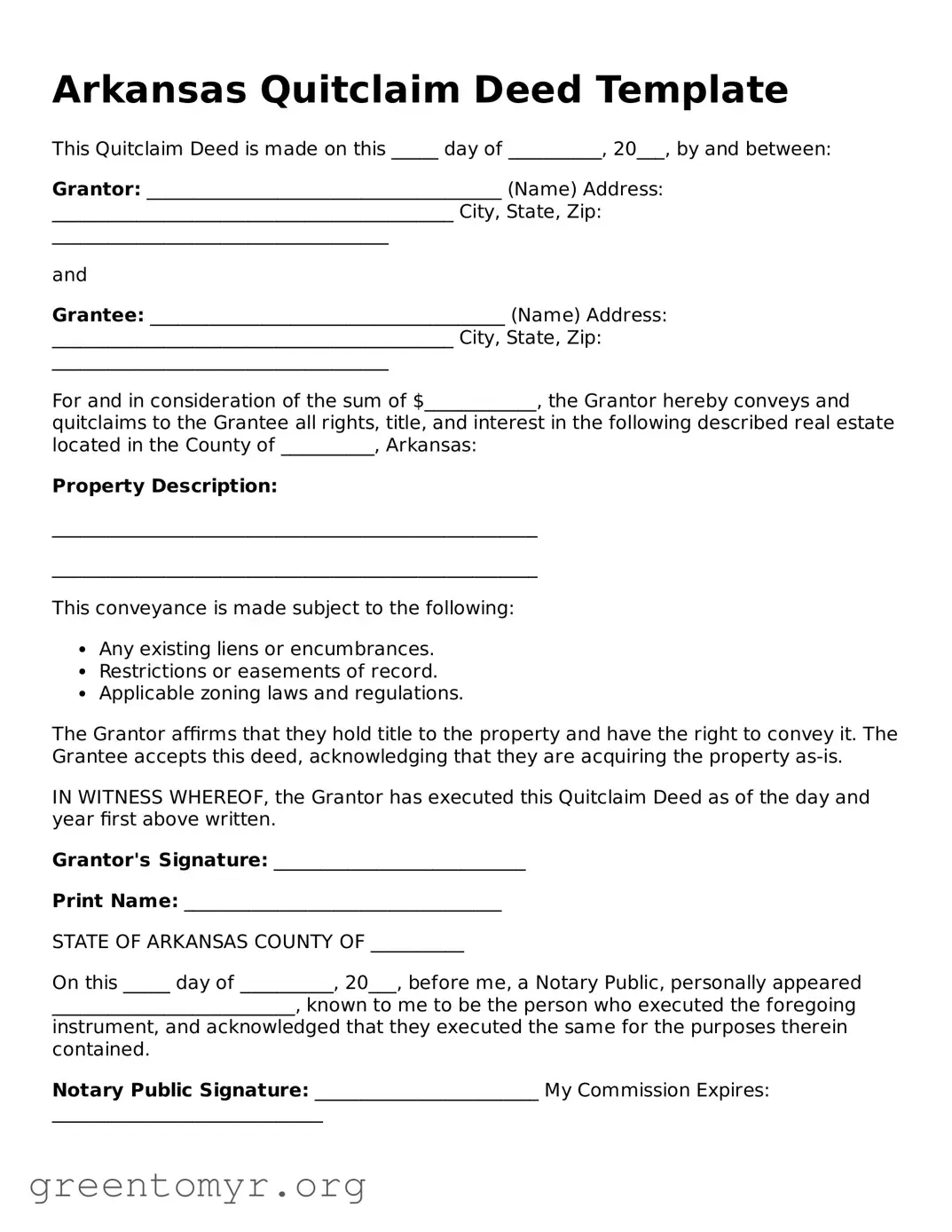
Arkansas Quitclaim Deed Template
This Quitclaim Deed is made on this _____ day of __________, 20___, by and between:
Grantor: ______________________________________ (Name) Address: ___________________________________________ City, State, Zip: ____________________________________
and
Grantee: ______________________________________ (Name) Address: ___________________________________________ City, State, Zip: ____________________________________
For and in consideration of the sum of $____________, the Grantor hereby conveys and quitclaims to the Grantee all rights, title, and interest in the following described real estate located in the County of __________, Arkansas:
Property Description:
____________________________________________________
____________________________________________________
This conveyance is made subject to the following:
The Grantor affirms that they hold title to the property and have the right to convey it. The Grantee accepts this deed, acknowledging that they are acquiring the property as-is.
IN WITNESS WHEREOF, the Grantor has executed this Quitclaim Deed as of the day and year first above written.
Grantor's Signature: ___________________________
Print Name: __________________________________
STATE OF ARKANSAS COUNTY OF __________
On this _____ day of __________, 20___, before me, a Notary Public, personally appeared __________________________, known to me to be the person who executed the foregoing instrument, and acknowledged that they executed the same for the purposes therein contained.
Notary Public Signature: ________________________ My Commission Expires: _____________________________
| Fact Name | Description |
|---|---|
| Definition | A quitclaim deed is a legal document used to transfer ownership of real estate without any warranties. |
| Governing Law | Arkansas Code Annotated § 18-12-101 governs the use of quitclaim deeds in Arkansas. |
| Parties Involved | The form involves a grantor (the person transferring the property) and a grantee (the person receiving the property). |
| No Warranty | Quitclaim deeds do not guarantee that the grantor has clear title to the property. |
| Common Uses | Often used in divorce settlements, property transfers between family members, or to clear up title issues. |
| Filing Requirements | The completed deed must be filed with the county clerk's office where the property is located. |
| Consideration | A nominal consideration is often stated in the deed, but it is not always required. |
| Tax Implications | Transfer taxes may apply, depending on the value of the property being transferred. |
| Record Keeping | It is advisable to keep a copy of the quitclaim deed for personal records after filing. |
Once you have the Arkansas Quitclaim Deed form, you will need to fill it out carefully. After completing the form, it should be signed and notarized before being submitted to the appropriate county office for recording.
A Quitclaim Deed is a legal document used to transfer ownership of real estate from one party to another without any guarantees or warranties regarding the property title. In Arkansas, this form is often used among family members or in situations where the grantor does not wish to provide a guarantee of title. It effectively conveys the grantor's interest in the property, if any, to the grantee.
A Quitclaim Deed is typically used in the following scenarios:
To complete a Quitclaim Deed in Arkansas, follow these steps:
While it is not legally required to have a lawyer prepare a Quitclaim Deed, seeking legal advice can be beneficial. A lawyer can help ensure that the deed is completed correctly and that all legal requirements are met, particularly if the property has complex title issues.
The costs associated with a Quitclaim Deed can vary. Common expenses include:
No, a Quitclaim Deed is not the same as a Warranty Deed. A Warranty Deed provides a guarantee that the grantor holds clear title to the property and has the right to transfer it. In contrast, a Quitclaim Deed transfers whatever interest the grantor may have without any assurances about the title.
Once a Quitclaim Deed is executed and recorded, it generally cannot be revoked. The transfer of property is considered final. However, if there was fraud or mistake involved in the transaction, legal action may be necessary to address those issues.
A Quitclaim Deed must include the following information:
A Quitclaim Deed must be filed with the county clerk’s office in the county where the property is located. It is advisable to check with the specific county for any additional filing requirements or fees.
Using a Quitclaim Deed may have tax implications, particularly if the property is being transferred as a gift or if there is a change in ownership. It is important to consult with a tax professional to understand any potential tax consequences related to the transfer of property.
Filling out a Quitclaim Deed form in Arkansas can seem straightforward, but many people make common mistakes that can lead to complications down the line. One frequent error is not providing accurate property descriptions. A vague or incorrect description can create confusion about the property being transferred. It's crucial to include the full legal description, which can typically be found in the property’s title deed.
Another mistake involves the names of the parties involved. When completing the form, individuals sometimes misspell names or fail to include middle initials. These details matter. Any discrepancies can cause issues during the transfer process or when the deed is recorded. Always double-check the names to ensure they match official documents.
Many people overlook the importance of signatures. All parties involved in the transaction must sign the Quitclaim Deed. Failing to do so can render the deed invalid. Additionally, if one party is unable to sign, a power of attorney may be required to authorize someone else to sign on their behalf.
Not having the deed notarized is another common oversight. In Arkansas, a Quitclaim Deed must be notarized to be legally binding. Without a notary’s signature and seal, the deed may not be accepted by the county clerk’s office. It’s a simple step that can save you from potential headaches later.
People often forget to record the Quitclaim Deed after it has been signed and notarized. Recording the deed with the local county clerk is essential for establishing public notice of the property transfer. Failing to record can lead to disputes over ownership in the future, as others may not be aware of the change.
Lastly, individuals sometimes neglect to understand the implications of a Quitclaim Deed. This type of deed does not guarantee that the property title is clear or free of liens. It simply transfers whatever interest the grantor has in the property. Being aware of this limitation is vital to avoid misunderstandings or disputes later on.
When dealing with property transfers in Arkansas, a Quitclaim Deed is a common document used to convey ownership. However, several other forms and documents often accompany it to ensure a smooth transaction. Below is a list of essential documents that can help streamline the process.
Each of these documents plays a vital role in the property transfer process in Arkansas. Understanding them can help you navigate the complexities of real estate transactions with confidence. Always consider consulting a professional to ensure everything is in order for a successful transfer.
A Quitclaim Deed is often compared to several other legal documents used in property transactions. Here are four documents that share similarities with a Quitclaim Deed:
When filling out the Arkansas Quitclaim Deed form, attention to detail is crucial. Here’s a list of things you should and shouldn't do to ensure a smooth process.
Following these guidelines will help ensure that your Quitclaim Deed is filled out correctly and can be processed without complications.
When it comes to the Arkansas Quitclaim Deed form, several misconceptions can lead to confusion. Understanding these can help ensure that property transfers are handled correctly. Here are seven common misconceptions:
Many people believe that a Quitclaim Deed guarantees full ownership of the property. In reality, it transfers whatever interest the grantor has, which may be none at all.
This is a common misunderstanding. A Warranty Deed provides a guarantee that the title is clear, while a Quitclaim Deed does not offer any such assurance.
Some people think that recording the deed is unnecessary. However, recording it protects your interest and provides public notice of the ownership change.
This is not entirely accurate. While Quitclaim Deeds can be used for many types of property, certain situations, like transferring a mortgage, may require different forms.
While it's common for all parties to sign in person, it is not a strict requirement. Signatures can be obtained separately, provided that the deed is properly executed.
This misconception can be costly. A Quitclaim Deed does not remove any liens or debts tied to the property; those obligations remain with the property itself.
This is misleading. While a Quitclaim Deed is generally irrevocable, in certain circumstances, the grantor may be able to challenge or revoke the deed, especially if fraud or coercion is involved.
Understanding these misconceptions can help individuals navigate property transfers more effectively. Always consider consulting with a legal professional for specific situations.
When filling out and using the Arkansas Quitclaim Deed form, it is essential to understand its purpose and implications. Here are some key takeaways to consider: