Content Navigation

The Arkansas Small Estate Affidavit form serves as a vital tool for individuals seeking to simplify the process of settling small estates after the passing of a loved one. This form is particularly beneficial for estates valued under a specific threshold, allowing heirs to bypass the lengthy and often costly probate process. By utilizing this affidavit, individuals can claim property, assets, and other belongings without the need for formal court proceedings. The form requires essential information, including details about the deceased, a list of assets, and the names of heirs. Additionally, it must be signed under oath, ensuring that all provided information is accurate and truthful. Understanding how to properly fill out and submit the Small Estate Affidavit can save time and reduce stress during an already difficult period, making it an important resource for families navigating estate matters in Arkansas.

Arkansas Small Estate Affidavit Example

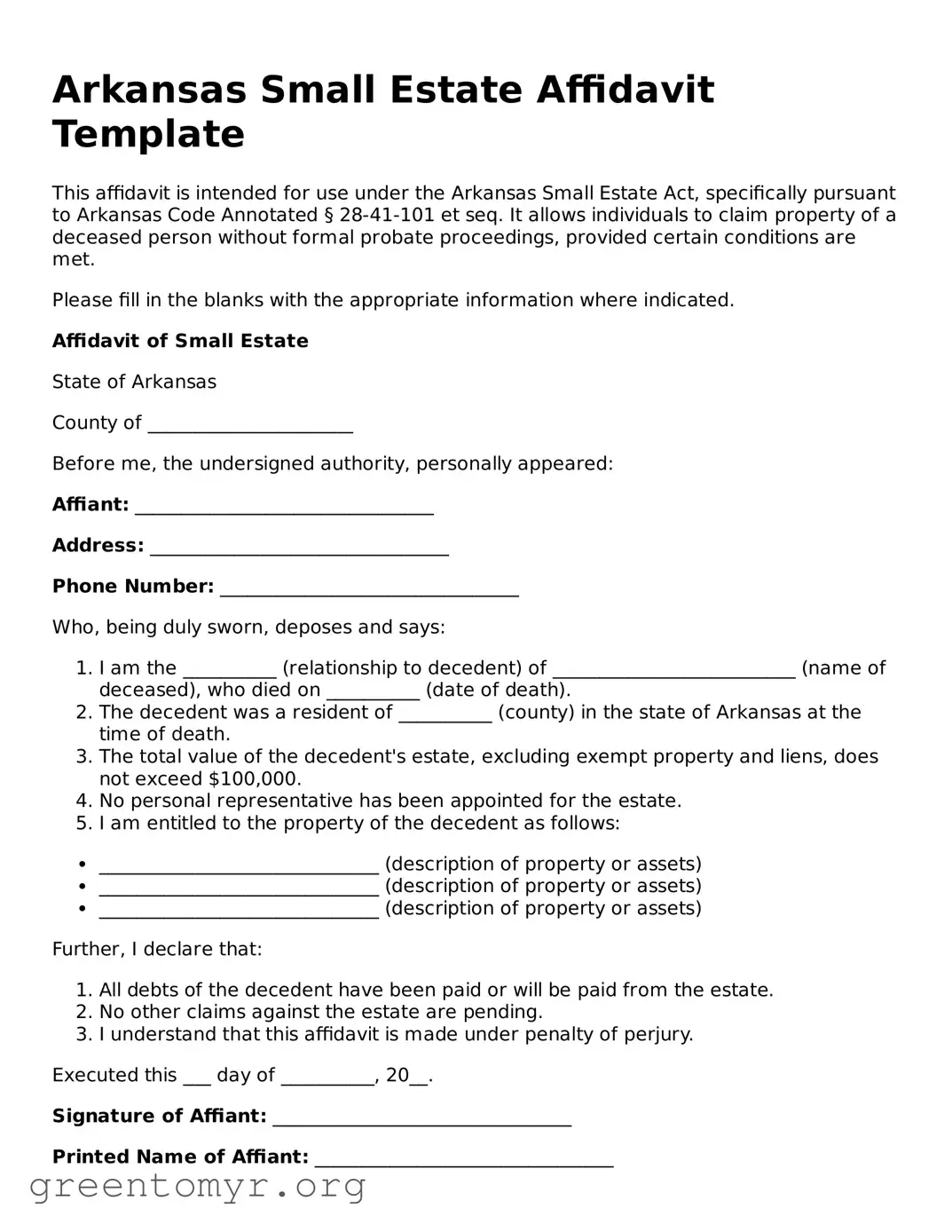
Arkansas Small Estate Affidavit Template

This affidavit is intended for use under the Arkansas Small Estate Act, specifically pursuant to Arkansas Code Annotated § 28-41-101 et seq. It allows individuals to claim property of a deceased person without formal probate proceedings, provided certain conditions are met.

Please fill in the blanks with the appropriate information where indicated.

Affidavit of Small Estate

State of Arkansas

County of ______________________

Before me, the undersigned authority, personally appeared:

Affiant: ________________________________

Address: ________________________________

Phone Number: ________________________________

Who, being duly sworn, deposes and says:

  1. I am the __________ (relationship to decedent) of __________________________ (name of deceased), who died on __________ (date of death).
  2. The decedent was a resident of __________ (county) in the state of Arkansas at the time of death.
  3. The total value of the decedent's estate, excluding exempt property and liens, does not exceed $100,000.
  4. No personal representative has been appointed for the estate.
  5. I am entitled to the property of the decedent as follows:
  • ______________________________ (description of property or assets)
  • ______________________________ (description of property or assets)
  • ______________________________ (description of property or assets)

Further, I declare that:

  1. All debts of the decedent have been paid or will be paid from the estate.
  2. No other claims against the estate are pending.
  3. I understand that this affidavit is made under penalty of perjury.

Executed this ___ day of __________, 20__.

Signature of Affiant: ________________________________

Printed Name of Affiant: ________________________________

Sworn to and subscribed before me this ___ day of __________, 20__.

Notary Public: ________________________________

My Commission Expires: ________________________________

PDF Form Features

Fact Name Description
Purpose The Arkansas Small Estate Affidavit allows individuals to settle the estate of a deceased person without going through formal probate, simplifying the process for small estates.
Eligibility This form can be used if the total value of the estate is $100,000 or less, excluding certain assets such as real estate.
Governing Law The use of the Small Estate Affidavit is governed by Arkansas Code Annotated § 28-41-101 et seq.
Filing Requirements To file, the affidavit must be signed by all heirs and must include a list of the deceased's assets and debts.
Asset Distribution Once the affidavit is filed, heirs can collect assets directly from financial institutions or other entities holding the deceased's property.
Timeframe The process can typically be completed within a few weeks, making it a faster alternative to traditional probate.
Limitations Not all estates qualify; estates with complex issues, disputes among heirs, or significant debts may still require formal probate proceedings.

Guide to Using Arkansas Small Estate Affidavit

After gathering the necessary information and documentation, proceed to complete the Arkansas Small Estate Affidavit form. This process will help ensure that the estate is handled efficiently and in accordance with state regulations.

  1. Obtain the Arkansas Small Estate Affidavit form from a reliable source, such as the state’s official website or your local courthouse.
  2. Begin by filling in the decedent’s full name and date of death at the top of the form.
  3. Provide the decedent’s last known address, including the city, state, and ZIP code.
  4. List the names and addresses of all heirs or beneficiaries entitled to inherit from the estate.
  5. Indicate the total value of the estate, ensuring it does not exceed the state’s limit for small estates.
  6. Include a description of the property being claimed, such as real estate, bank accounts, or personal belongings.
  7. Sign and date the affidavit in the designated area, affirming that the information provided is accurate.
  8. Have the affidavit notarized to validate the document.
  9. Make copies of the completed affidavit for your records and for each heir or beneficiary.
  10. File the original affidavit with the appropriate probate court in the county where the decedent lived.

Get Answers on Arkansas Small Estate Affidavit

What is the Arkansas Small Estate Affidavit?

The Arkansas Small Estate Affidavit is a legal document that allows individuals to settle the estate of a deceased person without going through the formal probate process. This form is particularly useful for estates that meet certain criteria, allowing heirs or beneficiaries to claim assets directly. By using this affidavit, individuals can simplify the transfer of property and expedite the distribution of the deceased's assets.

Who is eligible to use the Small Estate Affidavit?

To qualify for the Arkansas Small Estate Affidavit, the estate must meet specific conditions:

  1. The total value of the estate must not exceed $100,000, excluding certain types of property such as real estate.
  2. The deceased must have been a resident of Arkansas at the time of death.
  3. At least 30 days must have passed since the death of the individual.

If these criteria are met, heirs or beneficiaries can use the affidavit to collect and distribute assets without formal probate proceedings.

How do I complete the Small Estate Affidavit?

Completing the Arkansas Small Estate Affidavit involves several steps:

  • Obtain the affidavit form from the appropriate court or legal resource.
  • Provide necessary information, including the deceased's name, date of death, and details about the estate's assets.
  • Sign the affidavit in the presence of a notary public.
  • Submit the completed affidavit to the relevant institutions, such as banks or financial institutions, to claim assets.

It is essential to ensure that all information is accurate and complete to avoid potential delays in the process.

What assets can be claimed using the Small Estate Affidavit?

The Small Estate Affidavit can be used to claim a variety of assets, including:

  • Bank accounts
  • Personal property, such as vehicles and furniture
  • Life insurance proceeds
  • Investment accounts

However, real estate typically does not qualify for this process, as it often requires a different legal procedure for transfer.

Are there any fees associated with the Small Estate Affidavit?

While there are no specific fees for filing the Small Estate Affidavit itself, individuals may encounter other costs, such as:

  • Notary fees for signing the affidavit.
  • Potential fees from financial institutions when claiming assets.
  • Costs associated with obtaining copies of the death certificate, which may be required.

It is advisable to budget for these potential expenses when planning to use the affidavit.

What if the estate exceeds the Small Estate limit?

If the value of the estate exceeds the $100,000 limit, the Small Estate Affidavit cannot be used. In such cases, the estate will likely need to go through the formal probate process. This process can be more complex and time-consuming, involving court hearings and potentially higher legal fees. Consulting with an attorney experienced in estate law can provide guidance on the best course of action for larger estates.

Common mistakes

Filling out the Arkansas Small Estate Affidavit form can be a straightforward process, but many individuals make common mistakes that can lead to delays or complications. One frequent error is providing inaccurate information about the decedent. It is crucial to ensure that the name, date of birth, and date of death are correct. Any discrepancies can raise questions and potentially invalidate the affidavit.

Another common mistake is failing to include all necessary assets. The Small Estate Affidavit is designed for estates with a value below a specific threshold, but it is essential to list all assets accurately. Omitting significant assets can result in legal complications and may even lead to a situation where the estate exceeds the allowable limit.

People often overlook the requirement for signatures. The affidavit must be signed by all individuals entitled to inherit under the law. Neglecting to gather the necessary signatures can render the document incomplete, causing delays in the distribution of the estate. Each heir must understand their role in this process and participate accordingly.

In addition, some individuals may not understand the importance of notarization. The Arkansas Small Estate Affidavit must be notarized to be legally binding. Failing to have the document notarized can lead to challenges and disputes, as the affidavit may not be recognized by financial institutions or courts.

Another mistake involves misunderstanding the timeline for filing the affidavit. Some people assume that they can file the affidavit at any time after the decedent's death. However, there are specific timeframes within which the affidavit must be submitted. Delaying this process can complicate matters and may affect the estate's administration.

Lastly, individuals often neglect to seek legal advice. While it may seem straightforward, the Small Estate Affidavit process can be fraught with complexities. Consulting with an attorney can provide clarity and help avoid pitfalls that may arise from misinterpretation of the law. Taking this step can save time, stress, and potential legal issues down the road.

Documents used along the form

The Arkansas Small Estate Affidavit is a useful tool for settling the estates of deceased individuals with limited assets. When using this form, it is often beneficial to have additional documents that can help streamline the process. Below is a list of other forms and documents that are commonly used alongside the Small Estate Affidavit in Arkansas.

  • Death Certificate: This official document certifies the death of the individual and is typically required to prove the death when filing for a small estate.
  • Will: If the deceased left a will, it may need to be submitted along with the Small Estate Affidavit to clarify the distribution of assets.
  • Affidavit of Heirship: This document establishes the rightful heirs of the deceased, especially when there is no will present.
  • Inventory of Assets: A detailed list of the deceased's assets can help in demonstrating the value and ownership of the estate, supporting the small estate claim.
  • Bank Statements: Recent bank statements can provide evidence of the deceased's financial situation and help verify the assets included in the estate.
  • Property Deeds: If real estate is part of the estate, copies of property deeds may be required to establish ownership and facilitate transfer.
  • Tax Returns: The deceased's last tax return may be necessary to provide insight into their financial affairs and ensure all tax obligations are met.
  • Letters of Administration: In cases where the estate is contested or there are disputes among heirs, this document may be needed to appoint an administrator for the estate.

Having these additional documents ready can facilitate a smoother process when dealing with a small estate in Arkansas. It is important to ensure that all paperwork is complete and accurate to avoid delays in settling the estate.

Similar forms

The Small Estate Affidavit is a useful legal tool for settling the affairs of a deceased person's estate when the value is below a certain threshold. Several other documents serve similar purposes in estate management. Here are four documents that share similarities with the Small Estate Affidavit:

  • Last Will and Testament: This document outlines how a person's assets should be distributed after their death. Like the Small Estate Affidavit, it provides a clear directive for asset distribution but typically requires formal probate proceedings.
  • Probate Petition: A probate petition is filed to initiate the probate process. It is similar to the Small Estate Affidavit in that both aim to settle an estate, but the probate petition involves court supervision, which can be more time-consuming and costly.
  • Affidavit of Heirship: This document establishes the heirs of a deceased person when no will exists. It functions similarly to the Small Estate Affidavit by facilitating the transfer of assets without going through probate, though it specifically focuses on identifying heirs.
  • Transfer on Death Deed: This deed allows a property owner to designate beneficiaries who will receive the property upon their death. It parallels the Small Estate Affidavit in that it simplifies the transfer of assets outside of probate, ensuring a quicker process for the beneficiaries.

Dos and Don'ts

When filling out the Arkansas Small Estate Affidavit form, it is essential to follow specific guidelines to ensure accuracy and compliance. Below is a list of do's and don'ts to consider.

  • Do provide accurate information about the deceased's assets.
  • Do include the names and addresses of all heirs.
  • Do sign the affidavit in the presence of a notary public.
  • Do keep copies of the completed affidavit for your records.
  • Do check for any required attachments before submission.
  • Don't omit any relevant details about the estate.
  • Don't sign the affidavit without proper notarization.
  • Don't submit the form if there are outstanding debts that need to be addressed.
  • Don't rush through the form; take time to review for errors.
  • Don't forget to file the affidavit with the appropriate court.

Misconceptions

When dealing with the Arkansas Small Estate Affidavit, several misconceptions can lead to confusion. Here are seven common misunderstandings:

  1. Only wealthy individuals can use the Small Estate Affidavit. Many believe that this form is reserved for those with significant assets. In reality, it is designed for estates valued under a specific threshold, making it accessible to a wide range of individuals.
  2. The Small Estate Affidavit eliminates the need for probate. While this form simplifies the process, it does not completely eliminate the need for probate in all situations. It is intended for small estates and has specific criteria that must be met.
  3. All debts must be paid before using the affidavit. Some think that all outstanding debts must be settled before filing. However, the affidavit allows for the transfer of assets, even if debts remain, as long as certain procedures are followed.
  4. Anyone can file a Small Estate Affidavit. This form is not available to just anyone. Only heirs or beneficiaries of the deceased can file, ensuring that the rightful individuals manage the estate.
  5. The Small Estate Affidavit is a one-size-fits-all solution. Each estate is unique, and while the affidavit provides a streamlined process, it may not be suitable for every situation. Specific circumstances may require different legal actions.
  6. Filing the affidavit guarantees asset transfer. While the affidavit facilitates the transfer of assets, it does not guarantee that all claims against the estate have been resolved. Proper due diligence is essential.
  7. The Small Estate Affidavit is the same as a will. Many confuse the two documents. A Small Estate Affidavit is a tool for settling an estate without a will, while a will outlines how a person's assets should be distributed after their death.

Understanding these misconceptions can help individuals navigate the process more effectively and ensure that their rights and interests are protected.

Key takeaways

Filling out and using the Arkansas Small Estate Affidavit form can simplify the process of settling a deceased person's estate when the total value is below a certain threshold. Here are some key takeaways to keep in mind:

  • Eligibility Requirements: The estate must not exceed $100,000 in value, excluding certain assets like real estate. This threshold can change, so it's essential to verify current limits.
  • Form Completion: Ensure that all sections of the affidavit are filled out completely and accurately. Incomplete forms can lead to delays in the process.
  • Notarization: The affidavit must be signed in front of a notary public. This adds an extra layer of legitimacy to the document.
  • Distribution of Assets: Once the affidavit is filed, it allows for the direct transfer of assets to the heirs without going through probate.
  • Filing Location: The completed affidavit should be filed in the county where the deceased resided. Check with local court offices for specific procedures.
  • Affidavit Copies: Make multiple copies of the signed affidavit for your records and for distribution to financial institutions or other entities holding the deceased's assets.
  • Deadline Awareness: There may be time limits for filing the affidavit after the death. Be aware of these deadlines to avoid complications.
  • Consultation Recommended: While the form is designed for ease of use, consulting with a legal professional can provide clarity and ensure that all steps are correctly followed.

Understanding these key points can make the process of using the Arkansas Small Estate Affidavit smoother and more efficient. Proper preparation and attention to detail can save time and reduce stress during a challenging time.