The Ages & Stages Questionnaires® 54 Month Questionnaire is designed to assess the developmental progress of children aged 51 months to 56 months. This tool gathers essential information about a child's abilities across various domains, including communication, gross motor skills, fine motor skills, problem-solving, and personal-social development. Parents, guardians, teachers, and childcare providers complete the questionnaire by marking whether the child regularly, sometimes, or not yet engages in specific activities. The form includes sections for the child's personal information, the person filling out the questionnaire, and program details. Important instructions encourage respondents to try activities with the child before answering and to create a fun atmosphere during completion. The questionnaire also provides space for additional comments and observations, allowing for a comprehensive understanding of the child's developmental status. By utilizing this structured approach, caregivers can better support children's growth and identify areas where further assistance may be needed.
Ages & Stages
Questionnaires®
54 51 months 0 days through 56 months 30 days
Month Questionnaire
Please provide the following information. Use black or blue ink only and print legibly when completing this form.
Date ASQ completed:
Child’s information
|
Middle |
|
|
|
Child’s first name: |
initial: |
Child’s last name: |
|
|
|
|
|
Child’s gender: |
|
|
|
|
Male |
Female |
Child’s date of birth: |
|
|
|
|
Person filling out questionnaire
|
Middle |
Last name: |
|
|
|
First name: |
initial: |
|
|
|
|
|
|
Relationship to child: |
|
|
|
|
|
Parent |
Guardian |
Teacher |
Child care |
|
|
provider |
|||
|
|
|
|
|
|
Street address: |
|
Grandparent |
Foster |
Other: |
|
|
|
or other |
parent |
|
|
|
|
|
|
||
|
|
relative |
|
|
|
|
State/ |
ZIP/ |
City: |
Province: |
Postal code: |
|
|
|
|
Home |
Other |
|
telephone |
telephone |
Country: |
number: |
number: |
|
|
|
|
|
|
|
|
|
Names of people assisting in questionnaire completion: |
|
|
|
|
|
|
|
|
Program Information
Child ID #:
Program ID #:
Program name:
P101540100 |
Ages & Stages Questionnaires®, Third Edition |
© 2009 Paul H. Brookes Publishing Co. All rights reserved. |
54 Month Questionnaire |
51 months 0 days |
through 56 months 30 days |
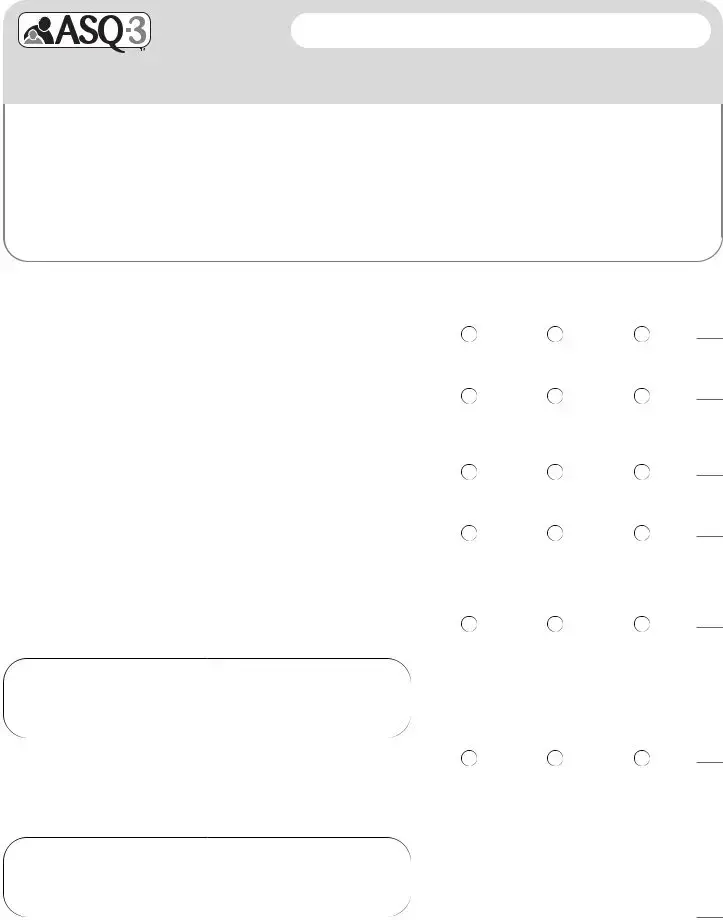
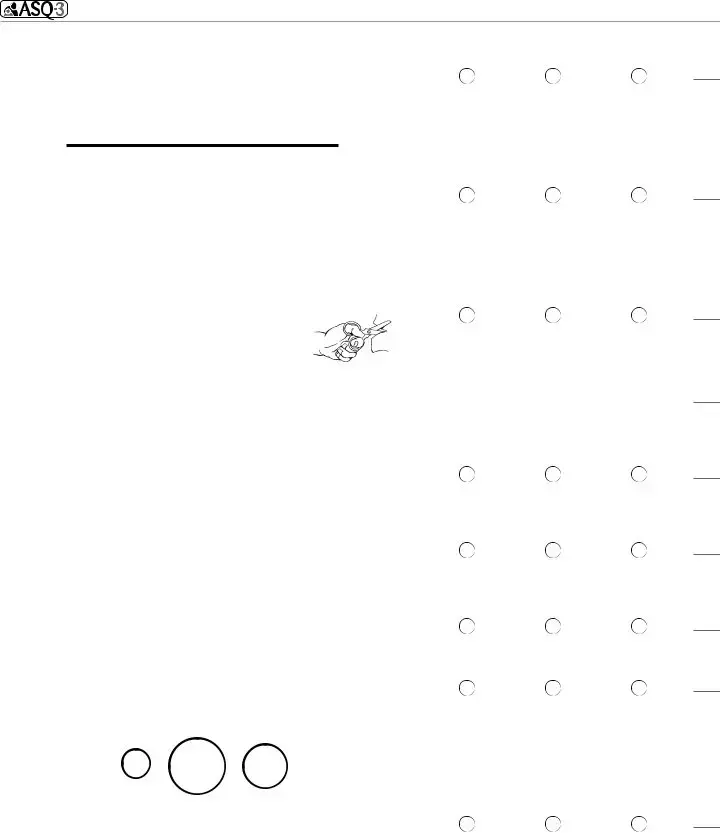
On the following pages are questions about activities children may do. Your child may have already done some of the activities described here, and there may be some your child has not begun doing yet. For each item, please fill in the circle that indicates whether your child is doing the activity regularly, sometimes, or not yet.
Important Points to Remember:
✓
❑ Try each activity with your child before marking a response.
✓
❑ Make completing this questionnaire a game that is fun for you and your child.
✓
❑ Make sure your child is rested and fed.
✓
❑ Please return this questionnaire by _______________.
Notes:
____________________________________________
____________________________________________
____________________________________________
____________________________________________
COMMUNICATION
YES |
SOMETIMES |
NOT YET |
1. Does your child tell you at least two things about common objects? For example, if you say to your child, ÒTell me about your ball,Ó does she say something like, ÒItÕs round. I throw it. ItÕs bigÓ?
2. Does your child use all of the words in a sentence (for example, Òa,Ó Òthe,Ó Òam,Ó Òis,Ó and ÒareÓ) to make complete sentences, such as ÒI am going to the park,Ó ÒIs there a toy to play with?Ó or ÒAre you com- ing, too?Ó
3. Does your child use endings of words, such as
4. Without giving your child help by pointing or repeating directions, does he follow three directions that are unrelated to one another? Give all three directions before your child starts. For example, you may ask your child, ÒClap your hands, walk to the door, and sit down,Ó or ÒGive me the pen, open the book, and stand up.Ó
5. Does your child use four- and
6. When talking about something that already happened, does your child use words that end in
Please write an example:
COMMUNICATION TOTAL
page 2 of 7
E101540200 |
Ages & Stages Questionnaires¨, Third Edition |
© 2009 Paul H. Brookes Publishing Co. All rights reserved. |
54 Month Questionnaire page 3 of 7
GROSS MOTOR
YES |
SOMETIMES |
NOT YET |
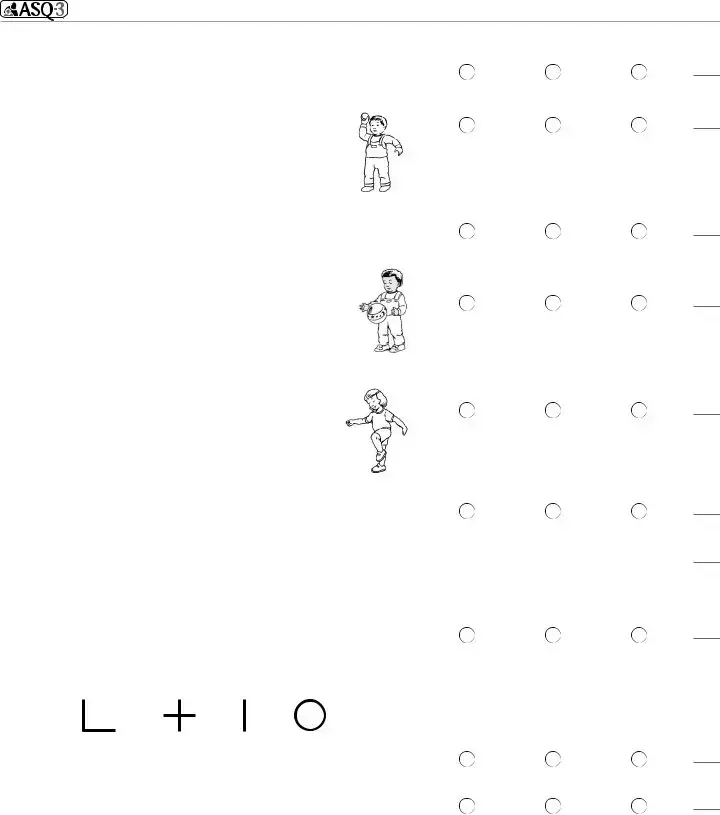
1. Does your child hop up and down on either the right foot or the left foot at least one time without losing her balance or falling?
2. While standing, does your child throw a ball OVERHAND in the direction of a person standing at least 6 feet away? To throw overhand, your child must raise his arm to shoulder height and throw the ball forward. (Dropping the ball or throwing the ball underhand should be scored as “not yet.”)
3. Does your child jump forward a distance of 20 inches from a standing position, starting with her feet together?
4. Does your child catch a large ball with both hands? (You should stand about 5 feet away and give your child two or three tries before you mark the answer.)
5. Without holding onto anything, does your child stand on one foot for at least 5 seconds without losing her balance and putting her foot down? (You may give your child two or three tries before you mark the answer.)
6. Does your child walk on his tiptoes for 15 feet (about the length of a large car)? (You may show him how to do this.)
GROSS MOTOR TOTAL
FINE MOTOR
YES |
SOMETIMES |
NOT YET |
1.Using the shapes below to look at, does your child copy at least three shapes onto a large piece of paper using a pencil, crayon, or pen, with- out tracing? (Your child’s drawings should look similar to the design of the shapes below, but they may be different in size.)
2.Does your child unbutton one or more buttons? Your child may use his own clothing or a doll’s clothing.
3.Does your child color mostly within the lines in a coloring book or within the lines of a
E101540300 |
Ages & Stages Questionnaires®, Third Edition |
© 2009 Paul H. Brookes Publishing Co. All rights reserved. |
54 Month Questionnaire page 4 of 7
FINE MOTOR (continued) |
YES |
SOMETIMESNOT YET |
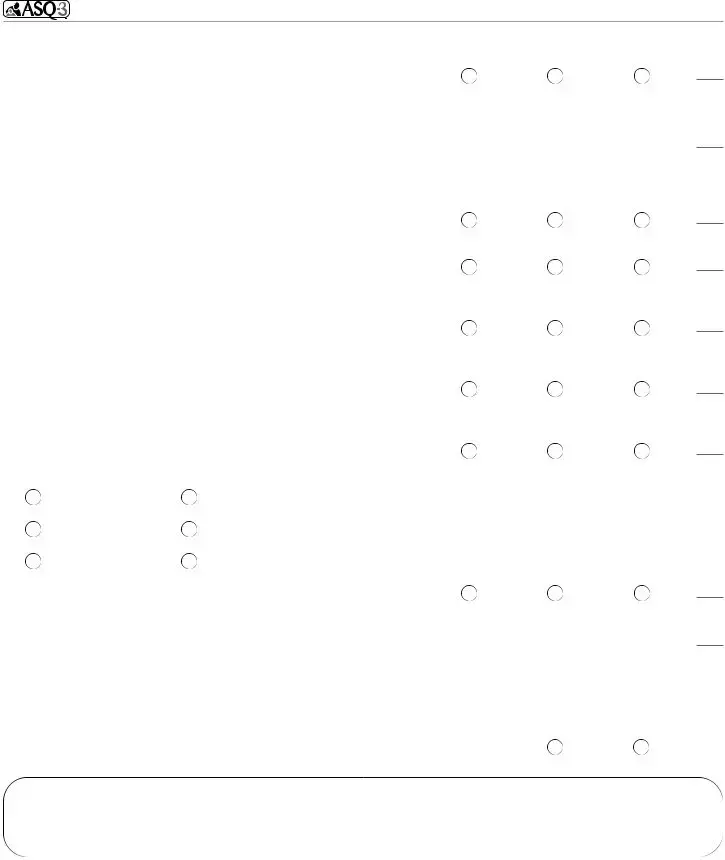
4. Ask your child to trace on the line below with a pencil. Does your child trace on the line without going off the line more than two times? (Mark “sometimes” if your child goes off the line three times.)
5. Ask your child to draw a picture of a person on a blank sheet of paper. You may ask your child, “Draw a picture of a girl or a boy.” If your child draws a person with head, body, arms, AND legs, mark “yes.” If your child draws a person with only three parts (head, body, arms, or legs), mark “sometimes.” If your child draws a person with two or fewer parts (head, body, arms, or legs), mark “not yet.” Be sure to include the sheet of paper with your child’s drawing with this questionnaire.
6. Draw a line across a piece of paper. Using
FINE MOTOR TOTAL
PROBLEM SOLVING
YES |
SOMETIMES |
NOT YET |
1. When shown objects and asked, “What color is this?” does your child name five different colors, like red, blue, yellow, orange, black, white, or pink? (Mark “yes” only if your child answers the question correctly using five colors.)
2. Does your child dress up and
3. If you place five objects in front of your child, can she count them by saying, “One, two, three, four, five” in order? (Ask this question WITHOUT providing help by pointing, gesturing, or naming.)
4. When asked, “Which circle is smallest?” does your child point to the smallest circle? (Ask this question WITHOUT providing help by pointing, gesturing, or looking at the smallest circle.)
5. Does your child count up to 15 without making mistakes? If so, mark “yes.” If your child counts to 12 without making mistakes, mark “some- times.”
E101540400 |
Ages & Stages Questionnaires®, Third Edition |
© 2009 Paul H. Brookes Publishing Co. All rights reserved. |
54 Month Questionnaire page 5 of 7
PROBLEM SOLVING |
(continued) |
|
YES |
SOMETIMES |
NOT YET |
6. Does your child know the names of numbers? (Mark “yes” if he identi- |
|
|
|
||
fies the three numbers below. Mark “sometimes” if he identifies two |
|
|
|
||
numbers.) |
|
|
|
|
|
3 |
1 |
2 |
|
PROBLEM SOLVING TOTAL |
|
YES |
SOMETIMES |
NOT YET |
1. Does your child wash her hands using soap and water and dry off with a towel without help?
2. Does your child tell you the names of two or more playmates, not in- cluding brothers and sisters? (Ask this question without providing help by suggesting names of playmates or friends.)
3. Does your child brush his teeth by putting toothpaste on the tooth- brush and brushing all of his teeth without help? (You may still need to
check and rebrush your child’s teeth.)
4. Does your child serve herself, taking food from one container to an- other, using utensils? (For example, does your child use a large spoon to scoop applesauce from a jar into a bowl?)
5. Does your child tell you at least four of the following? Please mark the items your child knows.
a. First name |
d. Last name |
b. Age |
e. Boy or girl |
c. City he lives in |
f. Telephone number |
6. Does your child dress and undress herself, including buttoning
OVERALL
Parents and providers may use the space below for additional comments.
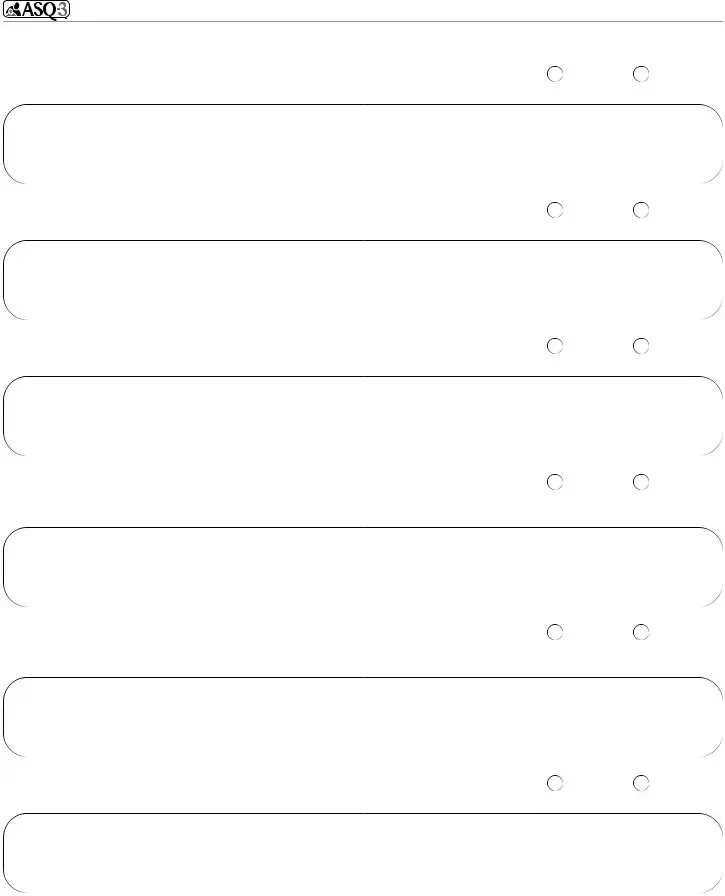
1. Do you think your child hears well? If no, explain: |
YES |
NO |
E101540500 |
Ages & Stages Questionnaires®, Third Edition |
© 2009 Paul H. Brookes Publishing Co. All rights reserved. |
54 Month Questionnaire page 6 of 7
OVERALL (continued) |
|
|
2. Do you think your child talks like other children her age? If no, explain: |
YES |
NO |
3. Can you understand most of what your child says? If no, explain: |
YES |
NO |
4. Can other people understand most of what your child says? If no, explain: |
YES |
NO |
5. Do you think your child walks, runs, and climbs like other children his age? |
YES |
NO |
If no, explain: |
|
|
6. Does either parent have a family history of childhood deafness or hearing |
YES |
NO |
impairment? If yes, explain: |
|
|
7. Do you have any concerns about your child’s vision? If yes, explain: |
YES |
NO |
E101540600 |
Ages & Stages Questionnaires®, Third Edition |
© 2009 Paul H. Brookes Publishing Co. All rights reserved. |
54 Month Questionnaire page 7 of 7
OVERALL (continued) |
|
|
8. Has your child had any medical problems in the last several months? If yes, explain: |
YES |
NO |
9. Do you have any concerns about your child’s behavior? If yes, explain: |
YES |
NO |
10. Does anything about your child worry you? If yes, explain: |
YES |
NO |
E101540700 |
Ages & Stages Questionnaires®, Third Edition |
© 2009 Paul H. Brookes Publishing Co. All rights reserved. |
|
54 Month |
51 months 0 days through |
|||
|
56 months 30 days |
|
|||
|
|
|
|
|
|
Child’s name: ________________________________________________________ |
Date ASQ completed: __________________________________________ |
|
|||
|
|
|
|
|
|
Child’s ID #: ______________________________________________________ |
Date of birth: ______________________________________________ |
||||
Administering program/provider: |
|
|
|
|
|
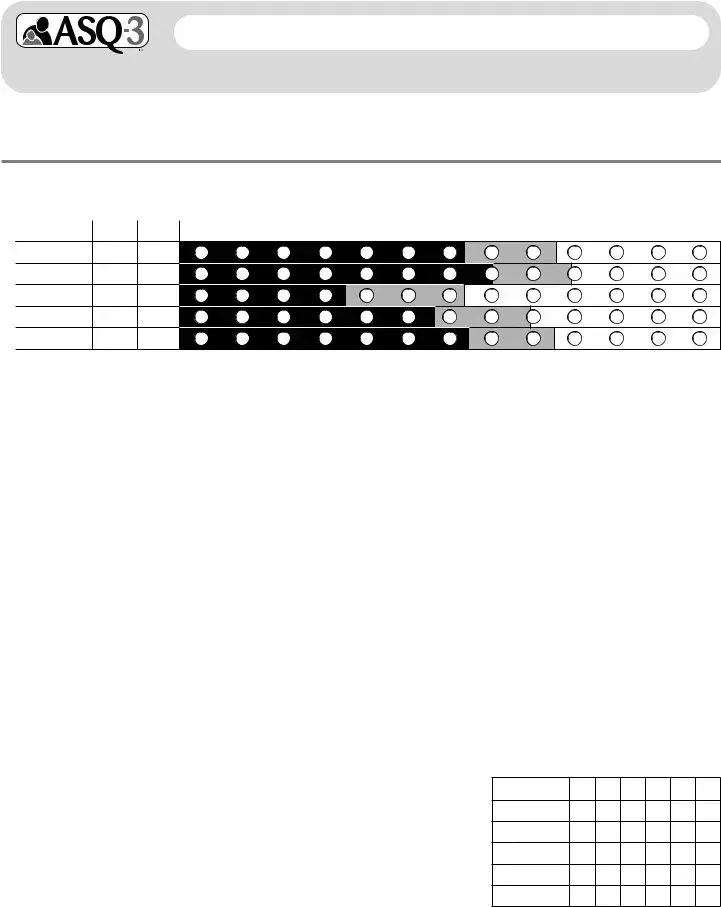
1.SCORE AND TRANSFER TOTALS TO CHART BELOW: See
|
Total |
0 |
5 |
10 |
15 |
20 |
25 |
30 |
35 |
40 |
45 |
50 |
55 |
60 |
Area |
Cutoff Score |
|||||||||||||
Communication |
31.85 |
|
|
|
|
|
|
|
|
|
|
|
|
|
Gross Motor |
35.18 |
|
|
|
|
|
|
|
|
|
|
|
|
|
Fine Motor |
17.32 |
|
|
|
|
|
|
|
|
|
|
|
|
|
Problem Solving |
28.12 |
|
|
|
|
|
|
|
|
|
|
|
|
|
32.33 |
|
|
|
|
|
|
|
|
|
|
|
|
|
2.TRANSFER OVERALL RESPONSES: Bolded uppercase responses require
1. |
Hears well? |
Yes |
NO |
6. |
Family history of hearing impairment? |
YES |
No |
|
Comments: |
|
|
|
Comments: |
|
|
2. |
Talks like other children his age? |
Yes |
NO |
7. |
Concerns about vision? |
YES |
No |
|
Comments: |
|
|
|
Comments: |
|
|
3. |
Understand most of what your child says? |
Yes |
NO |
8. |
Any medical problems? |
YES |
No |
|
Comments: |
|
|
|
Comments: |
|
|
4. |
Others understand most of what your child says? |
Yes |
NO |
9. |
Concerns about behavior? |
YES |
No |
|
Comments: |
|
|
|
Comments: |
|
|
5. |
Walks, runs, and climbs like other children? |
Yes |
NO |
10. |
Other concerns? |
YES |
No |
|
Comments: |
|
|
|
Comments: |
|
|
3.ASQ SCORE INTERPRETATION AND RECOMMENDATION FOR
If the child’s total score is in the If the child’s total score is in the If the child’s total score is in the
area, it is above the cutoff, and the child’s development appears to be on schedule.
area, it is close to the cutoff. Provide learning activities and monitor.
area, it is below the cutoff. Further assessment with a professional may be needed.
4.
______ |
Provide activities and rescreen in _____ months. |
______ |
Share results with primary health care provider. |
______ |
Refer for (circle all that apply) hearing, vision, and/or behavioral screening. |
______ |
Refer to primary health care provider or other community agency (specify |
|
reason): __________________________________________________________. |
______ |
Refer to early intervention/early childhood special education. |
______ |
No further action taken at this time |
______ |
Other (specify): ____________________________________________________ |
5.OPTIONAL: Transfer item responses (Y = YES, S = SOMETIMES, N = NOT YET, X = response missing).
1 |
2 |
3 |
4 |
5 |
6 |
Communication
Gross Motor
Fine Motor
Problem Solving
P101540800 |
Ages & Stages Questionnaires®, Third Edition |
© 2009 Paul H. Brookes Publishing Co. All rights reserved. |
| Fact Name | Fact Description |
|---|---|
| Age Range | The ASQ 54 Month Questionnaire is designed for children aged 51 months 0 days through 56 months 30 days. |
| Completion Guidelines | Parents or guardians should use black or blue ink and print legibly when filling out the form. |
| Child Information | The form collects basic information about the child, including name, gender, and date of birth. |
| Respondent Information | Individuals completing the questionnaire must provide their relationship to the child, such as parent, guardian, or teacher. |
| Communication Skills | The questionnaire assesses various communication skills, including sentence structure and vocabulary use. |
| Motor Skills Assessment | It evaluates both gross and fine motor skills, such as hopping, throwing, and drawing. |
| Problem Solving | The form includes questions to gauge a child's problem-solving abilities, including counting and color identification. |
| Personal-Social Skills | It assesses personal-social skills, such as handwashing, self-dressing, and identifying playmates. |
| Return Instructions | Parents are instructed to return the completed questionnaire by a specified date, which must be filled in on the form. |
Filling out the ASQ 54 Month Questionnaire form is an important step in assessing your child's development. After completing the form, it will be submitted for review, where professionals will analyze the responses to provide valuable insights into your child's growth and areas for improvement.
The ASQ 54 Month Questionnaire is designed to assess the developmental progress of children aged 51 months to 56 months. This tool helps parents, guardians, and educators identify areas where a child may excel or need additional support. By observing and answering questions about various activities, caregivers can gain insights into the child's communication, motor skills, problem-solving abilities, and personal-social development.
When filling out the ASQ 54 Month Questionnaire, use black or blue ink and print clearly. It is important to try each activity with your child before marking a response. To make the process enjoyable, consider turning it into a game. Ensure your child is well-rested and fed to get the best results. After completing the questionnaire, return it by the specified due date to ensure timely evaluation.
The questionnaire covers several key developmental areas:
The questionnaire should be completed by a person who is familiar with the child's abilities and daily activities. This may include parents, guardians, teachers, or childcare providers. It is beneficial to have input from multiple individuals who interact with the child regularly, as this can provide a more comprehensive view of the child's development.
Filling out the ASQ 54 Month Questionnaire can be a straightforward task, but many people make mistakes that can affect the accuracy of the results. One common error is not providing clear and legible information. The instructions specify using black or blue ink and printing legibly. If the handwriting is difficult to read, it can lead to misunderstandings or misinterpretations of the child’s abilities.
Another mistake is not involving the child in the process. The questionnaire encourages parents to try each activity with their child before marking a response. Skipping this step can result in inaccurate assessments. For example, if a parent marks “yes” without actually observing the child perform the task, they may overestimate or underestimate the child's skills.
Some individuals forget to consider the child's mood or state before completing the questionnaire. The instructions recommend ensuring the child is well-rested and fed. If the child is tired or hungry, they may not perform at their best, leading to skewed results. It’s essential to choose a time when the child is likely to be engaged and cooperative.
Additionally, people often overlook the importance of answering all questions. Incomplete forms can lead to gaps in information, making it difficult for professionals to assess the child’s development accurately. Every question serves a purpose, and each response contributes to the overall picture of the child’s abilities.
Another frequent mistake is failing to include the names of individuals who assisted in completing the questionnaire. This information can be valuable for professionals reviewing the form. It provides context about who observed the child and can help clarify any discrepancies in the responses.
Some parents may also misinterpret the rating system. Understanding the difference between “yes,” “sometimes,” and “not yet” is crucial. Misunderstanding these terms can lead to inaccurate scoring, which may affect the recommendations provided by professionals later on.
Finally, people sometimes neglect to return the questionnaire by the specified deadline. Timeliness is important, as it ensures that the child receives the appropriate support and resources based on their developmental needs. Missing the deadline can delay important assessments and interventions that could benefit the child.
The Ages & Stages Questionnaires® (ASQ) 54 Month Questionnaire is a valuable tool for assessing a child's development at a specific age. To provide a comprehensive evaluation, several other forms and documents are often used alongside the ASQ. Each of these documents serves a unique purpose in understanding a child's growth and needs.
These documents, when used together with the ASQ 54 Month Questionnaire, create a fuller picture of a child's development. They help parents, caregivers, and educators work collaboratively to support the child's growth and learning journey.
The ASQ 54 Month Questionnaire form is similar to several other developmental assessment tools. Each document serves a similar purpose in evaluating a child's growth and developmental milestones. Below are four documents that share similarities with the ASQ 54 Month Questionnaire:
When filling out the ASQ 54 Month Questionnaire form, there are several important guidelines to follow. Here are ten key dos and don'ts to ensure the process is smooth and effective.
Following these guidelines will help ensure that the questionnaire accurately reflects your child's abilities and developmental milestones.
Misconceptions about the ASQ 54 Month Questionnaire can lead to confusion and misinterpretation of its purpose and use. Here are four common misconceptions, along with clarifications to help understand the form better:
Understanding these misconceptions can help ensure that the ASQ 54 Month Questionnaire is utilized effectively, providing valuable insights into a child's development.
Filling out the ASQ 54 Month Questionnaire form is a crucial step in assessing your child's developmental milestones. Here are some key takeaways to ensure a smooth process:
By keeping these points in mind, you can effectively complete the ASQ 54 Month Questionnaire and contribute to your child's developmental journey.