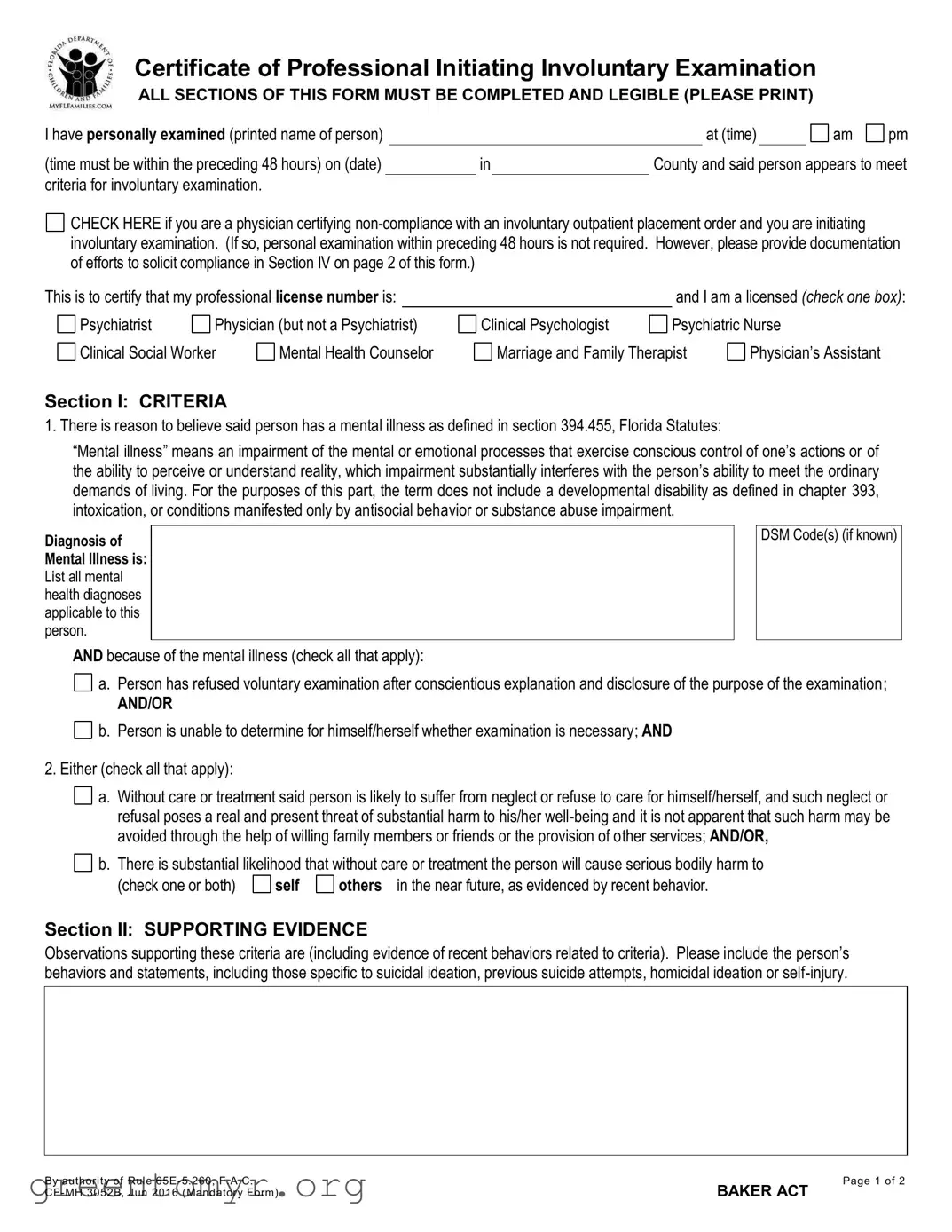
The Baker Act form serves as a critical tool in the process of initiating involuntary examinations for individuals who may be experiencing mental health crises. This form must be completed in its entirety and legibly, ensuring that all necessary information is provided. It begins with a certification by a qualified professional, who must have personally examined the individual within the previous 48 hours. This examination is essential to determine if the person meets the criteria for involuntary examination as outlined in Florida Statutes. The form includes sections for documenting the individual's mental health diagnoses, the reasons for initiating the examination, and any supporting evidence of behaviors that justify the need for intervention. Additionally, it allows for the inclusion of information regarding non-compliance with previous outpatient treatment orders, should that apply. Law enforcement details may also be required to assist in locating the individual if necessary. Each section is designed to gather comprehensive information, ensuring that the decision to proceed with an involuntary examination is made with careful consideration of the individual's circumstances.

Certificate of Professional Initiating Involuntary Examination
ALL SECTIONS OF THIS FORM MUST BE COMPLETED AND LEGIBLE (PLEASE PRINT)
I have personally examined (printed name of person) |
|
|
|
|
at (time) |
|
am |
pm |
|
(time must be within the preceding 48 hours) on (date) |
|
|
in |
|
County and said person appears to meet |
||||
criteria for involuntary examination. |
|
|
|
|
|
|
|
|
|
CHECK HERE if you are a physician certifying
This is to certify that my professional license number is:
Psychiatrist |
|
Physician (but not a Psychiatrist) |
||
Clinical Social Worker |
|
Mental Health Counselor |
||
|
||||
|
and I am a licensed (CHECK ONE BOX): |
|
Clinical Psychologist |
Psychiatric Nurse |
|
Marriage and Family Therapist |
Physician’s Assistant |
|
Section I: CRITERIA
1. There is reason to believe said person has a mental illness as defined in section 394.455, Florida Statutes:
“Mental illness” means an impairment of the mental or emotional processes that exercise conscious control of one’s actions or of the ability to perceive or understand reality, which impairment substantially interferes with the person’s ability to meet the ordinary
demands of living. For the purposes of this part, the term does not include a developmental disability as defined in chapter 393, intoxication, or conditions manifested only by antisocial behavior or substance abuse impairment.
Diagnosis of Mental Illness is: List all mental health diagnoses applicable to this person.
DSM Code(s) (if known)
AND because of the mental illness (check all that apply):
a. Person has refused voluntary examination after conscientious explanation and disclosure of the purpose of the examination;
AND/OR
b. Person is unable to determine for himself/herself whether examination is necessary; AND
2. Either (check all that apply):
a. Without care or treatment said person is likely to suffer from neglect or refuse to care for himself/herself, and such neglect or refusal poses a real and present threat of substantial harm to his/her
b. There is substantial likelihood that without care or treatment the person will cause serious bodily harm to
(check one or both) |
|
self |
|
others in the near future, as evidenced by recent behavior. |
Section II: SUPPORTING EVIDENCE
Observations supporting these criteria are (including evidence of recent behaviors related to criteria). Please include the person’s behaviors and statements, including those specific to suicidal ideation, previous suicide attempts, homicidal ideation or
By authority of Rule |
Page 1 of 2 |
BAKER ACT |

Certificate of Professional Initiating Involuntary Examination
Section III: OTHER INFORMATION
Other information, including source relied upon to reach this conclusion is as follows. If information is obtained from other persons, describe these sources (e.g., reports of family, friends, other mental health professionals or law enforcement officers, as well as medical or mental health records, etc.).
Section IV:
Complete this section if you are a physician who is documenting
Section V: INFORMATION FOR LAW ENFORCEMENT
Provide identifying information (if known) if requested by law enforcement to find the person so he/she may be taken into custody for examination:
Age:
Male
Female Race/ethnicity:
Other details (such as height, weight, hair color, what wearing when last seen, where last seen):
If relevant, information such as access to weapon, recent violence or pending criminal charges:
This form must be transported with the person to the receiving facility to be retained in the clinical record. Copies may be retained by the initiating professional and by the law enforcement agency transporting the person to the receiving facility.
Section VI: SIGNATURE
am
Signature of Professional |
Date Signed |
Time |
pm
Printed Name of Professional |
Phone Number (including area code)) |
By authority of Rule |
Page 2 of 2 |
BAKER ACT |
| Fact Name | Description |
|---|---|
| Purpose | The Baker Act form initiates involuntary examination for individuals who may have a mental illness and pose a threat to themselves or others. |
| Completion Requirements | All sections of the form must be completed and legible. A personal examination of the individual must occur within the preceding 48 hours unless the examiner is certifying non-compliance with an outpatient placement order. |
| Governing Law | The Baker Act is governed by Florida Statutes, specifically section 394.455, which defines mental illness and outlines criteria for involuntary examination. |
| Documentation | Supporting evidence and observations must be included in the form, detailing the individual's behaviors and statements related to their mental health condition. |
Completing the Baker Act form requires careful attention to detail and accuracy. Ensure all sections are filled out legibly and completely, as this is crucial for the subsequent procedures that will follow. Below are the steps to guide you through the process of filling out the form.
The Baker Act form is a legal document used in Florida to initiate an involuntary examination for individuals who may have a mental illness. This form is completed by a licensed professional who has personally examined the individual and believes they meet specific criteria for involuntary examination.
Only licensed professionals such as psychiatrists, clinical psychologists, mental health counselors, and certain other mental health practitioners can complete the Baker Act form. These professionals must have conducted a personal examination of the individual within the preceding 48 hours.
To qualify for an involuntary examination under the Baker Act, the individual must be believed to have a mental illness that substantially interferes with their ability to meet ordinary demands of living. Additionally, they must either refuse voluntary examination or be unable to determine if examination is necessary. Furthermore, there must be a likelihood of substantial harm to themselves or others without care or treatment.
The Baker Act form requires detailed information, including:
If the individual refuses voluntary examination, the initiating professional must document this refusal on the form. The professional must also provide an explanation of the examination's purpose to the individual before proceeding with the Baker Act process.
Yes, the Baker Act form can be utilized to document non-compliance with an involuntary outpatient placement order. This section must be completed by a physician who has determined that the individual has failed to comply with the treatment ordered by the court.
The supporting evidence section should include specific observations and statements made by the individual that relate to their mental health. This may involve noting any suicidal or homicidal ideation, previous suicide attempts, or self-injury behaviors.
Law enforcement may request identifying information about the individual to facilitate their transport for examination. The form must accompany the individual to the receiving facility and be retained in their clinical record. Law enforcement agencies may also keep copies of the form.
Completing the Baker Act form initiates a legal process that can lead to involuntary examination and treatment. This process is designed to protect individuals who may be a danger to themselves or others due to mental illness. It is crucial that the form is completed accurately and thoroughly to ensure the individual's rights and well-being are respected.
Yes, the Baker Act form is mandatory for initiating an involuntary examination in Florida. Professionals must use the official form to ensure compliance with state laws and regulations regarding mental health treatment.
Filling out the Baker Act form requires careful attention to detail. One common mistake is leaving sections incomplete or illegible. All sections must be filled out completely and clearly. If any part is left blank or difficult to read, it may delay the process or result in the form being rejected. Ensuring clarity is essential for effective communication with law enforcement and mental health professionals.
Another frequent error involves failing to provide adequate supporting evidence. Section II asks for observations and behaviors that justify the need for involuntary examination. Without detailed descriptions, including specific incidents or statements, the rationale for the examination may not be convincing. It is important to document relevant behaviors, especially those indicating suicidal or harmful tendencies.
People often overlook the importance of accurate diagnosis in Section I. Listing the correct mental health diagnoses and DSM codes is crucial. Misdiagnosis can lead to inappropriate treatment and may hinder the individual’s chances of receiving the necessary care. A clear and accurate representation of the individual’s mental health status is vital for their safety and well-being.
Additionally, some individuals fail to check all applicable criteria boxes. The form requires multiple criteria to be met for involuntary examination. If the professional does not check all relevant boxes, it may suggest that the person does not meet the required standards for examination. Thoroughly reviewing the criteria and ensuring all applicable boxes are checked can prevent misunderstandings.
Finally, neglecting to provide identifying information for law enforcement can pose significant challenges. Section V requires details that help law enforcement locate the individual. Omitting this information can delay intervention and care. Providing comprehensive details, such as physical description and last known whereabouts, is essential for a timely response.
The Baker Act is a critical legal mechanism in Florida that allows for the involuntary examination of individuals who may be experiencing a mental health crisis. Alongside the Baker Act form, several other documents may be required to ensure that the process is handled appropriately and with care. Below is a list of these important forms and documents.
Understanding these documents can help individuals and their families navigate the complexities of mental health care. Each form plays a vital role in ensuring that the rights and needs of the individual are respected throughout the process.
The Baker Act form is a legal document used in Florida for the involuntary examination of individuals believed to have mental illness. Several other documents share similarities with the Baker Act form in terms of purpose, structure, and the information they require. Here are ten such documents:
When filling out the Baker Act form, it is essential to follow specific guidelines to ensure accuracy and compliance. Below is a list of actions to take and avoid.
The Baker Act is a crucial piece of legislation that allows for the involuntary examination of individuals experiencing mental health crises. However, several misconceptions surround the Baker Act form that can lead to confusion and anxiety. Below are five common misconceptions, along with clarifications to promote understanding.
In reality, only qualified professionals such as psychiatrists, physicians, clinical social workers, and mental health counselors can initiate a Baker Act. This ensures that the decision is made based on clinical judgment and expertise.
Individuals undergoing an involuntary examination under the Baker Act retain certain rights. They have the right to be informed about the examination, to receive appropriate care, and to have their situation reviewed by a qualified professional.
The Baker Act is not intended as a long-term solution. It is a temporary measure designed to provide immediate care and assessment. The goal is to stabilize the individual and connect them with ongoing support and treatment as needed.
The Baker Act form must accompany the individual when they are transported to a receiving facility. This ensures that the receiving professionals have all necessary information for continued care and assessment.
While the form may seem straightforward, it requires careful consideration and detailed observations. Professionals must provide accurate information regarding the individual's mental health status, behaviors, and any relevant history to ensure appropriate care.
All sections of the Baker Act form must be completed and clearly printed. Incomplete or illegible forms may lead to delays or issues in processing.
Professionals must conduct a personal examination of the individual within 48 hours prior to filling out the form, unless they are certifying non-compliance with an involuntary outpatient placement order.
The criteria for involuntary examination must be met, including evidence of mental illness and a potential threat to the individual or others. It is essential to check all applicable boxes accurately.
Supporting evidence must be documented, detailing the individual’s behaviors, statements, and any relevant observations that justify the need for involuntary examination.
This form should accompany the individual to the receiving facility and must be retained in the clinical record. Copies can be kept by the initiating professional and law enforcement.