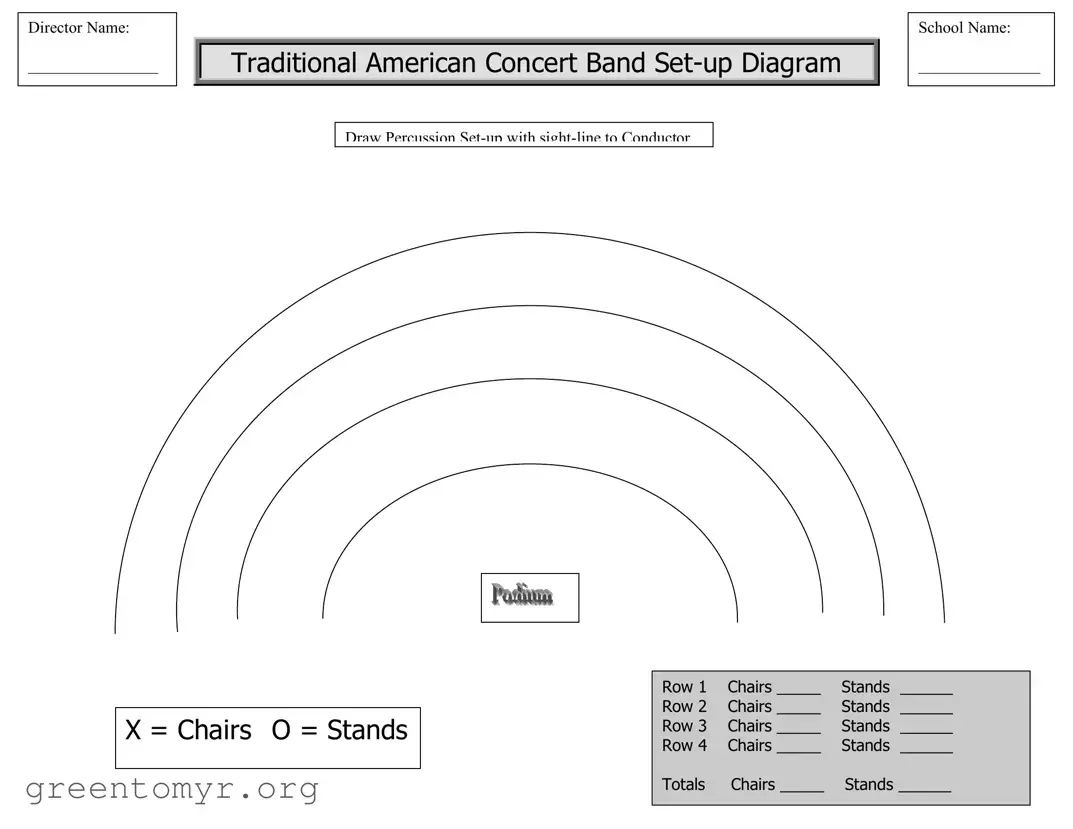
When organizing a concert band performance, having a clear and detailed seating arrangement is essential for both the musicians and the audience. The Band Seating Chart form serves as a vital tool for band directors to communicate their specific needs for chair and stand placements. This form captures important details such as the director's name, the school hosting the performance, and the date and time of the event. It also includes a traditional American concert band setup diagram, allowing directors to visualize the optimal arrangement for their musicians. The form specifies the number of chairs and music stands required for each row, ensuring that every musician has the necessary space and equipment to perform effectively. Additionally, it emphasizes the importance of maintaining a proper sight-line for percussionists to the conductor, which is crucial for a cohesive performance. By filling out this form accurately, directors help the stage crew prepare the setup according to their specifications, ultimately enhancing the overall concert experience.
Director Name:
________________
Traditional American Concert Band
Draw Percussion
School Name:
_______________
X = Chairs O = Stands
Row 1 |
Chairs _____ |
Stands |
______ |
Row 2 |
Chairs _____ |
Stands |
______ |
Row 3 |
Chairs _____ |
Stands |
______ |
Row 4 |
Chairs _____ |
Stands |
______ |
Totals |
Chairs _____ |
Stands ______ |
|
|
|
|
|
Concert Band
ROW 5
ROW 4
ROW 3
ROW 2
ROW 1
PODIUM
School: _______________________________________
Director: ______________________________________
Performance Date: _____________ Time: __________
ROW 1 ______ CHAIRS & _______ MUSIC STANDS
ROW 2 |
______ CHAIRS & _______ MUSIC STANDS |
ROW 3 |
______ CHAIRS & _______ MUSIC STANDS |
ROW 4 |
______ CHAIRS & _______ MUSIC STANDS |
ROW 5 |
______ CHAIRS & _______ MUSIC STANDS |
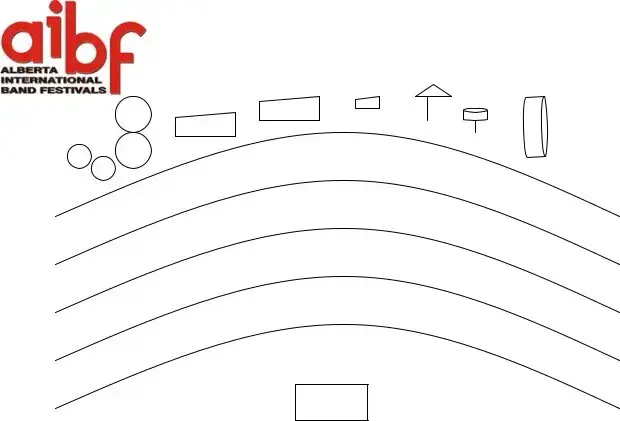
The AIBF stage crew will do their best to set the stage for your requirements.
Please note that percussion MUST stay in the basic
PLEASE FAX THIS FORM TO
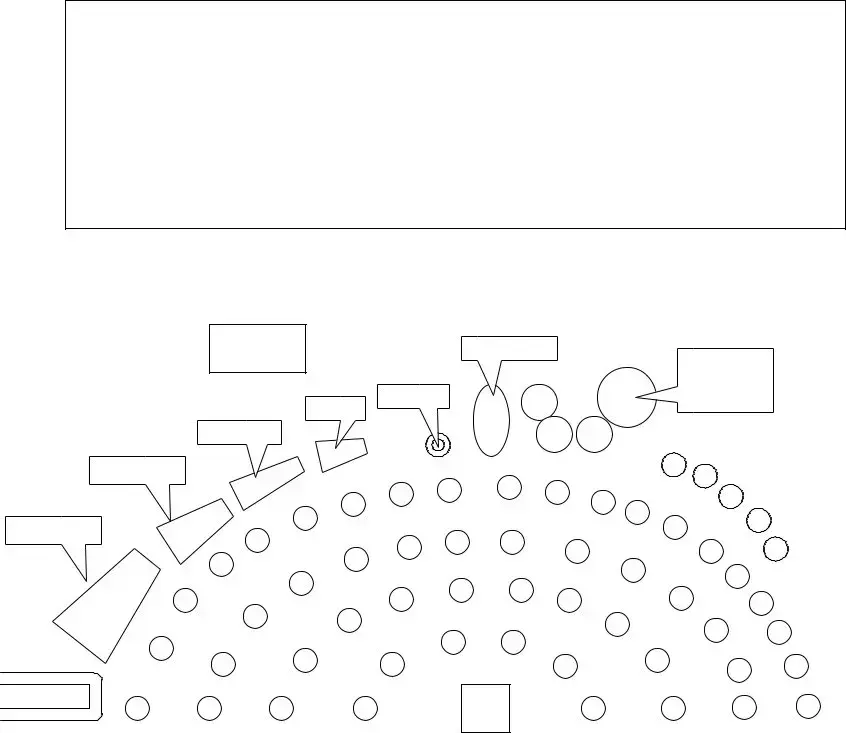
2007 Huron Concert Band
Row 1: 6 Chairs/3 Stands (Flute)
Row 2: 10 Chairs/8 Stands (1st & 2nd Clarinets, Oboe, Bassoon, Bass Clarinet)
Row 3: 14 Chairs/10 Stands (3rd Clarinet, Horns, Bari, Tenor, Alto
Row 4: 19 Chairs/13 Stands (Trumpets, Trombones, Euphonium, Tuba)
Row 5: 5 Stands
Percussion: 11 Stands
Auxiliary
Vibes
Bass
Timpani
Snare
Bells
Xylophone
Marimba
Chimes
| Fact Name | Description |
|---|---|
| Director Information | The form requires the director's name and school name to ensure proper identification and coordination. |
| Seating Arrangement | It includes a detailed seating chart for the concert band, specifying the number of chairs and music stands for each row. |
| Submission Deadline | The completed form must be faxed to the designated number before March 1, 2008, to ensure timely arrangements. |
| Governing Law | This form is governed by the regulations applicable to performance events in educational institutions in the state of Illinois. |
Once you have your Band Seating Chart form, you'll need to fill it out carefully to ensure everything is set for your performance. Gather the necessary information, including the director's name, school name, and performance details. This will help the stage crew understand your needs and set up the stage accordingly.
The Band Seating Chart form is designed to help organize the seating arrangement for your concert band performance. It ensures that each musician has a designated spot, which can enhance the overall sound and visual presentation of the band. By providing a clear layout, it allows for better communication between the musicians and the conductor.
The form should be filled out by the band director. This person is responsible for determining the seating arrangement and ensuring that all musicians are placed appropriately based on their instruments and roles within the band.
You will need to provide the following information:
Additionally, you will need to draw the percussion setup and indicate sight-lines to the conductor.
To determine the number of chairs and stands, consider the number of musicians in each section of the band. Each musician typically requires one chair and one stand. You can refer to previous seating charts or consult with your musicians to ensure that everyone is accounted for.
If you have a specific seating arrangement, you can draw it directly on the form. Make sure to indicate the placement of each section clearly. The stage crew will use this information to set up the stage according to your preferences.
If changes are necessary after you have submitted the form, contact the designated person as soon as possible. The earlier you communicate any adjustments, the better chance there is for accommodating your requests.
The completed form must be faxed to 780-438-1465, attention Rob Speers, prior to March 1, 2008. Be sure to meet this deadline to ensure that your seating arrangement can be accommodated.
Yes, feel free to include any additional notes or specific requests on the form. This can help the stage crew understand your needs better and ensure that everything runs smoothly on the day of the performance.
If the form is not submitted, the stage crew may not have the necessary information to set up the stage according to your needs. This could lead to confusion and affect the performance. It is crucial to submit the form on time to avoid any issues.
Filling out the Band Seating Chart form can be straightforward, but several common mistakes can lead to confusion and inefficiency. One frequent error is neglecting to provide the director's name and the school name at the top of the form. These details are essential for proper identification and coordination with the stage crew. Without this information, the form may not be processed correctly, potentially affecting the setup.
Another mistake involves incorrect calculations of chairs and stands. Many people fail to total the number of chairs and stands accurately. For example, if a section has 6 chairs and 3 stands, it is crucial to ensure that these numbers are reflected in the totals section. Inaccurate totals can lead to an inadequate setup, resulting in logistical issues during rehearsals or performances.
Additionally, some individuals overlook the specific requirements for the percussion section. The form explicitly states that percussion must adhere to the basic setup as shown in the diagram. Ignoring this guideline can disrupt the overall arrangement and sight-lines for the conductor. Ensuring that percussion is placed correctly is vital for maintaining harmony during the performance.
Finally, failing to submit the form by the deadline is a common oversight. The instruction to fax the completed form prior to March 1, 2008, is critical. Late submissions can lead to complications, as the stage crew may not have enough time to accommodate last-minute changes. Adhering to deadlines ensures a smooth and organized setup process.
The Band Seating Chart form is an essential document for organizing a concert band performance. It provides a structured way to outline the seating arrangement for musicians, ensuring that everyone has a designated spot. Along with this form, several other documents may be utilized to facilitate a smooth performance. Below is a list of related forms and documents that are often used in conjunction with the Band Seating Chart.
These forms and documents work together to create a comprehensive framework for managing a concert band performance. Utilizing them effectively can lead to a successful and enjoyable experience for both performers and the audience.
The Band Seating Chart form is essential for organizing a concert band. It shares similarities with several other documents that serve similar purposes. Here are four documents that are comparable:
When filling out the Band Seating Chart form, it's important to ensure that all information is accurate and clearly presented. Here are some guidelines to help you navigate the process effectively:
By following these guidelines, you can help ensure that the seating arrangement meets the needs of the band and contributes to a successful performance.
When it comes to the Band Seating Chart form, several misconceptions can lead to confusion among directors and participants. Here are four common misunderstandings:
Many people believe that the Band Seating Chart form is only necessary for large ensembles. In reality, it is beneficial for bands of all sizes. Even smaller groups can use the chart to ensure that musicians are arranged optimally for sightlines and acoustics.
Some assume that the percussion section can be placed anywhere on stage. However, the form specifies that percussion must adhere to a basic set-up. This arrangement is designed to maintain sightlines to the conductor and ensure effective communication during performances.
Another common belief is that the seating chart is only relevant on performance day. In truth, it serves as a planning tool that can be used during rehearsals as well. Proper seating can enhance collaboration and improve overall performance quality.
Some directors think that submitting the form is optional. However, it is crucial for the stage crew to have this information in advance. Properly completed forms help ensure that the stage is set up according to the specific needs of each band, leading to a smoother performance experience.
Here are some key takeaways for effectively filling out and using the Band Seating Chart form: