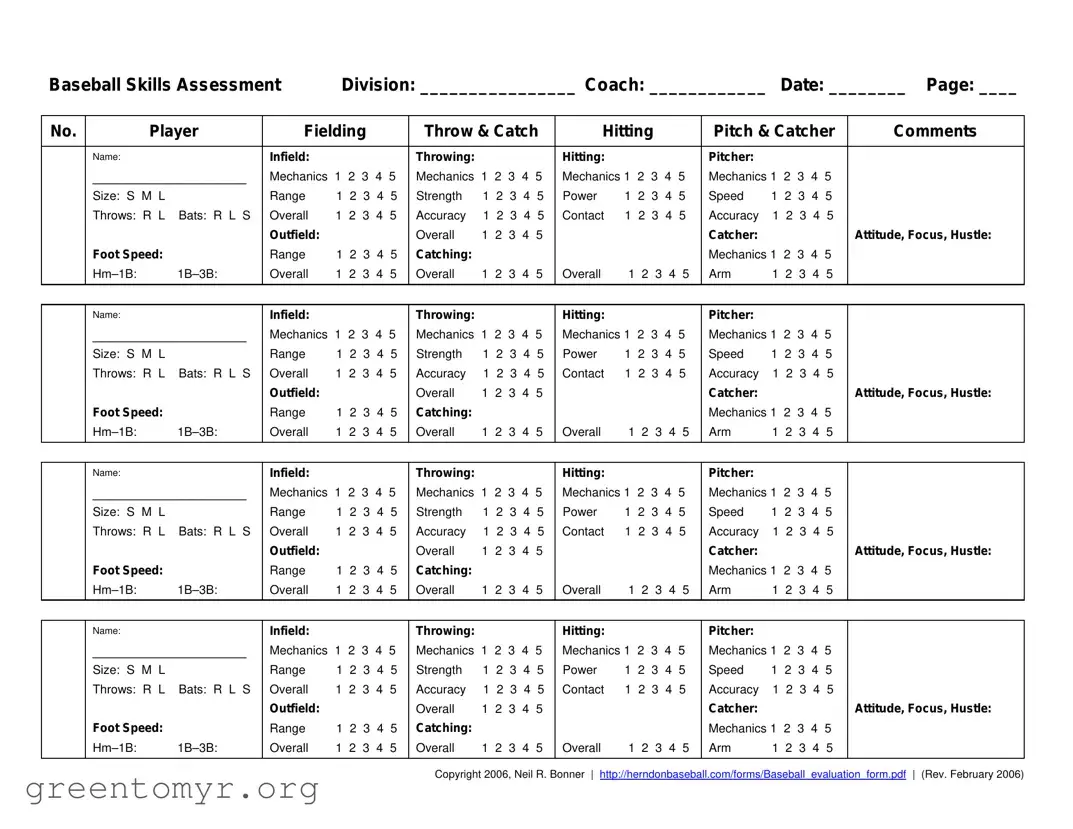
The Baseball Assessment form serves as a crucial tool for coaches evaluating players during tryouts. This standardized document provides a comprehensive framework for assessing various skills essential for baseball performance. It includes sections for fielding, throwing, hitting, and pitching, allowing coaches to score players in multiple categories. Each skill is rated on a five-point scale, where a score of five indicates exceptional ability, while one reflects significant challenges. Additional metrics such as size, strength, and speed are also captured, ensuring a holistic view of each player's capabilities. The form encourages comments to provide context for the scores, helping coaches make informed decisions. Overall, it aims to facilitate a fair selection process for All-Star teams and house leagues alike, promoting transparency and consistency in player evaluations.

Baseball Skills Assessment |
Division: ________________ Coach: ____________ |
Date: ________ |
Page: ____ |
|||||||||||||||||
|
|
|
|
|
|
|
|
|
||||||||||||
No. |
Player |
Fielding |
Throw & Catch |
Hitting |
|
|
Pitch & Catcher |
Comments |
||||||||||||
|
|
|
|
|
|
|
|
|
|
|
|
|
|
|
|
|
|
|
|
|
|
Name: |
|
Infield: |
|
Throwing: |
|
|
|
|
|
Hitting: |
|
|
|
|
|
Pitcher: |
|
|
|
|
_________________ |
Mechanics 1 2 3 4 5 |
Mechanics 1 2 3 4 5 |
Mechanics 1 2 3 4 5 |
Mechanics 1 2 3 4 5 |
|
|
|||||||||||||
|
Size: S M L |
|
Range |
1 2 3 4 5 |
Strength |
1 2 3 4 5 |
Power |
1 |
2 |
3 |
4 |
5 |
Speed |
1 2 3 4 5 |
|
|
||||
|
Throws: R L |
Bats: R L S |
Overall |
1 2 3 4 5 |
Accuracy |
1 2 3 4 5 |
Contact |
1 |
2 |
3 |
4 |
5 |
Accuracy |
1 2 3 4 5 |
|
|
||||
|
|
|
Outfield: |
|
Overall |
1 |
2 |
3 |
4 |
5 |
|
|
|
|
|
|
Catcher: |
|
Attitude, Focus, Hustle: |
|
|
Foot Speed: |
|
Range |
1 2 3 4 5 |
Catching: |
|
|
|
|
|
|
|
|
|
|
|
Mechanics 1 2 3 4 5 |
|
|
|
|
Overall |
1 2 3 4 5 |
Overall |
1 |
2 |
3 |
4 |
5 |
Overall |
1 2 3 4 5 |
Arm |
1 2 3 4 5 |
|
|
||||||
|
|
|
|
|
|
|
|
|
|
|
|
|
|
|
|
|
|
|
|
|
|
|
|
|
|
|
|
|
|
|
|
|
|
|
|
|
|
|
|
|
|
|
Name: |
|
Infield: |
|
Throwing: |
|
|
|
|
|
Hitting: |
|
|
|
|
|
Pitcher: |
|
|
|
|
_________________ |
Mechanics 1 2 3 4 5 |
Mechanics 1 2 3 4 5 |
Mechanics 1 2 3 4 5 |
Mechanics 1 2 3 4 5 |
|
|
|||||||||||||
|
Size: S M L |
|
Range |
1 2 3 4 5 |
Strength |
1 2 3 4 5 |
Power |
1 |
2 |
3 |
4 |
5 |
Speed |
1 2 3 4 5 |
|
|
||||
|
Throws: R L |
Bats: R L S |
Overall |
1 2 3 4 5 |
Accuracy |
1 2 3 4 5 |
Contact |
1 |
2 |
3 |
4 |
5 |
Accuracy |
1 2 3 4 5 |
|
|
||||
|
|
|
Outfield: |
|
Overall |
1 |
2 |
3 |
4 |
5 |
|
|
|
|
|
|
Catcher: |
|
Attitude, Focus, Hustle: |
|
|
Foot Speed: |
|
Range |
1 2 3 4 5 |
Catching: |
|
|
|
|
|
|
|
|
|
|
|
Mechanics 1 2 3 4 5 |
|
|
|
|
Overall |
1 2 3 4 5 |
Overall |
1 |
2 |
3 |
4 |
5 |
Overall |
1 2 3 4 5 |
Arm |
1 2 3 4 5 |
|
|
||||||
|
|
|
|
|
|
|
|
|
|
|
|
|
|
|
|
|
|
|
|
|
|
|
|
|
|
|
|
|
|
|
|
|
|
|
|
|
|
|
|
|
|
|
Name: |
|
Infield: |
|
Throwing: |
|
|
|
|
|
Hitting: |
|
|
|
|
|
Pitcher: |
|
|
|
|
_________________ |
Mechanics 1 2 3 4 5 |
Mechanics 1 2 3 4 5 |
Mechanics 1 2 3 4 5 |
Mechanics 1 2 3 4 5 |
|
|
|||||||||||||
|
Size: S M L |
|
Range |
1 2 3 4 5 |
Strength |
1 2 3 4 5 |
Power |
1 |
2 |
3 |
4 |
5 |
Speed |
1 2 3 4 5 |
|
|
||||
|
Throws: R L |
Bats: R L S |
Overall |
1 2 3 4 5 |
Accuracy |
1 2 3 4 5 |
Contact |
1 |
2 |
3 |
4 |
5 |
Accuracy |
1 2 3 4 5 |
|
|
||||
|
|
|
Outfield: |
|
Overall |
1 |
2 |
3 |
4 |
5 |
|
|
|
|
|
|
Catcher: |
|
Attitude, Focus, Hustle: |
|
|
Foot Speed: |
|
Range |
1 2 3 4 5 |
Catching: |
|
|
|
|
|
|
|
|
|
|
|
Mechanics 1 2 3 4 5 |
|
|
|
|
Overall |
1 2 3 4 5 |
Overall |
1 |
2 |
3 |
4 |
5 |
Overall |
1 2 3 4 5 |
Arm |
1 2 3 4 5 |
|
|
||||||
|
|
|
|
|
|
|
|
|
|
|
|
|
|
|
|
|
|
|
|
|
|
|
|
|
|
|
|
|
|
|
|
|
|
|
|
|
|
|
|
|
|
|
Name: |
|
Infield: |
|
Throwing: |
|
|
|
|
|
Hitting: |
|
|
|
|
|
Pitcher: |
|
|
|
|
_________________ |
Mechanics 1 2 3 4 5 |
Mechanics 1 2 3 4 5 |
Mechanics 1 2 3 4 5 |
Mechanics 1 2 3 4 5 |
|
|
|||||||||||||
|
Size: S M L |
|
Range |
1 2 3 4 5 |
Strength |
1 2 3 4 5 |
Power |
1 |
2 |
3 |
4 |
5 |
Speed |
1 2 3 4 5 |
|
|
||||
|
Throws: R L |
Bats: R L S |
Overall |
1 2 3 4 5 |
Accuracy |
1 2 3 4 5 |
Contact |
1 |
2 |
3 |
4 |
5 |
Accuracy |
1 2 3 4 5 |
|
|
||||
|
|
|
Outfield: |
|
Overall |
1 |
2 |
3 |
4 |
5 |
|
|
|
|
|
|
Catcher: |
|
Attitude, Focus, Hustle: |
|
|
Foot Speed: |
|
Range |
1 2 3 4 5 |
Catching: |
|
|
|
|
|
|
|
|
|
|
|
Mechanics 1 2 3 4 5 |
|
|
|
|
Overall |
1 2 3 4 5 |
Overall |
1 |
2 |
3 |
4 |
5 |
Overall |
1 2 3 4 5 |
Arm |
1 2 3 4 5 |
|
|
||||||
|
|
|
|
|
|
|
|
|
|
|||||||||||
|
|
|
|
|
Copyright 2006, Neil R. Bonner | http://herndonbaseball.com/forms/Baseball_evaluation_form.pdf |
| (Rev. February 2006) |
||||||||||||||
Standard Structure for Baseball Tryouts & Skills Assessment
This standardized format may be used for all outdoor baseball tryouts. This structure is designed for evaluating players for
Using the attached Baseball Skills Assessment Form, coaches should score each player according to the listed categories of skills. The evaluation form uses a five point scale to measure the various skills that a player should possess in order to play baseball at a competitive/competent level. A score of five (5) points should be awarded for any skill which the player demonstrates an exceptional level of ability relative to his peers. A score of one (1) point should be awarded for any skill which the player demonstrates an extremely poor level of ability relative to his peers. Score two, three or four points for levels of skill
So that the
Coaches should add 1 or 2 points to the players with the fastest times during the base running assessment and deduct 1 or 2 points to the slowest players. Coaches may award or deduct points based on a player’s demonstrated attitude, focus and hustle. Finally, coaches may wish to add between 1 and 5 points for pitching or catching skills as these positions are very important to a team.
Format of Tryouts
So that there be a well defined structure and opportunities for evaluation, the league should consider structuring the tryouts as follows. Everyone should plan on the tryouts taking between 2 and 2.5 hours to complete.
T im e |
Ac t ivity |
|
5 min. |
Opening remarks by |
|
0:05 |
Explain format of tryouts, how players will be evaluated, and |
|
|
importance of behavior, hustle and good attitude. |
|
10 min. |
Warm up. Jog once around entire field, then |
|
0:15 |
to a partner. |
|
10 min. |
Base Running skills. Lineup players at home plate. Time players |
|
0:25 |
on their ability to go from the batter’s box to 1B. Afterwards, have |
|
|
them run from 1B to 3B. Allow them to overrun 3B as you don’t |
|
|
want them to slide into 3B. Make sure players tag each base. Use a |
|
|
stopwatch to call out times. |
|
20 min. |
Infield skills. Lineup players in outfield just behind the shortstop. |
|
0:45 |
Each player rotates through the positions starting with shortstop. |
|
|
Coach hits five balls to shortstop who fields and makes a throw to |
|
|
1B. Hit balls to left and right to evaluate range. Then hit one ball to |
|
|
2Bman who throws it to the shortstop who then throws to 1B for a |
|
|
double play. Players then rotate from SS to 2B to 1B to home. |
|
5 min. |
Water break. Have players return to dugout for a quick break. |
|
25 min. |
Outfield skills. Lineup players in deep outfield. If using a pitching |
|
1:15 |
machine to simulate flyballs, have four small cones setup in a |
|
|
square approximately 50 feet apart. Have the player start in the |
|
|
center of the square. The flyball should come right to him. He then |
|
|
rotates to each cone position and moves once the ball is “hit”. This |
|
|
will test his range and the ability to catch. After each ball the player |
|
|
throws the ball to 2B who throws it to 3B who throws it to the |
|
|
player at home. Players rotate from OF to 2B to 3B to home. |
|
5 min. |
Water break. Have players return to dugout for a quick break. |
|
35 min. |
Hitting skills. Have about 1/3 of the players in the dugout ready to |
|
1:55 |
hit. The other players field the batted balls. Rotate players as |
|
|
needed. Recommend using pitching machine for consistency unless |
|
|
several coaches with good pitching skills are available to throw |
|
|
“batting practice” balls to each player. Give each player 5 to 8 good |
|
|
pitches. Bunting first pitch is optional. |
|
5 min. |
Thank You. Have manager thank all players for attending the |
|
2:00 |
tryouts. Let them know when a decision will be made regarding |
|
|
who makes the team. Let them know that anyone not interested in |
|
|
trying out as a pitcher or catcher may be dismissed. |
|
20 min. |
Pitchers & Catchers. Any player that would like to be considered |
|
2:20 |
as a pitcher or catcher should tryout. Have pitchers throw |
|
|
approximately 5 pitches. Catchers should catch at least two pitchers. |
Copyright 2006, Neil R. Bonner | http://herndonbaseball.com/forms/Baseball_evaluation_form.pdf | (Rev. February 2006)
| Fact Name | Details |
|---|---|
| Form Purpose | The Baseball Skills Assessment Form is used to evaluate players' skills during tryouts. |
| Evaluation Categories | Players are assessed in categories such as fielding, throwing, hitting, and pitching. |
| Scoring System | A five-point scale is used to rate each skill, from one (poor) to five (excellent). |
| Overall Assessment | Coaches compile scores to select players for All-Star teams and other leagues. |
| Tryout Structure | The tryouts are structured to last between 2 to 2.5 hours, with specific activities scheduled. |
| Player Categories | Evaluations include infield, outfield, and catcher positions, among others. |
| Behavior Assessment | Coaches also consider players' attitudes, focus, and hustle during evaluations. |
| Age Group | The form is suitable for players of various ages, primarily youth baseball leagues. |
| Governing Law | State-specific forms may be governed by local sports regulations or youth sports laws. |
Completing the Baseball Assessment form is an essential step in evaluating players' skills for the team selection process. Following the steps below will ensure that all necessary information is accurately recorded, facilitating a fair assessment of each player's abilities.
After completing the form, it will be used to assess each player's skills and facilitate team selection. The evaluations will help coaches make informed decisions regarding player placements and team dynamics.
The Baseball Assessment form is designed to evaluate players' skills during tryouts. It provides coaches with a standardized way to assess various abilities, including fielding, throwing, hitting, and pitching. By using this form, coaches can fairly compare players and make informed decisions about team selections for All-Star travel teams or house leagues.
Players are scored on a scale of 1 to 5 for each skill category. A score of 5 indicates exceptional ability, while a score of 1 reflects a very poor level of skill. Scores of 2, 3, or 4 are used for levels in between. This scoring system allows coaches to quantify players' skills, making it easier to identify the most talented individuals for team selection.
The assessment form evaluates a range of skills, including:
Each of these skills is critical for a player's performance on the field and is given a specific score based on their demonstrated abilities.
Tryouts generally last between 2 to 2.5 hours. This time frame includes various activities such as warm-ups, base running, infield and outfield skills assessments, hitting practice, and evaluations for pitching and catching. The structured format ensures that each player has ample opportunity to showcase their skills while allowing coaches to gather comprehensive evaluations.
Once the assessments are completed, coaches will review the scores and determine the best candidates for the team. The top eight players are typically selected based on their scores. The remaining spots may be filled at the discretion of the All-Star manager, who can consider additional factors such as teamwork and attitude. Players will be informed about the selection results and any further steps they need to take.
Filling out the Baseball Assessment form can be a straightforward process, but many people make common mistakes that can affect the evaluation's accuracy. One of the most frequent errors is failing to complete all sections. Each part of the form is designed to assess specific skills, and leaving sections blank can lead to an incomplete assessment.
Another mistake is inconsistent scoring. Evaluators sometimes score players without considering their performance relative to peers. It's important to use the five-point scale consistently across all categories to ensure fairness and accuracy in evaluations.
Many evaluators also overlook the importance of comments. Providing specific feedback in the comments section can help clarify scores and offer insights into a player’s strengths and areas for improvement. This feedback is valuable for both coaches and players.
Some individuals neglect to double-check player names and other identifying information. Accurate identification is crucial for record-keeping and ensures that evaluations are correctly attributed to the right players. Errors in names can lead to confusion later on.
Another common oversight involves not considering the player's position when scoring. Each position has different skill requirements, and failing to take these into account can skew the assessment. Evaluators should be mindful of the specific skills needed for each role.
Additionally, not accounting for player attitude and hustle can be a significant mistake. These qualities often influence a player's overall performance and should be reflected in the evaluation. Ignoring these aspects can lead to an incomplete picture of the player’s abilities.
In some cases, evaluators may forget to provide a well-rounded assessment. Focusing too heavily on one area, such as hitting, while neglecting others like fielding or pitching can lead to an unbalanced evaluation. Each skill category should receive appropriate attention.
Lastly, inadequate communication about the evaluation process can lead to confusion. It is essential to explain the assessment criteria and expectations clearly to all evaluators and players. This transparency helps everyone understand how scores are determined and what is being assessed.
The Baseball Assessment form is a valuable tool used to evaluate players' skills during tryouts. Alongside this form, several other documents can enhance the evaluation process and ensure a comprehensive understanding of each player's abilities. Below is a list of commonly used forms and documents that complement the Baseball Assessment form.
Utilizing these documents alongside the Baseball Assessment form can streamline the evaluation process and enhance communication within the team. Each form serves a specific purpose, contributing to a well-organized and effective baseball program.
Player Evaluation Form: Similar to the Baseball Assessment form, this document assesses a player's skills across various categories. It typically includes sections for scoring abilities in areas like fielding, hitting, and overall performance.
Sports Skills Assessment: This form evaluates athletes' skills in multiple sports. Like the Baseball Assessment, it uses a scoring system to measure performance in key areas, helping coaches make informed decisions.
Coaching Feedback Form: Coaches use this document to provide feedback on players' performances. It shares similarities in structure, focusing on specific skill sets and offering comments to guide player development.
Tryout Evaluation Sheet: This sheet is used during player tryouts to assess skills. It includes a scoring rubric similar to the Baseball Assessment form, allowing for quick evaluations of players' abilities.
Fitness Assessment Form: This document measures physical fitness levels, including speed and strength. It parallels the Baseball Assessment by categorizing skills and assigning scores based on performance.
Team Selection Criteria: Coaches often use this document to outline the criteria for selecting team members. It shares a similar goal of evaluating player skills and ensuring a balanced team composition.
Player Development Plan: This plan outlines strategies for improving player skills over time. It is similar in that it focuses on specific skill assessments and sets benchmarks for progress.
Performance Review Form: This form evaluates an athlete's performance over a season. Like the Baseball Assessment, it includes scoring for various skills and offers feedback for future improvement.
Game Performance Analysis: This document analyzes players' performances during games. It uses a scoring system similar to the Baseball Assessment form to evaluate skills demonstrated in competitive situations.
When filling out the Baseball Assessment form, it’s important to follow certain guidelines to ensure accuracy and clarity. Here’s a list of things you should and shouldn't do:
This form can also be used for evaluating players in local leagues, not just for All-Star selections. It serves as a tool for coaches at all levels to assess skills.
The scoring system is straightforward. Coaches use a five-point scale to rate skills, making it easy to understand and apply during evaluations.
Coaches can adjust their evaluation criteria based on what they believe makes a strong team. This flexibility allows for a more tailored assessment.
The assessment includes categories for attitude, focus, and hustle. These factors are important in determining a player's overall contribution to the team.
Players can enhance their skills over time, which may lead to better evaluations in future assessments. Continuous practice and feedback are encouraged.
While physical abilities are crucial, the form also evaluates mental aspects such as attitude and teamwork, which are vital for success in baseball.
Coaches consider a variety of factors, including potential and improvement, not just the top scores. This ensures a more balanced team selection.
The structured tryout format allows ample time for each skill area, ensuring thorough evaluations. Each segment is designed to maximize assessment opportunities.
While strong skills are important, coaches look for overall potential and teamwork. A player may still be valuable even if they are not the best in every category.
Before filling out the Baseball Assessment form, ensure you have all necessary player information at hand, including the player's name, division, coach's name, and date.
Use the five-point scale consistently to evaluate each skill. A score of 5 indicates exceptional ability, while a score of 1 reflects significant challenges.
Take note of players’ strengths and weaknesses in various categories, such as fielding, throwing, and hitting. This helps in making informed decisions during team selection.
Incorporate comments for each player to provide context to the scores. This can include observations about their attitude, focus, and hustle during the assessment.
After scoring, use the quantitative results to guide team selections, but remember that the final decisions can also factor in subjective criteria, particularly for positions like pitcher and catcher.