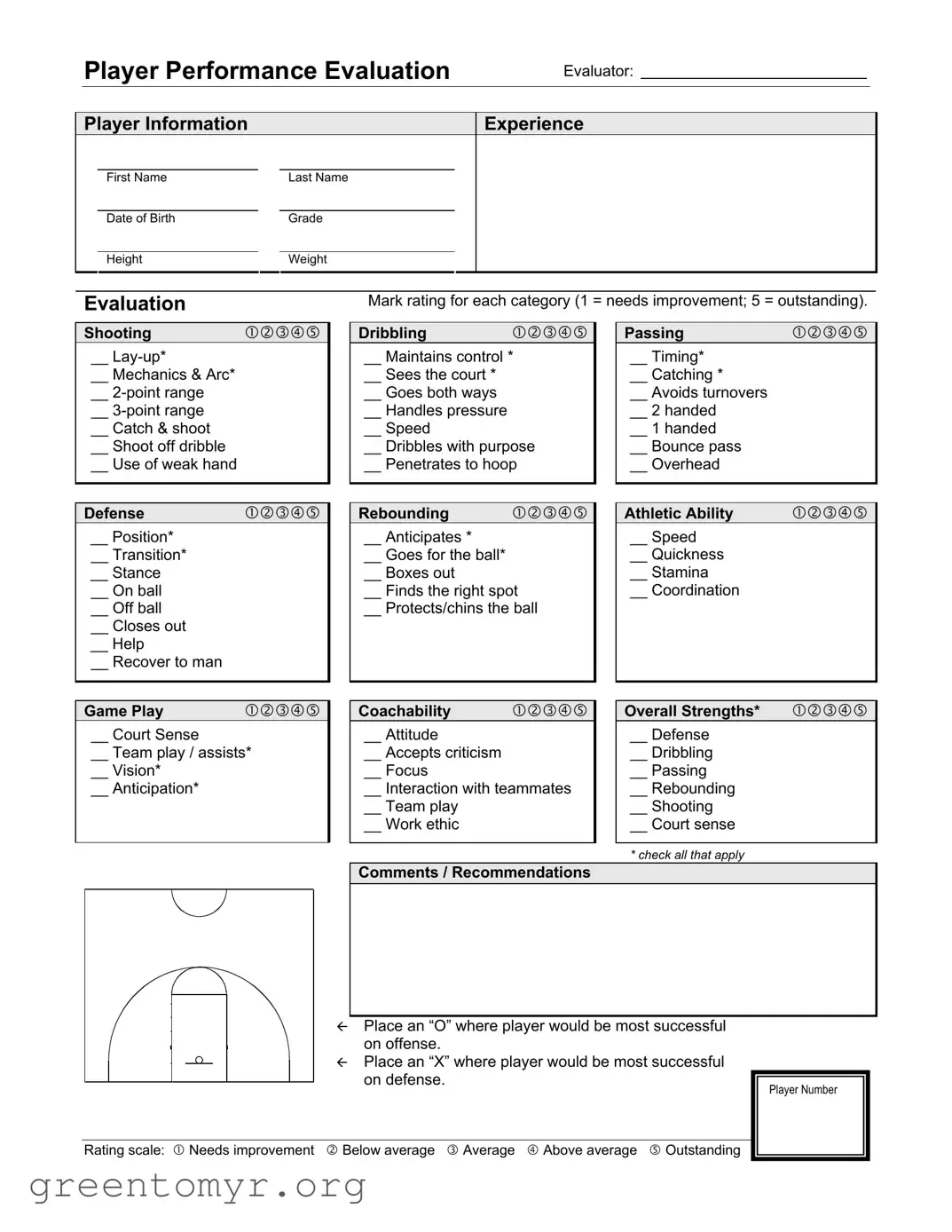
The Basketball Evaluation form serves as a vital tool for coaches and evaluators to assess a player's performance across multiple categories. This comprehensive form includes sections for player information, such as name, date of birth, grade, height, and weight. Each player is rated on a scale from 1 to 5 in areas like shooting, defense, dribbling, rebounding, passing, athletic ability, game play, and coachability. Specific skills, such as lay-ups, mechanics, and court sense, are evaluated to provide a well-rounded view of the athlete's capabilities. Additionally, evaluators can highlight overall strengths and provide comments or recommendations to guide future development. The form also encourages coaches to indicate where a player would excel on offense and defense, ensuring a tailored approach to player growth. This systematic evaluation not only aids in identifying areas for improvement but also helps in recognizing outstanding skills that can be further nurtured.
Player Performance Evaluation |
Evaluator: |
|
|
|
|||
|
|
|
|
Player Information
Experience
First Name |
|
Last Name |
|
|
|
Date of Birth |
|
Grade |
|
|
|
Height |
|
Weight |
|
|
|
Evaluation
Mark rating for each category (1 = needs improvement; 5 = outstanding).
Shooting
__
__ Mechanics & Arc* __
Defense
__ Position* __ Transition* __ Stance __ On ball __ Off ball __ Closes out __ Help
__ Recover to man
Dribbling
__ Maintains control * __ Sees the court * __ Goes both ways __ Handles pressure __ Speed
__ Dribbles with purpose __ Penetrates to hoop
Rebounding
__ Anticipates *
__ Goes for the ball* __ Boxes out
__ Finds the right spot __ Protects/chins the ball
Passing
__ Timing* __ Catching *
__ Avoids turnovers __ 2 handed
__ 1 handed __ Bounce pass __ Overhead
Athletic Ability
__ Speed __ Quickness __ Stamina __ Coordination
Game Play
__ Court Sense
__ Team play / assists* __ Vision*
__ Anticipation*
Coachability
__ Attitude
__ Accepts criticism __ Focus
__ Interaction with teammates __ Team play
__ Work ethic
Overall Strengths*
__ Defense __ Dribbling __ Passing __ Rebounding __ Shooting __ Court sense
* check all that apply
Comments / Recommendations
Å Place an “O” where player would be most successful on offense.
Å Place an “X” where player would be most successful on defense.
Player Number
Rating scale: |
Needs improvement |
Below average |
Average |
Above average |
Outstanding |
| Fact Name | Details |
|---|---|
| Purpose | The Basketball Evaluation Form is designed to assess a player's skills and performance in various categories such as shooting, defense, and overall athletic ability. |
| Evaluator Information | The form requires the evaluator's name to ensure accountability and provide context for the assessment. |
| Player Information | Essential details such as the player's first name, last name, date of birth, grade, height, and weight are included to identify the player and understand their physical attributes. |
| Rating Scale | The evaluation uses a scale from 1 to 5, where 1 indicates needs improvement and 5 signifies outstanding performance in each skill category. |
| Skill Categories | Players are assessed across various skill categories, including shooting, defense, dribbling, rebounding, passing, athletic ability, game play, and coachability. |
| State-Specific Forms | Different states may have specific forms or requirements governed by local sports associations, which can include additional categories or evaluation criteria. |
| Comments Section | The form includes a section for comments and recommendations, allowing evaluators to provide personalized feedback and suggestions for improvement. |
After completing the Basketball Evaluation form, the next step involves reviewing the ratings and comments to ensure accuracy. This evaluation will help in understanding the player's strengths and areas for improvement.
The Basketball Evaluation Form is designed to assess a player's skills and abilities in various aspects of the game. Coaches and evaluators use it to provide a structured way to rate players on their shooting, defense, dribbling, passing, and overall athletic ability. This evaluation helps identify strengths and areas for improvement, guiding training and development for each player.
The evaluation is typically conducted during practice sessions or games. An evaluator, often a coach or experienced player, observes the player in action. They will rate the player on a scale from 1 to 5 in various categories. A score of 1 indicates that the player needs improvement, while a score of 5 signifies outstanding performance. Evaluators may also provide comments and recommendations to offer additional insights into the player’s performance.
The evaluation covers several key categories, including:
Each category includes specific skills and attributes that the evaluator will assess, providing a comprehensive overview of the player’s abilities.
The ratings help categorize a player's performance level. The scale is as follows:
This scale allows for a nuanced understanding of a player's capabilities and can help guide their development in specific areas.
Yes, feedback is an essential part of the evaluation process. Evaluators often provide comments and recommendations based on their observations. This feedback is valuable for players, as it highlights both strengths and areas for improvement. It can also help players understand how they can enhance their skills and contribute more effectively to their team.
The Basketball Evaluation Form is a useful tool for coaches during team selection. By reviewing the evaluations, coaches can identify which players excel in specific areas and how they might fit into the team's overall strategy. The form helps ensure that selections are based on objective assessments rather than subjective opinions, leading to a more balanced and competitive team.
Completing a Basketball Evaluation form can be a critical step in assessing a player's skills and potential. However, many individuals make common mistakes that can lead to inaccurate evaluations. Understanding these pitfalls can enhance the quality of feedback provided. Here are eight frequent errors to avoid.
One common mistake is failing to provide complete player information. Omitting details such as the player's first name, last name, or date of birth can create confusion and hinder the evaluation process. Each piece of information helps to build a clearer picture of the player, which is essential for coaches and scouts.
Another frequent error involves neglecting to accurately assess the player's experience level. Evaluators may overlook this section, which can lead to a mismatch between the player's current skill set and their potential development. Properly documenting experience helps to tailor training and development strategies.
Many evaluators also struggle with the rating system. Some might apply a rating of 1 or 5 without considering the nuances of a player’s abilities. For instance, a player who is average in shooting but outstanding in defense may receive an inaccurate overall score if the evaluator does not take the time to consider each skill area carefully.
Another mistake is not checking all applicable categories. Players often have a mix of strengths and weaknesses, and failing to mark all relevant skills may result in an incomplete evaluation. This can prevent coaches from understanding where the player excels and where they need improvement.
Additionally, evaluators sometimes forget to provide comments or recommendations. This section offers valuable insights that can guide future training and development. Without specific feedback, players may miss out on crucial opportunities for growth.
Inconsistency in evaluating similar skills can also lead to confusion. For example, if one evaluator rates a player's shooting mechanics as a 3 while another rates it as a 4, it creates discrepancies that can affect the overall assessment. Consistency is key to ensuring that evaluations are fair and reliable.
Moreover, some evaluators may focus too heavily on physical attributes, neglecting the importance of coachability and team play. Skills like attitude and work ethic are just as critical to a player's success on the court. Ignoring these aspects can lead to an incomplete understanding of the player's overall potential.
Lastly, failing to place an “O” or an “X” in the designated areas can lead to misunderstandings about a player’s offensive and defensive strengths. These symbols are meant to clarify where a player is most effective, and omitting them can result in missed opportunities for strategic development.
By being mindful of these common mistakes, evaluators can provide more accurate and helpful assessments. This, in turn, supports players in their journey to improve their skills and succeed in the game.
In the realm of basketball evaluations, various forms and documents complement the Basketball Evaluation form, each serving a distinct purpose. These documents help coaches, players, and organizations better understand a player's abilities, development areas, and overall potential. Below is a list of commonly used forms that accompany the Basketball Evaluation form.
Utilizing these forms alongside the Basketball Evaluation form creates a comprehensive framework for assessing and nurturing player development. By maintaining thorough documentation, coaches and organizations can ensure that each player receives the guidance and support they need to excel on and off the court.
The Basketball Evaluation form serves as a crucial tool for assessing a player's skills and potential. Several other documents share similar characteristics, focusing on performance evaluation in various sports and activities. Here’s a list of six such documents:
Each of these documents serves a distinct purpose but shares the common goal of fostering athlete development through structured evaluation and feedback.
When filling out the Basketball Evaluation form, it's essential to approach the task thoughtfully. Here are some key do's and don'ts to keep in mind:
By following these guidelines, you can ensure that your evaluation is both fair and constructive. This will ultimately benefit the player and help them grow in their skills.
Misconceptions about the Basketball Evaluation form can lead to misunderstandings about its purpose and use. Here are five common misconceptions explained:
When filling out and using the Basketball Evaluation form, consider these key takeaways: