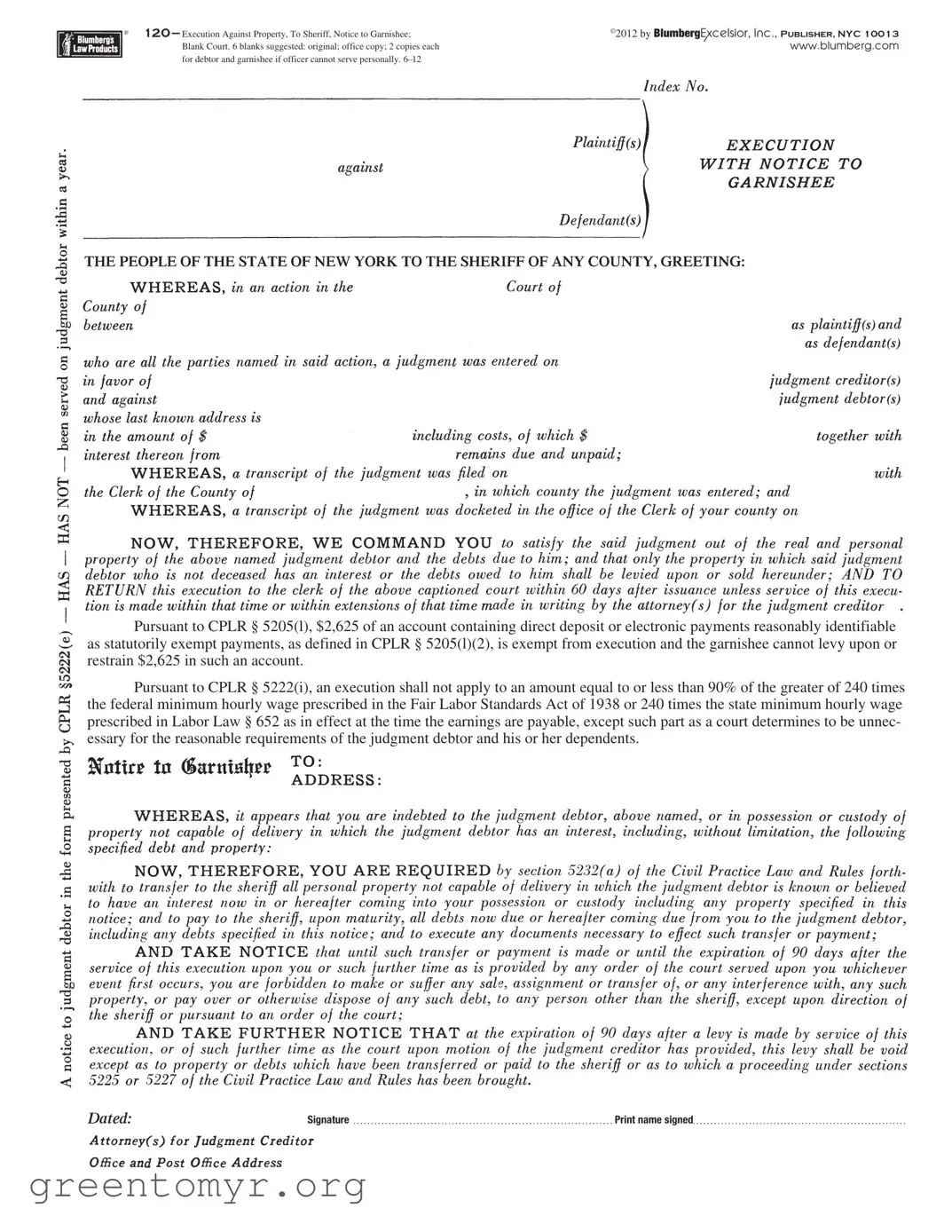
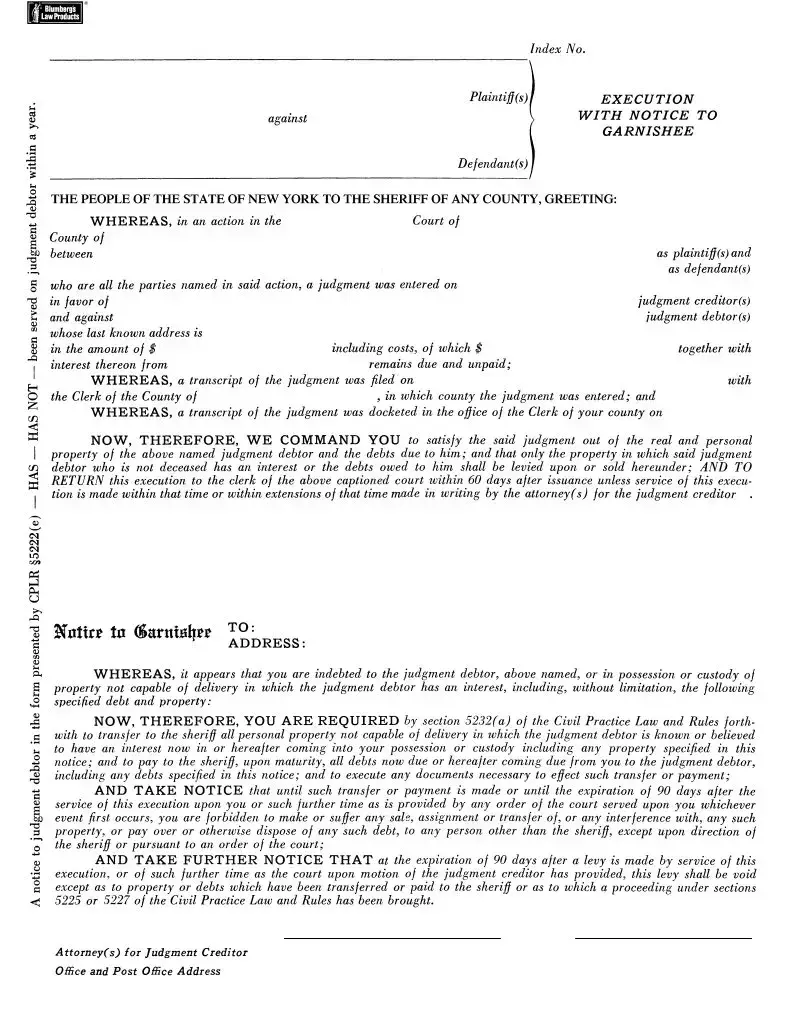
The Blumberg 120 form plays a crucial role in the legal process of executing a judgment against a debtor's property. This form is specifically designed for use by a sheriff when carrying out a court order to collect a debt. It includes important details such as the names of the plaintiff and defendant, the address of the judgment debtor, and the location of the property involved. Notably, the form provides a section for the garnishee, which is the third party holding the debtor's property or funds. This is essential for notifying them of their responsibilities and the legal implications of the execution. Additionally, the Blumberg 120 form outlines exemptions that protect certain amounts in the debtor's account from being levied, ensuring that the debtor retains some financial security. For instance, it specifies that $2,625 of direct deposit or electronic payments is exempt from execution, as defined by state law. The form also emphasizes that the execution must adhere to specific limits, such as not applying to earnings below a certain threshold. Overall, the Blumberg 120 form is a vital document that facilitates the enforcement of judgments while balancing the rights of debtors and creditors.
120 — Execution Against Property, To Sheriff, Notice to Garnishee; |
©2012 by BlumbergExcelsior, Inc., PUBLISHER, NYC 10013 |
Blank Court. 6 blanks suggested: original; office copy; 2 copies each |
www.blumberg.com |
for debtor and garnishee if officer cannot serve personally. |
|
Pursuant to CPLR § 5205(l), $2,625 of an account containing direct deposit or electronic payments reasonably identifiable as statutorily exempt payments, as defined in CPLR § 5205(l)(2), is exempt from execution and the garnishee cannot levy upon or restrain $2,625 in such an account.
Pursuant to CPLR § 5222(i), an execution shall not apply to an amount equal to or less than 90% of the greater of 240 times the federal minimum hourly wage prescribed in the Fair Labor Standards Act of 1938 or 240 times the state minimum hourly wage prescribed in Labor Law § 652 as in effect at the time the earnings are payable, except such part as a court determines to be unnec- essary for the reasonable requirements of the judgment debtor and his or her dependents.
DATED: |
Signature |
Print name signed |

ENDORSEMENT
Please take notice that the following named defendants were not served with a summons herein, viz.:
and that, as to them, the execution must be restricted as below prescribed.
An execution against property shall not be levied upon the sole property of such a defendant, but it may be collected out of real and personal property owned by him jointly with the other defendants who were summoned or with any of them, and out of the real and personal property of the latter or any of them.
Attorney(s) for
Name and Address of Garnishee
Address of Judgment Debtor
Location of Property
INDEX NO.COURTCOUNTY OF
EXECUTION
|
|
|
AGAINST PROPERTY |
|
|
|
|
With Notice to Garnishee |
|
|
|
|
|
|
|
|
|
|
|
|
|
|
LAW OFFICES OF |
|
|
|
|
Plaintiff(s) |
|
|
|
against |
|
|
|
|
|
Defendant(s) |
|
|
|
|
|
|
|
|
|
|
|
Sheriff of any County |
Attorney(s) for |
|||
Levy and collect as within directed |
Office and Post Office Address |
|||
with interest from |
|
|
||
besides your fees, etc. |
Dated and time received |
|||
Sheriff
| Fact Name | Description |
|---|---|
| Form Purpose | The Blumberg 120 form is used for execution against property, allowing a sheriff to collect debts owed by a judgment debtor. |
| Governing Law | This form is governed by the New York Civil Practice Law and Rules (CPLR), specifically sections 5205 and 5222. |
| Exempt Funds | Under CPLR § 5205(l), $2,625 in accounts with direct deposits or electronic payments that are statutorily exempt cannot be levied. |
| Copies Required | The form requires an original, an office copy, and two copies each for the debtor and garnishee if personal service is not possible. |
| Joint Property Collection | Execution against property may include joint property owned by the debtor and other defendants, but not the sole property of defendants not served. |
Filling out the Blumberg 120 form is an important step in the process of executing a judgment against property. This form requires specific information that helps facilitate the legal proceedings. Below are the steps to complete the form accurately.
After completing the form, it is essential to make copies as required. Typically, you will need the original form, an office copy, and two copies for both the debtor and garnishee. Ensure that all information is accurate before submitting it to the appropriate sheriff's office for execution.
The Blumberg 120 form is primarily used for executing a judgment against a debtor's property. It serves as a notice to the sheriff and garnishee, outlining the necessary steps to collect a debt owed by the judgment debtor. This form helps ensure that the process is carried out in compliance with relevant laws.
You will need a total of six copies of the Blumberg 120 form. This includes the original for the court, an office copy for your records, and two copies each for the debtor and garnishee, in case the sheriff cannot serve them personally.
According to CPLR § 5205(l), $2,625 from an account containing direct deposits or electronic payments that are identifiable as statutorily exempt payments cannot be levied upon. This means that the garnishee cannot restrain or collect this amount from the debtor's account.
The exempt amount is determined by calculating 90% of the greater of 240 times the federal minimum hourly wage or 240 times the state minimum hourly wage. This calculation is based on the wages that are payable at the time, ensuring that the debtor has enough funds for their reasonable requirements and those of their dependents.
If a defendant was not served with a summons, you must indicate this on the form. The execution against property will then be restricted, meaning it cannot be levied on the sole property of that defendant. However, it can be collected from jointly owned property with other defendants who were properly summoned.
The sheriff of the county where the debtor resides or where the property is located is responsible for serving the Blumberg 120 form. If the sheriff cannot serve the debtor or garnishee personally, additional copies of the form may be necessary for mailing or other forms of service.
The form requires several key pieces of information, including:
Make sure all information is accurate to avoid delays in the execution process.
The sheriff plays a crucial role in executing the judgment. They are responsible for serving the Blumberg 120 form, levying the property as directed, and collecting the owed amount. Additionally, the sheriff will provide a record of the execution process, which is important for both the creditor and the court.
For more information, you can visit the Blumberg website at www.blumberg.com. They provide resources and guidance on completing the form correctly and understanding the execution process.
When filling out the Blumberg 120 form, individuals often make several common mistakes that can hinder the process. One frequent error is not providing complete and accurate information regarding the judgment debtor. Omitting essential details, such as the full name or correct address, can lead to delays or complications in the execution process.
Another mistake involves the failure to include all required copies of the form. The instructions suggest that individuals submit the original form, an office copy, and two copies for both the debtor and garnishee. Neglecting to provide the necessary copies can result in the form being rejected or not processed in a timely manner.
People sometimes misinterpret the exemptions outlined in the form. For example, the $2,625 exemption for certain accounts is a critical aspect. Misunderstanding this provision may lead individuals to incorrectly state the amounts that can be levied, potentially violating legal guidelines.
Additionally, individuals may overlook the endorsement section, which requires clear identification of defendants who were not served. Failing to accurately complete this section can complicate the execution process, as it may not be clear which properties are exempt from levy.
Another common issue is the incorrect calculation of the exempt amounts based on the applicable minimum wage laws. The form references specific calculations that must be adhered to. Errors in these calculations can lead to improper claims and legal challenges.
Moreover, some individuals forget to sign the form or provide a printed name. This oversight can render the document invalid, causing further delays in the execution process.
Finally, not adhering to the proper formatting and structure of the form can create confusion. Ensuring that all sections are filled out as instructed is essential for the successful processing of the Blumberg 120 form.
The Blumberg 120 form is an essential document used in legal proceedings related to the execution against property. It serves as a formal notice to the sheriff and garnishee, detailing how and when property can be seized to satisfy a judgment. Alongside this form, several other documents are commonly utilized to ensure the process runs smoothly. Here’s a brief overview of four such documents.
Understanding these accompanying documents can enhance your comprehension of the execution process. Each plays a crucial role in ensuring that the rights of both creditors and debtors are respected throughout legal proceedings.
The Blumberg 120 form is primarily used for executing a judgment against a debtor's property. Several other legal documents serve similar purposes in the context of debt collection and garnishment. Below are five documents that share similarities with the Blumberg 120 form:
When filling out the Blumberg 120 form, it is important to follow specific guidelines to ensure accuracy and compliance. Here are five things you should and shouldn't do:
Misconceptions about the Blumberg 120 form can lead to confusion regarding its purpose and use. Here are five common misconceptions:
The Blumberg 120 form is a legal document used in the execution against property. Here are some key takeaways regarding its use and completion:
Completing the Blumberg 120 form accurately is crucial for the execution process. Each section must be filled out carefully to comply with legal standards and protect the rights of all parties involved.