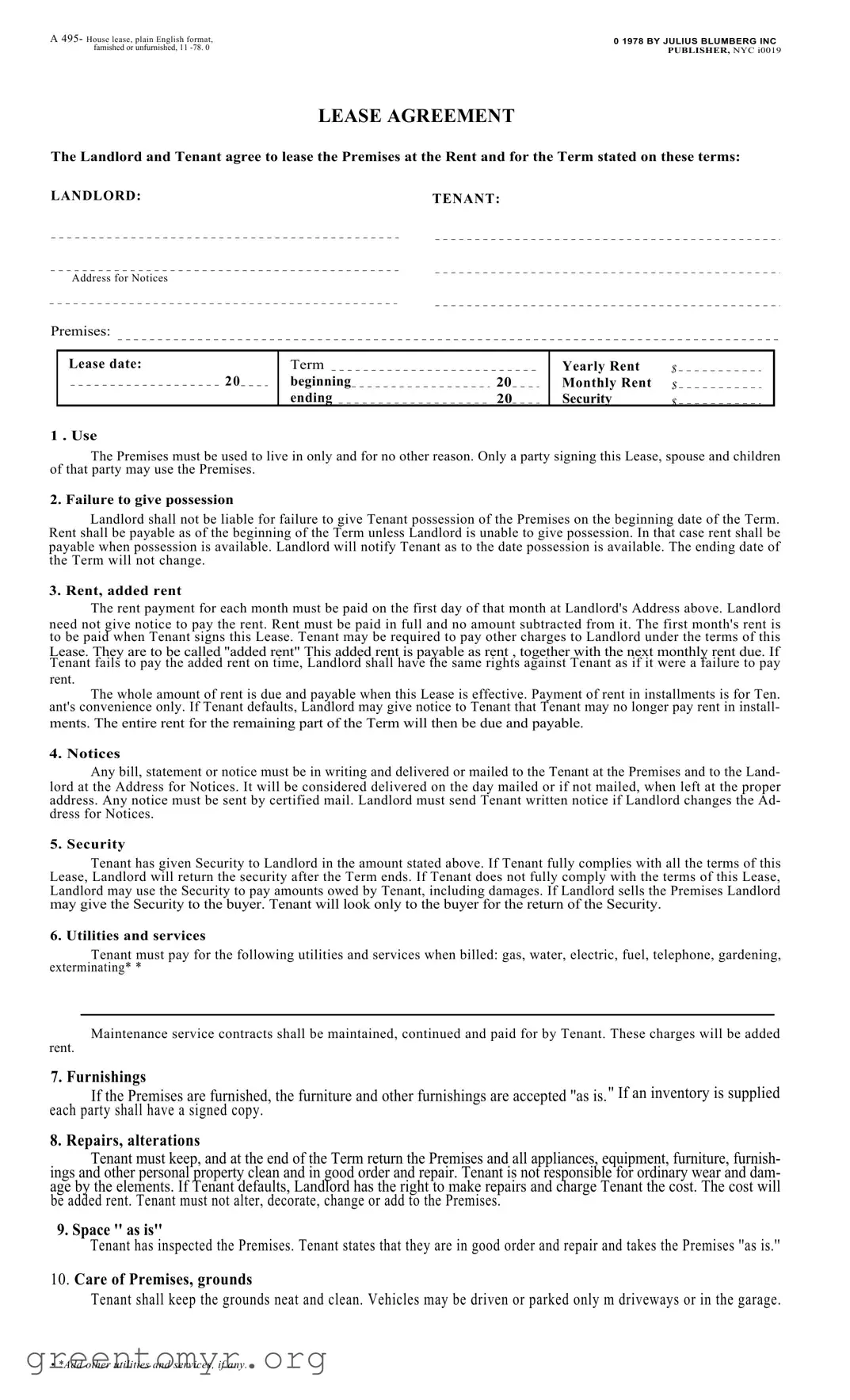
The Blumberg Lease Agreement form is a comprehensive document designed to facilitate the rental process between landlords and tenants. It outlines essential details such as the rental amount, lease term, and the specific premises being leased. The agreement can accommodate both furnished and unfurnished properties, ensuring clarity for all parties involved. Key provisions address the use of the premises, stipulating that it is intended solely for residential living. The form also includes important sections on rent payment procedures, security deposits, and the responsibilities of both the landlord and tenant regarding maintenance and repairs. Additionally, it covers the rights of the landlord to enter the premises, the handling of notices, and the implications of tenant defaults. Notably, the lease specifies that any modifications must be agreed upon in writing, emphasizing the importance of clear communication. Furthermore, the document aligns with legal requirements, including regulations concerning lead paint disclosures for properties built before 1978. Overall, the Blumberg Lease Agreement serves as a vital tool in establishing a fair and transparent rental relationship.

A 495- House lease, plain English format, |
0 1978 BY JULIUS BLUMBERG INC |
famished or unfurnished, 11 |
PUBLISHER, NYC i0019 |
|
LEASE AGREEMENT
The Landlord and Tenant agree to lease the Premises at the Rent and for the Term stated on these terms:
LANDLORD:TENANT:
Address for Notices
Premises:
Lease date: |
Term |
|
Yearly Rent |
$ |
20 |
beginning |
20 |
Monthly Rent |
$ |
|
ending |
20 |
Security |
$ |
1 . Use
The Premises must be used to live in only and for no other reason. Only a party signing this Lease, spouse and children of that party may use the Premises.
2. Failure to give possession
Landlord shall not be liable for failure to give Tenant possession of the Premises on the beginning date of the Term. Rent shall be payable as of the beginning of the Term unless Landlord is unable to give possession. In that case rent shall be payable when possession is available. Landlord will notify Tenant as to the date possession is available. The ending date of the Term will not change.
3. Rent, added rent
The rent payment for each month must be paid on the first day of that month at Landlord's Address above. Landlord
need not give notice to pay the rent. Rent must be paid in full and no amount subtracted from it. The first month's rent is to be paid when Tenant signs this Lease. Tenant may be required to pay other charges to Landlord under the terms of this
Lease. They are to be called ''added rent" This added rent is payable as rent , together with the next monthly rent due. If Tenant fails to pay the added rent on time, Landlord shall have the same rights against Tenant as if it were a failure to pay
rent.
The whole amount of rent is due and payable when this Lease is effective. Payment of rent in installments is for Ten. ant's convenience only. If Tenant defaults, Landlord may give notice to Tenant that Tenant may no longer pay rent in install-
ments. The entire rent for the remaining part of the Term will then be due and payable.
4. Notices
Any bill, statement or notice must be in writing and delivered or mailed to the Tenant at the Premises and to the Land- lord at the Address for Notices. It will be considered delivered on the day mailed or if not mailed, when left at the proper address. Any notice must be sent by certified mail. Landlord must send Tenant written notice if Landlord changes the Ad- dress for Notices.
5. Security
Tenant has given Security to Landlord in the amount stated above. If Tenant fully complies with all the terms of this Lease, Landlord will return the security after the Term ends. If Tenant does not fully comply with the terms of this Lease, Landlord may use the Security to pay amounts owed by Tenant, including damages. If Landlord sells the Premises Landlord may give the Security to the buyer. Tenant will look only to the buyer for the return of the Security.
6. Utilities and services
Tenant must pay for the following utilities and services when billed: gas, water, electric, fuel, telephone, gardening, exterminating* *
Maintenance service contracts shall be maintained, continued and paid for by Tenant. These charges will be added
rent.
7. Furnishings
If the Premises are furnished, the furniture and other furnishings are accepted ''as is.'' If an inventory is supplied each party shall have a signed copy.
8. Repairs, alterations
Tenant must keep, and at the end of the Term return the Premises and all appliances, equipment, furniture, furnish- ings and other personal property clean and in good order and repair. Tenant is not responsible for ordinary wear and dam- age by the elements. If Tenant defaults, Landlord has the right to make repairs and charge Tenant the cost. The cost will be added rent. Tenant must not alter, decorate, change or add to the Premises.
9. Space '' as is''
Tenant has inspected the Premises. Tenant states that they are in good order and repair and takes the Premises ''as is.''
10.Care of Premises, grounds
Tenant shall keep the grounds neat and clean. Vehicles may be driven or parked only m driveways or in the garage.
• *Add other utilities and services, if any.
11. Fire, damage
Tenant must give Landlord immediate notice in case of fire or other damage to the Premises. Landlord will have the right to repair the damage within a reasonable time or cancel this Lease. If Landlord repairs, Tenant shall pay rent only to the date of the fire or damage and shall start to pay rent again when the Premises become usable. Landlord may cancel the Lease by giving Tenant 3 days' written notice. The Term shall be over at the end of the third day and all rent shall be paid to the date of the damage.
12. Liability
Landlord 'is not liable for loss, expense or damage to any person or property unless it is due to Landlord's negligence. Tenant must pay for damages suffered and money spent by Landlord relating to any claim arising from any act or neglect of Tenant. Tenant is responsible for all acts of Tenant's family, employees, guests and invitees.
13. Landlord's consent
If Tenant requires Landlord's consent to any act and such consent is not given, Tenant's only right is to ask the Court to force Landlord to give consent. Tenant agrees not to make any claim against Landlord for money or subtract any sum from the rent because such consent was
14. Assignment, sublet
Tenant may not sublet all or part of the Premises, or assign this Lease or permit any other person to use the Premises.
15. Landlord may enter, keys, signs
Landlord may at reasonable times, enter the Premises to examine, to make repairs or alterations, and to show it to possible buyers, lenders or tenants. Tenant must give to Landlord keys to all locks. Locks may not be changed or additional locks installed without Landlord's consent. Doors must be locked at all times. Windows must be locked when Tenant is out. Landlord may place the usual ''For Rent'' or ''For Sale'' signs upon the Premises.
16. Subordination
This Lease and Tenant's rights are subject and subordinate to all present and future (a) leases for the Premises or the land on which it stands, (b) mortgages on the leases or on the Premises or on the land, (c) agreements securing money paid or to be paid by the lender, under mortgages, and (d) terms, conditions, renewals, changes of any kind in and extensions of the mortgages or leases or Lender agreements. Tenant must promptly execute any certificate(s) that Landlord requests to show that this Lease is subject and subordinate.
17. Condemnation
If all of the Premises is taken or condemned by a legal authority, the Term, and Tenant's rights shall end as of the date the authority takes title to the Premises. If any part of the Premises is taken, Landlord may cancel this Lease on notice to Tenant setting forth a cancellation date not less than 30 days from the date of the notice. If the Lease is cancelled, Tenant must deliver the Premises to Landlord on the cancellation date together with all rent due to that date. The entire award for any taking belongs to Landlord. Tenant gives Landlord any interest Tenant might have to any part of the award and shall make no claim for the value of the remaining part of the Term.
18. Compliance with authorities
Tenant must, at Tenant's cost, promptly comply with all laws, orders, rules and directions of all governmental author- ities, property owners associations, insurance carriers or Board of Fire Underwriters or similar group. Tenant may not do anything which may increase Landlord's insurance premiums. If Tenant does Tenant must pay the increase as added rent.
19.Tenant's defaults and Landlord's remedies
A.Landlord may give 5 days written notice to Tenant to correct any of the following defaults:
1.Failure to pay rent or added rent on time.
2.Improper assignment of the Lease, improper subletting all or part of the Premises, or allowing another to use the Premises.
3.Improper conduct by Tenant or other occupant of the Premises.
4.Failure to fully perform any other term m the Lease.
B.If Tenant fails to correct the defaults in section A within the 5 days, Landlord may cancel the Lease by giving Tenant a written 3 day notice stating the date the Term will end. On that date the Term and Tenant's rights in this Lease auto-
matically end and Tenant must leave the Premises and give Landlord the keys. Tenant continues to be responsible for rent, expenses, damages and losses.
C. If the Lease is canceled, or rent or added rent is not paid on time, or Tenant vacates the Premises, Landlord may in addition to other remedies take any of the following steps:
1.Enter the Premises and remove Tenant and any person or property;
2.Use dispossess, eviction or other lawsuit method to take back the Premises.
D. If the Lease is ended or Landlord takes back the Premises, rent and added rent for the unexpired Term becomes due and payable. Landlord may
20.Bankruptcy
If (1) Tenant assigns property for the benefit of creditors, (2) Tenant files a voluntary petition or an involuntary petition is filed against Tenant under any bankruptcy or insolvency law, or (3) a trustee or receiver of Tenant or Tenant's property is appointed, Landlord may give Tenant 30 days notice of cancellation of the Term of this Lease. If any of the above is not fully dismissed within the 30 days, , the Term shall end as of the date stated in the notice. Tenant must continue to pay rent. damages, losses and expenses without offset.
21. Correcting tenant's default
If Tenant fails to correct a default after notice from Landlord, Landlord may correct it for Tenant at Tenant's ex- pense. The sum Tenant must repay to Landlord will be added rent.
22.Waiver of jury,. counterclaim, set off
Landlord and Tenant waive trial by a jury in any matter which comes up between the parties under or because of this Lease (except for a personal injury or property damage claim). In a proceeding to get possession of the Premises, Tenant shall not have the right to make a counterclaim or set off.

23. Written instructions
Landlord has given or may give written instructions about the care and use of the appliances, equipment and other personal property on the Premises. Tenant must obey the instructions.
24. Illegality
If any part of this Lease is not legal, the rest of the Lease will be unaffected.
25. No waiver
Landlord's failure to enforce any terms of this Lease shall not prevent Landlord from enforcing such terms at a later time.
26. Quiet enjoyment
Landlord agrees that if Tenant pays the rent and is not in default under this Lease, Tenant may peaceably and quietly have, hold and enjoy the Premises for the Term of this Lease.
27. Successors
This Lease is binding on all parties who lawfully succeed to the rights or take the place of the Landlord or Tenant.
28. Representations, changes in Lease
Tenant has read this Lease. All promises made by the Landlord are in this Lease. There are no others. This Lease may be changed only by an agreement in writing signed by and delivered to each party.
29. Paragraph headings
The Paragraph headings are for convenience only.
30. Effective date
This Lease is effective when Landlord delivers to Tenant a copy signed by all parties.
Signatures The parties have entered into this Lease on the date first above stated.
LANDLORD:TENANT:
WITNESS:
____
EPA and HUD Lead Paint Regulations, Effective September 6, 1996
Landlords must disclose known
3140 Lead Paint Information Booklet |
3141 Lead Paint Lease Disclosure Form |
'December 6, 1996 for owners of I to 4 residential dwellings.
'Leases for less than 100 days,

TO
...
LEASE
Date |
• |
||
Expires |
• 20 |
||
Payable |
|
|
|
|
|
|
|
|
|
|
|
| Fact Name | Description |
|---|---|
| Form Type | The Blumberg Lease Agreement is a standard residential lease form used for renting houses. |
| Governing Law | This lease agreement is governed by the laws of the state where the property is located. |
| Security Deposit | The tenant must provide a security deposit, which the landlord may retain if the tenant fails to comply with lease terms. |
| Possession | The landlord is not liable for failing to provide possession on the lease start date if they notify the tenant when possession is available. |
| Utilities Responsibility | The tenant is responsible for paying utilities such as gas, water, and electricity when billed. |
Filling out the Blumberg Lease Agreement form is an important step in establishing a clear and legally binding relationship between a landlord and a tenant. This process requires careful attention to detail to ensure that all necessary information is accurately provided. Below are the steps to guide you through completing the form effectively.
Once the form is completed, both parties should keep a signed copy for their records. This ensures that everyone is on the same page regarding the terms of the lease. After signing, the landlord should provide the tenant with a copy of the signed lease, making the agreement official and enforceable.
The Blumberg Lease Agreement form is designed to establish a clear and legally binding relationship between a landlord and tenant. It outlines the terms of the lease, including rent amounts, duration, and specific responsibilities of both parties. The form ensures that both the landlord and tenant understand their rights and obligations regarding the leased premises.
The tenant has several responsibilities, including:
If the tenant fails to meet these obligations, the landlord has the right to take appropriate action, which may include terminating the lease.
Rent is structured to be paid monthly on the first day of each month at the landlord's specified address. The tenant is required to pay the first month's rent upon signing the lease. If there are additional charges, referred to as "added rent," these must also be paid in full along with the regular monthly rent. If the tenant does not pay rent or added rent on time, the landlord can take legal action to recover the owed amounts.
If the landlord is unable to provide possession of the premises on the agreed start date, they are not held liable for this failure. Rent will not be due until the tenant can take possession. The landlord must notify the tenant of the new possession date, but the lease term's end date remains unchanged. This means that the tenant will still be obligated to fulfill the lease for the full term, regardless of the delay in taking possession.
Filling out the Blumberg Lease Agreement form can seem straightforward, but several common mistakes can lead to complications down the line. Understanding these pitfalls can help both landlords and tenants navigate the leasing process more smoothly.
One frequent error is failing to provide complete and accurate information in the designated fields. Whether it’s the names of the landlord and tenant, the address of the premises, or the rental amounts, each detail matters. Incomplete information can create confusion and disputes later. Always double-check that all sections are filled out correctly before submitting the form.
Another mistake involves neglecting to specify the lease term. The beginning and ending dates of the lease are crucial. If these dates are left blank or inaccurately filled in, it can lead to misunderstandings about the duration of the tenancy. This oversight may also impact the calculation of rent payments and security deposits.
Many tenants and landlords also overlook the importance of understanding the security deposit terms. The amount of security should be clearly stated, and both parties must understand the conditions under which it may be withheld. If the lease does not explicitly outline these conditions, disputes may arise at the end of the lease term regarding the return of the deposit.
Additionally, failing to read and understand the utility payment responsibilities can lead to unexpected expenses. The lease should specify which utilities the tenant is responsible for. If this section is not properly filled out or understood, tenants may find themselves facing bills they did not anticipate, leading to financial strain.
Another common error is not addressing the issue of repairs and alterations. Tenants must understand their responsibilities regarding maintenance and repairs. If the lease does not clearly outline what is expected of the tenant in terms of upkeep, it can lead to disagreements about damages and repairs at the end of the lease.
Landlords and tenants often forget to include any additional terms or conditions that are important to either party. These can include pet policies, smoking restrictions, or rules about alterations to the property. Not addressing these issues in the lease can create conflicts during the tenancy.
Moreover, the failure to provide proper notice regarding changes in contact information can lead to miscommunication. Both parties should ensure that the lease includes a clear process for notifying each other about any changes in addresses or contact information, as this is essential for effective communication.
Lastly, many individuals do not pay attention to the requirement for written notices. The lease stipulates that any notice must be in writing and delivered in a specific manner. Ignoring this requirement can lead to disputes over whether proper notice was given for issues such as rent increases or lease terminations.
By being mindful of these common mistakes when filling out the Blumberg Lease Agreement form, both landlords and tenants can help ensure a smoother leasing experience. Attention to detail and clear communication can prevent misunderstandings and foster a more positive landlord-tenant relationship.
The Blumberg Lease Agreement form is often accompanied by various other documents that help clarify the terms of the lease and protect the rights of both landlords and tenants. Below is a list of common forms and documents that are frequently used alongside the Blumberg Lease Agreement.
Each of these documents plays a vital role in the leasing process. They help maintain clear communication and protect the interests of both landlords and tenants. Understanding and utilizing these forms can lead to a smoother rental experience.
When filling out the Blumberg Lease Agreement form, it's important to follow certain guidelines to ensure accuracy and compliance. Here’s a helpful list of things to do and avoid:
By following these guidelines, you can help ensure a smoother leasing experience and avoid potential issues in the future.
Understanding the Blumberg Lease Agreement form is crucial for both landlords and tenants. However, several misconceptions can lead to confusion or mismanagement of expectations. Here are four common misconceptions:
This is incorrect. The Blumberg Lease Agreement can be used for both furnished and unfurnished properties. The terms regarding furnishings are clearly stated, allowing flexibility for landlords and tenants alike.
Many believe that landlords must always provide possession on the agreed start date. However, the lease specifies that landlords are not liable for delays in giving possession. Rent is still due unless the landlord cannot provide access.
Some tenants assume that their security deposit will be returned without conditions. The lease outlines that the security deposit may be used to cover damages or unpaid rent, and it will only be returned if the tenant complies with all lease terms.
This misconception can lead to significant issues. The lease clearly states that tenants are not allowed to make alterations or changes to the premises without landlord consent. This protects the property and ensures that it remains in good condition.
Ensure all parties involved are clearly identified in the lease agreement. This includes the Landlord and Tenant, along with their respective addresses for notices.
Understand the terms of the lease, including the monthly rent, security deposit, and the duration of the lease.
Remember that the premises should only be used for residential purposes. Unauthorized use may lead to issues.
Be aware that the Landlord is not liable for failing to provide possession of the premises on the start date if circumstances prevent it.
Rent must be paid in full and on time, with the first month's rent due upon signing the lease. Late payments may result in added fees.
Keep written records of all notices, as they must be delivered in writing and can be considered delivered upon mailing or delivery.
The security deposit will be returned only if all lease terms are met. If not, the Landlord may retain it to cover damages or unpaid rent.
Be responsible for the payment of utilities, including gas, water, and electricity. These costs may be considered as added rent.
Understand that any alterations to the premises require the Landlord's consent, and failure to obtain permission may result in penalties.
In case of any damage, notify the Landlord immediately. The Landlord has the right to repair damages and may charge the costs to the tenant.