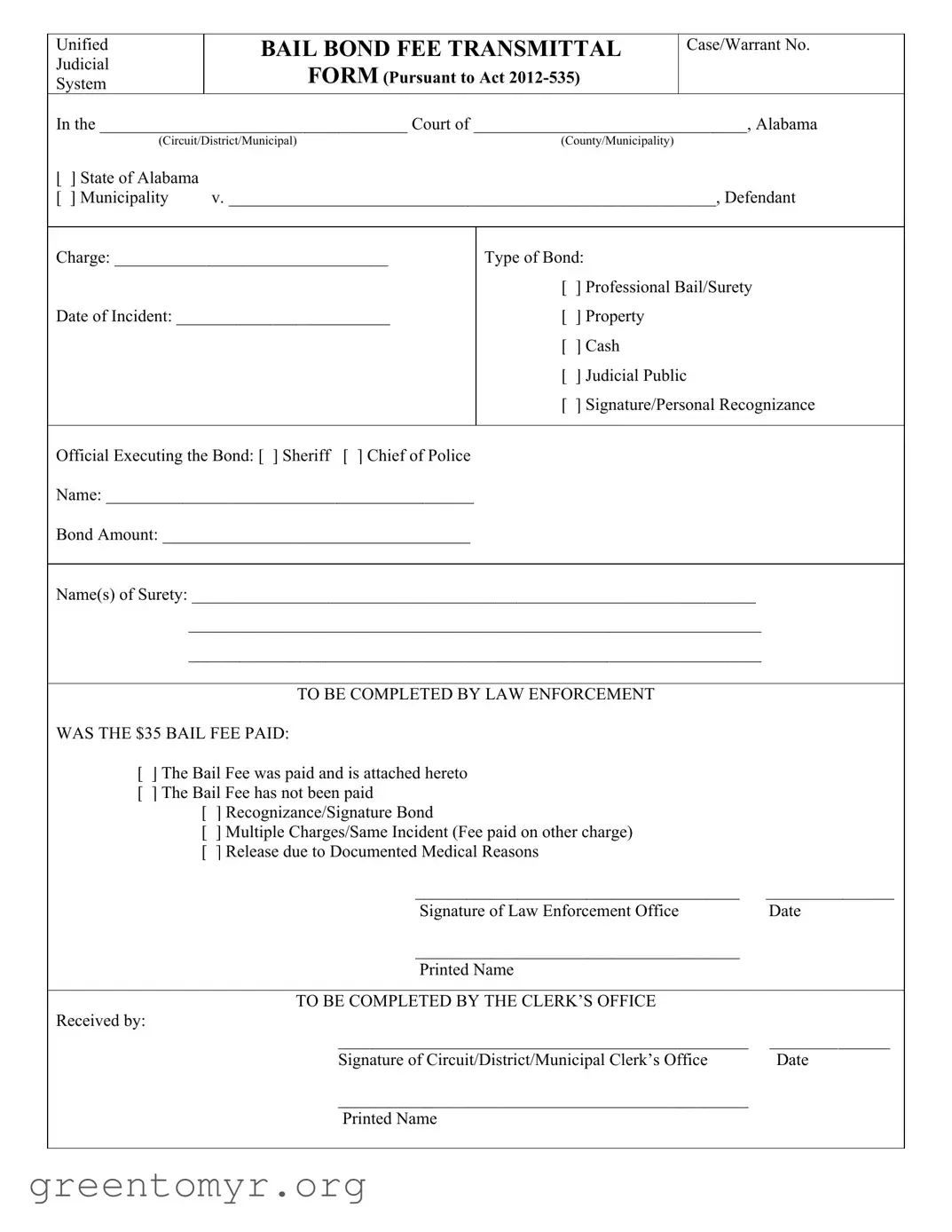
The Bond Release Alabama form is an essential document used in the bail process within the state of Alabama. This form serves multiple purposes, including the transmittal of bail bond fees and the official release of a defendant from custody. It captures critical information such as the case or warrant number, the court in which the case is being handled, and the specific charges against the defendant. The type of bond is clearly indicated, whether it is a professional bail/surety, property, cash, or a judicial public bond. Additionally, the form requires details about the bond amount and the names of the sureties involved. Law enforcement's role is also highlighted, as they must confirm whether the bail fee has been paid and provide their signature, along with the date and printed name. The clerk’s office plays a vital role as well, receiving the completed form and acknowledging it with their signature and date. This structured approach ensures that all parties are aware of the bond conditions and the status of the bail fee, ultimately facilitating a smoother release process for defendants.

Unified
Judicial
System
BAIL BOND FEE TRANSMITTAL
FORM (PURSUANT TO ACT
Case/Warrant No.
In the ____________________________________ Court of ________________________________, Alabama
|
(Circuit/District/Municipal) |
(County/Municipality) |
|
[ |
] State of Alabama |
|
|
[ |
] Municipality |
v. _________________________________________________________, Defendant |
|
Charge: ________________________________
Date of Incident: _________________________
Type of Bond:
[] Professional Bail/Surety
[] Property
[] Cash
[] Judicial Public
[] Signature/Personal Recognizance
Official Executing the Bond: [ ] Sheriff [ ] Chief of Police
Name: ___________________________________________
Bond Amount: ____________________________________
Name(s) of Surety: __________________________________________________________________
___________________________________________________________________
___________________________________________________________________
TO BE COMPLETED BY LAW ENFORCEMENT
WAS THE $35 BAIL FEE PAID:
[ ] The Bail Fee was paid and is attached hereto [ ] The Bail Fee has not been paid
[ ] Recognizance/Signature Bond
[ ] Multiple Charges/Same Incident (Fee paid on other charge) [ ] Release due to Documented Medical Reasons
______________________________________ |
_______________ |
Signature of Law Enforcement Office |
Date |
______________________________________ |
|
Printed Name |
|
|
|
TO BE COMPLETED BY THE CLERK’S OFFICE |
|
Received by: |
|
________________________________________________ |
______________ |
Signature of Circuit/District/Municipal Clerk’s Office |
Date |
________________________________________________ |
|
Printed Name |
|
| Fact Name | Details |
|---|---|
| Governing Law | The Bond Release Alabama form is governed by Act 2012-535. |
| Form Purpose | This form is used for the transmittal of bail bond fees in Alabama. |
| Case Identification | The form requires a case or warrant number to identify the legal matter. |
| Court Specification | Users must specify the type of court: Circuit, District, or Municipal. |
| Defendant Information | The name of the defendant must be clearly indicated on the form. |
| Charge Description | The specific charge against the defendant must be documented. |
| Bond Types | Various bond types are available, including cash, property, and surety bonds. |
| Bail Fee Payment | The form includes a section to confirm whether the $35 bail fee was paid. |
| Law Enforcement Role | Law enforcement officials must sign the form, confirming their involvement. |
| Clerk's Office Confirmation | The form must also be signed by a representative from the Clerk’s Office upon receipt. |
After completing the Bond Release Alabama form, it will be submitted to the appropriate court. Ensure all information is accurate to avoid delays in processing. Below are the steps to fill out the form correctly.
The Bond Release Alabama form is a legal document used in the state of Alabama to facilitate the release of a defendant from custody. It outlines the details of the case, including the charges against the defendant, the type of bond being used, and the amount of the bond. This form is essential for ensuring that all necessary parties are informed and that the bail process adheres to state regulations.
This form must be completed by law enforcement officials and the clerk’s office involved in the case. Specifically, it requires input from the official executing the bond, which could be a sheriff or chief of police, as well as the clerk’s office for final processing. Additionally, the surety or individual posting the bond will need to provide their information.
The form requires various pieces of information, including:
Additionally, law enforcement must indicate whether the bail fee was paid and provide a signature and date.
The Bond Release Alabama form allows for several types of bonds, including:
Each type of bond has different implications regarding how the defendant is released and the responsibilities of the surety.
Yes, there is typically a bail fee associated with the bond. According to the form, a $35 bail fee must be paid unless the bond is a recognizance or signature bond. Law enforcement must confirm whether this fee has been paid as part of the process.
Once the Bond Release Alabama form is completed, it must be submitted to the clerk’s office for processing. The clerk will review the form, ensure all required information is provided, and then sign and date it to confirm receipt. This step is crucial for the official release of the defendant.
Yes, the form accommodates situations involving multiple charges for the same incident. In such cases, the law enforcement officer can indicate that the bail fee has been paid for another charge, streamlining the release process for the defendant.
When filling out the Bond Release Alabama form, individuals often make several common mistakes that can lead to delays or complications in the release process. Understanding these pitfalls can help ensure that the form is completed correctly and efficiently.
One frequent error is failing to provide complete information about the case or warrant number. This number is crucial for identifying the specific legal matter at hand. Omitting this detail can result in confusion and may lead to the form being rejected or delayed. Always double-check that the case or warrant number is filled out accurately and clearly.
Another common mistake involves not specifying the correct type of bond. The form offers several options, including professional bail/surety, property, cash, and judicial public. Selecting the wrong type can complicate the release process. It’s essential to review the options carefully and ensure that the chosen type matches the situation.
People sometimes overlook the requirement to indicate whether the $35 bail fee has been paid. This detail is vital for processing the bond. If the fee has been paid, it should be marked appropriately, and any necessary documentation should be attached. Neglecting to address this can lead to unnecessary delays in the release.
Additionally, individuals may forget to include the name of the surety or provide incomplete information about them. The surety's name is a key component of the bond agreement. Inaccurate or missing details about the surety can create complications that could prolong the release process.
Another area of confusion arises when individuals do not sign the form in the designated areas. Both the law enforcement officer and the clerk’s office need to sign the form for it to be valid. Failing to secure these signatures can result in the form being deemed incomplete, causing further delays.
Lastly, people often neglect to provide a clear date of the incident. This information is essential for establishing the context of the bond. Without a specific date, the processing of the bond may be hindered, leading to unnecessary frustration. Always ensure that the date is accurately filled in before submitting the form.
When navigating the legal landscape in Alabama, especially in relation to bail and bond processes, several forms and documents often accompany the Bond Release Alabama form. Each of these documents serves a specific purpose and plays a crucial role in ensuring that the legal proceedings are conducted smoothly and in accordance with the law.
Understanding these documents can significantly aid individuals involved in the bail process in Alabama. Each form is designed to ensure compliance with legal requirements and to protect the rights of all parties involved. Familiarity with these documents can help demystify the process and empower defendants and sureties alike.
The Bond Release Alabama form serves a specific purpose in the legal process, particularly in the context of bail and release from custody. Several other documents share similarities with this form, each serving distinct yet related functions. Here’s a list of nine documents that are comparable to the Bond Release Alabama form:
Each of these documents plays a crucial role in the bail process, ensuring that all parties understand their rights and responsibilities. They contribute to the overall legal framework that governs the release of individuals from custody in Alabama.
When filling out the Bond Release Alabama form, it is essential to follow specific guidelines to ensure accuracy and compliance. Here are ten things you should and shouldn't do:
Misconception 1: The Bond Release Alabama form is only for cash bonds.
This is not true. The form accommodates various types of bonds, including professional bail/surety, property, cash, and judicial public bonds. It is essential to select the appropriate type based on the circumstances of the case.
Misconception 2: Completing the form guarantees immediate release from custody.
While the form is a critical step in the release process, it does not guarantee immediate release. Factors such as court schedules, pending charges, and the completion of all necessary payments can influence the timing of release.
Misconception 3: Only law enforcement can fill out the form.
This is misleading. While law enforcement plays a role in completing certain sections, defendants or their representatives can also provide necessary information. Collaboration between all parties is vital for a smooth process.
Misconception 4: The $35 bail fee is optional.
This fee is not optional. It is a required payment for processing the bond release, and failure to pay it can delay or prevent release. Understanding this requirement is crucial for anyone involved in the bail process.
Here are five key takeaways about filling out and using the Bond Release Alabama form: