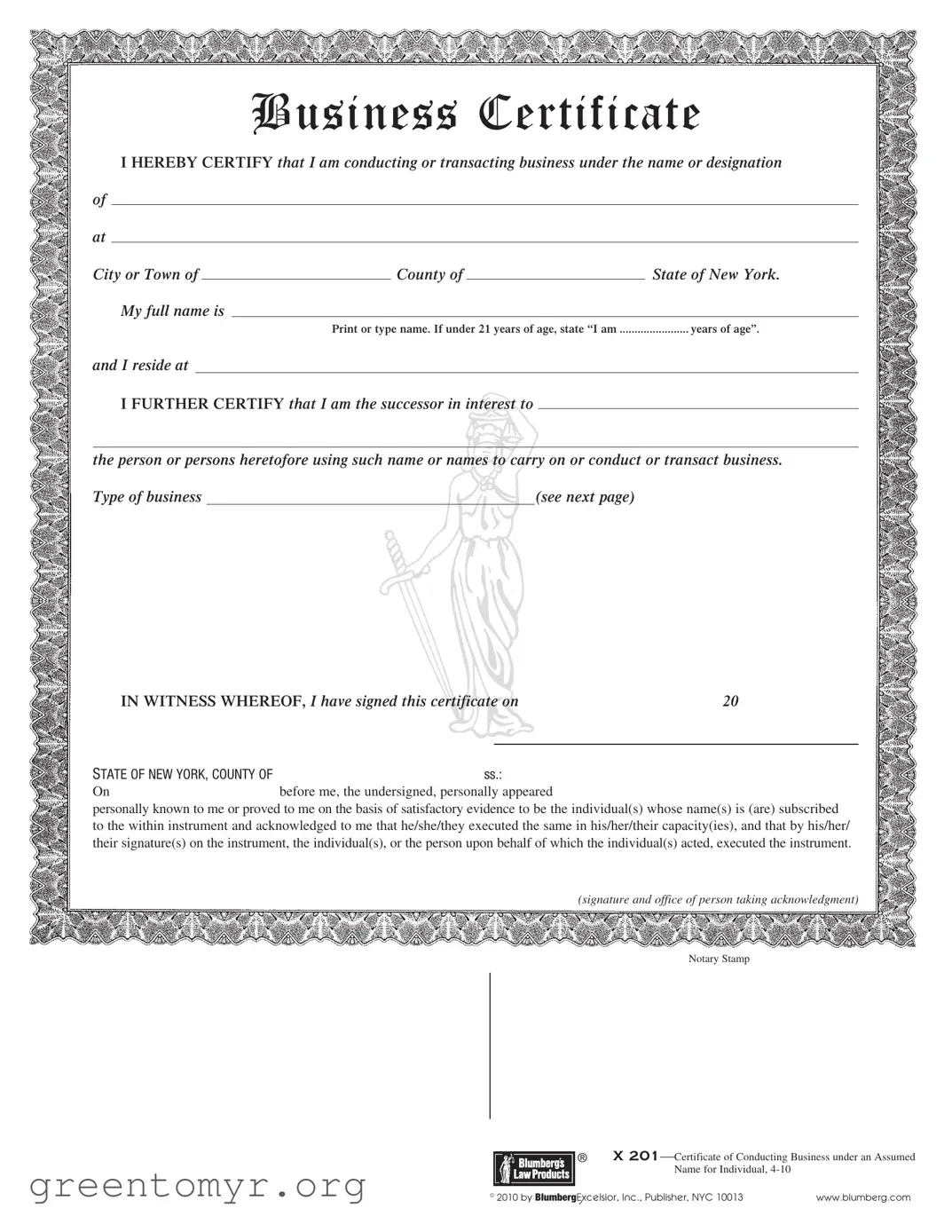
Starting a business can be an exciting venture, but it also comes with its own set of responsibilities, one of which is ensuring that you have the right paperwork in place. The Business Certificate form is an essential document for anyone looking to conduct business under a name that differs from their legal name in New York. This form serves as a formal declaration of your business identity, allowing you to operate under an assumed name while providing transparency to the public. You'll be asked to provide basic information such as your name, the name of your business, and your address. If you're under 21, you’ll need to note your age, which helps to establish your eligibility to enter into contracts. Additionally, the form requires you to certify that you are the successor to any previous business owners using the same name, ensuring that there’s a clear lineage of ownership. It’s important to specify the type of business you’re conducting, as this information may be required by your local county. Once completed, the form must be signed in the presence of a notary public, who will verify your identity and the authenticity of your signature. Finally, a certified copy of this certificate must be displayed at your business location, making it accessible to the public. Understanding these aspects of the Business Certificate form can help you navigate the process smoothly and set a solid foundation for your entrepreneurial journey.

BUSINESS CERTIFICATE
I HEREBY CERTIFY that I am conducting or transacting business under the name or designation
of at
City or Town ofCounty ofState of New York. My full name is
Print or type name. If under 21 years of age, state “I am |
years of age”. |
and I reside at
I FURTHER CERTIFY that I am the successor in interest to
the person or persons heretofore using such name or names to carry on or conduct or transact business.
Type of business |
|
(see next page) |
IN WITNESS WHEREOF, I have signed this certificate on |
20 |
||
STATE OF NEW YORK, COUNTY OF |
|
|
|
SS.: |
|
||
On |
before me, the undersigned, personally appeared |
|
|
personally known to me or proved to me on the basis of satisfactory evidence to be the individual(s) whose name(s) is (are) subscribed to the within instrument and acknowledged to me that he/she/they executed the same in his/her/their capacity(ies), and that by his/her/ their signature(s) on the instrument, the individual(s), or the person upon behalf of which the individual(s) acted, executed the instrument.
(signature and office of person taking acknowledgment)
Notary Stamp
|
|
® |
X |
|
|
|
|
Name for Individual, |
|
|
|
|
|
|
© 2010 by BlumbergExcelsior, Inc., Publisher, NYC 10013 |
www.blumberg.com |
|||

State of New York |
ss.: |
|
County of |
||
|
||
On |
before me, the undersigned, |
|
personally appeared |
|
personally known to me or proved to me on the basis of satisfac- tory evidence to be the individual(s) whose name(s) is (are) sub- scribed to the within instrument and acknowledged to me that he/ she/they executed the same in his/her/their capacity(ies), and that by his/her/their signature(s) on the instrument, the individual(s), or the person upon behalf of which the individual(s) acted, executed the instrument.
State of |
ss.: |
|
County of |
||
|
||
On |
before me, the undersigned, |
|
personally appeared |
|
personally known to me or proved to me on the basis of satis- factory evidence to be the individual(s) whose name(s) is (are) subscribed to the within instrument and acknowledged to me that he/she/they executed the same in his/her/their capacity(ies), and that by his/her/their signature(s) on the instrument, the individual(s), or the person upon behalf of which the individual(s) acted, executed the instrument.
(signature and office of individual taking acknowledgment) |
(signature and office of individual taking acknowledgment) |
INDEX No.
CERTIFICATE
OF
CONDUCTING BUSINESS UNDER
THE NAME OF
GBL §130.4. A certified copy of the original certificate, or if an amended certificate has been filed, then of the most recent amended certificate filed shall be conspicuously displayed on the premises at each place in which the business for which the same was filed is conducted.
Some counties request the type of business.
Consultant Services |
|
Educational Services |
|
Real Estate Services |
|
Retail Trade |
|
Home Improvement Services |
Wholesale Trade |
Other (state type) |
|
| Fact Name | Description |
|---|---|
| Purpose | The Business Certificate serves to officially register a business name under which an individual is conducting business in New York. |
| Governing Law | This certificate is governed by the New York General Business Law §130.4. |
| Residency Requirement | The individual must provide their full name and residential address, ensuring transparency in business operations. |
| Age Declaration | If the individual is under 21 years of age, they must declare their age in the certificate. |
| Successor Certification | The form includes a section for certifying that the individual is the successor in interest to any previous users of the business name. |
| Display Requirement | A certified copy of the Business Certificate must be displayed at each business location where the name is used. |
Completing the Business Certificate form is an important step for anyone looking to conduct business under a specific name in New York. After filling out the form, you will need to submit it to the appropriate local authority. Ensure that all information is accurate and complete to avoid any delays in processing.
The Business Certificate form is used to officially register a business name in New York State. It serves to inform the public about the identity of the individual or entity conducting business under a specific name. This helps to ensure transparency and accountability in business operations.
Any individual or entity conducting business under a name that is not their legal name must file a Business Certificate. This includes sole proprietors, partnerships, and other business entities. It is essential for anyone who wants to operate under a different name to comply with this requirement.
To complete the form, you will need to provide the following information:
Make sure to print or type clearly to avoid any errors.
The form allows for various types of businesses to be registered, including but not limited to:
Choose the category that best fits your business for accurate registration.
Yes, the Business Certificate form must be notarized. This means that you will need to sign the form in the presence of a notary public, who will then acknowledge your signature. This step adds an extra layer of authenticity to your filing.
Once you have filed your Business Certificate, it is important to display a certified copy conspicuously at each location where your business operates. This ensures that customers and the public can easily see your business registration details.
If you decide to change your business name, you must file an amended Business Certificate. This updated certificate will replace the original and must also be displayed at your business locations. Keeping your registration current is crucial for compliance.
Yes, there is typically a filing fee associated with submitting the Business Certificate. The exact amount may vary by county, so it’s advisable to check with your local county clerk’s office for the current fee structure.
The processing time for a Business Certificate can vary. Generally, it may take a few days to a few weeks, depending on the county's workload and procedures. It’s best to file your certificate well in advance of starting your business operations to avoid any delays.
When filling out the Business Certificate form, individuals often make several common mistakes that can lead to delays or complications. One frequent error is failing to provide the correct business name. The name listed must match exactly with the name under which the business operates. If there are any discrepancies, it could result in the rejection of the application.
Another mistake is neglecting to include the full name of the applicant. The form explicitly states to print or type the name clearly. Omitting or misspelling the name can create issues when verifying the applicant’s identity. This can also complicate future legal matters if the name on the certificate does not align with other official documents.
Many applicants forget to indicate their age if they are under 21. The form requires a statement of age in such cases. This oversight may seem minor, but it can prevent the form from being processed. It is essential to read each section carefully to ensure compliance with all requirements.
In addition, individuals often overlook the section regarding the type of business. The form lists various categories, and selecting the appropriate one is crucial. Failing to do so can lead to confusion and may even require resubmission of the form.
Another common issue is the lack of a proper signature. The form must be signed by the applicant. Some people mistakenly believe that typing their name suffices, but a handwritten signature is typically required. This step is vital for the authenticity of the document.
Individuals sometimes forget to have their signatures notarized. The acknowledgment section requires a notary public to witness the signing. Without this step, the certificate may be deemed invalid, leading to potential legal challenges down the line.
Furthermore, applicants may neglect to include the correct date on which they signed the certificate. The date is important for record-keeping and can affect the timeline of the business's legal standing. Inaccurate dating can lead to complications in future filings or legal situations.
Lastly, many fail to display the certificate as required. Once the certificate is filed, a certified copy must be conspicuously displayed at the business premises. Ignoring this requirement can result in penalties or legal issues, particularly if the business is inspected by local authorities.
When starting a business, several forms and documents are often necessary alongside the Business Certificate form. Each document serves a specific purpose and helps ensure compliance with local laws and regulations. Below is a list of commonly used documents that may accompany the Business Certificate.
Understanding these documents is crucial for anyone looking to establish a business. Each plays a vital role in ensuring that the business operates legally and efficiently. Properly completing and filing these forms can help avoid potential legal issues in the future.
When filling out the Business Certificate form, consider the following guidelines to ensure accuracy and compliance.
Misconceptions about the Business Certificate form can lead to confusion for individuals looking to start or operate a business. Here are seven common misconceptions clarified:
Understanding these misconceptions can help ensure compliance and smooth operation of a business. Properly filing and maintaining a Business Certificate is an essential step in establishing a legitimate business presence.
When filling out and using the Business Certificate form, keep these key takeaways in mind:
Following these guidelines will help ensure a smooth process when filling out and utilizing your Business Certificate form.