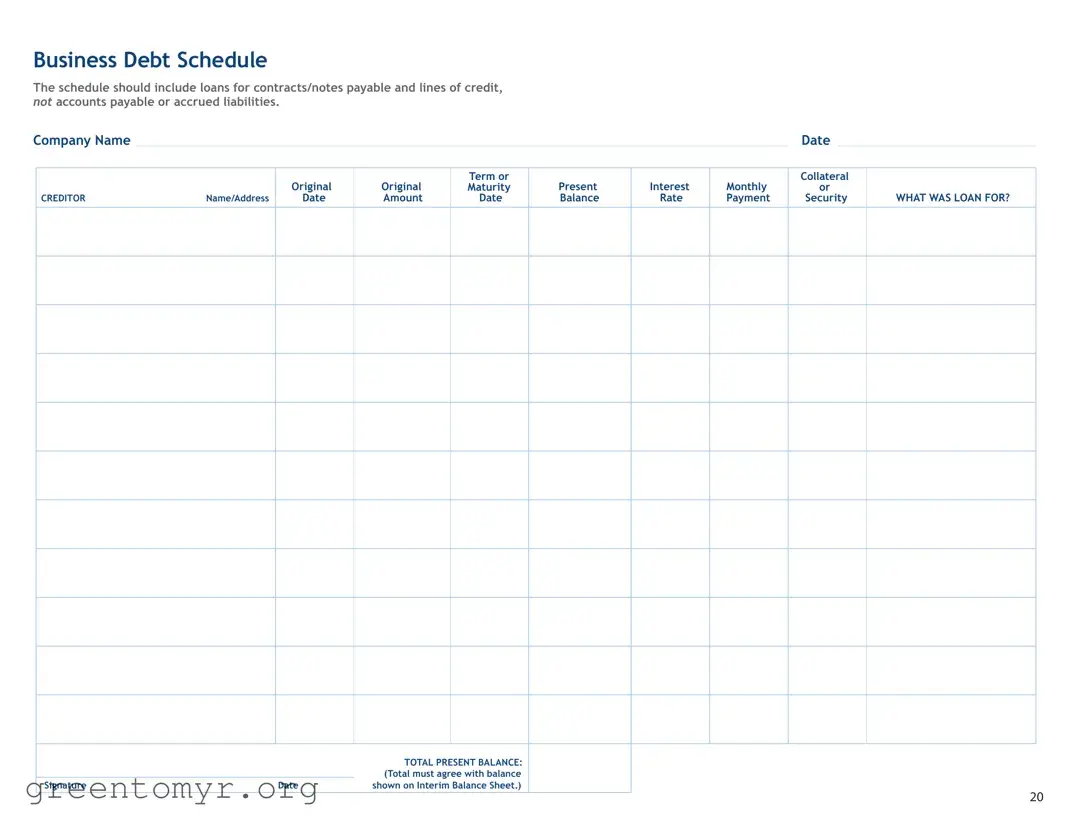
The Business Debt Schedule form is an essential tool for any business looking to maintain a clear overview of its financial obligations. This document helps track various loans, including contracts, notes payable, and lines of credit. It’s important to note that accounts payable and accrued liabilities are not included in this schedule. Each entry on the form requires specific information, such as the creditor's name and address, the original date of the loan, the original amount borrowed, and the term or maturity date. Additionally, businesses must provide the present balance, interest rate, monthly payment, and any collateral or security associated with the loan. A brief description of what the loan was for adds context to each entry. At the end of the schedule, a total present balance must be calculated, ensuring it aligns with the balance shown on the interim balance sheet. This comprehensive overview aids in financial planning and decision-making, making it a vital part of a business's financial documentation.

Business Debt Schedule
The schedule should include loans for contracts/notes payable and lines of credit, not accounts payable or accrued liabilities.
Company Name |
|
Date |
CREDITOR |
Name/Address |
Original
Date
Original Amount
Term or Maturity Date
Present Balance
Interest
Rate
Monthly Payment
Collateral
or
Security
WHAT WAS LOAN FOR?
|
|
TOTAL PRESENT BALANCE: |
|
|
(Total must agree with balance |
Signature |
Date |
shown on Interim Balance Sheet.) |
20
| Fact Name | Details |
|---|---|
| Purpose | The Business Debt Schedule is used to list all loans and lines of credit for a business, excluding accounts payable and accrued liabilities. |
| Required Information | The form requires details such as creditor name and address, original date of the loan, original amount, term or maturity date, present balance, interest rate, monthly payment, collateral, and purpose of the loan. |
| Total Present Balance | The total present balance must match the balance shown on the interim balance sheet to ensure accuracy in financial reporting. |
| Governing Laws | The specific governing laws can vary by state, but generally, business debt disclosures are regulated under state commercial laws. |
| Signature Requirement | A signature is required on the form, affirming that the information provided is accurate and complete. |
| Confidentiality | Details in the Business Debt Schedule are typically confidential and should be handled with care to protect sensitive business information. |
| Review Process | It is advisable for businesses to regularly review and update their Business Debt Schedule to reflect current financial obligations. |
| Usage | This form is often utilized in loan applications, financial audits, and during business sales or mergers to provide a clear picture of outstanding debts. |
Completing the Business Debt Schedule form is a crucial step in managing your company's financial obligations. This document will help you organize and present your business debts clearly. Follow the steps below to fill out the form accurately.
The Business Debt Schedule form is designed to provide a clear overview of a company's outstanding debts. It helps in organizing information related to loans, contracts, notes payable, and lines of credit. This form does not include accounts payable or accrued liabilities. By summarizing these debts, the form assists businesses in understanding their financial obligations and aids in making informed decisions about cash flow and financing.
When filling out the Business Debt Schedule, you should include the following details for each creditor:
At the end of the form, you will need to calculate the total present balance, which should match the balance shown on the Interim Balance Sheet.
It's essential to differentiate between types of debts because it helps in accurately assessing a company's financial health. The Business Debt Schedule focuses on long-term obligations like loans and credit lines, which impact cash flow and financial strategy. Excluding accounts payable and accrued liabilities keeps the focus on significant debts that require ongoing management and repayment. This distinction ensures that stakeholders have a clear picture of the company's liabilities.
Updating the Business Debt Schedule should be done regularly, ideally on a monthly basis. This allows for accurate tracking of payments made, changes in balances, and any new debts incurred. Regular updates help maintain a clear understanding of the company's financial position and support effective financial planning. Additionally, any significant changes in debt or terms should be recorded promptly to ensure the information remains current and useful.
When filling out the Business Debt Schedule form, many people overlook critical details that can lead to inaccuracies. One common mistake is including accounts payable or accrued liabilities. This form is specifically designed for loans, contracts, notes payable, and lines of credit. Ensure you focus only on those categories to maintain clarity and accuracy.
Another frequent error is failing to provide complete information for each creditor. Each entry should include the creditor's name and address, the original date of the loan, and the original amount. Missing any of this information can lead to confusion and may even affect the validity of the document.
Many individuals also forget to update the present balance of each loan. It’s essential to reflect the current amount owed accurately. If the present balance does not match the interim balance sheet, it can raise red flags during review. Double-check this figure to avoid discrepancies.
Interest rates can be tricky, and errors in this section are common. People sometimes enter the wrong rate or forget to include it altogether. This information is crucial as it affects monthly payments and the overall financial picture. Always verify the interest rate with your loan documents.
Another mistake is neglecting to specify what the loan was for. This section provides context for the debt and can be important for lenders or auditors. Whether it was for equipment, inventory, or operational expenses, clarity here is vital.
People often miscalculate the monthly payment amounts as well. Ensure that you are using the correct figures from your loan agreements. Miscalculating this can lead to incorrect total balances and an inaccurate financial picture.
Lastly, not signing and dating the form is a common oversight. This may seem minor, but it is essential for the document's legitimacy. A signature and date confirm that the information provided is accurate and complete. Always take a moment to ensure this step is not overlooked.
The Business Debt Schedule form is a vital tool for businesses to track their financial obligations. However, it is often accompanied by several other documents that provide a comprehensive view of a company’s financial status. Below is a list of related forms and documents that are commonly used alongside the Business Debt Schedule.
Using these documents in conjunction with the Business Debt Schedule form allows businesses to maintain a clear understanding of their financial obligations and overall health. Proper documentation can facilitate better decision-making and improve financial management.
The Business Debt Schedule form is an important document for businesses to outline their financial obligations. It shares similarities with several other financial documents. Here’s a look at six documents that are comparable to the Business Debt Schedule:
When filling out the Business Debt Schedule form, it is crucial to be thorough and accurate. Here are some important dos and don’ts to keep in mind:
By following these guidelines, you can ensure that your Business Debt Schedule form is completed correctly and efficiently. Accuracy is vital for maintaining the integrity of your financial reporting.
Understanding the Business Debt Schedule form is essential for anyone managing a business's financial obligations. However, there are several misconceptions that can lead to confusion. Below are five common misconceptions about this form:
By addressing these misconceptions, business owners can better understand the importance of the Business Debt Schedule and ensure they are accurately representing their financial obligations.
The Business Debt Schedule form is an essential tool for tracking and managing a company's debts. Here are key takeaways regarding its completion and use: