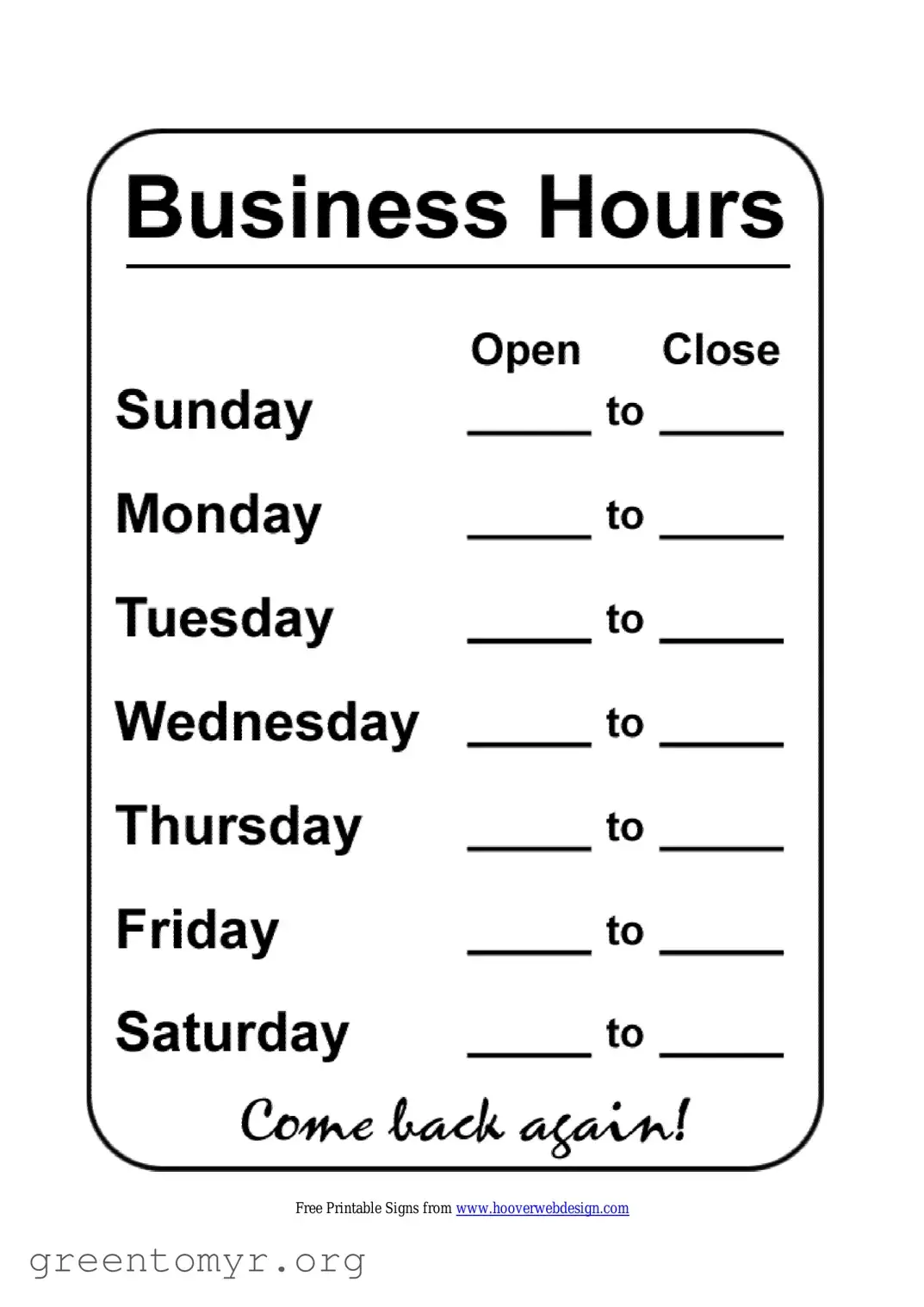
The Business Hours form serves as a crucial tool for businesses to communicate their operating times clearly to customers. It outlines the specific hours of operation for each day of the week, from Sunday through Saturday. This form typically includes designated opening and closing times, ensuring that patrons know when they can visit. Additionally, it provides an opportunity for businesses to display their hours prominently, enhancing visibility and accessibility. A well-structured Business Hours form can help reduce confusion and improve customer satisfaction. Many businesses also opt to create free printable signs based on this form, allowing them to easily share their hours in a visually appealing manner. By utilizing this form effectively, businesses can streamline their communication and foster a positive relationship with their clientele.
Free Printable Signs from www.hooverwebdesign.com
| Fact Name | Description |
|---|---|
| Purpose | The Business Hours form is used to communicate the operating hours of a business to customers. |
| Days Covered | This form includes all seven days of the week: Sunday through Saturday. |
| Open and Close Times | Each day allows for specific opening and closing times to be indicated, ensuring clarity for customers. |
| State-Specific Forms | Some states may require specific formats or additional information based on local regulations. |
| Governing Laws | Business hours regulations can vary by state, often governed by local business codes and ordinances. |
| Accessibility | The form can be printed for display, making it easy for businesses to share their hours with the public. |
| Customer Engagement | Encouraging customers to "Come back again!" fosters a welcoming atmosphere and enhances customer relations. |
After completing the Business Hours form, you will be able to submit your information for processing. This ensures that your business hours are accurately recorded and made available for your customers. Follow the steps below to fill out the form correctly.
The Business Hours form is designed to help businesses clearly communicate their operating hours to customers. By filling out this form, you can specify when your business is open and closed throughout the week. This information is crucial for customers who want to plan their visits accordingly.
To fill out the form, simply enter the opening and closing times for each day of the week. You will see fields for Sunday through Saturday. Make sure to double-check your entries to ensure accuracy. Once completed, you can print the form or save it for your records.
It's common for businesses to have different hours on different days. The Business Hours form allows you to specify unique hours for each day of the week. Just enter the appropriate opening and closing times for each day, and your customers will have a clear understanding of when you are available.
The standard Business Hours form does not include a section for holidays. However, you can create a separate note or sign to inform customers of any special hours during holidays. This way, you can keep your customers informed about any changes to your regular schedule.
Yes, the form is designed to be printable. Once you have filled it out, look for the print option on your device. You can print it directly or save it as a PDF for future reference. This makes it easy to display your business hours prominently in your location.
If your business hours change, simply update the Business Hours form with the new times. It's important to keep this information current so that customers always know when they can visit. Once updated, print the new version and display it where customers can see it.
Yes, the form includes a note about free printable signs. You can use these resources to create visually appealing signs that clearly display your business hours. This can enhance visibility and ensure that your customers are always informed.
If you have any questions or need assistance with the Business Hours form, consider reaching out to your local business support center or a contract specialist. They can provide guidance and help you navigate any issues you may encounter.
Filling out the Business Hours form can seem straightforward, but many individuals make common mistakes. One frequent error is failing to specify the opening and closing times for each day. When the fields for "Open" and "Close" are left blank, it creates confusion for customers trying to determine when the business is available.
Another mistake is entering times in an incorrect format. For example, using 24-hour time instead of the standard 12-hour format can lead to misunderstandings. It’s important to ensure that the times are clearly marked as AM or PM to avoid any potential scheduling conflicts.
Some people overlook the importance of consistency across the week. For instance, if a business operates on different hours during weekends compared to weekdays, this should be clearly indicated. Failing to do so may mislead customers about when they can visit.
Finally, neglecting to update the form when business hours change is a common oversight. If a business temporarily alters its hours for holidays or special events, it’s crucial to reflect those changes in the form. Keeping the information current helps maintain clear communication with customers.
When managing a business, several forms and documents complement the Business Hours form. Each of these documents serves a specific purpose and helps streamline operations. Below is a list of commonly used forms that can enhance your business's efficiency and communication.
Utilizing these documents alongside the Business Hours form can help create a more organized and efficient business environment. Each form plays a vital role in ensuring smooth operations and enhancing communication with both employees and customers.
When filling out the Business Hours form, it's essential to follow certain guidelines to ensure accuracy and clarity. Below is a list of things you should and shouldn't do:
By adhering to these guidelines, you can help ensure that your business hours are communicated effectively to your customers.
Understanding the Business Hours form is essential for effective communication with customers and clients. However, several misconceptions can lead to confusion. Here are seven common misconceptions:
Misconception 1: The form is only for retail businesses.
This form is useful for any business type, including service providers, restaurants, and online stores.
Misconception 2: You must fill out every day of the week.
It is not mandatory to list hours for each day. If a business is closed on certain days, those can simply be left blank.
Misconception 3: The form only allows for standard hours.
Businesses can specify any hours they operate, including irregular or seasonal hours.
Misconception 4: Once submitted, the hours cannot be changed.
Businesses can update their hours as needed. Flexibility is key in responding to changing circumstances.
Misconception 5: The form is not important for online businesses.
Even online businesses benefit from clearly stated hours to manage customer expectations and inquiries.
Misconception 6: Customers do not pay attention to business hours.
In reality, customers often check business hours before visiting or contacting a business.
Misconception 7: The form is only for physical locations.
Virtual services and remote businesses also need to communicate their availability clearly.
Addressing these misconceptions can enhance customer satisfaction and streamline business operations.
Understanding how to properly fill out and utilize the Business Hours form is essential for effective communication with your customers. Here are some key takeaways to consider:
By keeping these points in mind, you can optimize the use of your Business Hours form and improve customer interactions.