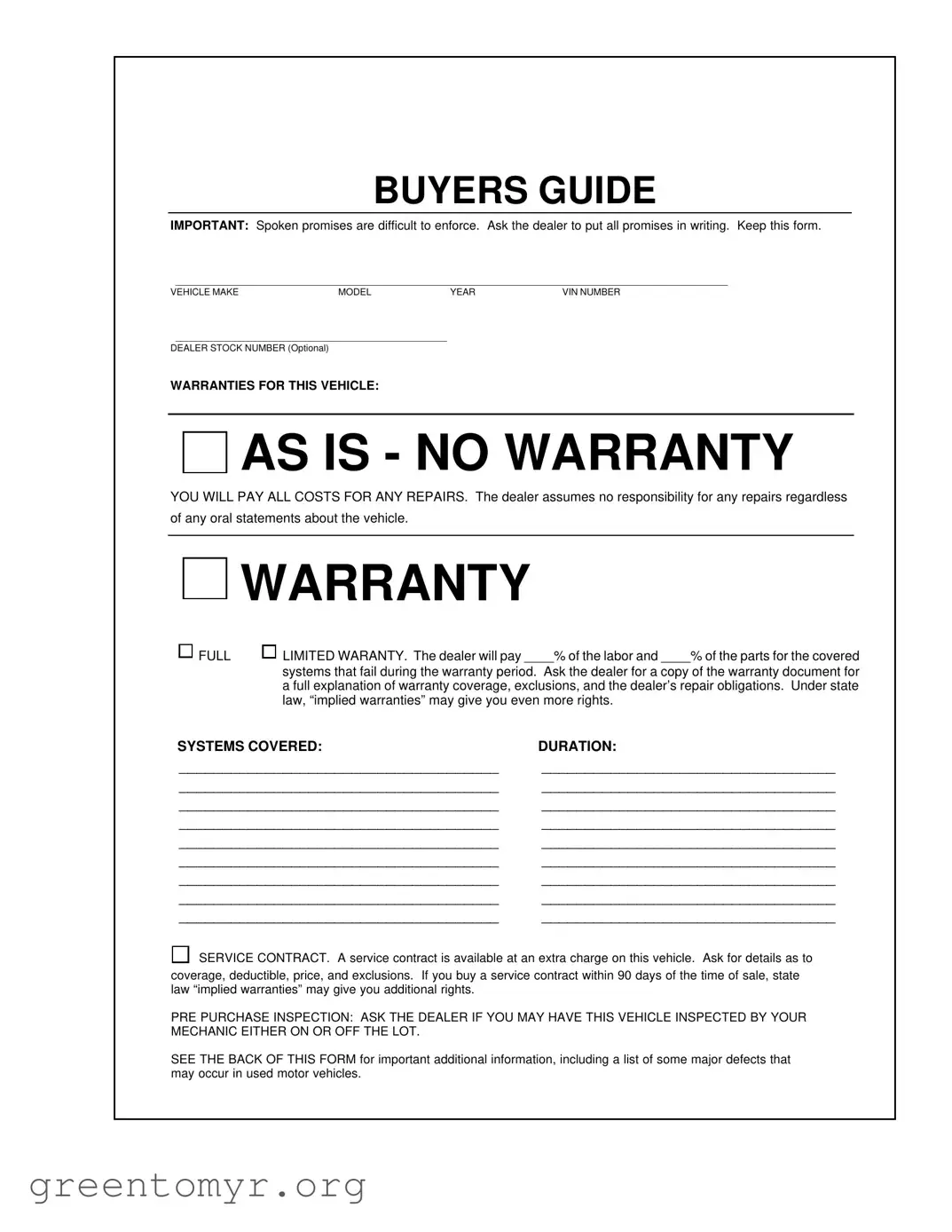
When purchasing a vehicle, understanding the Buyers Guide form is essential for making an informed decision. This form outlines important information regarding the vehicle's condition, warranties, and your rights as a buyer. It begins with a clear reminder that spoken promises can be difficult to enforce, so it is crucial to have any agreements documented in writing. The form specifies the vehicle's make, model, year, and VIN number, ensuring that you are aware of exactly what you are considering. It also addresses the types of warranties available, ranging from "as is" with no warranty to a full limited warranty that covers certain repairs during a specified period. Buyers are encouraged to inquire about the percentage of labor and parts that the dealer will cover under the warranty. Additionally, the form highlights the option of purchasing a service contract, which may offer further protection at an additional cost. Another key aspect is the pre-purchase inspection, where buyers are urged to have the vehicle checked by a mechanic of their choice. This can uncover potential issues before finalizing the purchase. Finally, the form provides a list of common defects that may occur in used vehicles, helping buyers to be vigilant about potential problems. Keeping this form is not just a formality; it serves as a vital reference throughout the buying process and beyond.
BUYERS GUIDE
IMPORTANT: Spoken promises are difficult to enforce. Ask the dealer to put all promises in writing. Keep this form.
__________________________________________________________________________________________________________
VEHICLE MAKEMODELYEARVIN NUMBER
____________________________________________________
DEALER STOCK NUMBER (Optional)
WARRANTIES FOR THIS VEHICLE:
AS IS - NO WARRANTY
YOU WILL PAY ALL COSTS FOR ANY REPAIRS. The dealer assumes no responsibility for any repairs regardless
of any oral statements about the vehicle.
WARRANTY
FULL
LIMITED WARANTY. The dealer will pay ____% of the labor and ____% of the parts for the covered
systems that fail during the warranty period. Ask the dealer for a copy of the warranty document for a full explanation of warranty coverage, exclusions, and the dealer’s repair obligations. Under state law, “implied warranties” may give you even more rights.
SYSTEMS COVERED: |
DURATION: |
_____________________________________ |
__________________________________ |
_____________________________________ |
__________________________________ |
_____________________________________ |
__________________________________ |
_____________________________________ |
__________________________________ |
_____________________________________ |
__________________________________ |
_____________________________________ |
__________________________________ |
_____________________________________ |
__________________________________ |
_____________________________________ |
__________________________________ |
_____________________________________ |
__________________________________ |
SERVICE CONTRACT. A service contract is available at an extra charge on this vehicle. Ask for details as to
coverage, deductible, price, and exclusions. If you buy a service contract within 90 days of the time of sale, state law “implied warranties” may give you additional rights.
PRE PURCHASE INSPECTION: ASK THE DEALER IF YOU MAY HAVE THIS VEHICLE INSPECTED BY YOUR MECHANIC EITHER ON OR OFF THE LOT.
SEE THE BACK OF THIS FORM for important additional information, including a list of some major defects that may occur in used motor vehicles.
BUYERS GUIDE
IMPORTANT: Spoken promises are difficult to enforce. Ask the dealer to put all promises in writing. Keep this form.
__________________________________________________________________________________________________________
VEHICLE MAKEMODELYEARVIN NUMBER
____________________________________________________
DEALER STOCK NUMBER (Optional)
WARRANTIES FOR THIS VEHICLE:
IMPLIED WARRANTIES ONLY
This means that the dealer does not make any specific promises to fix things that need repair when you buy the vehicle or after the time of sale. But, state law “implied warranties” may give you some rights to have the dealer take care of serious problems that were not apparent when you bought the vehicle.
WARRANTY
FULL
LIMITED WARANTY. The dealer will pay ____% of the labor and ____% of the parts for the covered
systems that fail during the warranty period. Ask the dealer for a copy of the warranty document for a full explanation of warranty coverage, exclusions, and the dealer’s repair obligations. Under state law, “implied warranties” may give you even more rights.
SYSTEMS COVERED: |
DURATION: |
_____________________________________ |
__________________________________ |
_____________________________________ |
__________________________________ |
_____________________________________ |
__________________________________ |
_____________________________________ |
__________________________________ |
_____________________________________ |
__________________________________ |
_____________________________________ |
__________________________________ |
_____________________________________ |
__________________________________ |
_____________________________________ |
__________________________________ |
_____________________________________ |
__________________________________ |
SERVICE CONTRACT. A service contract is available at an extra charge on this vehicle. Ask for details as to
coverage, deductible, price, and exclusions. If you buy a service contract within 90 days of the time of sale, state law “implied warranties” may give you additional rights.
PRE PURCHASE INSPECTION: ASK THE DEALER IF YOU MAY HAVE THIS VEHICLE INSPECTED BY YOUR MECHANIC EITHER ON OR OFF THE LOT.
SEE THE BACK OF THIS FORM for important additional information, including a list of some major defects that may occur in used motor vehicles.

Below is a list of some major defects that may occur in used motor vehicles.
Frame & Body
Engine
Oil leakage, excluding normal seepage Cracked block or head
Belts missing or inoperable
Knocks or misses related to camshaft lifters and push rods
Abnormal exhaust discharge
Transmission & Drive Shaft
Improper fluid level or leakage, excluding normal seepage
Cracked or damaged case which is visible Abnormal noise or vibration caused by faulty
transmission or drive shaft
Improper shifting or functioning in any gear Manual clutch slips or chatters
Differential
Improper fluid level or leakage excluding normal seepage
Cracked of damaged housing which is visible Abnormal noise or vibration caused by faulty
differential
Cooling System
Leakage including radiator
Improperly functioning water pump
Electrical System
Battery leakage
Improperly functioning alternator, generator, battery, or starter
Fuel System
Visible leakage
Inoperable Accessories
Gauges or warning devices
Air conditioner
Heater & Defroster
Brake System
Failure warning light broken
Pedal not firm under pressure (DOT spec.) Not enough pedal reserve (DOT spec.)
Does not stop vehicle in straight line (DOT spec.) Hoses damaged
Drum or rotor too thin (Mfgr. Specs) Lining or pad thickness less than 1/32 inch Power unit not operating or leaking Structural or mechanical parts damaged
Steering System
Too much free play at steering wheel (DOT specs.) Free play in linkage more than 1/4 inch
Steering gear binds or jams
Front wheels aligned improperly (DOT specs.) Power unit belts cracked or slipping
Power unit fluid level improper
Suspension System
Ball joint seals damaged Structural parts bent or damaged Stabilizer bar disconnected Spring broken
Shock absorber mounting loose Rubber bushings damaged or missing Radius rod damaged or missing
Shock absorber leaking or functioning improperly
Tires
Tread depth less than 2/32 inch
Sizes mismatched
Visible damage
Wheels
Visible cracks, damage or repairs
Mounting bolts loose or missing
Exhaust System
Leakage
________________________________________________________________________________________________
DEALER
________________________________________________________________________________________________
ADDRESS
________________________________________________________________________________________________
________________________________________________________________________________________________
SEE FOR COMPLAINTS
IMPORTANT: The information on this form is part of any contract to buy this vehicle. Removal of this label before consumer purchase (except for purpose of
| Fact Name | Description |
|---|---|
| Purpose of the Buyers Guide | The Buyers Guide is designed to inform consumers about the warranties and options available for a vehicle they are considering purchasing. It emphasizes the importance of having promises made by the dealer in writing. |
| Warranties Explained | There are different warranty options listed on the Buyers Guide, including "As Is - No Warranty" and "Full Limited Warranty." Each option has specific implications for the buyer regarding repair responsibilities. |
| Implied Warranties | Under state law, implied warranties may provide additional rights to buyers. These rights can cover serious issues that were not visible at the time of purchase, even if the dealer does not explicitly offer a warranty. |
| Service Contracts | A service contract can be purchased for an extra fee. This contract may offer additional coverage and rights, especially if bought within 90 days of the vehicle purchase. |
| Pre-Purchase Inspection | The Buyers Guide encourages buyers to have the vehicle inspected by a mechanic, either on-site or off-site, to identify potential issues before completing the purchase. |
Filling out the Buyers Guide form is an essential step in your vehicle purchasing process. This form provides important information about the vehicle and outlines the warranties available. To ensure you complete the form accurately and understand your rights, follow these steps carefully.
Once you have completed the form, keep it in a safe place. This document serves as a record of the agreements made during the vehicle purchase, protecting your rights as a buyer.
The Buyers Guide form is a document that provides important information about the vehicle you are considering purchasing. It outlines the warranties available, any potential issues with the vehicle, and your rights as a buyer. Keeping this form is crucial, as it serves as a reference for both you and the dealer.
The Buyers Guide outlines several warranty options:
Yes, you should ask the dealer if you can have the vehicle inspected by your mechanic. This can be done either on or off the lot. A pre-purchase inspection can help identify any potential issues that may not be immediately visible.
A service contract is an additional agreement you can purchase for extra coverage on the vehicle. It may cover repairs and maintenance for a specified period. Be sure to ask the dealer for details about coverage, deductibles, prices, and any exclusions. If you buy a service contract within 90 days of the sale, state law may provide you with additional rights.
If you experience issues with the vehicle after your purchase, refer back to the Buyers Guide. It contains crucial information about warranties and your rights. You may want to contact the dealer to discuss any concerns or repairs needed, especially if they fall under the warranty coverage.
The Buyers Guide highlights several major defects that may occur in used vehicles, including:
Being aware of these potential issues can help you make a more informed decision.
Filling out the Buyers Guide form is a crucial step in the vehicle purchasing process. However, many people make common mistakes that can lead to confusion or complications later on. Here are eight mistakes to avoid.
One frequent error is not asking for written promises. Many buyers rely on verbal assurances from dealers, which can be difficult to enforce. Always request that any promises made by the dealer be documented in writing. This protects you and ensures clarity about what to expect.
Another mistake is failing to complete all sections of the form. Incomplete information can lead to misunderstandings about the vehicle’s condition or the terms of the sale. Take the time to fill in every relevant detail, including the vehicle's make, model, year, and VIN number.
Some buyers overlook the importance of understanding warranty options. The form provides different warranty choices, such as "As Is" or "Full Limited Warranty." Not fully grasping these options can result in unexpected repair costs later. Make sure to ask the dealer for clarification if needed.
People often neglect to inquire about service contracts. A service contract can offer additional protection, but it comes at an extra charge. It’s important to understand the coverage, costs, and exclusions associated with any service contract before making a decision.
Another common mistake is not requesting a pre-purchase inspection. Buyers should always ask if they can have the vehicle inspected by a trusted mechanic. This step can uncover hidden issues and save you from costly repairs down the line.
Many buyers also forget to review the back of the form. This section contains vital information about potential defects in used vehicles. Familiarizing yourself with these common issues can help you make a more informed decision.
Additionally, overlooking the dealer's obligations can be a significant oversight. The form outlines the dealer's responsibilities regarding repairs and warranties. Understanding these obligations can help you know what to expect if problems arise after the purchase.
Lastly, some buyers do not keep a copy of the filled-out form. This document is part of your contract to buy the vehicle. Retaining a copy ensures you have a reference for any future disputes or questions about the sale.
When purchasing a vehicle, it is essential to have all the necessary documentation to ensure a smooth transaction and protect your rights as a buyer. Along with the Buyers Guide form, several other documents are often used. Each of these documents serves a specific purpose in the car buying process. Below is a list of some commonly associated forms.
Being aware of these documents and their purposes can empower you during the vehicle purchasing process. Always ensure that you receive and understand each form before finalizing your purchase. This diligence can help protect your investment and ensure a positive buying experience.
Purchase Agreement: Similar to the Buyers Guide, a Purchase Agreement outlines the terms of the sale, including the vehicle's price, financing details, and any warranties or service contracts. Both documents serve to clarify the buyer's rights and obligations, ensuring that all promises made by the dealer are documented.
Warranty Document: A Warranty Document provides specific details about the coverage offered for a vehicle, similar to the warranty section in the Buyers Guide. Both documents inform the buyer about what repairs are covered, the duration of the warranty, and any exclusions that may apply.
Service Contract: A Service Contract, like the one mentioned in the Buyers Guide, offers additional coverage for repairs beyond standard warranties. Both documents emphasize the importance of understanding the terms and conditions associated with such contracts, including coverage limits and deductibles.
Inspection Report: An Inspection Report details the condition of the vehicle before purchase, akin to the pre-purchase inspection recommendation in the Buyers Guide. Both documents encourage buyers to have the vehicle examined for potential defects, thereby protecting their interests.
When filling out the Buyers Guide form, there are several important dos and don'ts to keep in mind. Following these guidelines can help ensure a smoother purchasing experience.
By following these tips, you can make a more informed decision when purchasing a vehicle.
When navigating the process of purchasing a vehicle, the Buyers Guide form serves as a critical tool. Here are some key takeaways to keep in mind:
By keeping these points in mind, you can navigate the vehicle purchasing process with greater confidence and awareness.