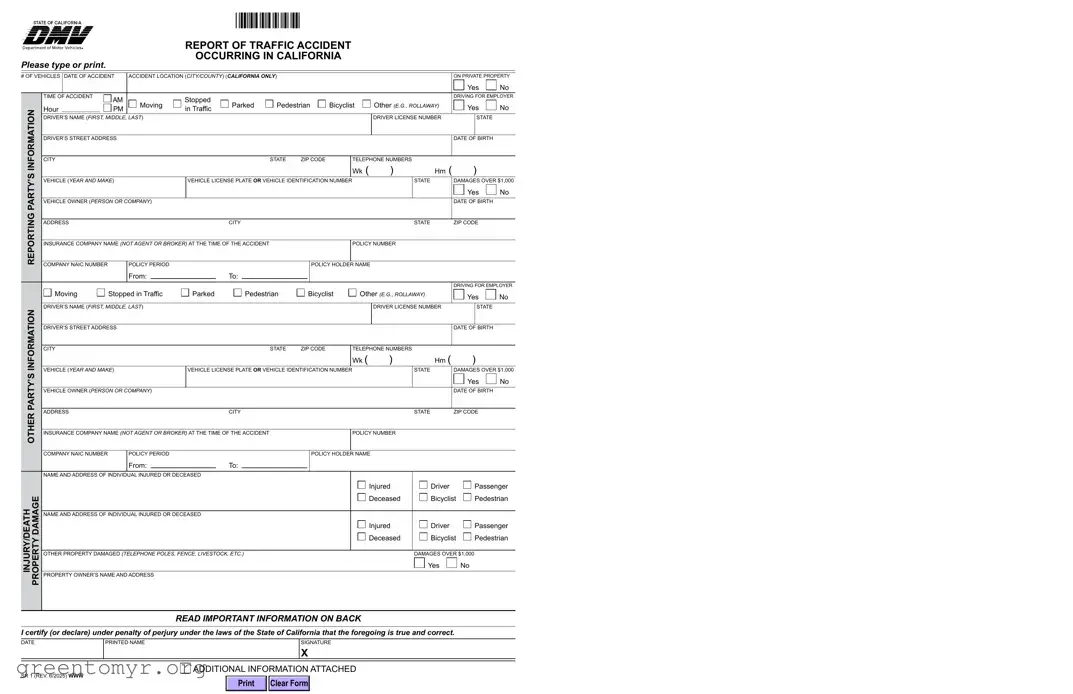
The California DMV SR1 form is a crucial document that must be completed and submitted following a traffic accident occurring within the state. This form serves as a report of the accident, capturing essential details such as the date, time, and location of the incident, as well as information about the vehicles and drivers involved. It requires the names and addresses of all parties, including any individuals injured or deceased as a result of the accident. Additionally, the form collects insurance information, ensuring that all drivers are financially responsible for any damages or injuries incurred. California law mandates that this report be filed within 10 days of the accident if there are injuries, fatalities, or property damage exceeding $1,000. Failure to submit the SR1 form on time may lead to the suspension of the driver's license. It's important to note that this form must be filed regardless of who is at fault in the accident, and it complements any reports made to law enforcement or insurance companies. Completing the SR1 accurately is essential, as it provides a formal record that can be referenced by various parties, including law enforcement and insurance agencies.
*SR1*
Please type or print.
REPORT OF TRAFFIC ACCIDENT
OCCURRING IN CALIFORNIA
# OF VEHICLES DATE OF ACCIDENT |
ACCIDENT LOCATION (CITY/COUNTY) (CALIFORNIA ONLY) |
ON PRIVATE PROPERTY |
|
|
|
|
|
|
|
|
|
|
|
|
|
|
|
|
|
|
|
|
|
|
|
|
|
|
Yes |
|
No |
||
|
|
|
|
|
|
|
|
|
|
|
|
|
|
|
|
|
|
|
|
|
|
|
|
|
|
|
||||
|
TIME OF ACCIDENT |
AM |
|
|
|
Stopped |
|
|
|
|
|
|
|
|
|
|
|
|
|
|
|
DRIVING FOR EMPLOYER |
||||||||
|
|
|
|
Moving |
|
Parked |
Pedestrian |
Bicyclist |
Other (E.G., ROLLAWAY) |
|
Yes |
|
No |
|||||||||||||||||
INFORMATION |
Hour |
|
|
PM |
in Traffic |
|
|
|
||||||||||||||||||||||
|
|
|
|
|
|
|
|
|
|
|
|
|
|
|
|
|
|
|
|
|
|
|||||||||
|
|
|
|
|
|
|
|
|
|
|
|
|
|
|
|
|
|
|
|
|
||||||||||
|
DRIVER’S NAME (FIRST, MIDDLE, LAST) |
|
|
|
|
|
|
|
|
|
|
|
|
|
DRIVER LICENSE NUMBER |
|
|
STATE |
|
|||||||||||
|
|
|
|
|
|
|
|
|
|
|
|
|
|
|
|
|
|
|
|
|
|
|
|
|
|
|
|
|
|
|
|
DRIVER’S STREET ADDRESS |
|
|
|
|
|
|
|
|
|
|
|
|
|
|
|
|
|
|
|
|
DATE OF |
BIRTH |
|
||||||
|
|
|
|
|
|
|
|
|
|
|
|
|
|
|
|
|
|
|
|
|
|
|
|
|
|
|
|
|||
|
CITY |
|
|
|
|
|
|
|
|
|
|
STATE |
ZIP CODE |
|
TELEPHONE NUMBERS |
|
|
|
|
|
|
|
|
|||||||
PARTY’S |
|
|
|
|
|
|
|
|
|
|
|
|
|
|
|
|
|
|
|
Wk ( |
) |
|
Hm ( |
) |
|
|
|
|||
|
VEHICLE (YEAR AND MAKE) |
|
|
|
|
VEHICLE LICENSE PLATE OR VEHICLE IDENTIFICATION NUMBER |
|
|
|
STATE |
|
|
DAMAGES OVER $1,000 |
|||||||||||||||||
|
|
|
|
|
|
|
|
|
|
|
|
|
|
|
|
|
|
|
|
|
|
|
|
|
|
Yes |
|
No |
||
|
|
|
|
|
|
|
|
|
|
|
|
|
|
|
|
|
|
|
|
|
|
|
|
|
|
|
||||
|
VEHICLE OWNER (PERSON OR COMPANY) |
|
|
|
|
|
|
|
|
|
|
|
|
|
|
|
|
|
DATE OF BIRTH |
|
||||||||||
REPORTING |
|
|
|
|
|
|
|
|
|
|
|
|
|
|
|
|
|
|
|
|
|
|
|
|
|
|
|
|
|
|
|
ADDRESS |
|
|
|
|
|
|
|
CITY |
|
|
|
|
|
|
|
|
STATE |
|
|
ZIP CODE |
|
||||||||
|
|
|
|
|
|
|
|
|
|
|
|
|
|
|
|
|
|
|
|
|
|
|
|
|
||||||
|
INSURANCE COMPANY NAME (NOT AGENT OR BROKER) AT THE TIME OF THE ACCIDENT |
|
|
|
|
|
|
POLICY NUMBER |
|
|
|
|
|
|
|
|
||||||||||||||
|
|
|
|
|
|
|
|
|
|
|
|
|
|
|
|
|
|
|
|
|
|
|
|
|
|
|
|
|
|
|
|
COMPANY NAIC NUMBER |
|
POLICY PERIOD |
|
|
|
|
|
|
|
|
|
|
POLICY HOLDER |
NAME |
|
|
|
|
|
|
|
|
|
|
|||||
|
|
|
|
|
From: |
|
|
|
|
|
To: |
|
|
|
|
|
|
|
|
|
|
|
|
|
|
|
|
|
|
|
|
|
|
|
|
|
|
|
|
|
|
|
|
|
|
|
|
|
|
|
|
|
|
|
|
|
|
|
|
|
|
|
|
|
|
|
|
|
|
|
|
|
|
|
|
|
|
|
|
|
|
|
|
|
|
|
DRIVING FOR EMPLOYER |
|||||
|
Moving |
Stopped in Traffic |
|
Parked |
|
|
|
Pedestrian |
|
Bicyclist |
Other (E.G., ROLLAWAY) |
|
|
|
Yes |
|
|
No |
||||||||||||
|
|
|
|
|
|
|
|
|
|
|
|
|
|
|
|
|
|
|
|
|
|
|
|
|
|
|
|
|||
|
|
|
|
|
|
|
|
|
|
|
|
|
|
|
|
|
|
|
|
|
|
|
|
|
|
|
|
|||
INFORMATION |
DRIVER’S NAME (FIRST, MIDDLE, LAST) |
|
|
|
|
|
|
|
|
|
|
|
|
|
DRIVER LICENSE NUMBER |
|
|
|
STATE |
|
||||||||||
|
|
|
|
|
|
|
|
|
|
|
|
|
|
|
|
|
|
|
|
|
|
|
|
|
|
|
|
|
|
|
|
DRIVER’S STREET ADDRESS |
|
|
|
|
|
|
|
|
|
|
|
|
|
|
|
|
|
|
|
|
DATE OF |
BIRTH |
|
||||||
|
|
|
|
|
|
|
|
|
|
|
|
|
|
|
|
|
|
|
|
|
|
|
|
|
|
|
||||
|
CITY |
|
|
|
|
|
|
|
|
|
|
STATE |
ZIP CODE |
|
TELEPHONE NUMBERS |
|
|
|
|
|
|
|
|
|||||||
|
|
|
|
|
|
|
|
|
|
|
|
|
|
|
|
|
|
|
|
Wk ( |
) |
|
Hm ( |
) |
|
|
|
|||
PARTY’S |
VEHICLE (YEAR AND MAKE) |
|
|
|
|
VEHICLE LICENSE PLATE OR VEHICLE IDENTIFICATION NUMBER |
|
|
|
STATE |
|
|
DAMAGES OVER $1,000 |
|||||||||||||||||
|
|
|
|
|
|
|
|
|
|
|
|
|
|
|
|
|
|
|
|
|
|
|
|
|
Yes |
|
No |
|||
|
|
|
|
|
|
|
|
|
|
|
|
|
|
|
|
|
|
|
|
|
|
|
|
|
|
|
||||
|
VEHICLE OWNER (PERSON OR COMPANY) |
|
|
|
|
|
|
|
|
|
|
|
|
|
|
|
|
|
DATE OF BIRTH |
|
||||||||||
|
|
|
|
|
|
|
|
|
|
|
|
|
|
|
|
|
|
|
|
|
|
|
|
|
|
|
|
|
|
|
OTHER |
ADDRESS |
|
|
|
|
|
|
|
CITY |
|
|
|
|
|
|
|
|
STATE |
|
|
ZIP CODE |
|
||||||||
|
|
|
|
|
|
|
|
|
|
|
|
|
|
|
|
|
|
|
|
|
|
|
|
|
|
|
|
|
|
|
|
INSURANCE COMPANY NAME (NOT AGENT OR BROKER) AT THE TIME OF THE ACCIDENT |
|
|
|
|
|
|
POLICY NUMBER |
|
|
|
|
|
|
|
|
||||||||||||||
|
|
|
|
|
|
|
|
|
|
|
|
|
|
|
|
|
|
|
|
|
|
|
|
|
|
|
|
|
|
|
|
COMPANY NAIC NUMBER |
|
POLICY PERIOD |
|
|
|
|
|
|
|
|
|
|
POLICY HOLDER |
NAME |
|
|
|
|
|
|
|
|
|
|
|||||
|
|
|
|
|
From: |
|
|
|
|
To: |
|
|
|
|
|
|
|
|
|
|
|
|
|
|
|
|
|
|
||
|
|
|
|
|
|
|
|
|
|
|
|
|
|
|
|
|
|
|
|
|
|
|
|
|
|
|
|
|||
|
NAME AND ADDRESS OF INDIVIDUAL INJURED OR DECEASED |
|
|
|
|
|
|
|
|
|
|
|
|
|
|
|
|
|
|
|
|
|
||||||||
INJURY/DEATH PROPERTY DAMAGE
NAME AND ADDRESS OF INDIVIDUAL INJURED OR DECEASED
OTHER PROPERTY DAMAGED (TELEPHONE POLES, FENCE, LIVESTOCK, ETC.)
PROPERTY OWNER’S NAME AND ADDRESS
Injured |
|
Driver |
Passenger |
|
Deceased |
|
Bicyclist |
Pedestrian |
|
Injured |
|
Driver |
Passenger |
|
Deceased |
|
Bicyclist |
Pedestrian |
|
|
DAMAGES OVER $1,000 |
|||
|
|
Yes |
|
No |
|
|
|
||
READ IMPORTANT INFORMATION ON BACK
I certify (or declare) under penalty of perjury under the laws of the State of California that the foregoing is true and correct.
DATE
PRINTED NAME
SIGNATURE
X
SR 1 (REV. 6/2025) WWW
ADDITIONAL INFORMATION ATTACHED
|
Clear Form |
|
|
|
|

A |
YOUR |
CALIFORNIA INSURANCE INFORMATION |
|
DO NOT DETACH |
DMV FILE NUMBER |
|||||||
The Department may send this part to the insurance company indicated. If not fully completed, |
|
|
||||||||||
VEHICLE |
|
|
||||||||||
it will be assumed you were not insured for the accident and your license will be suspended. |
|
|
||||||||||
|
|
|
|
|
|
|
|
|
||||
|
NAME OF INSURANCE COMPANY (NOT AGENT OR |
|
|
|
|
|
||||||
|
BROKER) THAT ISSUED THE LIABILITY POLICY |
|
|
|
|
|
||||||
|
COVERING THE OPERATION OF YOUR VEHICLE |
|
|
|
|
|
||||||
|
POLICY NUMBER |
|
POLICY PERIOD |
|
|
|
|
|
||||
|
|
|
|
From: |
To: |
|
|
|||||
I |
|
|
|
DRIVER LICENSE NUMBER |
||||||||
|
|
|
|
|
|
|
|
|
|
(DRIVER OF YOUR VEHICLE) |
||
N |
DATE OF ACCIDENT |
IN OR NEAR (CITY OR TOWN) (CALIFORNIA ONLY) |
|
|
|
|
|
|||||
S |
/ |
/ |
|
|
|
|
|
|
|
|
|
|
U |
|
|
|
|
|
|
|
|
|
|
|
|
VEHICLE (YEAR AND MAKE) |
|
VEHICLE IDENTIFICATION NUMBER |
|
|
|
VEHICLE LICENSE PLATE NUMBER |
STATE |
|||||
R |
|
|
|
|
|
|
|
|
|
|
|
|
A |
|
|
|
|
|
|
|
|
|
|
|
|
N |
DRIVER |
|
|
|
|
ADDRESS |
|
|
|
|
|
|
C |
|
|
|
|
|
|
|
|
|
|
|
|
E |
|
|
|
|
|
|
|
|
|
|
|
|
OWNER |
|
|
|
|
ADDRESS |
|
|
|
|
|
||
|
|
|
|
|
|
|
|
|
|
|
|
|
|
FULL NAME OF POLICY HOLDER |
|
|
|
ADDRESS |
|
|
|
|
|
||
|
|
|
|
|
|
|
|
|
|
|
|
|
|
|
|
|
|
|
|
|
|
|
|
|
|
SR 1A (REV. 6/2025) WWW
If the policy was not in effect, this form must be completed and returned to DMV within 20 days.
The undersigned company advises that with respect to the reported accident, the policy reported on the reverse side:
WAS NOT IN EFFECT |
|
|
|
|
|
|
|||
Was not a liability policy |
Did not cover the vehicle/driver |
Number is not a company policy number |
|||||||
Policy Number |
|
|
Policy Period from |
|
to |
|
|||
|
|
|
|
||||||
Signature |
|
|
|
|
MAIL TO: |
|
|
||
|
|
|
|
|
|
||||
Title |
|
|
|
|
|
Department of Motor Vehicles |
|||
|
|
|
|
|
P.O. Box 942884 |
|
|
||
|
|
|
|
|
|
|
|||
Date
Sacramento, CA
SR 1A (REV. 6/2025) WWW
|
Clear Form |
|
|
|
|
IMPORTANT INFORMATION
California law requires traffic accidents on a California street/highway or private property to be reported to the Department of Motor Vehicles (DMV) within 10 days if there was an injury, death or property damage in excess of $1,000. Untimely reporting could result in DMV suspending a driver license. Accidents involving vehicles not required to be registered such as an
The law requires the driver to file this SR 1 form with DMV regardless of fault. This report must be made in addition to any other report filed with a law enforcement agency, insurance company, or the California Highway Patrol (CHP) as their reports do not satisfy the filing requirement. An insurance agent, attorney, or other designated representative may file the report for the driver.
The law requires every driver and every owner of a motor vehicle to be “financially responsible” for any injury or damage resulting from operating or owning a motor vehicle. The minimum insurance level for “financial responsibility” is public liability and property damage coverage of $30,000 for injury or death of one person, $60,000 for injury or death of two or more persons and $15,000 property damage per accident. Comprehensive and collision insurance does not meet the legal requirement.
The California Vehicle Code (CVC) §1806 requires DMV to record accident information regardless of fault when individuals report accidents under the Financial Responsibility Law or if law enforcement agencies or CHP investigate and make a report.
WHEN COMPLETING THIS FORM...
Please print within the spaces and boxes on this form. If you need to provide additional information on a separate piece of paper(s) or you include a copy of any law enforcement agency report, please check the box to indicate ‘Additional Information Attached’. If you are the passenger reporting the accident, be sure to identify yourself by using the ‘other’ box and stating ‘passenger’ in the explanation.
•Write unk (for unknown) or none in any space or box when you do not have information on the other party involved.
•Give insurance information that is complete and which correctly and fully identifies the company that issued the policy.
•Place the correct National Association of Insurance Commissioners (NAIC) number for your insurance company in the boxes provided. The NAIC number should be located on your insurance ID card or you can contact your insurance agent or company for the information.
•Identify any person involved in the accident (driver, passenger, bicyclist, pedestrian, etc.) who you saw was injured or complained of bodily injury or know to be deceased.
•Record in the OTHER PROPERTY DAMAGED section any damage to telephone poles, fences, street signs, guard posts, trees, livestock, dogs, etc., meeting the filing requirement, including amount. This may require that you contact the owner of the property for an estimate of damages.
•Once you have completed this report, please mail it to: Department of Motor Vehicles
Insurance Unit
Mail Station J237
P.O. Box 942884
Sacramento, CA
DMV does not accept reports or take actions against
ADVISORY STATEMENT
The accident information on the SR 1 is required under the authority of Divisions 6 and 7 of the CVC. Failure to provide the informa- tion will result in suspension of the driving privilege. Except as made confidential by law (e.g., medical information) or exempted under the Public Records Act, the information is a public record, is regularly used by law enforcement agencies and insurance companies, and is open to public inspection. CVC §16005 limits the public record for SR 1 reports to accident involvement, but does allow persons with a proper interest (involved drivers, their employers, etc.) to receive specified information. Individuals may inspect or obtain copies of information contained in their records during regular office hours. The Financial Responsibility Unit Manager, 2570 24th Street, Sacramento, CA 95818 (telephone number:
NOTICE ON COLLECTION
•DMV collection of personal information is governed by: California Information Practices Act, Civil Code §1798 et seq; Govern- ment Code (GC) §11015.5; California Public Records Act GC §6250 et seq.; California Vehicle Code §1808; Driver’s Privacy Protection Act (18 United States Code
•The information collected may be shared with authorized service providers, state, federal, and/or local government agencies, law enforcement, and commercial entities as authorized by law.
•DMV uses this information to document drivers involved in an accident with property damage over $1000, or in bodily injury, or in the death of any person.
•All information on this form is mandatory.
•Failure to provide mandatory information may result in suspension of driving privileges of any person who fails, refuses, or neglects to make a report of an accident as required.
•You have the right to review and request corrections/deletions of DMV maintained records containing your personal information.
•Questions about this form should be directed to the DMV Insurance Unit at: P.O. Box 942884, M/S J237, Sacramento, CA 94284.
•For privacy policy questions or requests contact us at: DMV Chief Privacy Officer, 2415 First Avenue, MS F127, Sacramento, CA
95818 or
| Fact Name | Details |
|---|---|
| Purpose | The SR1 form is used to report traffic accidents that occur in California. |
| Filing Deadline | Accidents must be reported to the DMV within 10 days if there is injury, death, or property damage over $1,000. |
| Legal Requirement | California Vehicle Code (CVC) §1806 mandates the filing of this report regardless of fault. |
| Financial Responsibility | Drivers must have liability insurance with minimum coverage of $15,000 for one person, $30,000 for multiple persons, and $5,000 for property damage. |
| Who Can File | The report can be filed by the driver, an insurance agent, or an attorney on behalf of the driver. |
| Consequences of Non-Compliance | Failure to file the SR1 can lead to the suspension of the driver’s license. |
Filling out the California DMV SR1 form is a necessary step after a traffic accident. This form helps document the details of the incident and must be submitted within a specific timeframe to avoid penalties. Once you have completed the form, it should be mailed to the DMV for processing. Here are the steps to guide you through filling out the SR1 form:
The SR1 form, also known as the Report of Traffic Accident Occurring in California, is a document required by the California Department of Motor Vehicles (DMV). It must be filed within 10 days of an accident if there was an injury, death, or property damage exceeding $1,000. This form helps the DMV record accident information and ensures compliance with California's financial responsibility laws.
Any driver involved in a traffic accident in California that results in injury, death, or property damage over $1,000 must file the SR1 form. This requirement applies regardless of who was at fault in the accident. Additionally, an insurance agent or attorney can file the form on behalf of the driver.
The SR1 form requires various details, including:
Providing complete and accurate information is crucial to avoid complications.
Failing to file the SR1 form within the required timeframe can lead to serious consequences. The DMV may suspend your driver’s license if the form is not submitted. Additionally, not reporting the accident can affect your insurance coverage and liability in any claims arising from the incident.
Once you have completed the SR1 form, mail it to the following address:
Department of Motor Vehicles
Financial Responsibility Mail Station J237
P.O. Box 942884
Sacramento, CA 94284-0884
Ensure that you send it within 10 days of the accident to comply with California law.
Yes, if you need to provide more information than what is allowed on the form, you can attach a separate sheet. Be sure to check the box indicating that additional information is attached. This is useful for including police reports or other relevant documents.
If your insurance policy was not in effect during the accident, you must complete the SR1 form and submit it within 20 days. The form must indicate that the policy was not active, and you may face penalties for not having the required insurance coverage.
Filling out the California DMV SR1 form can be a straightforward process, but many people make common mistakes that can lead to delays or complications. One frequent error is leaving out important information. Ensure that every section is filled out completely, especially the accident date and location. Missing details can result in the form being rejected or delayed.
Another mistake is failing to provide accurate insurance information. It's crucial to include the correct name of the insurance company and the policy number. Double-check this information, as inaccuracies can lead to assumptions about your coverage, which might result in a license suspension.
Many individuals also forget to include the National Association of Insurance Commissioners (NAIC) number. This number is essential for identifying your insurance company. If you can’t find it on your insurance card, contact your insurance agent for assistance. Omitting this detail can complicate the processing of your form.
Another common oversight involves not properly identifying all parties involved in the accident. Make sure to list everyone, including drivers, passengers, and pedestrians. If someone was injured or is deceased, clearly state their role in the incident. This helps the DMV understand the full scope of the accident.
Some people neglect to report damage to other property, such as fences or telephone poles. If any property was damaged during the accident, document it in the "OTHER PROPERTY DAMAGED" section. Failing to include this information can lead to incomplete records.
In addition, individuals often forget to sign and date the form. This is a critical step, as your signature certifies that the information provided is true and correct. Without a signature, the form cannot be processed.
Submitting the form late is another mistake that can have serious consequences. California law requires that the SR1 form be submitted within 10 days of the accident if there were injuries, deaths, or property damage over $1,000. Late submissions can lead to a suspension of your driving privileges.
Some people also fail to check the box indicating if additional information is attached. If you are providing extra details or copies of law enforcement reports, be sure to indicate this clearly on the form. This helps the DMV process your report more efficiently.
Lastly, many forget to keep a copy of the completed form for their records. It’s wise to have a copy for your personal files, as it can be useful if questions arise later regarding the accident.
When filing the CA DMV SR1 form, there are several other documents that may be necessary to complete the process effectively. Each of these documents serves a specific purpose and can help ensure that all relevant information is accurately reported. Below is a list of commonly used forms and documents that often accompany the SR1.
Gathering these documents can help streamline the reporting process and ensure that all necessary information is submitted to the DMV and insurance companies. It is important to keep copies of everything submitted for personal records. By being thorough and organized, individuals can navigate the aftermath of an accident more effectively.
The California DMV SR1 form is essential for reporting traffic accidents. It serves a specific purpose, but there are other documents that share similar functions. Here are four documents that are comparable to the SR1 form:
Each of these documents plays a crucial role in the aftermath of an accident, ensuring that all necessary information is collected for legal and insurance purposes.
When filling out the California DMV SR1 form, it's essential to ensure accuracy and completeness. Here are some important do's and don'ts to keep in mind:
There are several misconceptions about the California DMV SR1 form that can lead to confusion. Here are four common misunderstandings:
Many people believe that the SR1 form is only necessary for accidents that result in severe injuries or fatalities. However, this form must be filed for any accident that causes property damage exceeding $1,000, regardless of the severity of injuries.
Some individuals think they can take their time reporting an accident. In reality, California law requires that the SR1 form be submitted to the DMV within 10 days of the accident. Failing to do so can result in the suspension of your driver's license.
Another common belief is that if you file a police report, you do not need to submit the SR1 form. This is incorrect. The SR1 form must be filed separately, as police reports do not fulfill this legal requirement.
Some people assume that only the driver involved in the accident is responsible for completing the SR1 form. However, anyone involved in the accident, including passengers, can file the report if necessary. It's essential to include all relevant information to ensure compliance with the law.
Filling out the California DMV SR1 form is an important step after a traffic accident. Here are some key takeaways to keep in mind:
By adhering to these guidelines, you can ensure that you fulfill your legal obligations and protect your driving record following an accident.