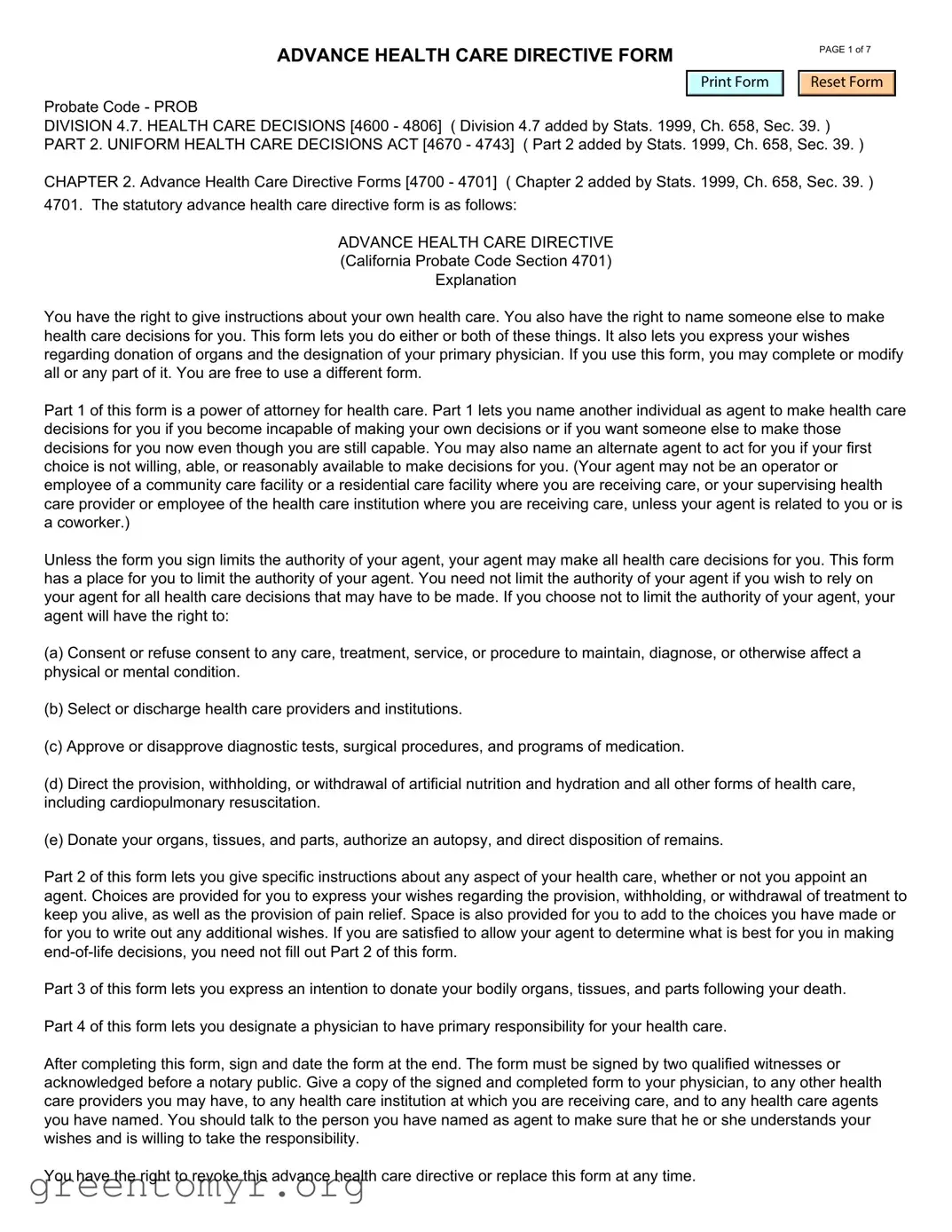
The California Advanced Health Care Directive is an essential document that allows individuals to express their healthcare preferences in advance, ensuring that their wishes are honored in times of medical uncertainty. This directive combines two key components: a power of attorney for healthcare and a living will. Through this form, individuals can appoint a trusted person, known as an agent, to make medical decisions on their behalf if they become unable to do so. Additionally, the directive provides an opportunity to outline specific treatment preferences, including the use of life-sustaining measures, pain management, and end-of-life care. By completing this form, individuals gain peace of mind, knowing that their healthcare choices reflect their values and beliefs. It is important to understand that this document can be modified at any time, allowing for changes in preferences as circumstances evolve. Ultimately, the California Advanced Health Care Directive empowers individuals to take control of their healthcare journey, fostering a sense of autonomy and dignity during challenging times.

ADVANCE HEALTH CARE DIRECTIVE FORM |
|
PAGE 1 of 7 |
|
|
|
|
|
|
|
|
|
|
Print Form |
|
Reset Form |
Probate Code - PROB
DIVISION 4.7. HEALTH CARE DECISIONS [4600 - 4806] ( Division 4.7 added by Stats. 1999, Ch. 658, Sec. 39. ) PART 2. UNIFORM HEALTH CARE DECISIONS ACT [4670 - 4743] ( Part 2 added by Stats. 1999, Ch. 658, Sec. 39. )
CHAPTER 2. Advance Health Care Directive Forms [4700 - 4701] ( Chapter 2 added by Stats. 1999, Ch. 658, Sec. 39. )
4701. The statutory advance health care directive form is as follows:
ADVANCE HEALTH CARE DIRECTIVE
(California Probate Code Section 4701)
Explanation
You have the right to give instructions about your own health care. You also have the right to name someone else to make health care decisions for you. This form lets you do either or both of these things. It also lets you express your wishes regarding donation of organs and the designation of your primary physician. If you use this form, you may complete or modify all or any part of it. You are free to use a different form.
Part 1 of this form is a power of attorney for health care. Part 1 lets you name another individual as agent to make health care decisions for you if you become incapable of making your own decisions or if you want someone else to make those decisions for you now even though you are still capable. You may also name an alternate agent to act for you if your first choice is not willing, able, or reasonably available to make decisions for you. (Your agent may not be an operator or employee of a community care facility or a residential care facility where you are receiving care, or your supervising health care provider or employee of the health care institution where you are receiving care, unless your agent is related to you or is a coworker.)
Unless the form you sign limits the authority of your agent, your agent may make all health care decisions for you. This form has a place for you to limit the authority of your agent. You need not limit the authority of your agent if you wish to rely on your agent for all health care decisions that may have to be made. If you choose not to limit the authority of your agent, your agent will have the right to:
(a)Consent or refuse consent to any care, treatment, service, or procedure to maintain, diagnose, or otherwise affect a physical or mental condition.
(b)Select or discharge health care providers and institutions.
(c)Approve or disapprove diagnostic tests, surgical procedures, and programs of medication.
(d)Direct the provision, withholding, or withdrawal of artificial nutrition and hydration and all other forms of health care, including cardiopulmonary resuscitation.
(e)Donate your organs, tissues, and parts, authorize an autopsy, and direct disposition of remains.
Part 2 of this form lets you give specific instructions about any aspect of your health care, whether or not you appoint an agent. Choices are provided for you to express your wishes regarding the provision, withholding, or withdrawal of treatment to keep you alive, as well as the provision of pain relief. Space is also provided for you to add to the choices you have made or for you to write out any additional wishes. If you are satisfied to allow your agent to determine what is best for you in making
Part 3 of this form lets you express an intention to donate your bodily organs, tissues, and parts following your death.
Part 4 of this form lets you designate a physician to have primary responsibility for your health care.
After completing this form, sign and date the form at the end. The form must be signed by two qualified witnesses or acknowledged before a notary public. Give a copy of the signed and completed form to your physician, to any other health care providers you may have, to any health care institution at which you are receiving care, and to any health care agents you have named. You should talk to the person you have named as agent to make sure that he or she understands your wishes and is willing to take the responsibility.
You have the right to revoke this advance health care directive or replace this form at any time.

ADVANCE HEALTH CARE DIRECTIVE FORM
PAGE 2 of 7
PART 1
POWER OF ATTORNEY FOR HEALTH CARE
(1.1) DESIGNATION OF AGENT: I designate the following individual as my agent to make health care decisions for me:
(name of individual you choose as agent)
(address) |
(city) |
(state) |
(ZIP Code) |
||
|
|
|
|
|
|
(home phone) |
(work phone) |
|
|
||
OPTIONAL: If I revoke my agent's authority or if my agent is not willing, able, or reasonably available to make a health care decision for me, I designate as my first alternate agent:
(name of individual you choose as first alternate agent)
(address) |
(city) |
(state) |
(ZIP Code) |
||
|
|
|
|
|
|
(home phone) |
(work phone) |
|
|
||
OPTIONAL: If I revoke the authority of my agent and first alternate agent or if neither is willing, able, or reasonably available to make a health care decision for me, I designate as my second alternate agent:
(name of individual you choose as second alternate agent)
(address) |
(city) |
(state) |
(ZIP Code) |
||
|
|
|
|
|
|
(home phone) |
(work phone) |
|
|
||
(1.2) AGENT'S AUTHORITY: My agent is authorized to make all health care decisions for me, including decisions to provide, withhold, or withdraw artificial nutrition and hydration and all other forms of health care to keep me alive, except as I state here:
(Add additional sheets if needed.)
(1.3) WHEN AGENT'S AUTHORITY BECOMES EFFECTIVE: My agent's authority becomes effective when my primary physician determines that I am unable to make my own health care decisions unless I mark the following box.
If I mark this box , my agent's authority to make health care decisions for me takes effect immediately.

ADVANCE HEALTH CARE DIRECTIVE FORM
PAGE 3 of 7
(1.4.) AGENT'S OBLIGATION: My agent shall make health care decisions for me in accordance with this power of attorney for health care, any instructions I give in Part 2 of this form, and my other wishes to the extent known to my agent. To the extent my wishes are unknown, my agent shall make health care decisions for me in accordance with what my agent determines to be in my best interest. In determining my best interest, my agent shall consider my personal values to the extent known to my agent.
(1.5) AGENT'S POSTDEATH AUTHORITY: My agent is authorized to donate my organs, tissues, and parts, authorize an autopsy, and direct disposition of my remains, except as I state here or in Part 3 of this form:
:
(Add additional sheets if needed.)
(1.6) NOMINATION OF CONSERVATOR: If a conservator of my person needs to be appointed for me by a court, I nominate the agent designated in this form. If that agent is not wiling, able, or reasonably available to act as conservator, I nominate the alternate agents whom I have named, in the order designated.
PART 2
INSTRUCTIONS FOR HEALTH CARE
If you fill out this part of the form, you may strike any wording you do not want.
(2.1)
(a) Choice Not to Prolong Life
I do not want my life to be prolonged if (1) I have an incurable and irreversible condition that will result in my death within a relatively short time, (2) I become unconscious and, to a reasonable degree of medical certainty, I will not regain consciousness, or (3) the likely risks and burdens of treatment would outweigh the expected benefits, OR
(b) Choice to Prolong Life
I want my life to be prolonged as long as possible within the limits of generally accepted health care standards.
(2.2) RELIEF FROM PAIN: Except as I state in the following space, I direct that treatment for alleviation of pain or discomfort be provided at all times, even if it hastens my death:
(Add additional sheets if needed.)
(2.3) OTHER WISHES: (If you do not agree with any of the optional choices above and wish to write your own, or if you wish to add to the instructions you have given above, you may do so here.) I direct that:
(Add additional sheets if needed.)

|
ADVANCE HEALTH CARE DIRECTIVE FORM |
PAGE 4 of 7 |
|
|
|
|
|
|
|
PART 3 |
|
|
DONATION OF ORGANS, TISSUES, AND PARTS AT DEATH |
|
|
(OPTIONAL) |
|
(3.1) |
Upon my death, I give my organs, tissues, and parts (mark box to indicate yes). |
|
By checking the box above, and notwithstanding my choice in Part 2 of this form, I authorize my agent to consent to any temporary medical procedure necessary solely to evaluate and/or maintain my organs, tissues, and/or parts for purposes of donation.
My donation is for the following purposes (strike any of the following you do not want):
(a)Transplant
(b)Therapy
(c)Research
(d)Education
If you want to restrict your donation of an organ, tissue, or part in some way, please state your restriction on the following lines:
If I leave this part blank, it is not a refusal to make a donation. My
PART 4
PRIMARY PHYSICIAN
(OPTIONAL)
(4.1) I designate the following physician as my primary physician:
(name of physician)
(address) |
(city) |
(state) |
(ZIP Code) |
(phone)
OPTIONAL: If the physician I have designated above is not willing, able, or reasonably available to act as my primary physician, I designate the following physician as my primary physician:
(name of physician)
(address) |
(city) |
(state) |
(ZIP Code) |
(phone)

ADVANCE HEALTH CARE DIRECTIVE FORM
PART 5
PAGE 5 of 7
(5.1) EFFECT OF COPY: A copy of this form has the same effect as the original.
(5.2) SIGNATURE: Sign and date the form here:
(date) |
(sign your name) |
(address) |
(print your name) |
(city) (state)
(5.3) STATEMENT OF WITNESSES: I declare under penalty of perjury under the laws of California (1) that the individual who signed or acknowledged this advance health care directive is personally known to me, or that the individual's identity was proven to me by convincing evidence (2) that the individual signed or acknowledged this advance directive in my presence, (3) that the individual appears to be of sound mind and under no duress, fraud, or undue influence, (4) that I am not a person appointed as agent by this advance directive, and (5) that I am not the individual's health care provider, an employee of the individual's health care provider, the operator of a community care facility, an employee of an operator of a community care facility, the operator of a residential care facility for the elderly, nor an employee of an operator of a residential care facility for the elderly.
First witness |
Second witness |
(print name)
(address)
(city)(state)
(print name)
(address)
(city)(state)
(signature of witness) |
(signature of witness) |
(date) |
(date) |
(5.4) ADDITIONAL STATEMENT OF WITNESSES: At least one of the above witnesses must also sign the following declaration:
I further declare under penalty of perjury under the laws of California that I am not related to the individual executing this advance health care directive by blood, marriage, or adoption, and to the best of my knowledge, I am not entitled to any part of the individual's estate upon his or her death under a will now existing or by operation of law.
(signature of witness) |
(signature of witness) |

ADVANCE HEALTH CARE DIRECTIVE FORM |
PAGE 6 of 7 |
|
PART 6
SPECIAL WITNESS REQUIREMENT
(6.1) The following statement is required only if you are a patient in a skilled nursing
STATEMENT OF PATIENT ADVOCATE OR OMBUDSMAN
I declare under penalty of perjury under the laws of California that I am a patient advocate or ombudsman as designated by the State Department of Aging and that I am serving as a witness as required by Section 4675 of the Probate Code.
(date) |
(sign your name) |
(address) |
(print your name) |
(city) (state) |
|
(Amended by Stats. 2018, Ch. 287, Sec. 1. (AB 3211) Effective January 1, 2019.)

ADVANCE HEALTH CARE DIRECTIVE FORM
PAGE 7 of 7
ACKNOWLEDGMENT
A notary public or other officer completing this certificate verifies only the identity of the individual who signed the document to which this certificate is attached, and not the truthfulness, accuracy, or validity of that document.
State of California,
County of
On |
before me, |
(insert name and title of officer)
personally appeared
who proved to me on the basis of satisfactory evidence to be the person(s) whose name(s) is/are subscribed to the within instrument and acknowledged to me that he/she/they executed the same in his/her/their authorized capacity(ies), and that by his/her/their signature(s) on the instrument the person(s), or the entity upon behalf of which the person
(s) acted, executed the instrument.
I certify under PENALTY OF PERJURY under the laws of the State of California that the foregoing paragraph is true and correct.
WITNESS my hand and official seal.
Signature |
|
(SEAL) |
|
|
|
| Fact Name | Details |
|---|---|
| Purpose | The California Advanced Health Care Directive allows individuals to outline their healthcare preferences and appoint an agent to make medical decisions on their behalf if they become unable to do so. |
| Governing Law | This form is governed by the California Probate Code, specifically Sections 4600-4800. |
| Agent Appointment | Individuals can designate one or more agents to make healthcare decisions, ensuring their wishes are respected even when they cannot communicate them. |
| Revocation | The directive can be revoked at any time by the individual, as long as they are still capable of making decisions. |
| Witness Requirements | Two witnesses or a notary public must sign the directive to ensure its validity, helping to confirm the individual’s intentions. |
Filling out the California Advanced Health Care Directive form is an important step in planning for your future health care needs. Once you complete the form, it will help ensure that your medical preferences are understood and respected when you are unable to communicate them yourself.
A California Advanced Health Care Directive is a legal document that allows you to outline your healthcare preferences in advance. It lets you specify what medical treatments you want or do not want if you become unable to communicate your wishes. This document also enables you to appoint someone you trust to make healthcare decisions on your behalf when you are unable to do so.
Creating an Advanced Health Care Directive ensures that your healthcare wishes are known and respected. It can relieve your loved ones from making difficult decisions during emotional times. By clearly stating your preferences, you help guide your family and medical providers in making choices that align with your values and beliefs.
You can appoint any adult you trust as your healthcare agent. This could be a family member, friend, or someone else who understands your values and wishes regarding medical treatment. It’s important to choose someone who will advocate for you and respect your decisions.
Your healthcare agent can make a variety of medical decisions on your behalf, including:
However, your agent must act in accordance with your wishes as expressed in the directive.
No, you do not need a lawyer to create an Advanced Health Care Directive in California. The form is designed to be user-friendly, and you can complete it on your own. However, if you have specific legal questions or complex situations, consulting a lawyer may be beneficial.
To ensure your directive is valid, follow these steps:
Make sure to keep the original document in a safe but accessible place.
Yes, you can change or revoke your Advanced Health Care Directive at any time as long as you are mentally competent. To make changes, simply complete a new directive and distribute it to your healthcare agent and providers. To revoke an existing directive, inform your agent and destroy the document.
If you do not have an Advanced Health Care Directive and become unable to communicate your wishes, medical decisions will be made by your family members or healthcare providers according to California law. This may lead to disagreements among family members about your care. Having a directive helps avoid confusion and ensures your preferences are followed.
Filling out the California Advanced Health Care Directive form is an important step in ensuring that your healthcare wishes are respected. However, many individuals make common mistakes that can lead to confusion or complications later on. Understanding these pitfalls can help you navigate the process more smoothly.
One frequent mistake is not being specific enough about medical preferences. When detailing your wishes regarding treatments or interventions, vague language can lead to misunderstandings. For instance, stating that you want “everything done” may not convey your true intentions. Instead, consider clearly outlining the types of treatments you would or would not want in various scenarios.
Another common error is failing to appoint an appropriate agent. Your agent is the person who will make healthcare decisions on your behalf if you are unable to do so. It’s crucial to choose someone who understands your values and preferences. Additionally, some people forget to discuss their wishes with their chosen agent. This conversation is vital to ensure that your agent is prepared to advocate for you.
Many individuals also overlook the importance of signing and dating the form correctly. In California, the directive must be signed by you, and if you are unable to sign, it must be witnessed or notarized according to state requirements. Neglecting these steps can render the document invalid, which defeats its purpose.
Another mistake is not reviewing or updating the directive regularly. Life circumstances change, and so do personal preferences. Failing to revisit the document can lead to outdated instructions that no longer reflect your wishes. It’s advisable to review your directive every few years or after significant life events, such as marriage, divorce, or a serious health diagnosis.
Lastly, many people forget to distribute copies of their completed directive. Simply filling out the form is not enough; it’s essential to share it with your healthcare provider, family members, and your appointed agent. This ensures that everyone involved is aware of your wishes and can act accordingly when the time comes.
By being mindful of these common mistakes, you can create a California Advanced Health Care Directive that truly reflects your healthcare preferences and provides peace of mind for you and your loved ones.
The California Advanced Health Care Directive form is an essential document that allows individuals to express their medical care preferences and designate someone to make healthcare decisions on their behalf if they become unable to do so. It is often used in conjunction with other important legal documents that further clarify an individual's wishes regarding health and financial matters. Below is a list of related forms and documents that can be beneficial in ensuring comprehensive planning.
Having these documents in place can provide peace of mind for both you and your loved ones. They serve as a roadmap for making difficult decisions during challenging times, ensuring that your preferences are honored and that your family is supported in navigating your healthcare and financial matters.
When filling out the California Advanced Health Care Directive form, it's important to follow certain guidelines. Here are ten things you should and shouldn't do:
The California Advanced Health Care Directive (AHCD) is an important document that allows individuals to express their healthcare preferences in advance. However, several misconceptions surround this form, which can lead to confusion and misunderstanding. Here are six common misconceptions:
This is not true. Anyone over the age of 18 can create an AHCD. Health care decisions may need to be made at any age, and having a directive ensures that your wishes are known.
An AHCD is not a will. While a will addresses the distribution of your assets after death, an AHCD focuses on your medical care preferences during your lifetime, particularly when you cannot communicate them.
This misconception is false. You can change or revoke your AHCD at any time as long as you are mentally competent. It’s essential to review your directive periodically, especially after significant life changes.
While many people associate AHCDs with end-of-life care, they can also address a wide range of medical treatments and preferences, including decisions about life-sustaining treatments, organ donation, and more.
Health care providers may not be aware of your preferences unless you have communicated them clearly through an AHCD. It’s crucial to share this document with your healthcare team and loved ones.
While the form can seem daunting, it is designed to be user-friendly. Many resources are available to help you understand the options and complete the directive accurately.
Understanding these misconceptions can empower individuals to take charge of their health care decisions and ensure their preferences are respected when it matters most.
The California Advanced Health Care Directive form is an important document that allows individuals to express their medical care preferences in advance. Here are some key takeaways to consider when filling out and using this form: