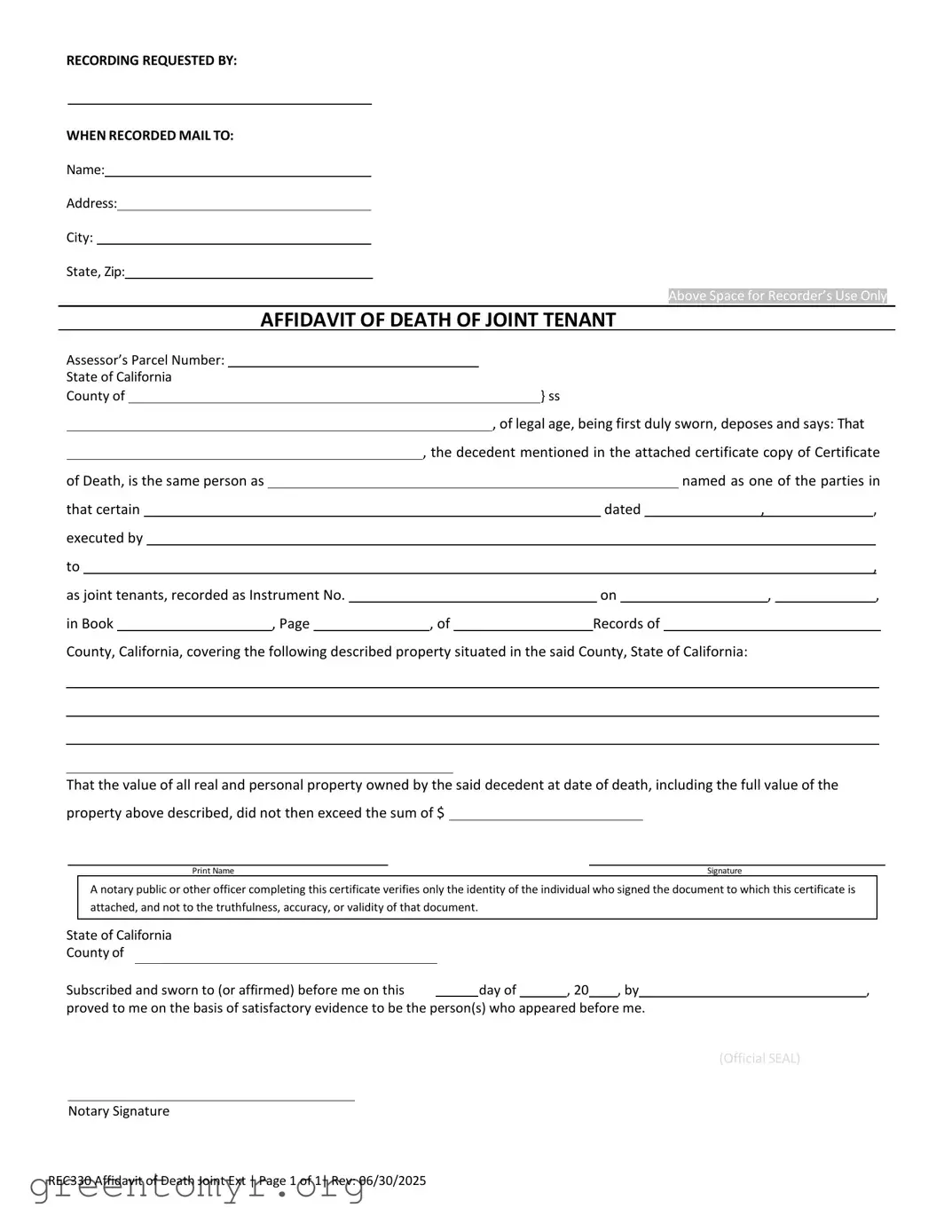
The California Death of a Joint Tenant Affidavit is a crucial document for individuals dealing with the transfer of property ownership following the death of a joint tenant. This form serves as a formal declaration that one of the joint tenants has passed away, allowing the surviving tenant to claim full ownership of the property without the need for probate. It simplifies the process of transferring property rights, ensuring that the surviving tenant can efficiently manage the estate and its associated responsibilities. Typically, this affidavit includes essential information such as the names of the deceased and surviving joint tenants, the date of death, and details about the property in question. By providing a clear and legally recognized method to assert ownership, the affidavit not only protects the interests of the surviving tenant but also helps prevent potential disputes among heirs. Understanding the significance and requirements of this form is vital for anyone navigating the complexities of joint tenancy and estate management in California.

RECORDING REQUESTED BY:
WHEN RECORDED MAIL TO:
Name:
Address:
City:
State, Zip:
Above Space for Recorder’s Use Only
|
|
|
|
|
|
|
AFFIDAVIT OF DEATH OF JOINT TENANT |
|
|
|
|
|
|||||||||||||||
|
Assessor’s Parcel Number: |
|
|
|
|
|
|
|
|
|
|
|
|
|
|
|
|
|
|
|
|
|
|||||
|
State of California |
|
|
|
|
|
|
|
|
|
|
|
|
|
|
|
|
|
|
|
|
|
|||||
|
County of |
|
|
|
|
|
|
|
|
|
|
} ss |
|
|
|
|
|
||||||||||
|
|
|
|
|
|
|
|
|
|
|
|
|
|
|
, of legal age, being first duly sworn, deposes and says: That |
|
|
||||||||||
|
|
|
|
|
|
|
|
|
|
|
, the decedent mentioned in the attached certificate copy of Certificate |
||||||||||||||||
|
of Death, is the same person as |
|
|
|
|
|
|
|
|
|
|
|
|
named as one of the parties in |
|||||||||||||
|
that certain |
|
|
|
|
|
|
|
|
|
|
|
|
|
dated |
|
, |
|
|
, |
|
||||||
|
executed by |
|
|
|
|
|
|
|
|
|
|
|
|
|
|
|
|
|
|
|
|
|
|
||||
|
to |
|
|
|
|
|
|
|
|
|
|
|
|
|
|
|
|
|
|
|
|
, |
|
||||
|
|
|
|
|
|
|
|
|
|
|
|
|
|
|
|
|
|
|
|
|
|
||||||
|
as joint tenants, recorded as Instrument No. |
|
|
|
|
|
|
|
|
on |
|
|
, |
|
, |
|
|||||||||||
|
in Book |
|
|
, Page |
|
|
, of |
|
|
|
Records of |
|
|
|
|
|
|||||||||||
|
|
|
|
|
|
|
|
|
|
|
|
|
|
|
|
|
|
|
|
|
|
|
|
|
|
|
|
County, California, covering the following described property situated in the said County, State of California:
That the value of all real and personal property owned by the said decedent at date of death, including the full value of the property above described, did not then exceed the sum of $
Print Name |
|
Signature |
A notary public or other officer completing this certificate verifies only the identity of the individual who signed the document to which this certificate is attached, and not to the truthfulness, accuracy, or validity of that document.
State of California
County of
Subscribed and sworn to (or affirmed) before me on this day of , 20 , by,
proved to me on the basis of satisfactory evidence to be the person(s) who appeared before me.
(Official SEAL)
Notary Signature
REC330 Affidavit of Death Joint Ext | Page 1 of 1| Rev: 06/30/2025
| Fact Name | Description |
|---|---|
| Purpose | The affidavit is used to establish the death of a joint tenant in California. |
| Governing Law | California Probate Code Section 5600 governs the transfer of property upon the death of a joint tenant. |
| Eligibility | Only the surviving joint tenant can file the affidavit after the death of the other joint tenant. |
| Required Information | The affidavit must include the name of the deceased joint tenant, the date of death, and the property details. |
| Filing Location | The affidavit is typically filed with the county recorder's office where the property is located. |
| Signature Requirement | The surviving joint tenant must sign the affidavit in the presence of a notary public. |
| Supporting Documents | A certified copy of the death certificate is usually required to accompany the affidavit. |
| Effect on Property | Upon filing, the property automatically transfers to the surviving joint tenant without going through probate. |
| Legal Advice | Consulting an attorney is recommended to ensure all legal requirements are met. |
Completing the California Death of a Joint Tenant Affidavit form is an important step in managing the affairs of a deceased joint tenant. After filling out the form, it will need to be submitted to the appropriate county office, along with any required documentation, to ensure that the property title is updated accordingly.
The California Death of a Joint Tenant Affidavit form is a legal document used to transfer ownership of property when one joint tenant passes away. This form serves as proof of the death and facilitates the transfer of the deceased tenant's interest in the property to the surviving joint tenant(s). It simplifies the process of transferring property without the need for probate, provided the property was held in joint tenancy.
This form is intended for use by surviving joint tenants of a property. If you are a joint tenant and your co-tenant has died, you can complete and file this affidavit to establish your sole ownership of the property. It is important to ensure that the property was indeed held in joint tenancy, as this form is not applicable to other forms of ownership.
To complete the affidavit, you will need to provide the following information:
Additionally, the affidavit must be signed under penalty of perjury, affirming that the information provided is true and correct.
The completed California Death of a Joint Tenant Affidavit should be filed with the county recorder's office in the county where the property is located. This filing serves to officially document the change in ownership and update public records accordingly. It is advisable to keep a copy of the filed affidavit for your records.
Yes, there is typically a filing fee when submitting the affidavit to the county recorder's office. The fee may vary by county, so it is recommended to check with your local recorder's office for the exact amount. Additionally, there may be costs associated with obtaining certified copies of the affidavit, if needed.
If there are multiple joint tenants and one of them passes away, the surviving joint tenants can use the affidavit to confirm their continued ownership of the property. Each surviving joint tenant may need to sign the affidavit, depending on the circumstances. If there are any disputes among the surviving tenants regarding the ownership or the deceased tenant's estate, it may be necessary to seek legal counsel.
No, the California Death of a Joint Tenant Affidavit is specifically designed for properties held in joint tenancy. If the property is held in a different form of ownership, such as tenancy in common or community property, this affidavit would not be appropriate. In such cases, it may be necessary to consult with a legal professional to determine the appropriate steps for transferring ownership after a joint tenant's death.
Filling out the California Death of a Joint Tenant Affidavit form can be a straightforward process, but many people make common mistakes that can lead to delays or complications. One frequent error is failing to provide accurate information about the deceased joint tenant. It’s essential to include the correct name, date of death, and any other identifying details. Inaccuracies can result in the affidavit being rejected.
Another mistake is neglecting to sign the affidavit. This may seem obvious, but many individuals forget to sign or mistakenly assume that a signature is not necessary. Without a signature, the affidavit holds no legal weight, and it cannot be processed.
People often overlook the requirement for notarization. The affidavit must be notarized to be valid. Skipping this step can invalidate the document and lead to further complications. Always ensure that a notary public is available to witness the signing of the affidavit.
Additionally, some individuals fail to include supporting documentation. It’s important to attach any necessary documents, such as a death certificate, to substantiate the claims made in the affidavit. Omitting these documents can delay the processing time or even result in rejection.
Another common mistake is not checking for consistency in the details provided. Discrepancies between the affidavit and other legal documents, such as wills or property titles, can raise questions. Ensure that all information aligns to avoid confusion.
Lastly, people sometimes misunderstand the implications of the affidavit. This document serves to transfer ownership of the deceased joint tenant's property to the surviving tenant. Failing to grasp this can lead to unintended consequences, especially if there are other heirs or beneficiaries involved. Understanding the purpose of the affidavit is crucial for a smooth transition of property ownership.
The California Death of a Joint Tenant Affidavit is an important document used to transfer property ownership after the death of a joint tenant. Several other forms and documents often accompany this affidavit to ensure a smooth transition of property rights. Below is a list of these documents, along with a brief description of each.
Gathering these documents is crucial for a successful property transfer. Each form plays a significant role in ensuring that the process is handled efficiently and legally. Be sure to review all requirements carefully to avoid any delays.
The California Death of a Joint Tenant Affidavit form is an important legal document used to establish the transfer of property ownership when one joint tenant passes away. Several other documents serve similar purposes in different contexts. Here are six documents that share similarities:
When filling out the California Death of a Joint Tenant Affidavit form, it is important to follow specific guidelines to ensure accuracy and compliance. Below is a list of things you should and shouldn't do.
This is not true. While the affidavit is commonly used for real estate, it can also apply to other assets held in joint tenancy, such as bank accounts or personal property. It serves as a formal declaration of the death of one joint tenant and facilitates the transfer of ownership to the surviving tenant.
Many people believe that the affidavit needs to be submitted to a court. In fact, it is typically not required to be filed with the court. Instead, the document is presented to the institution or entity that holds the asset, such as a bank or title company, to effectuate the transfer.
This is a common misunderstanding. The affidavit only requires the signature of the surviving joint tenant. The deceased tenant's signature is not needed, as they are no longer able to provide consent.
While it may seem straightforward, the affidavit should be completed by the surviving joint tenant or an authorized representative. This ensures that the information is accurate and that the person signing has the legal authority to do so.
This is an important point to clarify. The affidavit does not replace the need for a will. It only addresses the transfer of assets held in joint tenancy. A comprehensive estate plan, including a will, is still necessary to manage other assets and ensure that all wishes are honored after death.
The California Death of a Joint Tenant Affidavit form is an important document for individuals dealing with the death of a joint tenant. Understanding its key aspects can simplify the process of transferring property ownership. Here are six essential takeaways:
By keeping these takeaways in mind, individuals can navigate the process of using the California Death of a Joint Tenant Affidavit more effectively.