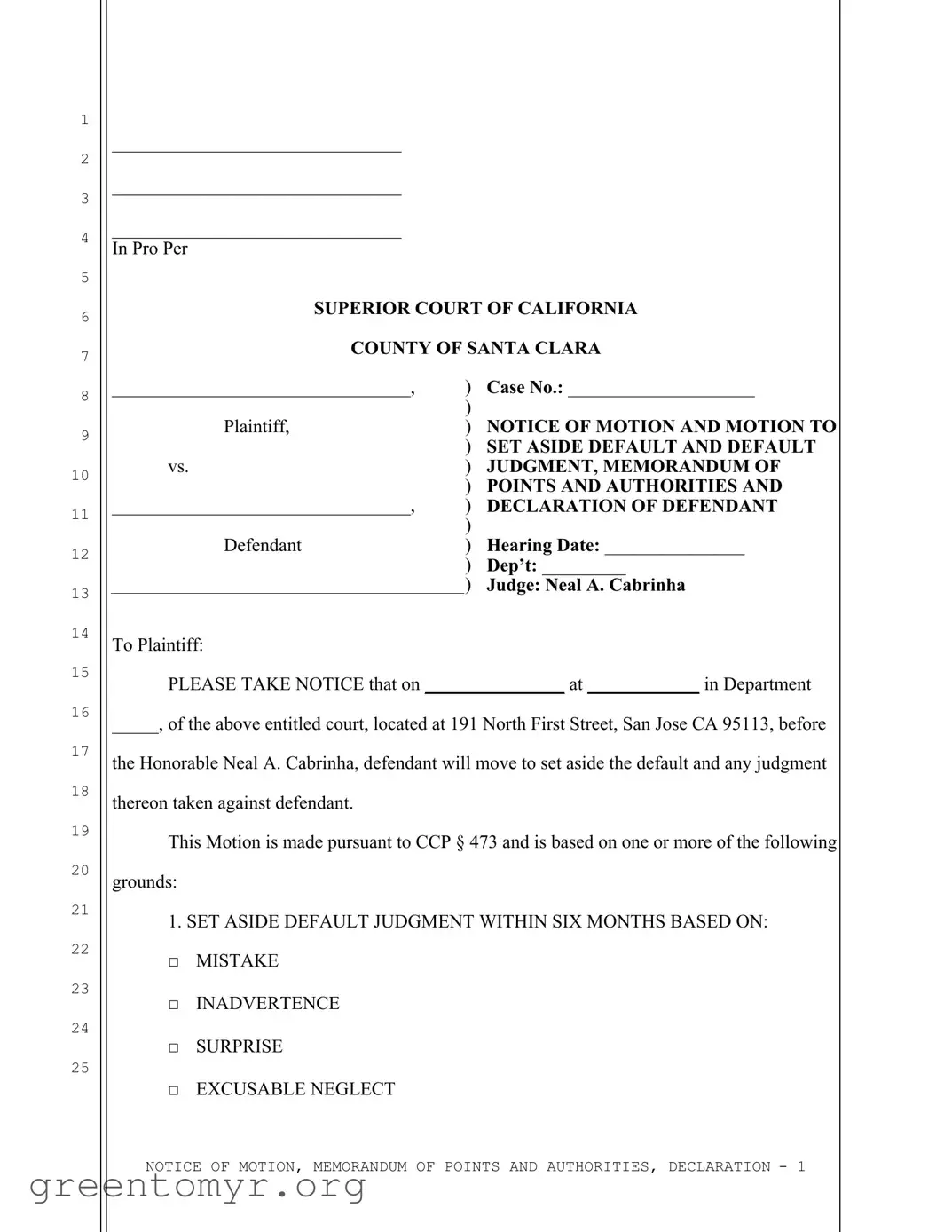
The California Motion Set Aside form serves as a vital tool for defendants seeking to challenge a default judgment that may have been entered against them. This form enables individuals to request that the court set aside a default and any associated judgments, allowing them a chance to present their case. It is particularly significant for those who may have missed deadlines due to reasons such as mistake, inadvertence, surprise, or excusable neglect. When filling out the form, defendants must provide specific information, including the case number, hearing date, and the grounds for their request. The legal framework for this motion is found in California Code of Civil Procedure Section 473, which emphasizes the importance of ensuring that cases are resolved based on their merits rather than procedural missteps. To support their motion, defendants typically attach a declaration outlining the reasons for their failure to respond in a timely manner, along with a proposed answer or other pleading. By utilizing this form, defendants can take proactive steps to rectify their situation and engage meaningfully in the legal process.

1
2
3
4
5
6
7
8
9
10
11
12
13
14
15
16
17
18
19
20
21
22
23
24
25
_______________________________
_______________________________
_______________________________
In Pro Per
SUPERIOR COURT OF CALIFORNIA
COUNTY OF SANTA CLARA
________________________________, |
) |
Case No.: ____________________ |
|
) |
|
Plaintiff, |
) |
NOTICE OF MOTION AND MOTION TO |
|
) SET ASIDE DEFAULT AND DEFAULT |
|
vs. |
) |
JUDGMENT, MEMORANDUM OF |
|
) POINTS AND AUTHORITIES AND |
|
________________________________, |
) |
DECLARATION OF DEFENDANT |
|
) |
|
Defendant |
) |
Hearing Date: _______________ |
|
) |
Dep’t: _________ |
|
) Judge: Neal A. Cabrinha |
|
To Plaintiff:
PLEASE TAKE NOTICE that on _______________ at ____________ in Department
_____, of the above entitled court, located at 191 North First Street, San Jose CA 95113, before
the Honorable Neal A. Cabrinha, defendant will move to set aside the default and any judgment thereon taken against defendant.
This Motion is made pursuant to CCP § 473 and is based on one or more of the following grounds:
1. SET ASIDE DEFAULT JUDGMENT WITHIN SIX MONTHS BASED ON:
□MISTAKE
□INADVERTENCE
□SURPRISE
□EXCUSABLE NEGLECT
NOTICE OF MOTION, MEMORANDUM OF POINTS AND AUTHORITIES, DECLARATION - 1

1
2
3
4
5
6
7
8
9
10
11
12
13
14
15
16
17
18
19
20
21
22
23
24
25
This Motion is based on the Memorandum of Points and Authorities and the Declaration of
________________________ which follow, and on all of the pleadings, records, and files in this
action.
Dated:
By:
In Pro Per
MEMORANDUM OF POINTS AND AUTHORITIES
Code of Civil Procedure Section 473 (b) states in relevant part:
The court may, upon any terms as may be just, relieve a party of his or her legal representative from a judgment, dismissal, order, or other proceeding taken against him taken against him or her through his or her mistake, inadvertence, surprise or excusable neglect. Application for this relief shall be accompanied by a copy of the answer or other pleading proposed to be filed therein, . . .
and shall be made within a reasonable time, in no case exceeding six months, after the judgment, order or proceeding was taken.
In the present case, defendant did not file a timely response to the complaint for the
reasons stated in the attached declaration. The policy of the law is to have every case tried on its
merits and that policy views with disfavor a party who, regardless of the merits, attempts to take
advantage of the mistake, inadvertence, or neglect of his adversary. This policy is so strong that
“any doubts in applying section 473 must be resolved in favor of the party seeking relief from
default.” Elston v. City of Turlock (1985) 38 Cal.3d 227, 233; Slusher v. Durrer (1977) 69 Cal.
App. 3d 747, 753.
For the reasons stated in this Memorandum and in the attached Declaration, the
court should set aside the default and any judgment thereon taken against defendant.
NOTICE OF MOTION, MEMORANDUM OF POINTS AND AUTHORITIES, DECLARATION - 2

1
2
3
4
5
6
7
8
9
10
11
12
13
14
15
16
17
18
19
20
21
22
23
24
25
DECLARATION OF DEFENDANT
I, _______________________________, declare:
I am the Defendant in this action. I have personal knowledge of the matters discussed below and, if called as a witness, I could competently testify to them. I did not file a timely response to
the complaint in this action for the following reason(s):
______________________________________________________________________________
______________________________________________________________________________
______________________________________________________________________________
______________________________________________________________________________
______________________________________________________________________________
______________________________________________________________________________
______________________________________________________________________________
______________________________________________________________________________
______________________________________________________________________________
______________________________________________________________________________
______________________________________________________________________________
______________________________________________________________________________
I declare under penalty of perjury under the laws of the State of California that the foregoing is true and correct.
Dated:By:
In Pro Per
NOTICE OF MOTION, MEMORANDUM OF POINTS AND AUTHORITIES, DECLARATION - 3
| Fact Name | Description |
|---|---|
| Governing Law | The California Motion Set Aside form is governed by California Code of Civil Procedure Section 473. |
| Time Limit | A motion to set aside a default judgment must be filed within six months of the judgment being entered. |
| Grounds for Motion | Common grounds for filing this motion include mistake, inadvertence, surprise, or excusable neglect. |
| Filing Requirements | The motion must be accompanied by a copy of the proposed answer or pleading to be filed. |
| Policy Favoring Trials | The legal policy encourages cases to be tried on their merits, favoring the party seeking relief from default. |
| Declaration Requirement | The defendant must provide a declaration explaining the reasons for not responding to the complaint in a timely manner. |
| Judicial Discretion | The court has discretion to grant relief from a judgment, dismissing the case based on the circumstances presented. |
Completing the California Motion Set Aside form is a crucial step if you want to challenge a default judgment against you. After filling out this form, you will need to file it with the court and attend a hearing where you can present your case. Here’s how to fill out the form step-by-step.
After completing the form, you will need to file it with the court and serve a copy to the plaintiff. Be sure to keep track of any deadlines and prepare for your hearing by gathering any necessary documents or evidence to support your case.
A Motion to Set Aside Default is a legal request made by a defendant in a civil case to have a court overturn a default judgment. This situation arises when the defendant fails to respond to a complaint within the required time frame. In California, this motion can be filed under specific grounds such as mistake, inadvertence, surprise, or excusable neglect. The goal is to allow the defendant a chance to present their case in court, rather than being judged solely based on their failure to respond.
In California, a defendant has a maximum of six months to file a Motion to Set Aside Default after the judgment has been entered. This time frame is critical. If you miss this deadline, you may lose your opportunity to challenge the default judgment. Therefore, it is essential to act promptly and gather all necessary documentation to support your motion within this period.
The grounds for filing a Motion to Set Aside Default include:
Each of these grounds must be clearly articulated in the motion and supported by evidence, such as personal declarations or relevant documents.
When filing a Motion to Set Aside Default, you must include several key documents:
Including these documents helps establish the legitimacy of your request and supports your case for having the default judgment set aside.
Yes, individuals can represent themselves in court, a process known as "pro per" representation. However, while it is permissible, it can be complex and challenging. Understanding court procedures and legal standards is crucial for effectively presenting your motion. If possible, seeking assistance from a legal professional or paralegal can provide valuable guidance and increase your chances of success.
Filling out the California Motion Set Aside form can be a daunting task, and many individuals make mistakes that can hinder their chances of success. One common error is failing to provide a clear and compelling reason for the motion. Simply stating "mistake" or "surprise" without elaboration does not provide the court with sufficient information. It's crucial to explain the circumstances surrounding the default clearly. This helps the court understand the context and may increase the likelihood of a favorable outcome.
Another mistake is not filing the motion within the required six-month timeframe. The law is strict about deadlines, and missing this window can result in the court denying the request outright. Individuals should mark their calendars and ensure they submit their motion promptly. This attention to detail can make all the difference in the outcome of their case.
In addition, many people overlook the importance of including a proposed answer or other pleading with their motion. This requirement is not merely a formality; it demonstrates to the court that the defendant is serious about contesting the original complaint. Without this documentation, the motion may appear incomplete and could be rejected.
Another frequent error is neglecting to sign the declaration. The declaration serves as a sworn statement of the facts and is a critical part of the motion. If the declaration is unsigned, it can lead to delays or even dismissal of the motion. Always double-check to ensure that all necessary signatures are present before submitting the form.
Additionally, some individuals fail to provide sufficient personal knowledge in their declarations. The court requires that the defendant has firsthand knowledge of the facts they are presenting. Vague statements or hearsay can weaken the motion. It's essential to be specific and honest about the reasons for the default.
Another pitfall is not addressing the opposing party properly. The notice of motion must be served to the plaintiff, and failing to do so can result in procedural issues. Ensuring that all parties are correctly notified is vital to the process and helps maintain the integrity of the legal proceedings.
Lastly, many applicants forget to review their entire motion for clarity and accuracy. Typos, grammatical errors, or unclear language can distract from the substance of the motion. Taking the time to proofread can enhance the professionalism of the document and improve the chances of a successful outcome. A well-prepared motion reflects diligence and respect for the court's time and resources.
The California Motion Set Aside form is often accompanied by several other documents that support the motion and provide necessary information to the court. Each of these documents plays a crucial role in the overall process. Below is a list of commonly used forms and documents related to this motion.
These documents collectively help present a comprehensive case to the court, allowing the defendant to effectively argue for the motion to set aside the default. Properly preparing and submitting these forms can significantly impact the outcome of the case.
The California Motion Set Aside form is a crucial document that allows a defendant to request the court to overturn a default judgment. Several other documents serve similar purposes in legal proceedings. Below are six documents that share similarities with the California Motion Set Aside form:
When filling out the California Motion Set Aside form, it is essential to follow certain guidelines to ensure the process goes smoothly. Here are four key do's and don'ts:
Understanding the California Motion Set Aside form can be challenging, and several misconceptions often arise. Here are four common misunderstandings regarding this legal process:
Many people believe that they must act within a few days of receiving a default judgment. In reality, California law allows for a motion to set aside a default judgment to be filed within six months of the judgment. This timeframe provides defendants with an opportunity to gather necessary information and prepare their case.
It is a common belief that filing this motion automatically results in the default judgment being set aside. However, the court has discretion in these matters. The motion must be supported by valid reasons, such as mistake, inadvertence, or excusable neglect, and the judge will consider these factors before making a decision.
Some individuals think that only licensed attorneys can initiate this process. In fact, individuals can represent themselves in court, a practice known as "pro per." While legal representation can be beneficial, it is not a requirement for filing a motion to set aside.
While it is important to provide a reason for not responding to the complaint, the law does not require an exhaustive account. A clear and concise explanation, supported by a declaration, is sufficient. The focus is on demonstrating that the failure to respond was due to a valid reason, such as mistake or excusable neglect.
Filling out and using the California Motion Set Aside form can be a straightforward process if you keep a few key points in mind. Here are some essential takeaways:
By following these guidelines, you can effectively navigate the process of filing a Motion Set Aside in California.