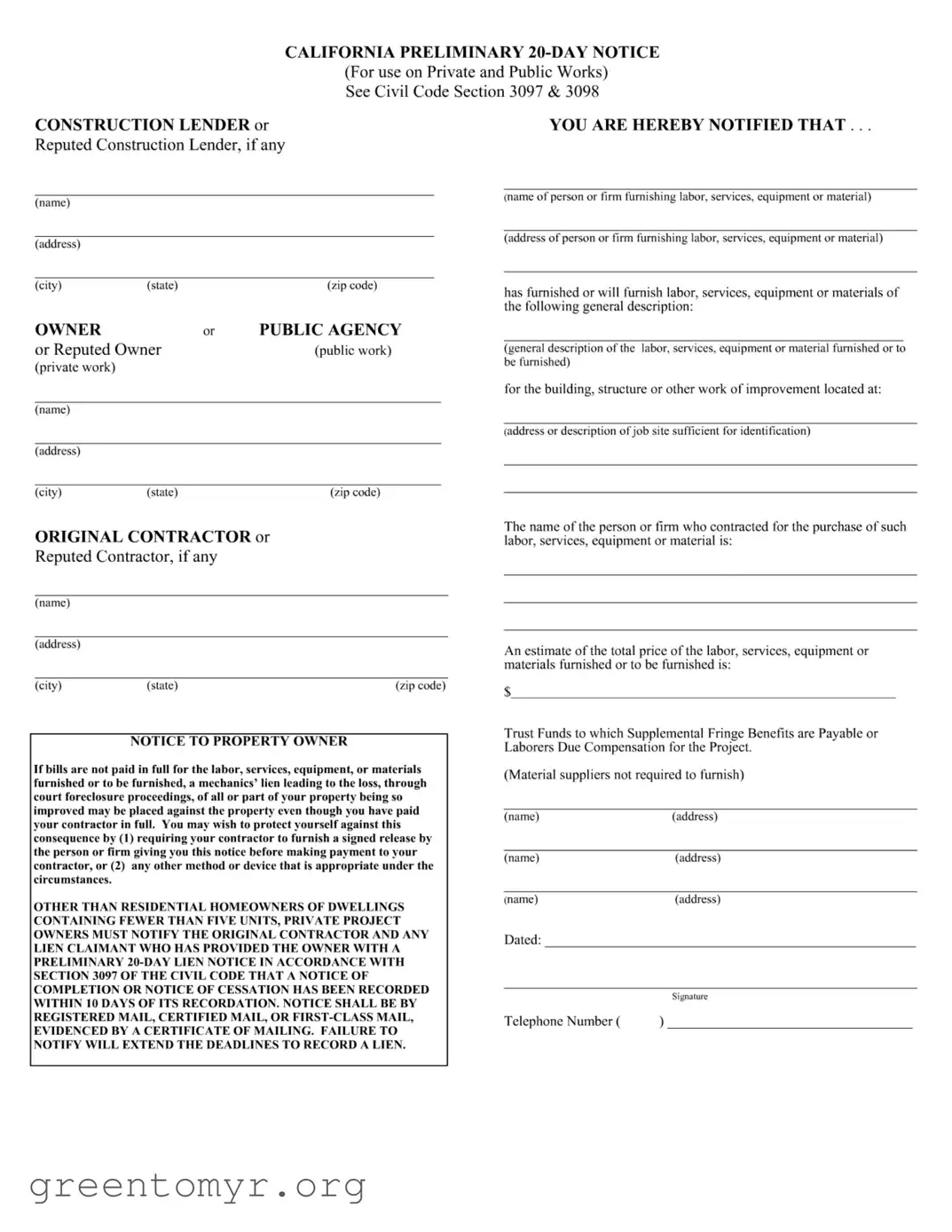
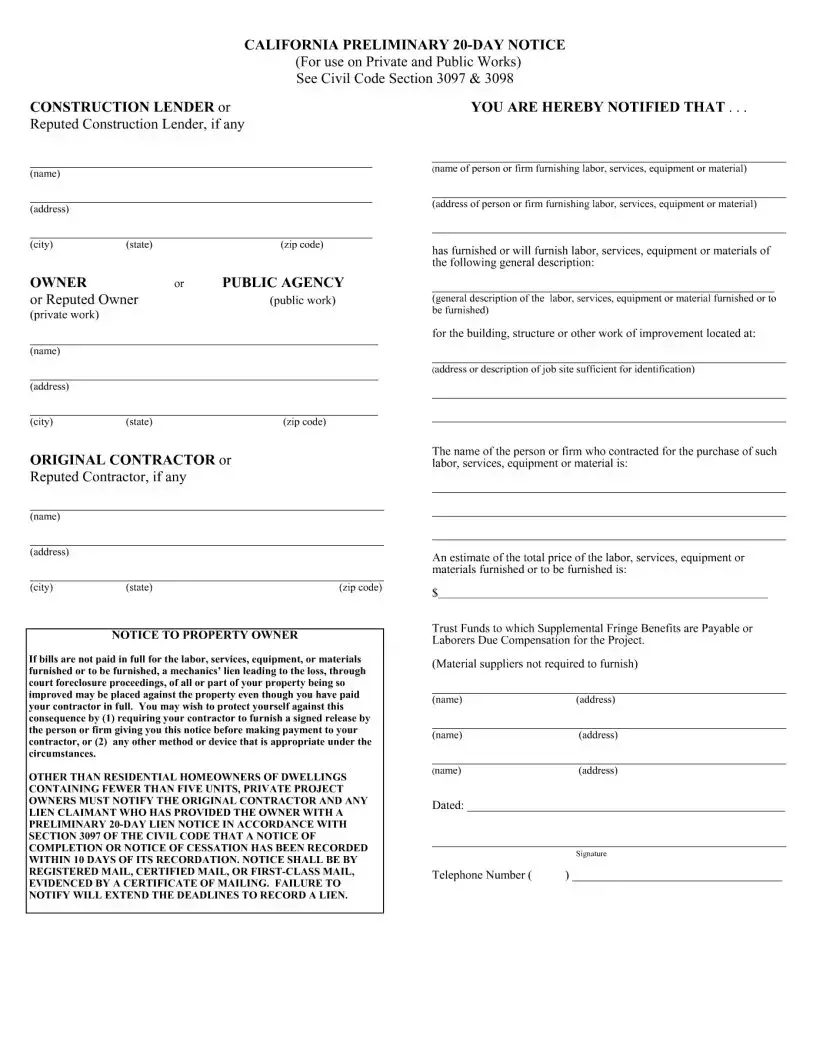
The California Preliminary 20-Day Notice form serves as a crucial document in the construction industry, particularly for those involved in private and public works. This notice is designed to inform property owners about the potential risks associated with unpaid labor, services, equipment, or materials provided for a construction project. It is essential for contractors, subcontractors, and suppliers to issue this notice to protect their rights and interests. The form includes key information such as the names and addresses of the construction lender, owner, and original contractor, as well as a detailed description of the work being performed. Additionally, it outlines the financial obligations related to the project and warns property owners that failure to pay could result in a mechanics' lien against their property, even if they have settled their accounts with the contractor. This notice also emphasizes the importance of communication between property owners and contractors, particularly regarding the recording of notices of completion or cessation. By understanding the implications of this form, all parties involved can take proactive measures to safeguard their investments and ensure compliance with California's construction laws.
| Fact Name | Description |
|---|---|
| Purpose | The California Preliminary 20-Day Notice informs property owners and contractors about labor, services, equipment, or materials provided on a project. |
| Governing Laws | This form is governed by California Civil Code Sections 3097 and 3098. |
| Deadline for Notice | The notice must be sent within 20 days of the first labor or material provided to preserve lien rights. |
| Who Should Use It | It is used by contractors, subcontractors, and suppliers involved in both private and public works projects. |
| Mechanics' Lien Warning | Failure to pay may result in a mechanics' lien, risking property loss despite full payment to the contractor. |
| Notification Requirement | Private project owners must notify the original contractor and lien claimants of a recorded Notice of Completion or Cessation within 10 days. |
| Mailing Methods | Notifications can be sent via registered mail, certified mail, or first-class mail, confirmed by a certificate of mailing. |
| Content of the Notice | The notice must include details like the description of work, parties involved, and the job site address. |
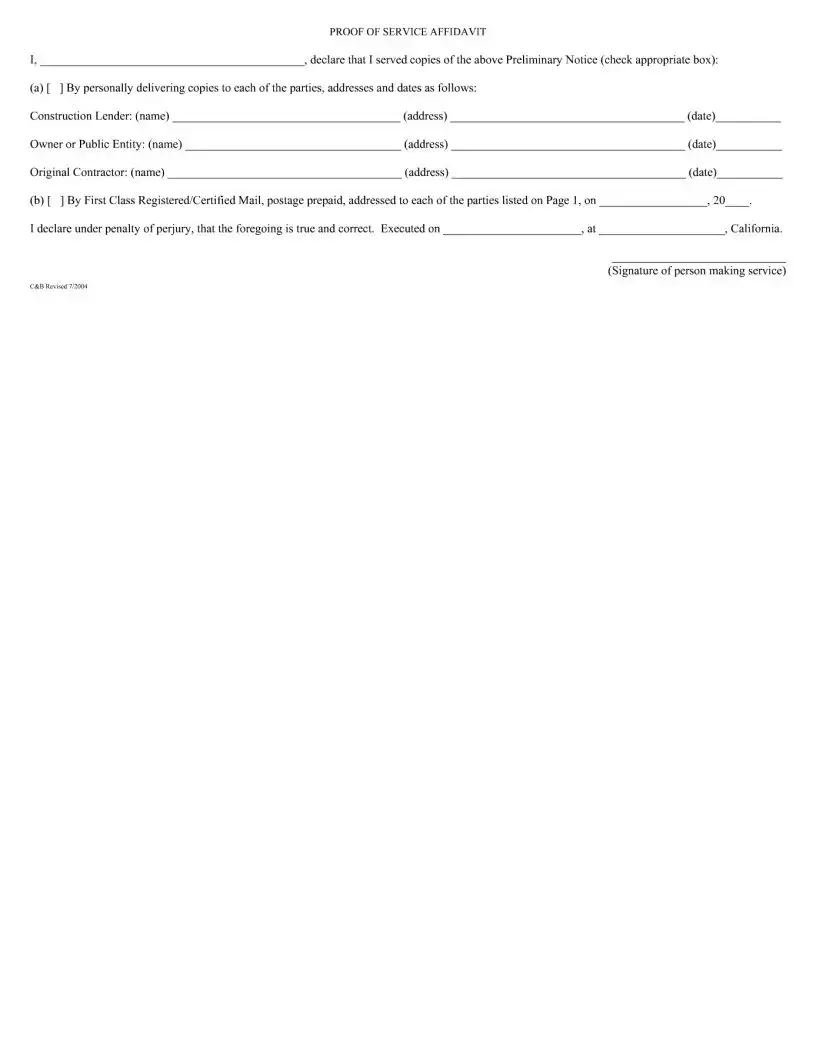
| Signature Requirement | The notice must be signed by the person serving it, affirming the truth of the information provided. |
| Estimate of Costs | The form includes a section for estimating the total price of the labor, services, or materials provided. |
Completing the California Preliminary 20-Day Notice form is essential for those involved in construction projects. This notice serves as a formal communication to property owners and other parties about the work being done and the potential for a mechanics' lien if payments are not made. Follow the steps below to accurately fill out the form.
After completing the form, it is crucial to serve it to the relevant parties, ensuring they receive notice of the work being performed. This step is vital to protect your rights and interests in the project.
The California Preliminary 20-Day Notice serves as a warning to property owners that a contractor, subcontractor, or supplier has provided or will provide labor, services, equipment, or materials for a construction project. It informs the owner that if payments are not made, a mechanics' lien could be placed against the property, even if the owner has paid the contractor in full.
Any contractor, subcontractor, laborer, or supplier who is providing materials or services for a construction project is required to send this notice. This includes both private and public works projects. It is particularly important for those who are not in direct contract with the property owner, as it helps to secure their right to payment.
The notice should be sent within 20 days of the first day that labor, services, equipment, or materials are provided. Sending it promptly is crucial, as failing to do so may limit the ability to file a lien later on.
The notice must contain several key pieces of information, including:
If a property owner does not receive the Preliminary 20-Day Notice, they may be unaware of potential claims against their property. This could lead to financial liability if a lien is filed later. It is in the owner’s best interest to ensure they receive this notice to protect themselves against unexpected claims.
Property owners can take several steps to protect themselves, including:
If a contractor or supplier fails to send the Preliminary 20-Day Notice within the required time frame, they may lose their right to file a mechanics' lien. This means they could miss out on recovering payment for their work, even if they have provided valuable services or materials.
The Preliminary 20-Day Notice is a critical step in the mechanics' lien process. It establishes the right of the contractor or supplier to file a lien if they do not receive payment. By sending this notice, they are formally notifying the property owner of their involvement in the project and their potential claim to payment.
Currently, the Preliminary 20-Day Notice must be sent in writing, either by personal delivery or through registered or certified mail. Electronic notices are not recognized as valid under California law, so it is important to follow the proper procedures to ensure the notice is legally effective.
Filling out the California Preliminary 20-Day Notice form can be a straightforward process, but many individuals make common mistakes that can lead to complications down the line. One frequent error is failing to provide complete and accurate information about the parties involved. This includes the names and addresses of the construction lender, owner, and contractor. When this information is incomplete or incorrect, it can create confusion and may hinder the enforcement of rights under the law.
Another mistake often made is neglecting to describe the labor, services, equipment, or materials in sufficient detail. The description should be clear and specific, allowing anyone reading the notice to understand exactly what work has been performed or will be performed. A vague or overly broad description can lead to disputes and may weaken the effectiveness of the notice.
People sometimes overlook the importance of including the correct job site address. The address provided must be sufficient for identification of the property in question. If the address is incorrect or insufficient, it could result in the notice being deemed invalid. This could prevent individuals from securing their rights to payment and protection under the mechanics' lien laws.
Additionally, many individuals fail to notify the original contractor and any lien claimant of a recorded Notice of Completion or Notice of Cessation within the required timeframe. This notification must be made within ten days of recordation and should be sent via registered, certified, or first-class mail. Not adhering to this requirement can extend deadlines for recording a lien, potentially jeopardizing the ability to enforce payment rights.
Lastly, individuals often forget to sign the form or provide their contact information. A signature is a critical component of the notice, as it verifies that the information provided is accurate and complete. Without a signature, the notice may not be considered valid, leaving the individual without the protections intended by the law. Ensuring that all parts of the form are properly completed can help safeguard rights and streamline the process.
The California Preliminary 20 Day Notice form is a crucial document in construction projects, ensuring that all parties involved are informed about the potential for a mechanics' lien. In addition to this form, several other documents are commonly used in conjunction with it to facilitate communication and protect the rights of those involved in the construction process. Below is a list of related forms and documents.
Each of these documents plays a significant role in the construction process, helping to clarify responsibilities, protect rights, and facilitate communication among all parties involved. Understanding their purposes can aid in navigating the complexities of construction projects in California.
When filling out the California Preliminary 20 Day Notice form, it is essential to approach the task with care. This document serves a critical purpose in construction and property management, ensuring that all parties involved are informed about labor, services, equipment, or materials being provided. Below are five important do's and don'ts to consider.
By following these guidelines, you can help ensure that your Preliminary 20 Day Notice is completed correctly and serves its intended purpose. Being diligent and informed will protect your rights and interests in the construction process.
This form applies to both private and public works, not just residential projects. It is essential for any construction work that involves labor, services, or materials.
Subcontractors are often required to send the Preliminary 20-Day Notice to protect their right to file a mechanics' lien. It serves as a warning to property owners about potential claims.
While the notice provides legal protection, it does not guarantee that payment will be received. It simply establishes a claim to the property in case of non-payment.
Property owners can still face liens even if they have paid their contractors in full. The notice informs them of this risk and suggests ways to mitigate it.
The notice should ideally be sent within 20 days of starting work or delivering materials. However, it can still be sent afterward to protect rights.
Failure to send the notice can result in losing the right to file a lien, which can have serious financial consequences for contractors and subcontractors.
All parties involved, including subcontractors and suppliers, should be notified. This ensures everyone is aware of their rights and obligations.
The Preliminary 20-Day Notice is straightforward and designed for easy completion. It requires basic information about the project and the parties involved.
For those involved in construction, sending the notice is a crucial step to protect their rights. It is not merely a formality but a necessary action in the construction process.
When filling out and using the California Preliminary 20 Day Notice form, it is essential to keep the following key takeaways in mind: