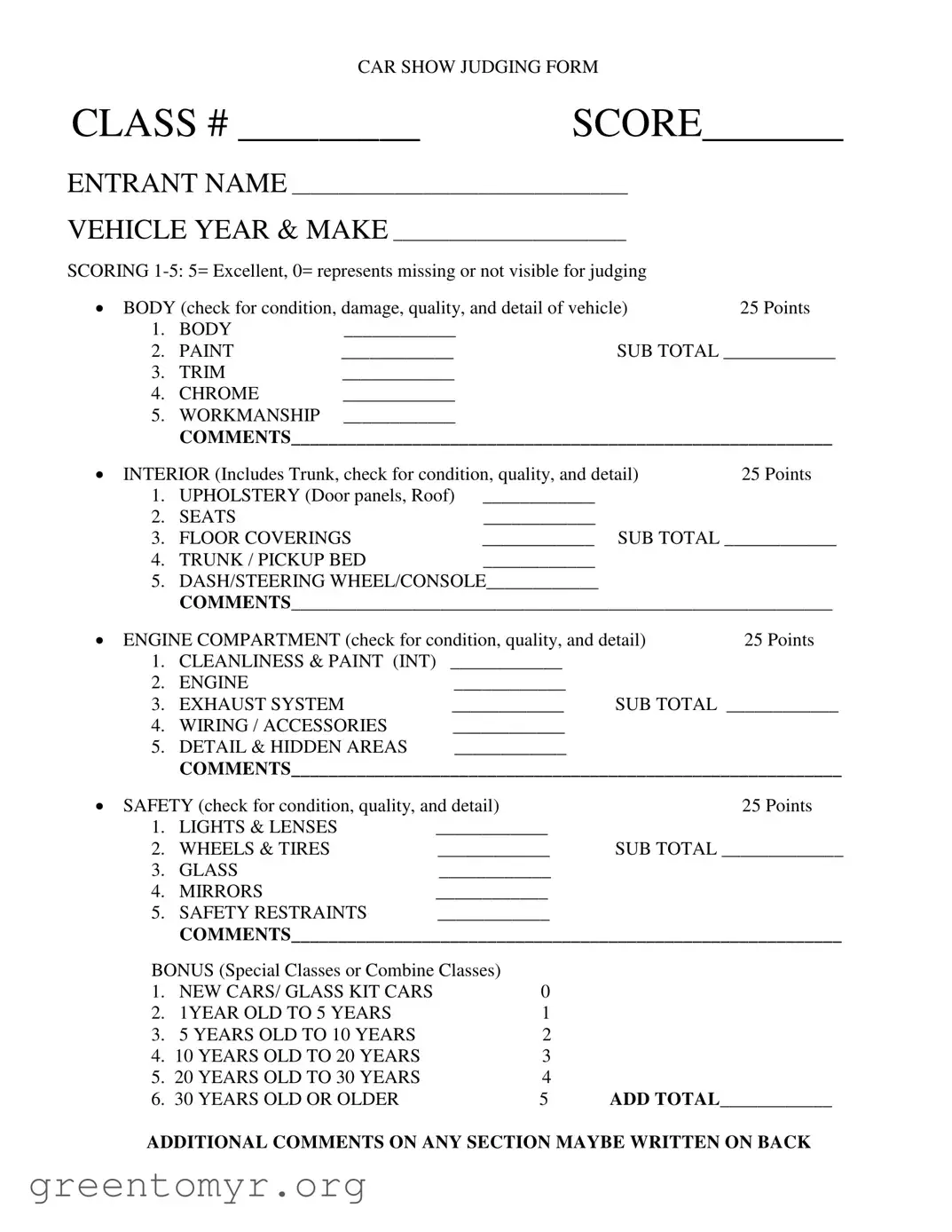
When attending a car show, the judging process plays a crucial role in highlighting the hard work and dedication of car enthusiasts. The Car Show Judging Form serves as a comprehensive tool to evaluate various aspects of each vehicle, ensuring a fair and thorough assessment. This form covers four main categories: Body, Interior, Engine Compartment, and Safety, each assigned a maximum of 25 points. Judges will examine the condition, quality, and detail of the vehicle's body, including paint, trim, and chrome work. The interior section assesses upholstery, seats, and even the trunk space, while the engine compartment evaluation focuses on cleanliness, engine condition, and wiring. Safety features, such as lights, tires, and restraints, are also scrutinized to ensure that vehicles meet essential safety standards. Additionally, a bonus scoring section allows for the inclusion of special classes or unique vehicle ages, providing a more nuanced evaluation. The form encourages judges to provide comments, offering insights that go beyond mere numbers. With this structured approach, car shows can celebrate the artistry and engineering behind each vehicle, fostering a sense of community among participants and spectators alike.
|
|
CAR SHOW JUDGING FORM |
|
|
CLASS # _________ |
SCORE_______ |
|||
ENTRANT NAME ____________________________________ |
|
|||
VEHICLE YEAR & MAKE _________________________ |
|
|||
SCORING |
|
|||
BODY (check for condition, damage, quality, and detail of vehicle) |
25 Points |
|||
1. |
BODY |
____________ |
|
|
2. |
PAINT |
____________ |
SUB TOTAL ____________ |
|
3. |
TRIM |
____________ |
|
|
4. |
CHROME |
____________ |
|
|
5. |
WORKMANSHIP |
____________ |
|
|
|
COMMENTS__________________________________________________________ |
|||
INTERIOR (Includes Trunk, check for condition, quality, and detail) |
25 Points |
|||
1. |
UPHOLSTERY (Door panels, Roof) |
____________ |
|
|
2. |
SEATS |
|
____________ |
|
3. |
FLOOR COVERINGS |
____________ SUB TOTAL ____________ |
||
4. |
TRUNK / PICKUP BED |
____________ |
|
|
5.DASH/STEERING WHEEL/CONSOLE____________
COMMENTS__________________________________________________________
ENGINE COMPARTMENT (check for condition, quality, and detail) |
25 Points |
|||
1. |
CLEANLINESS & PAINT (INT) ____________ |
|
|
|
2. |
ENGINE |
____________ |
|
|
3. |
EXHAUST SYSTEM |
____________ |
SUB TOTAL ____________ |
|
4. |
WIRING / ACCESSORIES |
____________ |
|
|
5. |
DETAIL & HIDDEN AREAS |
____________ |
|
|
|
COMMENTS___________________________________________________________ |
|||
SAFETY (check for condition, quality, and detail) |
|
25 Points |
||
1. |
LIGHTS & LENSES |
____________ |
|
|
2. |
WHEELS & TIRES |
____________ |
SUB TOTAL _____________ |
|
3. |
GLASS |
____________ |
|
|
4. |
MIRRORS |
____________ |
|
|
5. |
SAFETY RESTRAINTS |
____________ |
|
|
|
COMMENTS___________________________________________________________ |
|||
BONUS (Special Classes or Combine Classes) |
|
|
||
1. |
NEW CARS/ GLASS KIT CARS |
0 |
|
|
2. |
1YEAR OLD TO 5 YEARS |
1 |
|
|
3. |
5 YEARS OLD TO 10 YEARS |
2 |
|
|
4. |
10 YEARS OLD TO 20 YEARS |
3 |
|
|
5. |
20 YEARS OLD TO 30 YEARS |
4 |
|
|
6. |
30 YEARS OLD OR OLDER |
5 |
ADD TOTAL____________ |
|
ADDITIONAL COMMENTS ON ANY SECTION MAYBE WRITTEN ON BACK
| Fact Name | Description |
|---|---|
| Class Number | The form requires a class number for categorizing the vehicle. |
| Score System | Judges score each category from 0 to 5, where 5 means excellent. |
| Body Evaluation | The body section assesses condition, damage, quality, and detail, worth 25 points. |
| Interior Assessment | Interior includes upholstery, seats, and trunk, also totaling 25 points. |
| Engine Compartment | Judges check cleanliness, engine condition, and hidden areas in this 25-point section. |
| Safety Checks | Safety includes lights, wheels, and restraints, contributing another 25 points. |
| Bonus Points | Additional points can be awarded based on the age of the vehicle, with specific categories outlined. |
Filling out the Car Show Judging form is a straightforward process that requires attention to detail. Once completed, the form will help provide a comprehensive evaluation of each vehicle based on various criteria. Follow these steps to ensure you fill out the form accurately.
The Car Show Judging Form is designed to evaluate vehicles based on various criteria. Judges assess the condition, quality, and detail of different aspects of each car, including the body, interior, engine compartment, and safety features. Each section is scored on a scale of 0 to 5, with 5 being excellent. This structured approach helps ensure a fair and consistent judging process for all entrants.
The scoring system is straightforward and broken down into four main categories, each worth 25 points. The categories are:
Within each category, judges evaluate specific elements and assign scores from 0 to 5. A score of 0 indicates that an item is missing or not visible for judging, while a score of 5 represents excellent condition. Additionally, there is a bonus scoring section for special or combined classes based on the age of the vehicle.
The comments section is an opportunity for judges to provide feedback on each vehicle. Judges can note any specific strengths or weaknesses they observed during the evaluation. This feedback can be valuable for entrants looking to improve their vehicles for future shows. Additional comments can also be written on the back of the form if needed.
Filling out the Car Show Judging form can be straightforward, but several common mistakes can lead to inaccuracies in scoring. One frequent error is leaving sections blank. Each category requires specific details to ensure a fair assessment. If a judge cannot evaluate an aspect of the vehicle due to missing information, it could negatively impact the overall score.
Another mistake is failing to provide clear and detailed comments. Comments are essential for judges to understand the rationale behind the scores given. Vague remarks like "good condition" do not offer enough insight. Instead, providing specific observations about the vehicle's features will enhance the judging process.
Many entrants also overlook the importance of consistency in scoring. For example, if a vehicle's body is rated highly, but the paint is rated poorly without explanation, it can create confusion. Each component should logically relate to the overall condition of the vehicle. Judges appreciate a coherent evaluation that reflects the vehicle's overall quality.
Additionally, some individuals neglect to double-check their math. The scoring system requires adding various components, and simple arithmetic mistakes can alter the final score. A thorough review of the calculations can help avoid discrepancies that may affect the judging outcome.
Another common oversight is ignoring the bonus points section. Many entrants fail to consider how the age of the vehicle can influence their score. Understanding the bonus point system can provide an opportunity to enhance the total score significantly. Being aware of the age categories can lead to a more accurate representation of the vehicle's value in the competition.
Finally, not utilizing the back of the form for additional comments can be a missed opportunity. This space allows for further elaboration on any section that may require clarification or additional praise. Judges appreciate when entrants take the time to provide comprehensive feedback, which can help in the overall evaluation of the vehicle.
When organizing a car show, several documents and forms are commonly utilized alongside the Car Show Judging form. Each of these documents plays a crucial role in ensuring a smooth and effective judging process. Below is a list of additional forms that may be needed.
Incorporating these forms into the planning process can enhance the overall experience for both participants and judges. A well-structured approach to documentation contributes to a successful car show event.
The Car Show Judging Form serves a specific purpose in evaluating vehicles at a car show. It shares similarities with several other documents that also assess quality and performance in various contexts. Here are four documents that resemble the Car Show Judging Form:
When filling out the Car Show Judging form, it is essential to follow certain guidelines to ensure accuracy and clarity. Below is a list of things to do and avoid during this process.
By adhering to these guidelines, you can contribute to a fair and enjoyable judging process at the car show.
Understanding the Car Show Judging form is essential for both entrants and judges. However, several misconceptions can lead to confusion. Below are ten common misconceptions explained.
Clarifying these misconceptions can help participants better prepare for the judging process and improve their chances of success at the car show.
Here are some key takeaways for effectively filling out and using the Car Show Judging form: