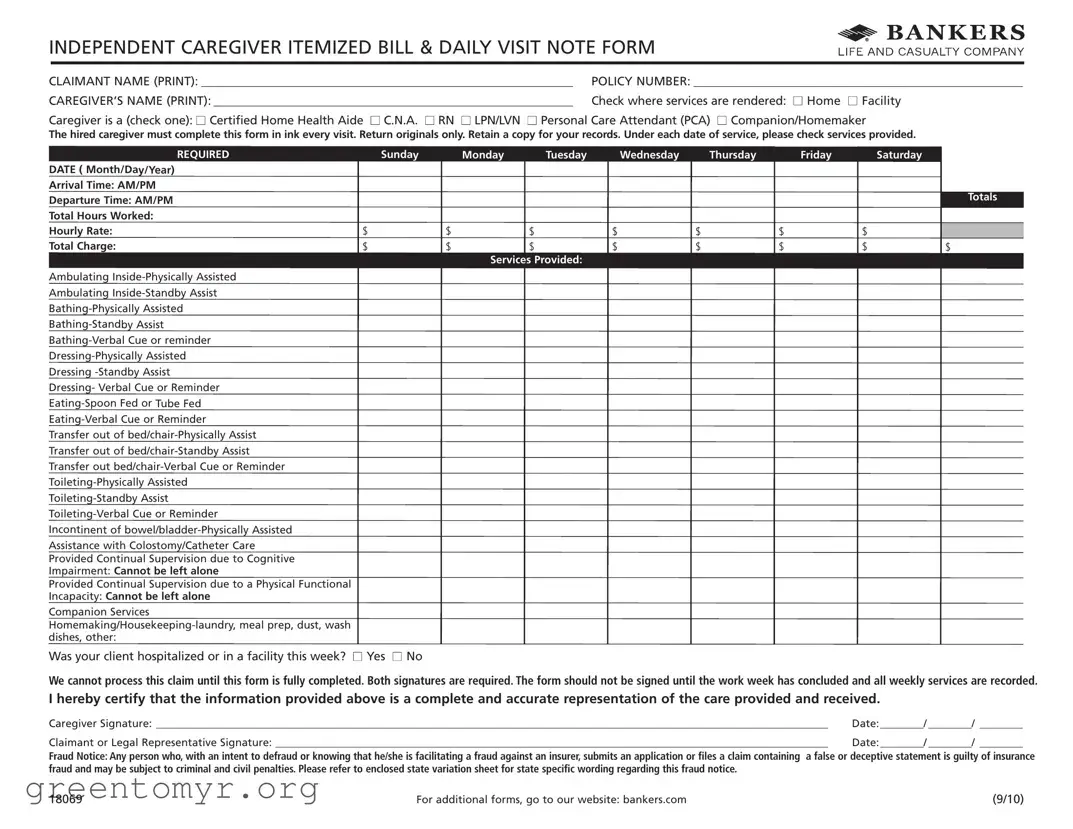
The Caregiver Daily Log form serves as an essential tool for documenting the services provided by caregivers to individuals in need of assistance. This form includes key sections that capture vital information, such as the claimant's name, policy number, and the caregiver's details. It allows caregivers to indicate where the services are rendered, whether at home or in a facility, and to identify their professional qualifications, such as being a Certified Home Health Aide or a Registered Nurse. Each visit requires the caregiver to complete the form in ink, ensuring accuracy and accountability. The log details the specific services provided, including assistance with bathing, dressing, eating, and toileting, among others. Caregivers must also record the date of service, arrival and departure times, total hours worked, and the corresponding charges. Furthermore, the form emphasizes the importance of signatures from both the caregiver and the claimant or legal representative, certifying that the information is complete and accurate. It also contains a fraud notice, reminding users of the legal implications of submitting false information. By maintaining a thorough record of caregiving activities, this form not only facilitates the claims process but also helps ensure that individuals receive the care they need.
INDEPENDENT CAREGIVER ITEMIZED BILL & DAILY VISIT NOTE FORM
CLAIMANT NAME (PRINT): _____________________________________________________________ |
POLICY NUMBER: ______________________________________________________ |
CAREGIVER’S NAME (PRINT): ___________________________________________________________ |
Check where services are rendered: n Home n Facility |
Caregiver is a (check one): n Certified Home Health Aide n C.N.A. n RN n LPN/LVN n Personal Care Attendant (PCA) n Companion/Homemaker
The hired caregiver must complete this form in ink every visit. Return originals only. Retain a copy for your records. Under each date of service, please check services provided.
REQUIRED
DATE ( Month/Day/Year)
Arrival Time: AM/PM
Departure Time: AM/PM
Total Hours Worked:
Hourly Rate:
Total Charge:
Sunday |
Monday |
Tuesday |
Wednesday |
Thursday |
Friday |
Saturday |
|
|
|
|
|
|
|
Totals |
$ |
$ |
$ |
$ |
$ |
$ |
$ |
|
$ |
$ |
$ |
$ |
$ |
$ |
$ |
$ |
|
|
Services Provided: |
|
|
|
|
|
Ambulating
Assistance with Colostomy/Catheter Care Provided Continual Supervision due to Cognitive Impairment: Cannot be left alone Provided Continual Supervision due to a Physical Functional Incapacity: Cannot be left alone
Companion Services
meal prep, dust, wash |
Was your client hospitalized or in a facility this week? n Yes n No
We cannot process this claim until this form is fully completed. Both signatures are required. The form should not be signed until the work week has concluded and all weekly services are recorded.
I hereby certify that the information provided above is a complete and accurate representation of the care provided and received.
Caregiver Signature: ____________________________________________________________________________________________________________________________ |
Date: ________/ ________/ |
________ |
Claimant or Legal Representative Signature: ______________________________________________________________________________________________________ |
Date: ________/ ________/ |
________ |
Fraud Notice: Any person who, with an intent to defraud or knowing that he/she is facilitating a fraud against an insurer, submits an application or files a claim containing a false or deceptive statement is guilty of insurance fraud and may be subject to criminal and civil penalties. Please refer to enclosed state variation sheet for state specific wording regarding this fraud notice.
18069 |
For additional forms, go to our website: bankers.com |
(9/10) |
| Fact Name | Description |
|---|---|
| Purpose | The Caregiver Daily Log form is used to document the services provided by caregivers to clients. |
| Completion Requirement | The form must be completed in ink by the caregiver during each visit to ensure accuracy. |
| Signatures | Both the caregiver and the claimant or legal representative must sign the form to validate the services rendered. |
| Service Tracking | Caregivers must check off the specific services provided under each date of service. |
| Hourly Rate | The form requires caregivers to record their hourly rate and total charges for the services provided. |
| Fraud Notice | The form includes a fraud notice, warning that false statements may lead to criminal and civil penalties. |
| State-Specific Regulations | Users should refer to the enclosed state variation sheet for specific laws governing the use of this form in their state. |
Filling out the Caregiver Daily Log form accurately is essential for ensuring that the services provided are properly documented and compensated. The following steps will guide you through the process of completing the form effectively.
Once you have completed the form, remember to return the originals only and keep a copy for your records. This ensures you have documentation of the services provided, which can be important for future reference.
The Caregiver Daily Log form serves as a detailed record of the services provided by a caregiver during their visits. It allows caregivers to document essential information, such as the date of service, arrival and departure times, total hours worked, and the specific services rendered. This form is crucial for billing purposes, ensuring that caregivers are compensated accurately for their work, and providing a clear account of care for the claimant or their legal representative.
The form must be completed by the hired caregiver, who can be a Certified Home Health Aide, Certified Nursing Assistant (C.N.A.), Registered Nurse (RN), Licensed Practical Nurse (LPN/LVN), Personal Care Attendant (PCA), or Companion/Homemaker. It is important that the caregiver fills out the form in ink during each visit to maintain a reliable and verifiable record of the services provided.
The Caregiver Daily Log form requires several key pieces of information:
Completing all sections accurately is essential for processing claims and ensuring proper compensation.
If your client was hospitalized or in a facility during the week, you must indicate this on the form by checking the appropriate box. This information is important for the claims process, as it may affect the services billed and the overall claim. Ensure that the form is filled out completely before submission, as incomplete forms cannot be processed.
Providing false or misleading information on the Caregiver Daily Log form can lead to serious consequences. The form includes a fraud notice that states any individual who submits a claim with the intent to defraud may face criminal and civil penalties. It is imperative to provide accurate and truthful information, as this protects both the caregiver and the claimant from potential legal issues.
Filling out the Caregiver Daily Log form can be straightforward, but there are common mistakes that can lead to delays or complications. One frequent error is leaving the claimant name or policy number blank. These fields are essential for identifying the client and processing the claim. Always ensure that this information is filled out completely and accurately.
Another common mistake is failing to check the appropriate boxes for services rendered. Each service provided should be marked clearly under the corresponding date. Omitting services can result in an incomplete log, which might delay payment or require additional follow-up.
Time entries are crucial, yet many caregivers forget to include either the arrival time or the departure time. This can create confusion about the total hours worked. Make sure to double-check that both times are entered for each visit to ensure accurate billing.
It's also important to remember to calculate the total charge correctly. Some caregivers overlook this step, which can lead to discrepancies in billing. Take the time to multiply the total hours worked by the hourly rate, and ensure that this total is clearly documented.
Another mistake involves signatures. Both the caregiver and the claimant or legal representative must sign the form. If one signature is missing, the claim cannot be processed. Always review the form before submission to confirm that both signatures are present.
Additionally, caregivers sometimes forget to indicate whether the client was hospitalized or in a facility during the week. This information is critical for processing the claim accurately. Always check the appropriate box to avoid complications.
Lastly, be cautious about submitting the form before the work week has concluded. Signing the form prematurely can lead to inaccuracies in the reported services. Wait until all services for the week are recorded before signing to ensure the information is complete and truthful.
The Caregiver Daily Log form is an essential document that helps track the care provided to individuals who require assistance. However, it is often accompanied by several other forms and documents that facilitate the caregiving process, ensure proper billing, and maintain clear communication among all parties involved. Below is a list of commonly used forms that complement the Caregiver Daily Log.
Each of these forms plays a vital role in the caregiving process, enhancing communication, ensuring safety, and supporting the well-being of those receiving care. By using these documents alongside the Caregiver Daily Log, caregivers can provide more effective and organized support to their clients.
The Caregiver Daily Log form shares similarities with several other documents commonly used in caregiving and healthcare settings. Each document serves a specific purpose in tracking services, billing, or communication between caregivers and clients. Below is a list of six documents that are similar to the Caregiver Daily Log form:
When filling out the Caregiver Daily Log form, attention to detail is crucial. Here’s a list of things you should and shouldn’t do:
Misconceptions about the Caregiver Daily Log form can lead to confusion and errors in the caregiving process. Here are six common misunderstandings:
Understanding these points can help ensure that the Caregiver Daily Log form is completed accurately and efficiently, ultimately benefiting both caregivers and clients.
Here are some important points to remember when filling out and using the Caregiver Daily Log form: